Balance Wk2 LG4 Cardiovascular-Renal Integration
 Call Kai
 Learn
Learn Practice Test
 Spaced Repetition
 Match
Match Flashcards
 Knowt Play
1/130

There's no tags or description
Looks like no tags are added yet.
Name | Mastery | Learn | Test | Matching | Spaced | Call with Kai | Chat |
|---|
No analytics yet
Send a link to your students to track their progress
131 Terms
B2LG4.3: What is the relationship between cardiac output and renal perfusion?
Answer: They are interdependent.
Extra Information:
Cardiac output helps determine blood flow and pressure delivered to the kidneys.
Reduced cardiac output can decrease renal perfusion.
What is the equation for cardiac output?
Answer: CO = HR × SV.
Extra Information:
CO = cardiac output.
HR = heart rate.
SV = stroke volume.
What is the approximate equation for mean arterial pressure?
Answer: MAP ≈ CO × SVR.
Extra Information:
- CO = cardiac output.
- SVR = systemic vascular resistance.
What is the equation for renal blood flow?
Answer: RBF = (renal artery pressure − renal vein pressure) / total renal vascular resistance.
Extra Information:
- Renal perfusion depends on the pressure gradient across the kidney.
What happens to renal perfusion if renal venous pressure rises while MAP stays the same?
Answer: Renal perfusion decreases.
Extra Information:
- Increased renal venous pressure reduces the pressure gradient across the kidney.
What three major factors determine stroke volume?
Answer: Preload, afterload, and contractility.
Extra Information:
- Filling can increase stroke volume up to a point.
- Afterload opposes ejection.
- Contractility determines intrinsic pumping strength.
What happens to stroke volume as afterload increases?
Answer: Stroke volume decreases.
Extra Information:
- Greater resistance opposes ventricular ejection.
How does increasing preload affect stroke volume?
Answer: It increases stroke volume up to a point.
Extra Information:
- Excessive filling does not continue to improve stroke volume indefinitely.
What determines venous return and preload?
Answer: Blood volume and venous compliance.
Extra Information:
- The kidney can alter blood volume through sodium and water handling.
How does renal sodium and water handling affect cardiovascular function?
Answer: It changes blood volume.
Extra Information:
- Changes in blood volume alter venous return and preload.
If cardiac output falls while SVR stays constant, what happens to MAP?
Answer: MAP falls.
Extra Information:
- MAP ≈ CO × SVR.
What compensation can raise MAP without immediately correcting cardiac output?
Answer: Increased SVR.
Extra Information:
- Vasoconstriction can temporarily support arterial pressure.
Approximately what percentage of resting cardiac output reaches the kidneys?
Answer: About 20–25%.
Extra Information:
- The kidneys receive a large fraction of cardiac output.
Why do the kidneys receive such high blood flow?
Answer: To support filtration, oxygen delivery, pressure sensing, and control of Na⁺ and water excretion.
Extra Information:
- Renal blood flow supports glomerular filtration.
- It delivers O₂ to metabolically active tubules.
What is renal plasma flow?
Answer: Plasma delivered to both kidneys per unit time.
Extra Information:
- RPF can fall with reduced cardiac output, renal vasoconstriction, or venous back-pressure.
What happens to renal plasma flow when cardiac output falls?
Answer: RPF can decrease.
Extra Information:
- Less forward cardiac output can mean less plasma delivered to the kidneys.
What is GFR?
Answer: The amount of ultrafiltrate formed across the glomerular capillaries.
Extra Information:
- GFR may briefly be preserved even while RPF is falling.
Can RPF fall while GFR is temporarily preserved?
Answer: Yes.
Extra Information:
- GFR can briefly be maintained if glomerular capillary pressure is supported.
What is filtration fraction?
Answer: FF = GFR / RPF.
Extra Information:
- It represents the fraction of renal plasma flow that is filtered.
What happens to filtration fraction if RPF falls while GFR is preserved?
Answer: Filtration fraction increases.
Extra Information:
- The denominator falls while the numerator is maintained.
How can moderate angiotensin II activity help preserve GFR during low renal flow?
Answer: By constricting the efferent arteriole.
Extra Information:
- Moderate efferent constriction supports glomerular capillary pressure.
- Filtration fraction can therefore rise.
What are the three major types of heart–kidney communication emphasized in the lecture?
Answer: Hemodynamic, neural, and hormonal.
Extra Information:
Hemodynamic: arterial pressure, cardiac output, venous pressure.
Neural: sympathetic nervous system.
Hormonal: RAAS, ADH, ANP, and BNP.

Why is the heart–kidney axis described as two-way coupling?
Answer: Dysfunction in either organ can affect the other.
Extra Information:
- Heart dysfunction can impair kidney perfusion.
- Kidney dysfunction can increase volume and pressure stress on the heart.
What is one heart-to-kidney link?
Answer: Reduced cardiac output can reduce renal perfusion.
Extra Information:
- Venous congestion can also impair kidney function.
What is one kidney-to-heart link?
Answer: Renal sodium and water retention can increase cardiac volume and pressure stress.
Extra Information:
- Fluid retention increases preload and congestion.
What is the central idea of B2LG4.3
Explain how cardiac output and renal perfusion are interdependent, including how decreased cardiac output triggers renal sodium and water retention
Answer: The heart supplies renal perfusion, while the kidneys regulate volume that affects cardiac function.
Extra Information:
This creates a cardiovascular–renal feedback loop.
B2LG4.4: What is the kidney's major role in long-term blood pressure regulation?
Answer: Control sodium and water balance.
Extra Information:
- This regulates extracellular volume, blood volume, cardiac output, and arterial pressure.
What is pressure natriuresis?
Answer: Increased arterial pressure causes increased renal Na⁺ excretion.
Extra Information:
- Even small increases in pressure can markedly increase salt output.
What is pressure diuresis?
Answer: Increased arterial pressure causes increased water excretion.
Extra Information:
- A rise of only a few mm Hg can substantially increase renal water output.
How does increased arterial pressure eventually lower itself through the renal-body fluid system?
Answer: ↑ BP → ↑ Na⁺/water excretion → ↓ volume → ↓ BP.
Extra Information:
- This is a negative-feedback system.
Why is pressure natriuresis a negative-feedback mechanism?
Answer: The response opposes the original increase in pressure.
Extra Information:
- Increased pressure causes salt and water loss.
- Volume and pressure then move back toward equilibrium.
Is the renal-body fluid system fast or slow?
Answer: Slow but powerful.
Extra Information:
- It provides long-term control of arterial pressure.
What is meant by the kidney's near-infinite feedback gain?
Answer: The kidney tends to return pressure toward its equilibrium point.
Extra Information:
- High pressure → more fluid excretion.
- Low pressure → less fluid excretion.
What two factors determine long-term arterial pressure in the renal-body fluid model?
Answer: The renal output curve and salt/water intake.
Extra Information:
Their intersection determines the equilibrium pressure.
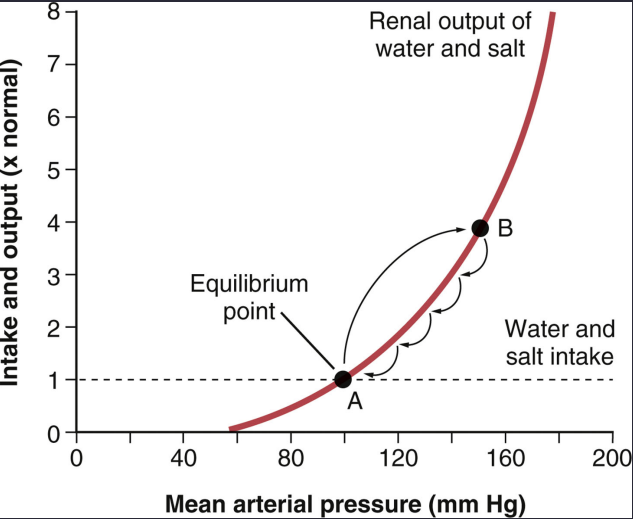
What happens when renal sodium excretion is impaired?
Answer: The renal output curve shifts rightward.
Extra Information:
The kidney requires a higher pressure to excrete the normal sodium intake.

What does a rightward pressure-natriuresis curve shift promote?
Answer: Hypertension.
Extra Information:
Higher arterial pressure is required to achieve sodium balance.

What happens to the renal output curve when sodium excretion is impaired at any given pressure?
Answer: It shifts rightward or becomes flatter.
Extra Information:
Both changes mean poorer sodium excretion at a given pressure.

How can increased salt intake raise long-term arterial pressure?
Answer: Salt retention increases volume until higher BP drives enough natriuresis.
Extra Information:
The new equilibrium occurs where renal output again matches intake.
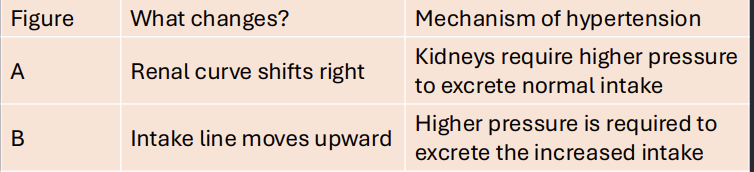
How do healthy kidneys respond to large chronic increases in salt intake?
Answer: They excrete the extra salt with little change in BP.
Extra Information:
Healthy kidneys have a steep chronic pressure-natriuresis relationship.

At normal salt intake, approximately where do the renal curves intersect in the lecture graph?
Answer: Around 95–100 mm Hg.
Extra Information:
This represents the stable equilibrium pressure at normal intake.

What would the acute renal curve predict immediately after salt intake rises sixfold?
Answer: A very large rise in pressure would initially be required.
Extra Information:
The slide estimates approximately 180–190 mm Hg.
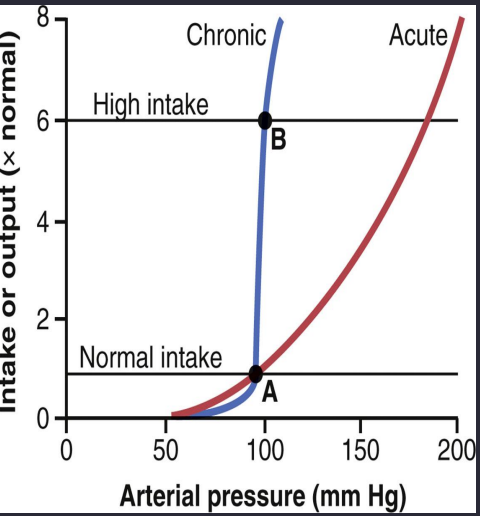
Why is the acute pressure-natriuresis curve relatively shallow?
Answer: Only immediate renal perfusion-pressure effects are operating.
Extra Information:
- Sodium-retaining hormonal systems have not yet fully adjusted.
What happens to the pressure-natriuresis relationship over hours to days?
Answer: The chronic curve becomes much steeper.
Extra Information:
Hormonal adjustments allow much greater sodium excretion with only a small BP change.

With healthy kidneys, how much does BP need to change chronically to handle six times normal sodium intake in the lecture example?
Answer: Only slightly, from about 95 to 100 mm Hg.
Extra Information:
- This demonstrates the power of chronic renal adaptation.
What is the rate-limiting step of RAAS?
Answer: Renin release.
Extra Information:
Renin initiates the renin-angiotensin-aldosterone cascade.

What physiologic signal activates RAAS?
Answer: Low effective circulating volume.
Extra Information:
- The kidney responds to perceived underfilling rather than simply total body fluid.
What three direct signals increase renin release?
Answer: Reduced afferent stretch, reduced macula-densa NaCl delivery, and increased β₁ sympathetic stimulation.
Extra Information:
These signals indicate reduced renal perfusion or effective circulating volume.
🫘 In the kidney
β₁ receptors are on juxtaglomerular cells.
↓ BP → ↑ sympathetic activity → β₁ stimulation → ↑ renin
How does reduced afferent arteriolar stretch affect renin?
Answer: It increases renin release.
Extra Information:
- Juxtaglomerular cells detect reduced perfusion pressure.
How does reduced NaCl delivery to the macula densa affect renin?
Answer: It increases renin release.
Extra Information:
- Low tubular NaCl signals reduced renal perfusion/filtration.
How does renal sympathetic β₁ stimulation affect renin?
Answer: It increases renin release.
Extra Information:
- Increased sympathetic activity is a direct stimulus for juxtaglomerular renin secretion.
What are four major effects of angiotensin II shown in the RAAS lecture diagram?
Answer: Vasoconstriction, increased norepinephrine, increased aldosterone, and increased ADH.
Extra Information:
These responses help restore pressure and circulating volume.

How does increased RAAS shift the pressure-natriuresis curve?
Answer: To the right.
Extra Information:
RAAS increases renal Na⁺ retention.
A higher BP is therefore needed to excrete the same amount of sodium.
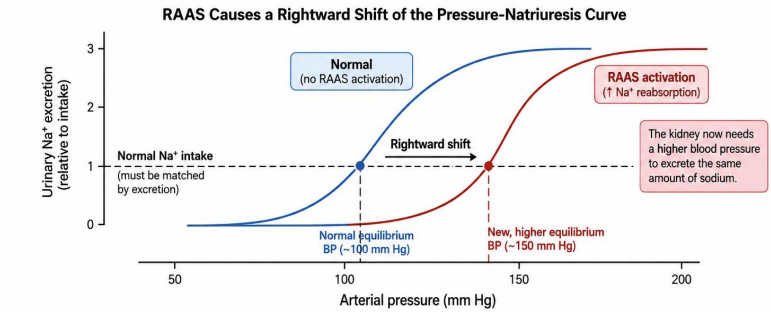
How does decreased RAAS shift the pressure-natriuresis curve?
Answer: To the left.
Extra Information:
Natriuresis can occur at lower arterial pressures.

What is the central idea of B2LG4.4?
Describe the role of the kidney in long-term blood pressure regulation through pressure natriuresis and the renin-angiotensin-aldosterone system (RAAS).
Answer: Kidneys control long-term BP by matching Na⁺ and water excretion to intake.
Extra Information:
Pressure natriuresis and RAAS are major mechanisms controlling this balance.
B2LG4.5: What is effective arterial blood volume?
Answer: The portion of arterial circulation effectively perfusing tissues and sensed by the kidneys/baroreceptors.
Extra Information:
- It is a functional concept rather than a directly measurable volume.
What mainly determines effective arterial blood volume?
Answer: Cardiac output, vascular tone, and blood distribution.
Extra Information:
- It is different from total body fluid.
What is total body fluid?
Answer: All intracellular plus extracellular fluid.
Extra Information:
- It is mainly determined by total body water and sodium content.
Can total body fluid and effective arterial blood volume move in opposite directions?
Answer: Yes.
Extra Information:
- This is crucial for understanding heart failure.
What happens to total body fluid in congestive heart failure?
Answer: It increases, often markedly.
Extra Information:
- Sodium and water retention contributes to fluid overload.
What happens to effective arterial blood volume in congestive heart failure?
Answer: It decreases.
Extra Information:
- Reduced cardiac output causes poor forward perfusion despite overall fluid overload.
How can a heart-failure patient be fluid overloaded but have low effective arterial blood volume?
Answer: The failing heart cannot effectively deliver the excess volume to the arterial circulation.
Extra Information:
- The kidneys sense arterial underfilling despite edema and congestion.
What happens to total body fluid and EABV in hemorrhage?
Answer: Both decrease.
Extra Information:
- Blood loss directly reduces circulating volume.
What happens to total body fluid and EABV in cirrhosis with ascites?
Answer: Total body fluid increases while EABV decreases.
Extra Information:
Splanchnic vasodilation and third-spacing reduce effective arterial filling.
Splanchnic = blood vessels supplying the abdominal organs, especially the intestines.
Splanchnic vasodilation means:
Abdominal blood vessels dilate → more blood pools in the splanchnic circulation → less effective blood is available in the arterial circulation.
What can happen to EABV in nephrotic syndrome?
Answer: It can be decreased, normal, or increased.
Extra Information:
Total body fluid is increased with edema.
EABV depends on whether the patient is underfilled or overfilled.
Underfill | Overfill | |
|---|---|---|
Main problem | Fluid leaves the blood vessels | Kidney directly retains Na⁺ |
Effective arterial blood volume (EABV) | ↓ Low | Normal or ↑ |
Renin-angiotensin-aldosterone system | ↑ Activated | Usually suppressed/less activated |
Why edema? | Secondary Na⁺/water retention | Primary Na⁺/water retention |
What happens to EABV in sepsis?
Answer: It decreases.
Extra Information:
- Profound vasodilation and increased capillary permeability reduce effective arterial filling.
How does reduced cardiac output affect renal blood flow?
Answer: Renal blood flow decreases.
Extra Information:
- Reduced forward flow decreases renal arterial inflow.
How does reduced cardiac output affect renal perfusion pressure?
Answer: It decreases.
Extra Information:
- This is one signal that activates renal compensatory mechanisms.
How can reduced cardiac output affect GFR?
Answer: GFR can decrease.
Extra Information:
- Low renal perfusion is one mechanism.
Does a rising creatinine in heart failure prove that cardiac output is severely reduced?
Answer: No.
Extra Information:
- Venous congestion, neurohormonal activation, medications, and intrinsic kidney factors can also worsen kidney function.
How does increased central venous pressure impair kidney function?
Answer: It increases renal venous back-pressure.
Extra Information:
- This decreases the pressure gradient driving renal perfusion.
Why can both low cardiac output and venous congestion reduce renal perfusion?
Answer: Both decrease the renal perfusion pressure gradient.
Extra Information:
- Low CO decreases renal arterial inflow.
- Venous congestion increases renal venous pressure.
What are the renal effects of sympathetic nervous system activation?
Answer: Reduced renal flow, increased renin, and increased tubular Na⁺ reabsorption.
Extra Information:
- Strong sympathetic activation can also lower GFR.
What happens during severe hemorrhage?
Answer: EABV and renal perfusion decrease.
Extra Information:
- This activates mechanisms that attempt to restore BP and circulating volume.
Trace the renal response to hemorrhage.
Answer: Hemorrhage → ↓ EABV → ↓ renal perfusion → renin → RAAS → vasoconstriction + Na⁺/water retention.
Extra Information:
- The overall goal is restoration of blood pressure and circulating volume.
Why does reduced cardiac output activate RAAS in heart failure?
Answer: The kidney senses reduced effective perfusion.
Extra Information:
- It responds as though the arterial circulation is underfilled.
How does angiotensin II affect afterload in heart failure?
Answer: It increases afterload.
Extra Information:
- Angiotensin II causes systemic vasoconstriction.
How do aldosterone and ADH affect volume in heart failure?
Answer: They increase sodium and water retention.
Extra Information:
- Blood volume and filling pressures rise.
How does sodium and water retention initially help reduced cardiac output?
Answer: It helps support arterial perfusion and blood pressure.
Extra Information:
- Increasing intravascular volume can initially support filling and circulation.
Why does continued sodium and water retention eventually become harmful in heart failure?
Answer: It raises filling pressures and worsens congestion.
Extra Information:
- Pulmonary and peripheral edema can worsen.
What happens to preload during persistent renal sodium and water retention?
Answer: Preload increases.
Extra Information:
- Expanded blood volume increases ventricular filling pressures.
What happens to pulmonary congestion when filling pressures become excessive?
Answer: Pulmonary congestion worsens.
Extra Information:
Fluid accumulation contributes to dyspnea, orthopnea, and crackles.
Orthopnea = shortness of breath when lying flat that improves when sitting or standing up.
It is classically associated with left-sided heart failure.
What happens to peripheral congestion when filling pressures rise?
Answer: Peripheral edema worsens.
Extra Information:
- Increased venous pressure promotes systemic congestion.
Why is persistent RAAS activation maladaptive in heart failure?
Answer: It promotes vasoconstriction, fluid retention, cardiac remodeling, and renal injury.
Extra Information:
- A compensatory mechanism becomes part of a self-reinforcing cardiorenal cycle.
Why can natriuretic peptides fail to correct fluid overload in heart failure?
Answer: ANP and BNP may not overcome persistent RAAS and SNS activity.
Extra Information:
- Natriuretic peptides oppose sodium and water retention.
Why can urine sodium be low in a fluid-overloaded heart-failure patient?
Answer: The kidneys sense low effective arterial blood volume and continue retaining Na⁺.
Extra Information:
- The kidney responds to arterial underfilling, not total-body fluid overload.
What is the main stimulus for continued Na⁺ retention in heart failure?
Answer: Reduced effective arterial blood volume.
Extra Information:
- Poor forward perfusion causes the kidney to interpret the circulation as underfilled.
Which systems are activated by arterial underfilling in heart failure?
Answer: SNS, RAAS, and ADH.
Extra Information:
- Together they promote vasoconstriction and Na⁺/water retention.
What is the self-reinforcing cardiorenal cycle in heart failure?
Answer: ↓ cardiac output → ↓ renal perfusion → RAAS/SNS activation → fluid retention and vasoconstriction → increased cardiac stress.
Extra Information:
- Persistent activation worsens both heart and kidney function.
What is the central idea of B2LG4.5?
Explain how impaired cardiac function leads to renal hypoperfusion, and describe how renal compensation (sodium/water retention) can increase cardiac preload – setting the stage for understanding heart failure management
Answer: Renal compensation for low cardiac output initially supports perfusion but can worsen heart failure through excessive volume retention.
Extra Information:
Compensation becomes maladaptive when preload and filling pressures become excessive.
B2LG4.6: What is preload?
Answer: Ventricular filling before contraction.
Extra Information:
- Blood volume and venous return are major determinants.
How does increased blood volume affect preload?
Answer: It increases preload.
Extra Information:
- More intravascular volume increases venous return and ventricular filling.
What is afterload?
Answer: The resistance opposing ventricular ejection.
Extra Information:
- Increased systemic vascular resistance raises afterload.
How does angiotensin II affect afterload?
Answer: It increases afterload through systemic vasoconstriction.
Extra Information:
- This can further burden a failing ventricle.
Why can increased preload initially help cardiac output?
Answer: Greater filling can increase stroke volume up to a point.
Extra Information:
- Excessive preload eventually raises filling pressures and congestion.
What happens when preload becomes excessive in heart failure?
Answer: Filling pressures and congestion increase.
Extra Information:
- Pulmonary and peripheral edema can develop or worsen.
What hemodynamic abnormality explains JVD, crackles, edema, and an S3 in acute decompensated heart failure?
Answer: Elevated ventricular filling pressures.
Extra Information:
- This represents increased preload with pulmonary and systemic congestion.
What is the expected preload in acute decompensated heart failure with volume overload?
Answer: Increased.
Extra Information:
- Sodium and water retention increases intravascular volume.
What is the expected afterload in the lecture's hypertensive acute heart-failure case?
Answer: Increased.
Extra Information:
- The patient's elevated blood pressure indicates increased load against ventricular ejection.
What happens to forward cardiac output in HFrEF?
HFrEF = Heart Failure with Reduced Ejection Fraction.
Answer: It decreases.
Extra Information:
Impaired systolic function reduces effective forward flow.
What is the most likely diagnosis in the case with orthopnea, PND, weight gain, JVD, crackles, edema, and S3?
Answer: Acute decompensated heart failure.
Extra Information:
- These findings indicate pulmonary and systemic congestion.