ch6 - microbial metabolim: fueling cell growth
 Call Kai
 Learn
Learn Practice Test
 Spaced Repetition
 Match
Match Flashcards
 Knowt Play
1/24

There's no tags or description
Looks like no tags are added yet.
Name | Mastery | Learn | Test | Matching | Spaced | Call with Kai | Chat |
|---|
No analytics yet
Send a link to your students to track their progress
25 Terms
energy and metabolism
living cells require energy
energy is the capacity to cause change (do work)
metabolism
all the chemical reactions that occur within a cell or inside an organism
allows cells to accomplish two fundamental tasks
break organic compounds down and harvest chemical energy from organic molecules to regenerate ATP to fuel/power all chemical reactions needed inside the cell
especially:
synthesize new parts (biosynthesis: putting small molecules together to make bigger molecules)
like dna from nucleotides, amino acids, and then combining them to make proteins
cell walls, membranes, ribosomes, nucleic acids (dna rna)
need to make all these parts in order to grow (get bigger) before they can divide
principles of metabolism - catabolism
two components of metabolism - C&A
catabolism: degradative reactions
breakdown of larger molecules into simpler molecules
bonds that hold those big molecules together need to be broken
energy source: glucose
exergonic reactions - when broken energy released/captured to make ATP
waste products (acids, carbon dioxide)
harvest the energy released during the breakdown of compounds and use it to make ATP
produces precursor metabolites used in biosynthesis
principles of metabolism - anabolism
biosynthetic reactions
building up of large molecules from simpler ones
new bonds are made to create bigger molecules
need to input energy to create bonds
endergonic reactions - uses energy
nutrients (source of nitrogen, sulfur, etc.)
synthesize and assemble subunits of macromolecules that make up the cell structures
processes use the ATP and precursor metabolites produced in catabolism
metabolic pathway
all chemical reactions that occur within the cell are part of metabolic pathways
defined as a sequence of chemical reactions that converts a starting molecule to an end-product
each reaction is carried out by a specific enzyme
may be linear, branched, cyclical
linear: intermediate A converted to IB carried out by an enzyme 1 (2nd reaction) and then B to end product by another enzyme 2(3rd reaction)
branched: we can get more than one end product
cyclic: starting material enter and going in a circle and then end product will be produced and leaves the circle
each of these reactions in the pathways are carried out by different enzymes

components of metabolic pathways - enzymes
important bcuz they function as biological catalysts
ex: heating up water to dissolve sugar in water, so we use enzymes in our body to speed up chemical reactions in cells and our bodies
speed up chemical reactions without being consumed by the reaction
not consumed: enzymes can carry out the same reaction again and again
reactions would occur without, but extremely slowly
need it to be fast or organisms won’t survive
enzymes lower the activation energy - energy needed to start a reaction, amt of energy required for the reactants to overcome in order to be converted to a product
smaller hump = more likely for reactants to become products
highly specific for substrate: one enzyme at each step
hand and glove or lock and key fit
why do we need a different enzyme for each?: within the protein, the globular enzyme, there’s an active/substrate binding site where only a specific substrate will fit into that site, and no other substrate will be able to bind in there and cause a reaction

components of metabolic pathways - ATP
adenosine triphosphate
adenine, which is the nitrogenous base, ribose, which is the 5 carbon sugar, and 3 phosphates attached to it (connected by high energy bonds)
universal energy carrying molecule
used to fuel endergonic reactions
need to break ATP down so the energy can be used
energy released when terminal phosphate bond broken
when we break the bonds, it requires energy
when a bond is broken, one of the phosphates will be removed and it results in ADP
going from ATP → ADP + Pi releases a lot of energy cuz of what happens in the entire reaction and gives energy wherever we need an input of energy
ATP is regenerated by the addition of a phosphate to adenosine diphosphate (ADP)
we attach an inorganic phosphate to ADP which requires energy coming from metabolism like the breakdown of glucose
energy, when bonds are broken, is used to make ATP so that ATP can be used in different parts of the cell

components of metabolic pathways - a chemical energy source (electron donor)
a compound broken down to release energy
electrons carry the energy
bonds are created by sharing of electrons and electrons released when bonds are broken
glucose is the most common organic molecule/sugar to be broken down
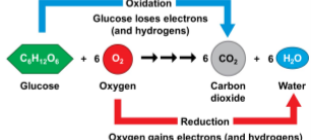
harvest energy via series of oxidation-reduction reactions
oxidation: loss of electrons
reduction: gain of electrons
in terms of food, when glucose is broken down its oxidized and loses electrons and eventually will be fully oxidized to co2 and water will be produced thru aerobic respiration
transfer of electrons during chemical reactions releases energy stored in organic molecules
this released energy is ultimately used to synthesize ATP
component of metabolic pathways - electron carriers (also carry protons)
3 types
NAD+ ← → NADH
FAD ← → FADH2
NADP+ ← → NADPH
at different steps of a metabolic pathway, molecules are broken down and their electrons are transferred to electrons carriers. when the carriers pick up these electrons, they become reduced
during respiration, glucose is broken down, bonds are broken, and electrons (energy stored in organic molecules) are released
electrons are transferred to electron carriers such as NAD+ and FAD which become reduced
reduced carriers are carrying high energy electrons
important bcuz reduced electron carriers represent stored energy that will be used to synthesize ATP
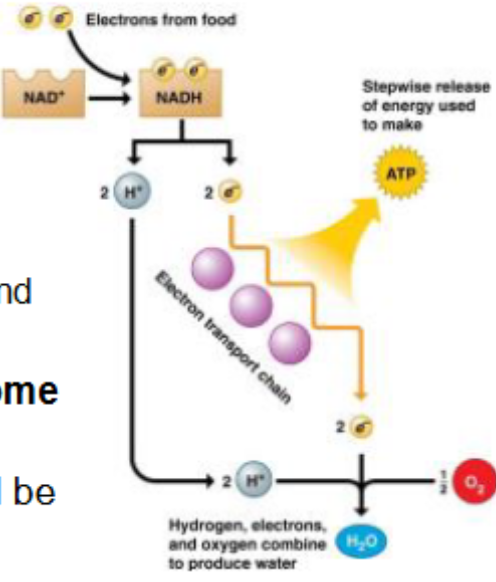
will pass electrons to ETC
components of ETC move electrons in a series of steps to a terminal electron acceptor
NADH picks up electron from some pathway and carries it to ETC and donates it to 1st component and will once again become NAD+
then the electron goes thru different components of ETC where a little bit of energy is pulled out of that electron to pump H+ and create a proton gradient
ATP synthase then uses that proton gradient to make ATP in aerobic respiration by binding to ADP + Pi
component of metabolic pathways - terminal electron acceptor
aerobic respiration: uses oxygen as TEA
the electron is donated by NADH to the 1st component which is complex 1
then NADH becomes NAD+ after it gives electron away
then electron is passed from complex 1 to 2 to 3
ultimately the electron has to go somewhere, and in this case of aerobic respiration the electron is donated to or picked up by oxygen
oxygen is the terminal electron acceptor: last molecule to pick up the electron
when it does pick up the electron, it combines with a proton and it creates water
anaerobic respiration: use other inorganic molecules at TEA
only occurs in certain bacteria, prokaryotes
eukaryotes cant do anaerobic respiration
EX: E. coli is a facultative anaerobe that can grow with or without oxygen
when it has O2 it carries out aerobic respiration using O2 as TEA
when there’s no more oxygen it can use nitrate as a TEA
when it uses nitrate its anaerobic respiration → without O2 bcuz final TEA is not oxygen

principles of metabolism
metabolism:
the way that the organism can break down food and releases energy stored in food
food energy is stored in covalent bonds that holds the different atoms in the food molecules
when bonds are broken it releases electrons (store and transfer energy)
metabolic processes
cellular respiration
aerobic respiration
anaerobic respiration
these 3 pathways can be used to breakdown glucose
fermentation
photosynthesis: its making glucose
principles of metabolism - cellular respiration
very common process by which living organism obtain energy from glucose to make ATP, in eukaryotes
involves the transfer of electrons from glucose when bonds are broken to electron carriers (like NAD+)
then NAD+ gains an electron to become NADH which then carries the electrons to components of the ETC from one component to the next to a terminal electron acceptor (O2 in AR which forms water and nitrate in AnR)
how does it make energy/ATP?: transfer of electrons through ETC pumps H+ across the inner mitochondrial membrane generating a proton motive force used to make ATP by ATP synthase (process called chemiosmosis)
as electrons go thru diff components, they release energy
this energy is used by some components which are the proton pumps: transport proteins that can take protons/H+ from the cytoplasm and pumps H+ from the mitochondrial matrix into the intermembrane space (to the outside)
then it passes it to the next and the next and (1,3,4) 3 components/complexes of the ETC use energy to pump these protons to the outside (IS)
WHY IS IT IMP: the more protons we pump outside, the more it helps to create the proton motive force PMF
this PMF is used to make ATP
down concentration gradient; high conc of protons flowing back inside to low conc through ATP synthase, these protons have a lot of energy, and we can harvest this energy to make ATP
the energy from this proton/H+ flow into the cytoplasm through the rotating enzyme thru ATP synthase is used to create ATP from the bond between ADP+Pi

catabolism and anabolism and energy
Breaking bonds requires energy
Forming bonds releases energy
Catabolism
You break bonds → this step requires energy
But the new bonds formed in the products release more energy than what was required
Net effect = energy released
catabolism is exergonic.
Anabolism
You form bonds → this step releases energy
But to get molecules into the right position, overcome activation energy, and attach unstable groups, the cell must spend ATP first
Net effect = energy required
anabolism is endergonic.
catabolism of glucose
3 pathways for harvesting energy from glucose: glycolysis, Krebs/TCA cycle, ETC
38 ATPs can be produced per glucose in prokaryotes
a little less in eukaryotes
majority of ATP made in ETC 34/38
thats why ETC and aerobic respiration is so important for growth of bacteria

catabolism of glucose - glycolysis
breaks down glucose (6 carbon molecule) into 2 pyruvate molecules (3 carbon)
splitting of glucose 6 → 3 and 3
pyruvate converted to Acetyl-CoA which is created after the removal of a carbon bcuz its a 2 carbon molecule
if we remove one of the carbons from a CO2 it becomes the 2 carbon molecule
have to create 2 carbon molecule cuz its the one needed in TCA/Krebs cycle
catabolism of glucose - Krebs (TCA) cycle
completes breakdown of glucose
totally oxidizes Acetyl-CoA and gets/extracts all the energy from the rest of the glucose molecule
ultimately results in the removal of the 2 carbons that went into there by CO2
catabolism of glucose - ETC
produces most of the ATP
water comes from ETC, CO2s come from TCA and glucose which is why end product is 6CO2 cuz started with 6 C
totally break down all the bonds between carbons of glucose releasing all electrons and all those electrons will be sent to the ETC and that will help us make a lot of ATP
principles of metabolism - fermentation
partial degradation of glucose using no ETC
during glycolysis NAD+ reduces to NADH
used by organisms that can’t carry out respiration to recycle NADH→NAD+
lack suitable inorganic electron acceptor
ex; when oxygen is not available - E. coli
when it runs out of nitrate as well it uses fermentation
E coli is a versatile organism/facultative anaerobe that can use Oxygen and survive without it
lack of ETC is why some bacteria use fermentation bcuz they can’t carry out respiration at all
includes lactic acid bacteria
most of the organisms we use to make food, they dont have ETC so only thing they can do is fermentation

why is fermentation important?
fermentation is important bcuz they have to regenerate the electron carrier NADH→NAD+, to give electrons away
this electron carrier is very important and there is a finite number of NAD+ in the cell
if all the NAD+ is gone after NAD+ → NADH during glycolysis, what will happen?
there will be no NAD+ left to accept electrons and pathways and reactions will stop
so, cell has to have a way to convert NADH back to NAD+ and that’s what fermentation does so that the pathways that need NAD+ to pick up electrons can continue (like glycolysis)
little ATP produced in fermentation
only 2 ATP/glucose in glycolysis
E. coli likes to be in the presence of oxygen because you can make 38 ATPs vs 2 ATPs
principles of metabolism - 2 common fermentation pathways
both start with glycolysis → pyruvate
use pyruvate or derivative as terminal electron acceptor
regeneration of NAD+
1. in lactic acid fermentation the pyruvate is reduced to lactic acid or lactate by picking up electron from NADH (NAD+ → NADH) and then NADH is oxidized → NAD+
can be carried out by humans and lactic acid bacteria
when you exercise really heavily, your muscles start to burn → buildup of lactic acid while not taking in a lot of oxygen
2. ethanol fermentation pathway: g→p, 1 carbon is removed from pyruvate as CO2, leaving a 2-carbon intermediate molecule called acetaldehyde
acetaldehyde taken electrons from NADH which regenerates → NAD+
by gaining those electrons, acetaldehyde is reduced to ethanol
important for the production of ethanol in terms of food and alcoholic beverages that are produced by yeast
that’s why some alcoholic beverages are bubbly bcuz of CO2 that is produced
most importantly these bacteria do these pathways to regenerate NAD+ so that glycolysis can continue bcuz even tho it only produces 2 ATP it can continue to do so
principles of metabolism - fermentation/end products
end products vary with microorganism
end products are commercially valuable
from pyruvate: → fermentation pathway (microorganisms) → end products
lactic acid (streptococcus, lactobacillus) → give flavor and texture to cheese, yogurt, pickles, its lactic acid
ethanol (saccharomyces) → wine, beer, bread, biofuel, CO2
butyric acid (clostridium) → solvents (butanol, acetone), isopropanol, CO2, H2
propionic acid (Propionibacterium)→ gives flavor to swiss cheese → propionic acid, acetic acid, CO2 gives holes, bubble bcuz of gas, longer = bigger bubbles
mixed acids (E. coli) → acetic acid, lactic acid, succinic acid, ethanol, CO2, H2
2,3-Butanediol (Enterobacter) → CO2, H2
catabolism of organic compounds other than glucose - polysaccharides and disaccharides
when we eat food there are other molecules that can be broken down as well including complex sugars
starch - broken down by amylases and when bacteria break down cellulose by cellulases → glucose (simple sugars)
and then glucose can be metabolized by glycolysis
disaccharides (lactose, maltose, sucrose) - hydrolyzed by specific disaccharides to simple sugars
lactose can be broken down by the enzyme B-galactosidase, and when its broken down its broken down to glucose and galactose
then each of these sugars can be metabolized separately

catabolism of organic compounds other than glucose - lipids
hydrolyzed/broken down by lipases
glycerol - converted to dihydroxyacetone phosphate, enters glycolysis
fatty acids - degraded by B-oxidation, enters TCA cycle
fatty acid chains are long hydrocarbon chains and B-oxidation takes 2 carbon at a time to convert it to acetyl-CoA
then acetyl-CoA can go into krebs cycle which will produce a lot of NADH and FADH2 and will result in production of lots of ATP when they donate electrons to ETC

catabolism of organic compounds other than glucose - proteins
hydrolyzed by proteases and peptidases
Protein → (protease) → smaller peptides → (peptidase) → amino acids
amino acids then can be used by whole cell or by the cell itself or the amino acids can be broken down →
deamination - removal of the amino group
standard amino acid: has amino group and carboxyl group and an R group attached to alpha carbon
the R group is what differs between amino acids
when they are broken down we can remove left or right group
the rest will be converted to precursor molecules that can go into glycolysis or other pathways
carbon skeletons converted into precursor molecules

anabolic pathways
part of metabolism: anabolism
synthesis of subunits from precursor molecules
used to make macromolecules: proteins, polysaccharides, lipids, and nucleic acids
made from precursor molecules: proteins from amino acids, carbs like starch from simple sugars like glucose, lipids from fatty acid and glycerol, and nucleic acids from nucleotides that contain nitrogenous bases
combine simple precursors to make complex molecules
all of this requires ATP, they require reducing power that would donate electrons like NADH and NADPH2
a lot of energy use by the cell is to go from precursor → macromolecules so that the cells can get bigger and divide
especially for bacteria cuz main goal for them is to divide and grow
consume ATP, reducing power and precursor metabolites

photosynthesis
uses pigments in the bacteria (chloroplast in this case derived from once free-living photosynthetic bacteria)
endosymbiotic theory: chloroplast and mitochondria were once free-living bacteria phagocytized by eukaryotic cell and became part of the cell
the photosynthetic organelle or bacteria takes energy from sunlight and CO2 and H2O from environment
these are used to produce organic molecules like glucose and oxygen as a byproduct
organic molecules along with oxygen that is produced is used by mitochondria or aerobic bacteria in cellular respiration to produce ATP (chemical energy)
waste/by product from this is CO2 and H2O and used by photosynthetic bacteria/organelle to make more organic molecule which is used by mitochondria and so on
process of photosynthesis is tightly connected to cellular respiration and vice versa
waste product of one is starting material for the reactions of the other
