Calculus I Memorization
 Call Kai
 Learn
Learn Practice Test
 Spaced Repetition
 Match
Match Flashcards
 Knowt Play
1/34

There's no tags or description
Looks like no tags are added yet.
Name | Mastery | Learn | Test | Matching | Spaced | Call with Kai | Chat |
|---|
No analytics yet
Send a link to your students to track their progress
35 Terms
Relative Maximum
point where the graph is higher than the points right next to it
Think of standing on top of a small hill.
       •
     /   \
   /       \
You're at the highest point nearby, even if there might be a taller mountain somewhere else.
Relative Minimum
a point where the graph is lower than the points right next to it.
Why is it called relative
Because you're only comparing to the points close by, not the entire graph.
Concave up
-UP like a cup
-You look at where f’’(X) is above the x axis
Concave down
-like a frown
-You look where f’’(x) is equal below x axis
How do you find critical points?
Get the function, take the derivative, factor if you need to and set the derivative equal to zero.
How do you find relative max and min with no calc
-Find critical points
-Make quick sign chart using one test number in each interval
-remember positive to neg is max
-negative to positive is min
critical points
Think of a critical point as a place where the graph might change direction.
when asked about relative min, max, increasing/decreasing what do you do?
Find f′(x)
Set f′(x)=0
Those answers are your critical points.
Then decide whether each one is a maximum, minimum, or neither.
The relationship between position, velocity, and acceleration
Position
↓ derivative
Velocity
↓ derivative
Acceleration
-Going down the chain means take derivative
-going upwards means take integral
Straight lines have the same slope everywhere
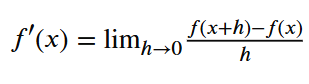
Definition of a derivative
Know how to do chain rule for e^x
absolute value
-distance from zero
-if x>0 then |x| = x
-e.g |7|=7
Absolute value for negatives
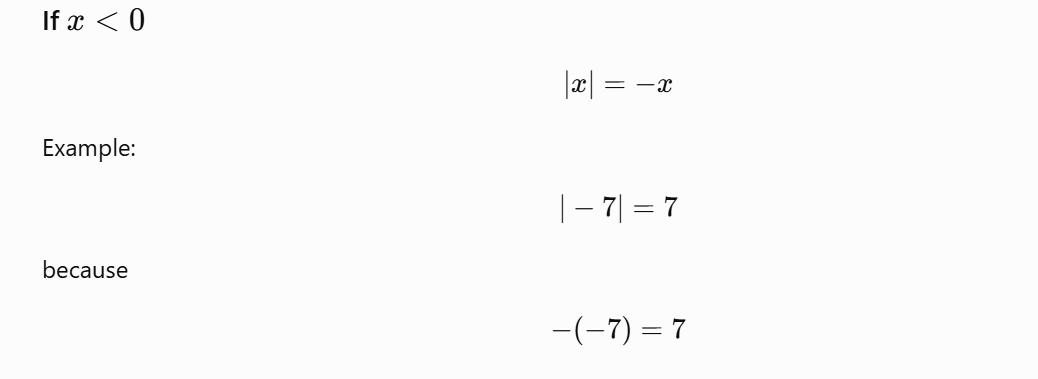
whenever you see an absolute value in a limit
always ask if you’re coming from the negative or positive side
relative extrema is literally just the same as relative max or min
Point of inflection
-where the graph changes bend
-∪
changes to
∩
or
∩
changes to
∪
How to find points of inflection
-Find the second derivative (\(f''(x)\)): Differentiate the original function twice.
-Find possible inflection points: Set \(f''(x) = 0\) or identify where \(f''(x)\) is undefined. Solve for \(x\)
-Test the intervals: Create a sign chart using your \(x\)-values. Pick a test value in the intervals between and around your \(x\)-values and plug them into the second derivative
-Confirm concavity change: If \(f''(x)\) changes signs (e.g., from positive to negative), you have found an inflection point. Plug the \(x\)-value back into the original function to get the corresponding \(y\)-coordinate. [1, 2]
Why do we use second derivative?
-f’(X)= is graph going up or down?
-f’’(x)= graph bending upward or downward?
Graph movement: Adding outside the function
-same thing if you subtract outside the function
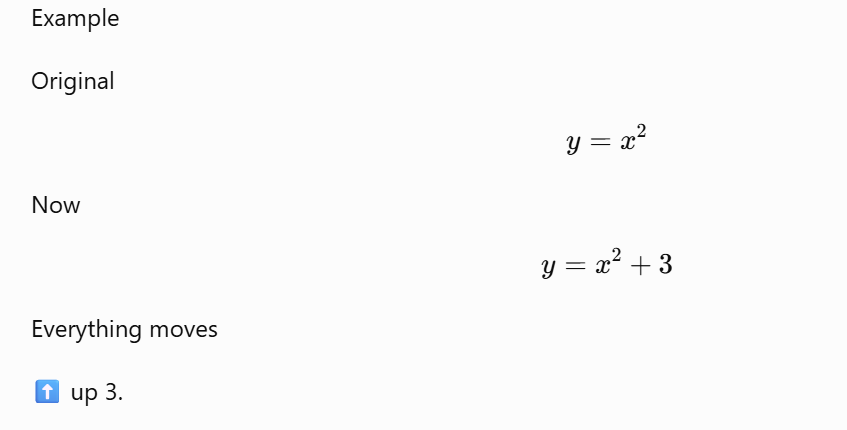
Graph movement: adding or subtracting inside
Its the opposite if you subtract inside
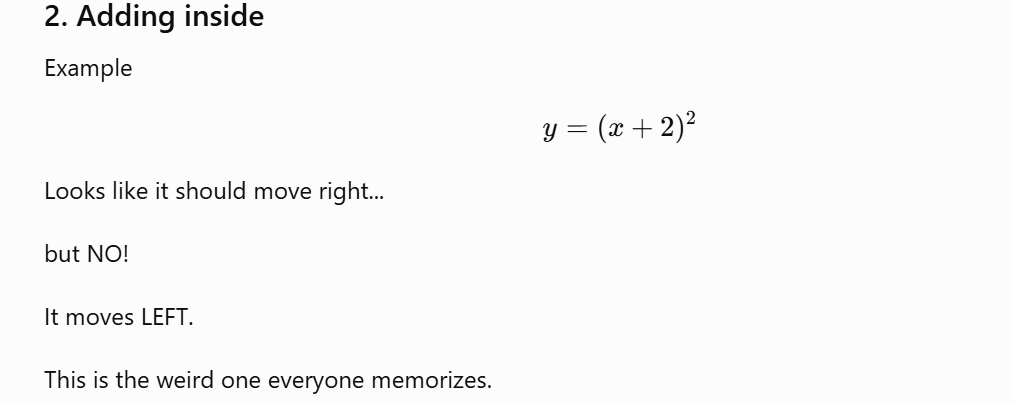
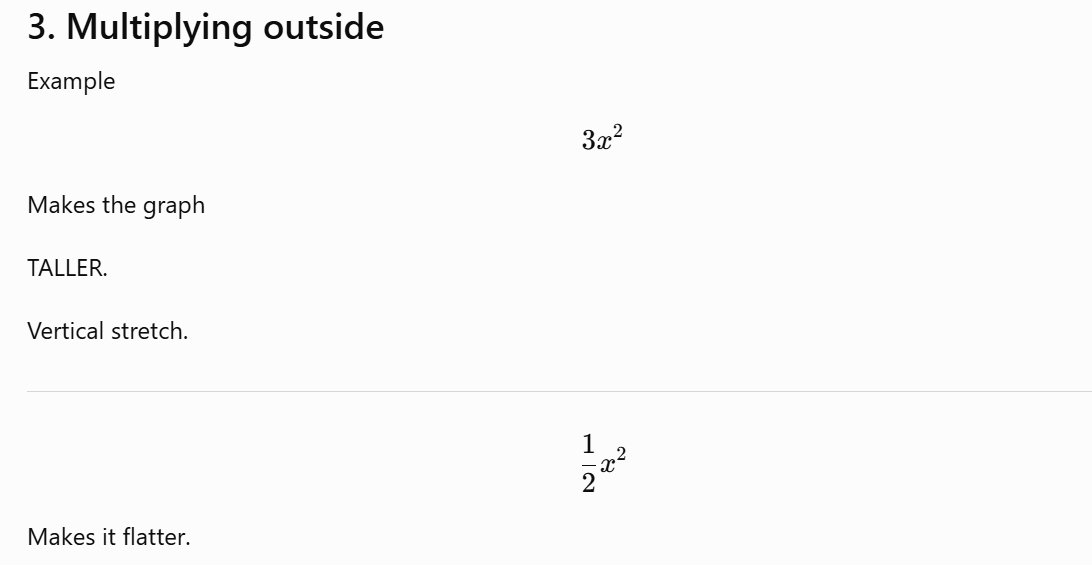
Graph movement: Multiplying outside
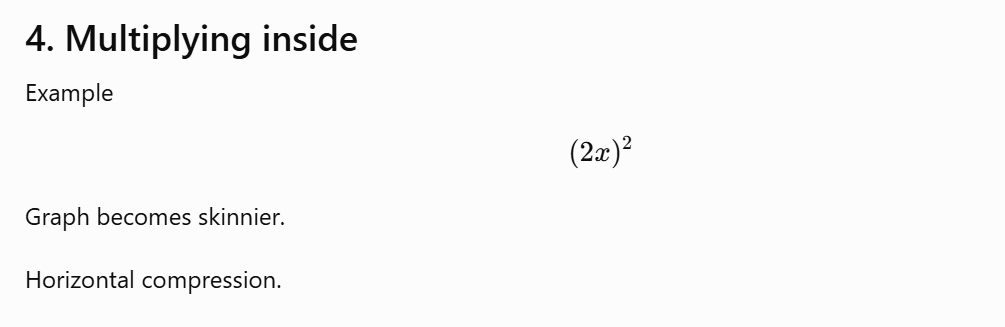
Graph movement: multiplying inside
use the factored and first derivative to find max and min on graph
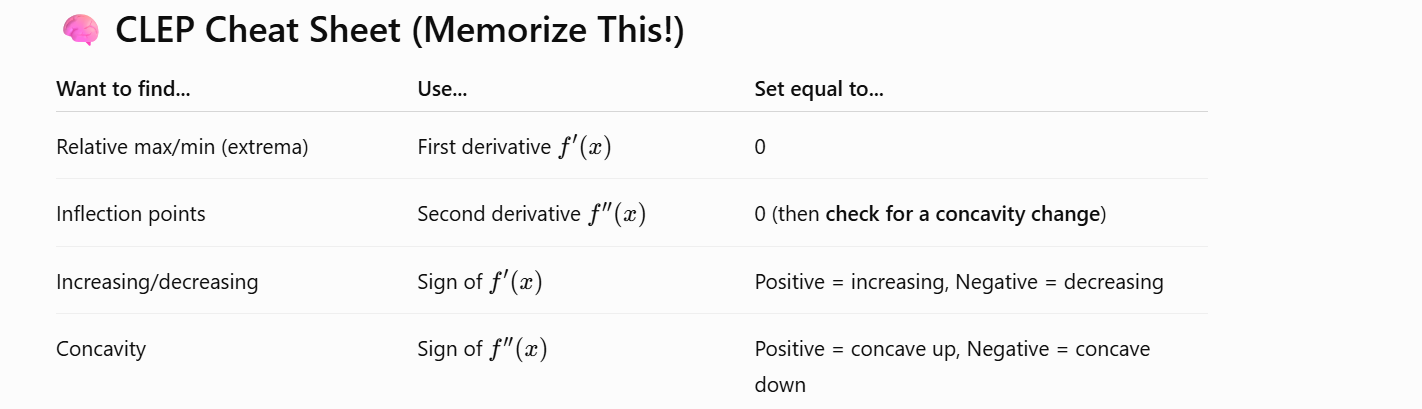
some clep cheat sheet for first and second derivatves
Three things that make a function be continuous
f(5) for e.g exists
lim of f(x) exists
they are equal to each other
e.g if f(5)=0 and the lim as x approaches 5= something else that means it IS NOT CONTINUOUS!
Average rate of change formula
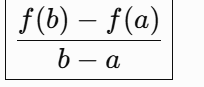
What does Avg rate of change mean
Think of a car:
-you travel from 0-4 miles but you didn't go the same speed the whole time
-so you measure total distance over total time to get your average
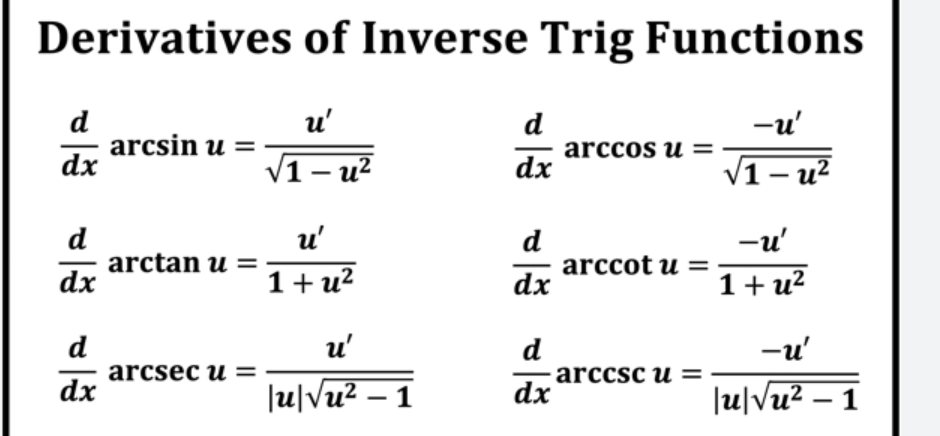
Derivatives of inverse trig functions
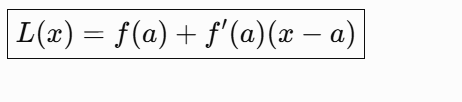
Linear approximation Formula
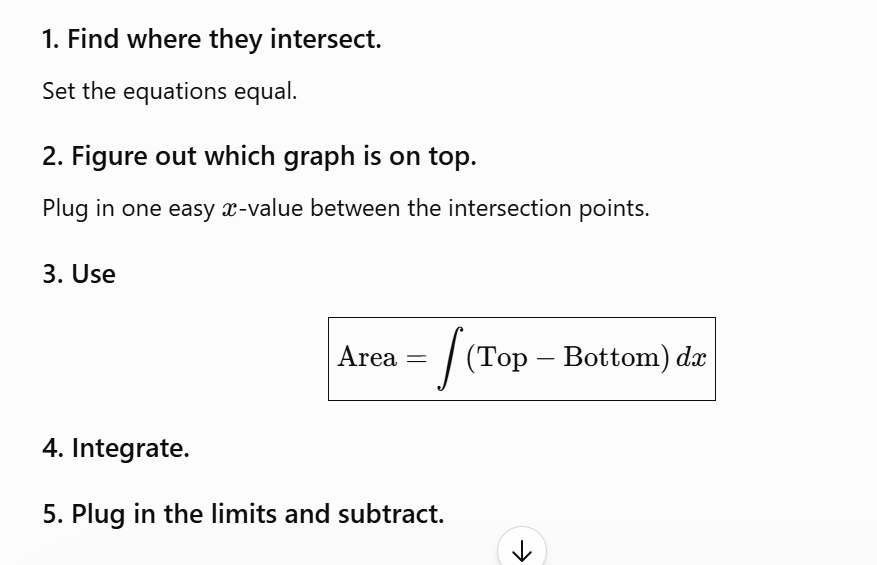
Area bounded between two curves