NEW Whitechapel
 Call Kai
 Learn
Learn Practice Test
 Spaced Repetition
 Match
Match Flashcards
 Knowt Play
1/39

There's no tags or description
Looks like no tags are added yet.
Name | Mastery | Learn | Test | Matching | Spaced | Call with Kai | Chat |
|---|
No analytics yet
Send a link to your students to track their progress
40 Terms
What were living conditions like in nineteenth-century Whitechapel?
Whitechapel suffered from air pollution
Smoke and fumes from London’s many factories blew from west to east
Whitechapel contained many small, narrow streets and alleyways
For an outsider, Whitechapel would have felt like a maze. People could easily get lost
In some situations, a person navigating through Whitechapel would struggle to see their hand in front of their face
Pollution also affected Whitechapel’s water supply
There was little clean drinking water
As a result, many residents of Whitechapel drank alcohol instead of water
Whitechapel had poor sanitation
It was common to see sewage in the streets
Whitechapel's Rookeries
Most housing was in overcrowded slum areas - also known as “rookeries” - famous for being dirty and full of crime. Each house was split into smaller, very crowded, apartments.
In 1877, one rookery contained 123 rooms, with 757 people, including many families living there, some were close to starvation.
The 1881 census shows the total population of Whitechapel District in 1881 as 30,709 - and there were only 4,069 occupied houses.
lodging houses
Lodging houses offered little more than a bed in dirty conditions.
Some lodging houses had three eight-hour sleeping shifts a day, so beds could be used by the maximum number of people.
The smell and heat in summer, and the huge number of rats, meant that these lodging houses were truly awful.
Diseases spread quickly in lodging houses due to poor hygiene and lack of cleanliness
Whitechapel had over 200 lodging houses. Roughly a quarter of the population of Whitechapel lived in lodging houses
Model Housing - The Peabody Estate
Whitechapel housing wasn’t all bad. In 1875, parliament passed the Artisans’ Dwellings Act in an attempt to improve the slums. In Whitechapel, a maze of narrow courtyards filled with cramped and unhealthy houses was replaced with 11 new blocks of flats. These were paid for by George Peabody, a wealthy American who had moved to London.
The Peabody Estate opened in 1881 and provided 286 flats.
Weekly rent started at a reasonable three shillings (15p) for a one-room flat and went up to six shillings (30p) for three rooms.
Work in Whitechapel
. Many residents worked in trades like tailoring, shoe-making, and making matches. The work premises - known as sweatshops - were small, cramped, and dusty, with little natural light. Hours were long (some sweatshop workers worked 20 hours a day and slept on-site) and wages were low.
Workhouses and Orphanages
Workhouses had been set up earlier in the 19th century as part of the poor relief system. They offered food and shelter to the very poor.
Inmates included the old, sick, disabled, orphans, and unmarried mothers. Conditions were deliberately made worse to put poor people off from entering the workhouse except as a last resort.
Inmates were expected to do hard manual labour and wear a uniform.
Families were split up and could be punished even for trying to talk to each other.
Vagrants, who stayed just one or two nights, were held separately from long-term residents, as they were thought to be lazy and a bad influence on the others.
Describe one feature of accommodation for the poorer people in the Whitechapel area
There were many slum houses. They had little ventilation.
penny hang
Homeless people or drunks out on the street could hire a 'penny hang'. This was a space on a thick rope. Two hooks fixed in the walls, ropes strung in parallel from one side to another at about shoulder height. was no room to lie down. You hung across it.
Socialist
Someone who believes in equality and government ownership of industries.
Anarchist
A radical political belief in removal of all government.
Nationalist
Someone who loves their country and wants it to be independent.
How was Whitechapel a perfect place for crime?
Narrow alleyways | A criminal with local knowledge could navigate through the maze of streets and escape the police |
Poor street lighting | Criminals could use the lack of lighting to commit their crimes undetected. Levels of crime were high at nighttime |
Air pollution caused low visibility | A person could become a victim of a crime without being able to see the criminal |
A large number of workhouses and orphanages | Many poor people and orphans were desperate to avoid the workhouse, leading to a life of crime |
A large number of rookeries | Overcrowded and poor-quality housing exposed people to more opportunities to become the victim of crimes such as theft |
A large number of sweatshops | Poor working conditions in Whitechapel decreased a person’s life expectancy. A death in the family could lead to a life of crime to make up for this loss of income |
Alcohol & Prostitution
Alcohol was a significant problem in Whitechapel
Alcohol was affordable
Gin was a popular drink for the poor
Many people became alcoholics to forget how poor their quality of life was
There were many pubs in Whitechapel
In one mile in Whitechapel, there were 45 pubs and gin palaces
Alcohol led to crime
Drunkenness often led to violent crimes such as assault
People would steal to afford to buy more alcohol
Prostitution became a serious concern in Whitechapel
Some women worked in brothels
This provided them with some protection
There were roughly 62 brothels in Whitechapel
Other women walked the streets looking for customers
These women were vulnerable to rape and assault
Prostitution was not illegal. People saw prostitution as a social issue
Society called prostitutes ‘unfortunates’
Most middle-class people had minimal sympathy for prostitutes and did not understand why a woman would prostitute herself
There were approximately 1,200 prostitutes in Whitechapel
A lack of contraception caused backstreet abortions and untrained doctors conducted this procedure which caused many women to die from infection, blood loss or shock.
Irish migrants
It was mostly Irish workers who were employed at the docks as ‘navvies’ (navigators); doing labouring jobs on canals, railways and roads; or working as dockers on the Thames.
Irish immigrants had a poor reputation among London society
Many people considered Irish immigrants as thugs and drunks
High levels of poverty affected Irish immigrants
Whitechapel’s Irish community suffered from persecution due to the Fenians
The Fenians were an Irish Catholic group. They demanded that the UK free Ireland from British rule
The Fenians bombed Clerkenwell Prison in London in 1867 and Gower Street Station in 1885
As a result, many people had an anti-Irish and anti-Catholic attitude
The Metropolitan Police created the Special Branch. Part of their responsibilities was to hunt for Irish terrorists
Between 1870 and 1900, life for Irish immigrants became tough
The press reported negatively on Irish immigrants
Irish immigrants struggled to find jobs, as employers assumed that all Irish immigrants supported the Fenians
Jewish Migrants
After 1881, Russian Jewish people started to come over to England in large numbers, in order to avoid persecution following the assassination of Tsar Alexander II.
Whitechapel was a popular area for Jewish immigrants
Whitechapel was affordable for the Jewish immigrants
Settling in one place gave more protection for Jewish immigrants
Many Jewish migrants started to work in sweatshops making clothes and shoes for Jewish employers, where conditions of work were poor and wage levels were low. Other businessmen could not compete with sweatshops on price, and business owners blamed immigrants for this.
People in Whitechapel disliked the Jewish community because of cultural differences:
The Jewish immigrants spoke a different language called Yiddish
This made them stand out from the white Christian community in Whitechapel
Judaism has different religious celebrations like the Sabbath
Most residents in Whitechapel celebrated Christian events
Newspapers blamed Jewish immigrants for the issues within Whitechapel
During the Jack the Ripper murders in 1888, many newspapers reported that the murderer was a Jewish person
Public Attitudes Towards the Metropolitan Police
By the mid-nineteenth century, the Met had established a good reputation among most people in London
Most areas viewed constables as reliable
The majority of Londoners wanted the peace and order
Areas like Whitechapel did not view the Met so positively
Gangs attacked the beat constables of H Division often
Anti-government protestors mostly came from the poorer classes
The difficulties of policing in Whitechapel
Slums
The densely packed rookeries and the dark, unlit alleyways and yards all made policing difficult. This was because criminals could watch for victims and quickly hide after committing crimes. Criminals with local knowledge could escape quickly
A constable found it difficult to police all the alleyways on his beat
Alcohol
Very strong drink was available to all but the very poorest people, and there were 45 pubs and gin houses in Whitechapel - one on almost every street corner.
Alcohol caused some people to become more vulnerable to becoming victims of crime.
Alcohol also made arguments worse, leading to violence. Also, it caused problems for police constables who were trying to get information about a crime from drunk witnesses and victims.
Gangs
Well-organised gangs developed that were involved in illegal pubs and unlicensed boxing matches. Because the police force was undermanned, there was no attempt to shut down fights or gangs’ criminal activities.
Some gangs, such as the Bessarabian Tigers and Odessians, also organised protection rackets, which took money from people in return for protecting them from attacks. If people refused to pay, they would have their shops or market stalls attacked and destroyed.
Gangs and protection rackets preyed on immigrants, who were already cautious of the police and rarely reported crimes due to language or cultural barriers.
Immigration
The presence of migrants in Whitechapel also caused tensions.
There were many stories in newspapers accusing these groups of criminal activity.
Police constables also had to respond to protests from some Jewish migrants about the low wages they were receiving for the long hours they had to work.
These protests caused problems for the police, who arrested the leaders on some occasions after violence had occurred.
Socialism and anarchism
Some people in Whitechapel were worried about political ideas such as socialism and anarchism being brought over to London by migrants, especially from Eastern Europe. These are political ideas which would change the way the country was run.
The idea of anarchism was developed by Russian revolutionaries.
Some Jewish migrants brought the idea of socialism to London with them and set up socialist organisations and a newspaper, Worker’s Friend,.
The Police in the 19th Century Being effective
Improved pay and training helped improve public trust in the police. By the 1840s many other areas across England created their own paid police forces.
H Division was run by a superintendent and a chief inspector. They had the support of 27 inspectors and 37 sergeants. They supervised 500 ordinary constables.
In 1880, if a beat constable was found to be away from his beat, or missed a crime committed on his beat (and couldn’t give a good reason), he could be fined or dismissed.
Describe two features of the growth of socialism in Whitechapel.
Socialist organisations were set up in Whitechapel. The International Workers’ Educational Club and a newspaper called ‘The Workers’ Friend’ were established.
• The growth of socialism also led to a fear of anarchist attacks in Whitechapel. People often associated socialism with anarchism, and were suspicious of Irish, Russian and Jewish migrants in Whitechapel after there had been assassination attempts and bomb attacks on important people on the continent.
The Police in the 19th Century Being ineffective
Policemen were paid less than labourers and some were drunk on the job. Some cartoons showed the police as violent brutes.
In Whitechapel in particular, the police were seen in a negative light due widespread poverty and the fact that they were seen as ‘upholders of unpopular government laws’. They were often attacked by violent gangs.
Following the establishment of the Met, constables (bobbies) were often expected to walk up to 20 miles a day and were only armed with a baton and whistle.
Whitechapel crime and associated policing problems:
Whitechapel had a terrible reputation for high levels of crime (much of it linked to levels of poverty and unemployment)
Crime was made easier, and policing more difficult, by the maze of badly lit alleyways and courtyards with multiple entrances and exits
Immigrant cultural and language barriers, plus prejudice against immigrants, added to policing problems
Some areas, such as Ewer Street, were so dangerous that the police wouldn’t go there
time of the Ripper murders
1888
Whitechapel sources
Cheap local newspapers aka penny dreadfuls e.g. Penny Illustrated Newspaper, Illustrated Police News (actually very anti-police)
National newspapers e.g. The Times, The Daily Telegraph
Records of crimes - H Division
Police investigations
Old Bailey records of trials
Cartoons from newspapers and journals
Housing and employment records
Council records
Censuses
Workhouse Records
Local police records
Coroners’ reports
H-Division:
Whitechapel was the H-Division of the Metropolitan Police
It was run by a Superintendent, a Chief Inspector, 27 Inspectors, 37 Sergeants and around 500 Constables
There were 15 CID (Criminal Investigation Department) detectives attached to the Whitechapel H-Division
There was a police-to-population ratio of 1:300 in Whitechapel compared to 1:390 for the whole of London (but there was far more crime in Whitechapel)
How Good Were Police Recruits in the Nineteenth Century?
By c1870, the Met struggled to attract good quality recruits because:
Constables had to work seven days a week
The pay was incredibly poor
Constables received a pay of roughly 21 shillings for a seven-day week
The work was inconsistent
Patrolling a beat could be very dangerous or very boring
Sergeants followed constables to ensure they were not avoiding work or sleeping on the job
As a result, the quality of police recruits declined by c.1870
This caused a worsening in the efficiency of the Met
The Metropolitan Police categorised London into
20 divisions
What responsibilities did a beat constable have?
An in-depth knowledge of his beat. This included the alleyways, pubs and shops around the beat
Stopping residents and questioning them
What were the Whitechapel Murders?
Between August 1888 and November 1888, a series of murders shocked the residents of Whitechapel. This is because:
Even in Whitechapel, it was uncommon to have so many murders in such a short amount of time
The Met believed that the same person murdered all five victims
The killer targeted women. Most of his victims were
Prostitutes
Divorced
Struggling with alcoholism
Who were the victims of the Whitechapel Murders?
Mary Ann Nichols | 43 | Prostitute | 31st August 1888 | Buck's Row |
Annie Chapman | 47 | Crocheter, flower seller and prostitute | 8th September 1888 | 29 Hanbury Street, Spitalfields |
Elizabeth Stride | 44 | Sewer, cleaner and prostitute | 30th September 1888 | Berners Street |
Catherine Eddowes | 46 | Sewer, cleaner and hop-picker | 30th September 1888 | Mitre Square, Aldgate |
Mary Jane Kelly | c.25 | Prostitute | 9th November 1888 | 13 Miller's Court, Spitalfields |
How did the killer become known as 'Jack the Ripper'?
Sensationalist newspapers frequently reported on the Whitechapel murders
They called the criminal the 'Whitechapel murderer' or the 'Whitechapel fiend'
Their articles increased the public's fear of the killer
Investigative Policing: Careful Observation
police made careful note of crime scenes. so evidence wasn’t disturbed before a detective arrived
they would record marks & bruises on the body & what people were wearing
but:
wasn’t always possible
sometimes they were disturbed
The Home Secretary and Policing in the 19th Century
Charles Warren was an unpopular commissioner
In 1888, the Jack the Ripper murders hit Whitechapel Warren was blamed by the government for the police’s failure to catch the murderer
The Whitechapel Vigilance Committee
A group of Whitechapel businessmen formed it in response to the Ripper murders and the perceived police failure to protect the community
hired people to patrol the streets at night, hoping too catch the Ripper/deter future crimes
Members of the committee walked the streets with hob-nail boots, whistles and burning planks of wood
offered financial rewards for information - added to the media frenzy and public anxiety
may have acted as an interference in the police work
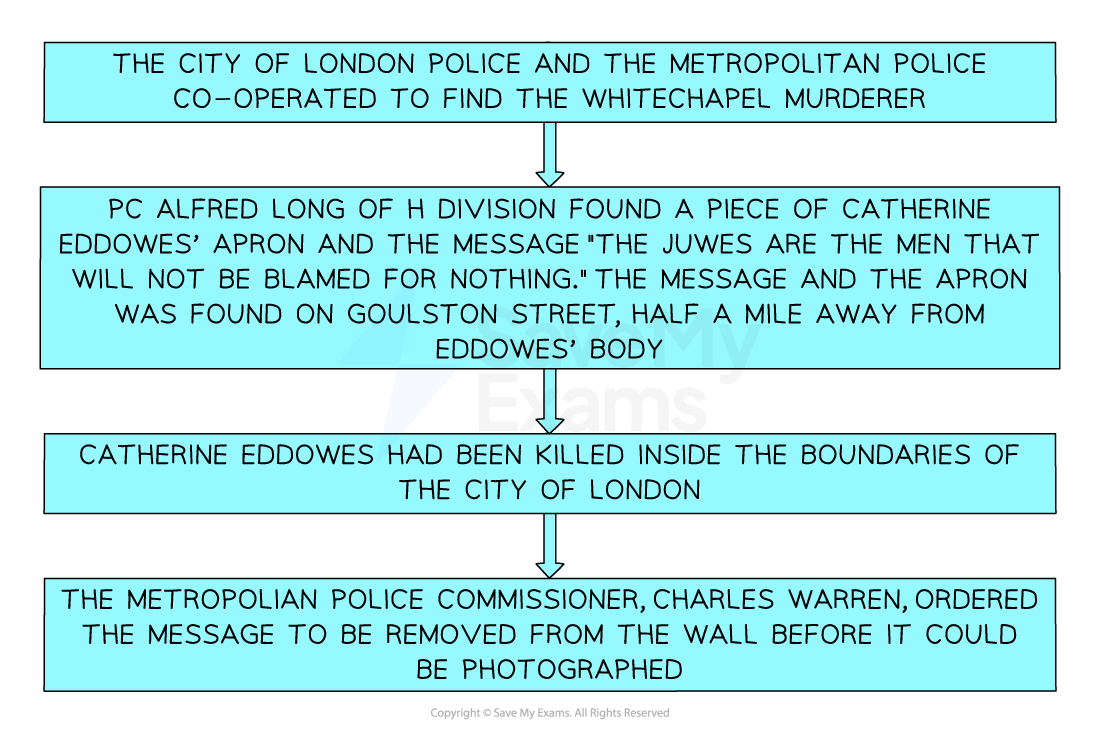
rivalry between the Metropolitan Police and the City of London Police
In 1888, there was a strong rivalry between the Metropolitan Police and the City of London Police
In the 1830s, the Met put pressure on the government to force the City of London Police to merge with them
The City of London Police only covered an area of roughly 1 square mile of London. Its boundaries fell inside the Metropolitan Police's zone of London
The government allowed the City of London Police to function independently from the Met. This is because:
It was a wealthy and powerful area of London and the government needed the support of the City of London's residents
It had a strong pride in its local police force
How did police rivalry affect the investigation into the Whitechapel murders?
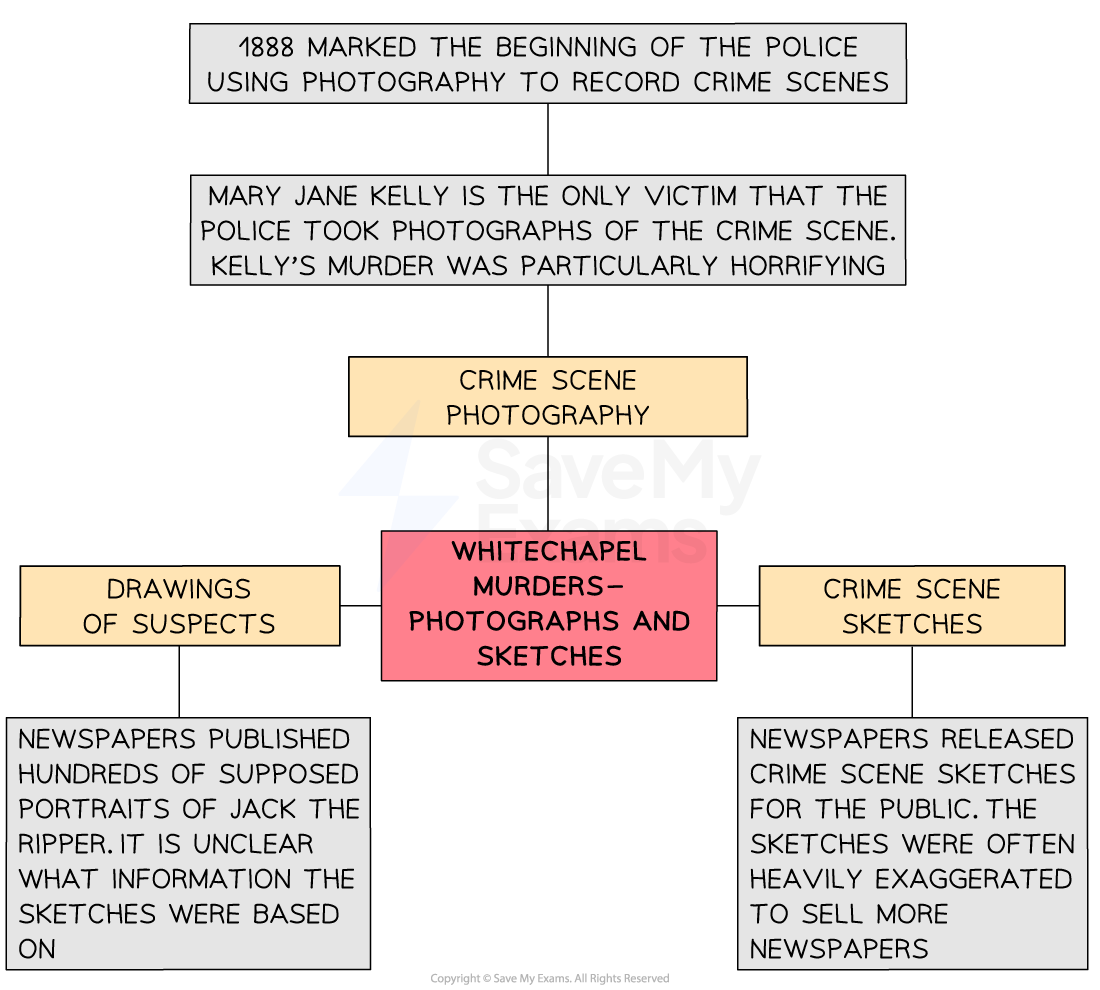
Investigative Policing: Photography and Sketches
Investigative Policing: Interviews & Following up clues
went house-to-house talking to people for information - took a lot of time & police, people may not be willing to help or not have relevant information
scrap of paper followed up after Annie Chapman’s murder. - followed up 300 lines of enquiry and arrested over 80 people, and nothing came out of it. the police had to do extra work
Describe one feature of the investigative policing methods used in the hunt for the Whitechapel murderer in 1888
One method used by the police to catch 'Jack the Ripper' was observation of the crime scene (1). A fragment of an envelope with a Sussex Regiment was found near the body of Annie Chapman (1).
The newspapers made investigating the Whitechapel murders a lot harder for the police. The newspapers in 1888:
Published factually incorrect statements about the murders
Encouraged anti-semitism by suggesting the murderer was a Jewish person
Created hysteria in Whitechapel, increasing the public's fear
The large amount of publicity disrupted the police investigation
The newspapers' constant reporting encouraged hoaxes
This spread misinformation about the murders