Psych Lap 2 Test
 Call Kai
 Learn
Learn Practice Test
 Spaced Repetition
 Match
Match Flashcards
 Knowt Play
1/80

There's no tags or description
Looks like no tags are added yet.
Name | Mastery | Learn | Test | Matching | Spaced | Call with Kai | Chat |
|---|
No analytics yet
Send a link to your students to track their progress
81 Terms
Nervous systems
Central: brain and spinal cord
Peripheral: somatic and autonomic (sympathetic and parasympathetic stem from the autonomic)
Interneurons: Sensory and Motor
Sensory Afferent neurons → to the spine
Motor Efferent neurons → from the spine
Spinal Reflex
spinal cord acts alone
receives sensory Afferent message
sends motor Efferent message
brain gets message AFTER action
Somatic Nervous System
soma = body
skeletal/striated muscles
conscious control
Autonomic Nervous System
involuntary
non-skeletal muscles
sympathetic and parasympathetic
sympathetic nervous system
STRESS
catabolic - expends energy
pupils dialte
bronchi relax
increases heart rate
inhibits digestion
contracts blood vessels
parasympathetic nervous system
PEACE
anabolic - stores energy
contracts pupils
bronchi constricts
slows heart rate
stimulates digestion
dilates blood vessels
return to homeostasis
Synapse: Neuron
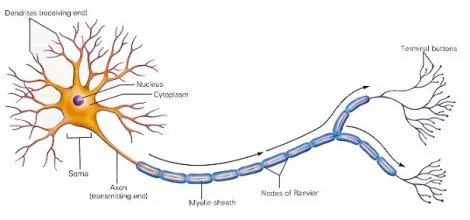
The neuron receives nerve impulses through its dendrites. It then send the nerve impulse through its axon to the terminal buttons where neurotransmitters are released to stimulate other neurons.
The neuron communicates electrochemically
It converts chemical energy to electrical energy to chemical energy
The transmission of information from one neuron to another (Halloween)
synthesis of neurotransmitter and formation of vesicles
transport of neurotransmitter down axon
release of neurotransmitter
interaction of neurotransmitter with receptor, exciting or inhibiting post-synaptic neuron
separation of neurotransmitter molecules from receptors
reuptake of neurotransmitter to be recycled
Vesticles without neurostransmitter teleported back to cell body
major neurotransmitters: Acetylcholine (ACh)
memory in hippocampus
movement - PNS
blocked in Alzheimer’s patients
excitatory
major neurotransmitters: Dopamine
movement
attention
learning
pleasure - cocaine blocks reuptake
too little - Parkinson’s disease
too much - Schizophrenia
major neurotransmitters: Serotonin
arousal
sleep
mood
appetite
LSD inhibits Serotonin (waking sleep)
major neurotransmitters: GABA (gamma-aminobutyric acid)
inhibits axons-increasing threshold of excitation
linked to seizures
major neurotransmitters: Glutamate
excitatory NT; linked to memory
excess can produce migraines (MSG-migraines)
hindbrain: medulla oblongata
necessary for survival controls:
heartbeat
respiration
swallowing
digestion
*remember medal - medals hang over your heart and lungs
hindbrain: pons “the bridge”
bridge or relay
sleep
arousal
*remember pond - lying next to a pond relaxing
hindbrain: cerebellum “little brain”
balance
coordination
much larger in animals as proportion of brain
*remember bell - athlete with a bell on their head trying to balance
midbrain and hindbrain: RAS - reticular activating system
sleep
arousal
attention
links to the hindbrain
*remember tickle - Freud lying down between patients → person comes along and tickles him → wake him up and make him alert
forebrain: cerebral cortex
outer later of the brain
4 lobes
somatosensory and motor cortex
the bodys untimate control and information-processing center
*remember Texas hat - cerebral cortex is on the part on the outside of the brain
forebrain: hippocampus
involved in learning and memory
*remember hippo compass - lost hippo uses his compass to help him remember how to get home (memory)
forebrain: amygdala
anger
aggression
fear
PTSD study: May be genetic precursor if amygdala is slow to “turn off”
*remember wig + dala - scary wig with dollars
forebrain: thalamus
“relay center”
sends sensory information to cerebral cortex (except smell)
also linked to RAS for sleep and arousal
*remember Hal & Amos - tells signals coming up where to be processed in the brain
forebrain: hypothalamus
the 4 F’s
food
fight
flight
s3x (Knowt made me sensory it)
*remember hypo the llamas - give the llamas water → cooling down the body, regulating body temperature
lateral hypothalamus
ON - stimulates eating
ventromedical hypothalamus
OFF - stops
Hemispheres of the brain
left: language functions
broca’s and wernicke’s areas
broca - speak grammatically
Wernicke - language comprehension
aphasia - language impairment
roger Sperry: split-brain
severed corpus callosum in epileptic patients
chimeric face study
verbally say right eye image
points to left eye image
four lobes of the brain
frontal
parietal
temporal
occipital
frontal
higher level thinking
parietal
primary somatosensory cortex
temporal
audition (hearing)
occipital
vision

locations
frontal - purple
parietal - green
occipital - red
temporal - blue
cerebellum - yellow
brain imaging: EEG - electroencephalogram
measures brain wave activity
ERPs (event-related potentials): minimize interference
brain imaging: CAT scan
computerized axial tomography
cross-sectional images of the brain
uses x-rays
brain imaging: MRI
magnetic resonance imaging
uses magnetic field instead of x-rays
fMRI-functional MRI, shows area of activity in the brain
brain imaging: PET scan
positron emission tomography
traces radioactive glucose
shows brain functions, levels/areas of activity
endocrine system
regulates growth, reproduction, metabolism and behavior
controls glands
releases hormones
uses negative-feedback loop
adrenal glands
secretes epinephrine and norepinephrine
fight or flight response
controls 50 other steroids
resistance to stress
muscle development
anabolic steroids (synthetic)
extreme aggression
mood swings
sterility
thyroid gland
produces thyroxine
too much - hyperthyroidism - weight loss, weak muscles
too little - hypothyroidism - slow metabolism, weight gain
pituitary gland
“master gland”
regulates other endocrine glands
controlled by the hypothalamus
ACTH - adrenocorticotropic hormone - stress hormone
begins “fight or flight” response
In which of the following parts of the brain would a lesion most likely result in aphasia?
wernicke’s area
After 3 hours of playing a physically exhausting professional tennis match, Chitra began to experience a sense of physical exhilaration and pleasure. It is likely that her feelings were more directly linked to…
endorphins
The reticular formation is located in the…
brainstem
The most extensive regions of the brain, which enable judging and planning, are called the…
association areas
The peripheral nervous system is to sensory neurons as the central nervous system is to…
interneurons
The skeletal nervous system is a component of the ____ nervous system.
peripheral
The secretions of the pituitary gland are most directly regulated by the…
hypothalamus
Sensory neurons are an important part of the…
peripheral nervous system
Which part of the human brain is the most similar to the brain of a frog?
the brainstem
Phineas Gage underwent a dramatic personality change after a tamping iron inflicted massive damage to his ____ lobe.
frontal
The part of the left frontal lobe that directs the muscle movements involved in speech is known as…
broca’s area
The motor cortex is located in the ____ lobe.
frontal
The part of the peripheral nervous system that controls glandular activity and the muscles of internal organs is called the…
autonomic Nervous system
Endocrine glands secrete hormones directly into…
the bloodstream
In order to identify which of Lucy;s brain areas was most active when she talked, neuroscientists gave her a temporarily radioactive from of glucose and a…
PET scan
Opiate drugs occupy the same receptor sites as…
endorphins
The myelin sheath helps to increase the ____ of neural impulses.
speed
Split-brain patients have had their ____ surgically cut.
corpus callosum
The structure located stop the brainstem that directs messages to the brain’s sensory receiving areas is called the…
thalamus
When the release of ACh is blocked by certain chemicals substances, the result is…
paralysis
Heartbeat acceleration is to heartbeat deceleration as the ____ nervous system is to the ____ system.
sympathetic; parasympathetic
An x-ray photograph of the brain is called a…
CAT scan
Sir Charles Sherrington observed that impulses took more time to travel neural pathways than he might have anticipated. His observation provided evidence for the existence of…
synaptic gaps
Epinephrine and norepinephrine are released by the ____ glands.
adrenal
The depolarization of a neural membrane creates an…
action potential
Stimulation of the reticular formation will cause a…
sleeping cat to awaken
With regard to the process of neural transmission, a refractory period refers to a time interval in which…
positively charged atoms are pumped back outside a neural membrane
The chemical messenger at every synaptic gap between a motor neuron and a muscle is…
acetycholine
The right hemisphere is superior to the left at…
recognizing peoples faces
A loss of physical coordination and balance is most likely to result from damage to the…
cerebellum
The surgical removal of a large tumor from Allen’s occipital lobe resulted in extensive loss of brain tissue. Allen is most likely to suffer some loss of…
visual perception
The part of a neuron that transmits neural messages to other neurons, muscles, or glands is called the…
axon
A neural impulse is generated only when excitatory minus inhibitory signals exceed a certain…
threshold
The branching extensions of nerve cells that receive incoming signals from sensory receptors or from other neurons are called the…
dendrites
The nineteenth-century theory that bumps on the skull reveal a person’s ability and traits is called…
phrenology
Neural impulses may travel as rapidly as…
200 miles per hour
Increasing the intensity of a stimulus above the threshold will not similarly increase the intensity of a neural response to that stimulus. This highlights the nature of the…
all-or-none response
The sensory cortex is located in the ____ lobe.
parietal
Neurotransmitters are released from vesicles located on knoblike terminals on the...
axon
To demonstrate that brain stimulation can make a rat violently aggressive, Professor Brown should electrically stimulate the rat’s…
amygdala