ED.21- OXYGEN DEMAND AND SUPPLY: GAS EXCHANGE
 Studied by 0 people
 Call Kai
 Learn
Learn Practice Test
 Spaced Repetition
 Match
Match Flashcards
 Knowt Play
1/13

There's no tags or description
Looks like no tags are added yet.
Name | Mastery | Learn | Test | Matching | Spaced | Call with Kai |
|---|
No study sessions yet.
14 Terms
Discuss constraints on the form and function of living organisms
Phylogenetic/Historical Constraints: New traits must be modifications of ancestral structures. For example, the number of tissue layers an organism has (diploblastic vs. triploblastic) limits the complexity of the organs and body cavities it can eventually develop.
Physical Constraints: Biological systems must obey the laws of physics and chemistry. For example, the rate of gas diffusion through a membrane limits how thick that membrane can be while still remaining functional.
limitations to passive transport
distance limits diffusion.
An increase in size....
-> increase in volume
-> decrease in relative surface area
-> increase in distance from edge to centre
-> distance increases faster than available exchange surface
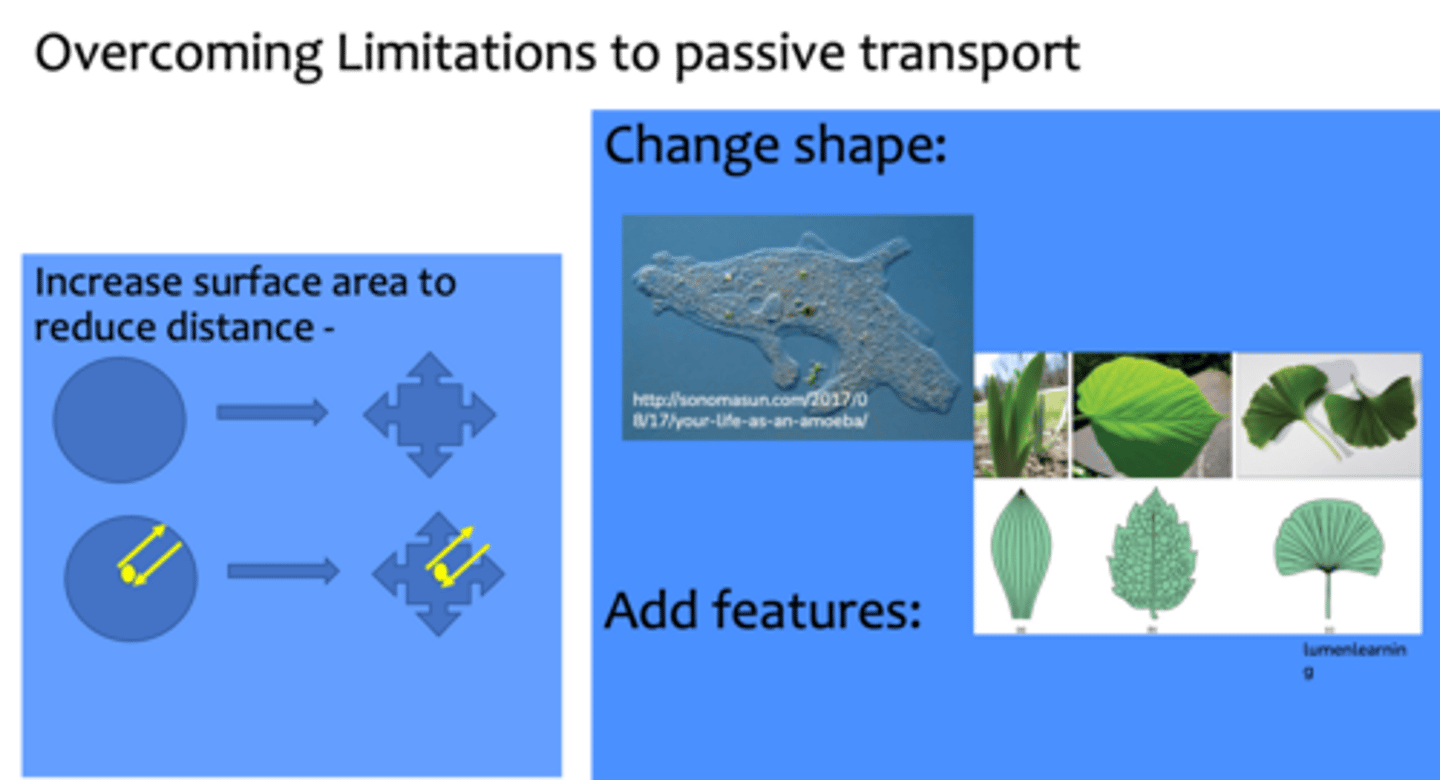
overcoming limitations to passive transport
increase surface area to reduce distance- change shape and add features.
multi-cellularity response
specialisation.
delivery systems needed for:
oxygen
nutirents
water/ion balance
temperature
specialised cells, tissues, needs.
leads to radiation ad expansion into different habitats
gas exchange
supply O2 and remove CO2.
limited by passive transport
partial pressure controls diffusion rate thus controls rate of gas exchange.
small aquatic organisms
Cutaneous respiration allows gas exchange across skin
Examples: Sponges and Cnidaria Nematodes Larval stages of many groups
most requirements for gas exchange met across skin.
cutaneous respiration
thin and small- all gas exchange through surface.
reaches limit as growth occurs.
bigger, more organs and tissue develop . mouth develops and carnivores looking for prey so require more oxygen
internal organs develop- gills and circulatory system. this takes over cutaneous respiration.
gills
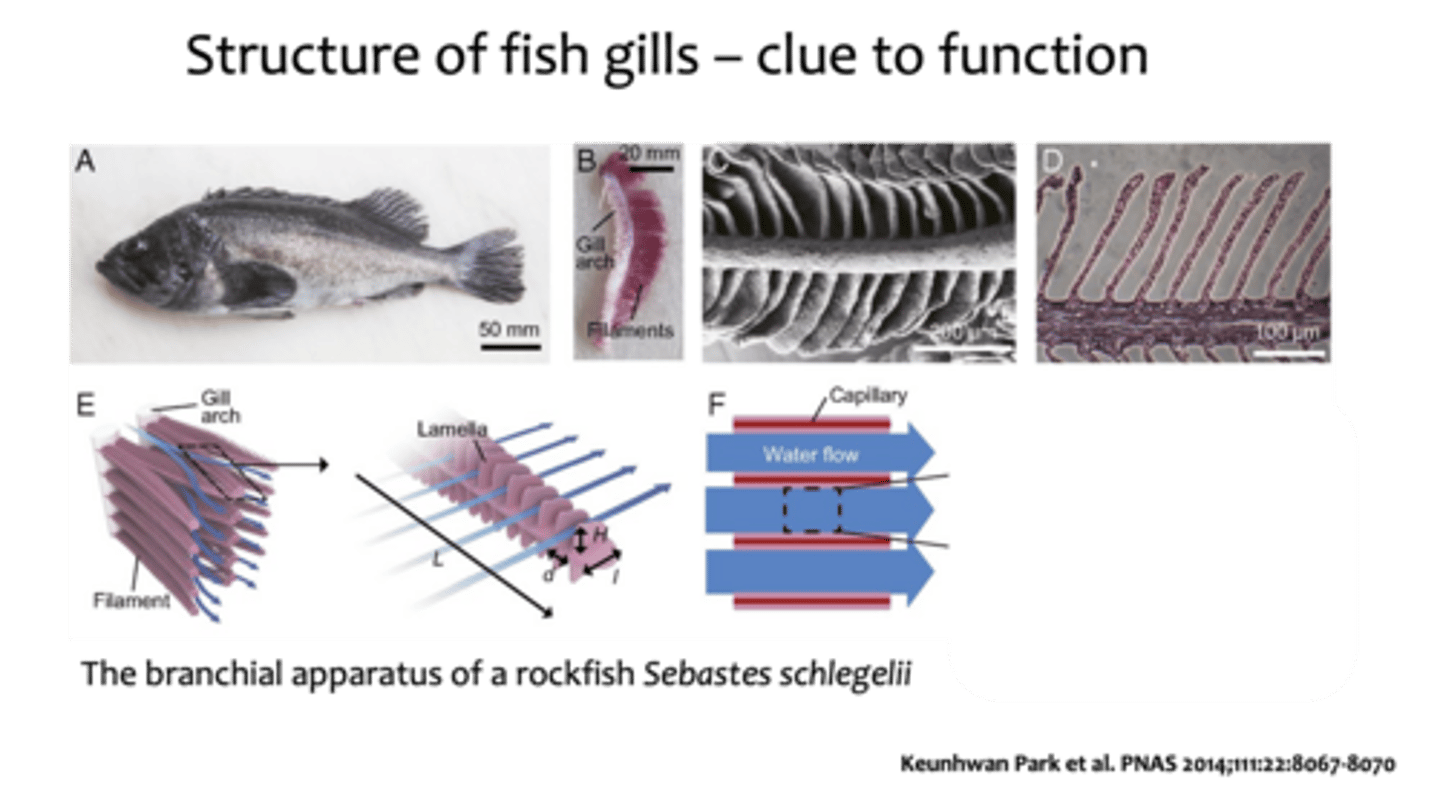
found in many animal groups. large surface area with short diffusion distances.

structure of gills
The branchial apparatus of a rockfish Sebastes schlegelii.
(A) Sebastes schlegelii having gills on both sides of the pharynx.
(B) The gill arch and filaments.
(C) SEM image of a gill filament.
(D) H&E-stained cross-section of a gill filament.
(E) A schematic illustration of gill morphology. Plate-like filaments hanging on branchial arches are covered with lamellae enclosing a blood capillary network. The blue arrows indicate the direction of water flow from the gill arches to the operculum. The well-ordered lamellar structures provide arrays of microchannels where oxygen diffuses to the capillaries.
(F) A schematic illustration of the top view of the interlamellar channels.
Explain the constraints of body size and multicellularity for gas exchange.
The Diffusion Limit: Oxygen can only diffuse effectively over very short distances (about 0.5 mm in many tissues).
Surface Area to Volume (SA:V) Ratio: As an organism grows, its volume increases much faster than its surface area. A large, solid multicellular body lacks enough surface area to provide oxygen to all its internal cells through the skin alone.
The Solution: This constraint forces larger organisms to develop specialised surfaces (gills, lungs) and transport systems (blood) to overcome the distance between the environment and the internal cells.
Hb proteins
chordata, echinodermata have haemoglobin
athropods and molluscs have haemocyanin
plants have myoglobin
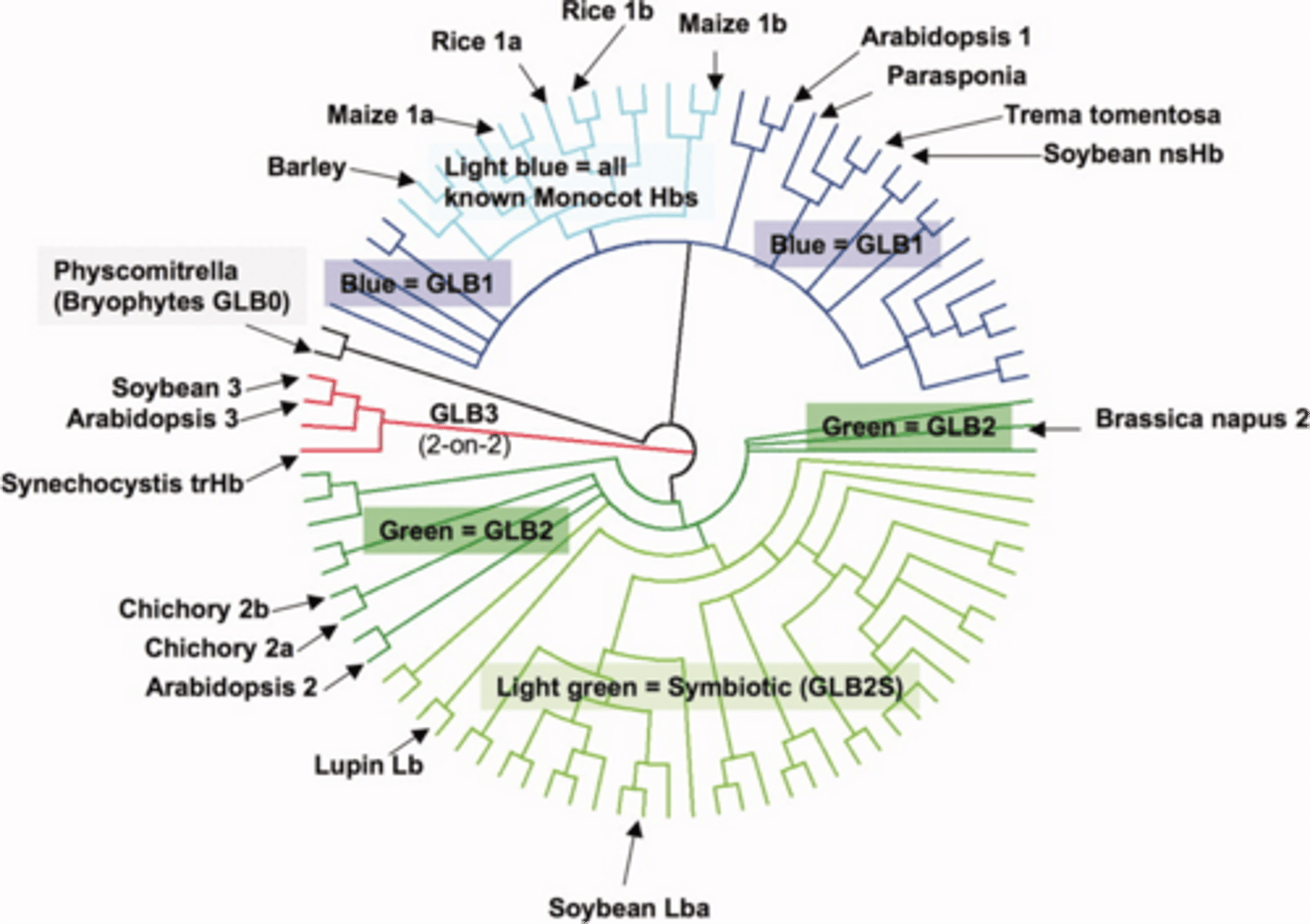
plant haemoglobin
Plant hemoglobin protein sequences group generally into three classes or clades and perhaps a fourth.
Recall the main features of respiratory organs in different animal groups
Large Surface Area: Extensive folding (like the lamellae in gills or alveoli in lungs) provides more space for gas exchange.
Thin Barriers: The distance between the air/water and the blood is kept to a minimum to facilitate rapid diffusion.
Moist Surfaces: Oxygen and CO2 must be dissolved in water to cross biological membranes.
Vascularisation: A dense network of capillaries is needed to carry gases away from the respiratory surface quickly.
Compare and discuss the modifications (adaptations) for gas exchange in different animal groups, and contrast across a wider range of taxa.
Invertebrates/Small Organisms: Many rely on simple diffusion across the body surface (e.g., flatworms).
Insects: Use a Tracheal System, a network of tubes that delivers air directly to every cell in the body, bypassing the need for a circulatory system for gas transport.
Fish (Gills): Use a counter-current exchange mechanism where blood flows in the opposite direction of water to maintain a constant diffusion gradient, extracting up to 80% of available oxygen.
Mammals (Lungs): Utilise tidal ventilation with millions of tiny sacs (alveoli) to create a massive internal surface area for exchange with the blood.