Anthropology 100 Final Exam
 Studied by 6 people
 Call Kai
 Learn
Learn Practice Test
 Spaced Repetition
 Match
Match Flashcards
 Knowt Play
1/106

There's no tags or description
Looks like no tags are added yet.
Name | Mastery | Learn | Test | Matching | Spaced |
|---|
No study sessions yet.
107 Terms
Victor Ríos
Theories: The Youth Control Complex;
Racialized Punitive Social Control; and
Cultural Misframing
• Coined term, “at-promise youth” to move
away from “at-risk youth.”
Cultural Anthropology
A set of methods and analytical tools that examine
how people make and find meaning in different social environments
Cultural Anthropology centers…
People’s everyday experiences in order to
understand what social relations look like in different places and periods of
time
Factors that change social relations over time
• Natural environment
• Access to resources
• Geography
• Political system
• Economic system
Culture
Exists as a set of social relations
Something that people create
Changes under different
circumstances
What does cultural anthropology try to understand?
• How people make sense of what is
happening to them
• How their actions are shaped by the
people and environments that
surround them
Define culture
The specific arrangement of human social relations in a given moment—the
norms and/or rules that shape how people make decisions and interact with each
other. Can change over time and space.
Claude Lévi-Strauss
Social facts” and comparative
ethnology
Asked: Should anthropologists view the people they study (their ways of life) in terms of how different they are from the society of the anthropologist (tended to be from North America and Europe)
Who wrote Body Ritual among the Nacirema (1956)
Horace Miner
Edward Burnett Tylor
• Primitive Culture (1871)
• “The Science of Culture” Essay
• President of Royal Anthropological
Institute
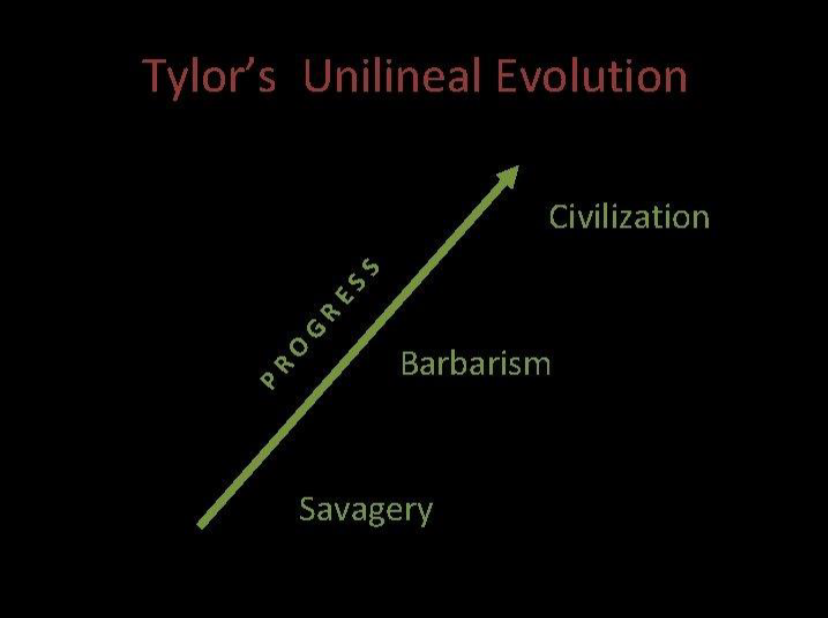
What is the unilineal evolution model and who created it?,
It is described as a set sequence of stages that all
groups will pass through at some point, although the pace of progress through these stages will vary greatly. Groups, both past and present, that are at the same level or stage of development were considered nearly identical. It was created by EB Tylor
Who developed cultural relativism and the theory of cultural diffusion?
Franz Boas
What is cultural relativism (comparative ethnography)
The idea that cultural values, practices and beliefs should be understood in their own cultural context and from the perspective of insiders rather than from standards of an outsider perspective
What did Bronislaw Malinowski do
Founder of functionalism and pioneered the ethnographic method of long-term participant observation
What is Participant Observation and who pioneered it
Being a part of a social situation and observing
it at the same time. Produces ‘situated knowledge’ – different from objective knowledge (Allows the anthropologist to develop an understanding of the
multiple meanings and layers behind people’s speech and actions); pioneered by Bronislaw Malinowsk
What is functionalism?
Components of a society
serve a job and together they make the society operate
The Kula Ring function
Sustain social relationships and to heighten an individual’s status in society and provide people with resources they can’t find on their own islands.
Who wrote Coming of Age in Samoa?
Margaret Mead
Emic
The frames and explanations the research subject(s) would use to make sense of what’s happening to them
Etic
The frames and explanations the researcher would use to make sense of what’s happening to the research subject(s)
Who termed Thick Description and what is it?
Clifford Geertz; Explains: Behavior, events, what’s being said AND Environment in which it occurs and your interpretation of it
What is Objective knowledge?
An analysis (based on observed and recorded data) that can be reproduced no matter who is observing.
Main data collection tools used by anthropologists
Participant Observation, Fieldnotes, and Interviews
Zora Neale Hurston
Documented lives of Black peoples in the
American South and Caribbean, including
Haiti through fieldwork: Collecting folk
tales from interlocutors- first to conduct ethnographic research on the African American community through an emic approach
Interlocutors
People whose lives we both observe and become a part of in anthropological study
Colonialism
The conquest of people followed by the creation of an organization controlled by members of the conquering polity and suited to rule over the conquered territory’s population
Coloniality
a long-standing patterns of power that emerged as a
result of colonialism, but that define culture, labour, intersubjective relations, and knowledge production well beyond the strict limits of colonial administrations
Who called colonialism a total project
Frantz Fanon- psychologist of colonialism
What is meant when calling colonialism a total project
It is a project that does not leave any part of the human person and its reality untouched
Who termed orientalism
Edward Said
What is orientalism
Knowledge about the so-called East has been
developed, and why these knowledge practices become both the pretext for colonialism and neocolonialism in the region, assumes that certain societies are predisposed to
despotism and cannot undertake self-government
Who wrote The Colonial Harem?
Malek Alloula
Phantasm
A figment of the imagination; an illusion; an apparition; a product of fantasy
Why Land Acknowledgments Matter
Recognizes the truth of settler colonialism, recognizes the truth of Indigenous people’s histories and present.- Chip Colwell
Harlemworld: Doing Race and Class in Contemporary Black America
Ethnographic analysis of African American
experiences of identity in everyday life in Harlem, New York
What is racialization?
Takes one’s racial classification as a pretext for what kinds of access they get to rights, resources, recognition, etc.
Who studied the Beginnings of Human
Classification and laid the groundwork for racial classification
Carl Linnaeus
Who wrote The Souls of Black Folk, Of Our
Spiritual Strivings and the term double consciousness?
Du Bois
What is a Soul in Du Bois terms
A consciousness; an awareness of self; something that makes us feel complete
What were some concepts from Du Bois Of Our Spiritual Striving
Double consciousness
Color Line
Veil
Agency
The capacity to make decisions
Structure
Norms and values that operate together to
regulate human behavior in society
Lila Abu-Lughod
Studied women’s human rights globally and liberal feminism’s interest in the Muslim world
Abu-Lughod’s argument
Intellectuals, feminist advocates, and policymakers in the West have reduced these problems to stories about the veil/burqa, and women’s clothing
More about contextual relativism – idea that different contexts have different experiences of oppression
Liberalism
A set of ideas and philosophies, and political, social, and economic practices and orders that are rooted in a commitment to individual freedom, equality before the law, and consent to being governed
Islamism
Political framework that believes Islam has a role to play in the organization of society and politics. Different strands of Islamism in different societies
Piety/Virtue
Cultivation of a moral and ethical self, oftentimes involving spiritual and religious devotion
Cultivate
Consciously working at
Discursive tradition
A set of beliefs and practices that, while rooted in a set of principles, are also being reworked and modified through debates and dialogues within texts and conversation over time and across different contexts
Comportment
outward behavior in social settings
Saba Mahmood
Participant observation of and interviews with women who took part in teaching and studying Islamic scripture (Qur’anic exegesis) who were part of what was known as the da’wa movement (Islamic Revival movement
Cultural relativism, by
contrast, says that people’s choices are structured by unchanging
beliefs and ways of life, and that cultures existed as bounded wholes
that do not influence each other
Structural Violence
Violence exerted systematically—indirectly—by everyone who belongs to a certain social order- Farmer
Social Order
system of structures that work together to maintain a
certain status quo
Who coined Obstetric Racism and what is it?
Dána-Ain Davis; The various forms of harm
to which racialized women are exposed during pregnancy, birth, and postpartum because of racial injustice
Iatrogenic
Relating to illness caused by a medical examination or treatment
K. Eliza Williamson
Demonstrate the intersections of obstetric violence, iatrogenesis, and structural racism that remain deeply embedded in Brazil’s health system, despite efforts to ‘humanise’ birth
Social Iatrogenesis
Harm caused by the way society is organized that
end up fostering ill health and a lack of autonomy over one’s healthIatrogenic harms include racist violence that converge upon pregnant and birthing people as well as their kin
Necropolitics
How the institution that is in power actually ends up fostering the destruction of life and populations
Judith Butler
Critical theory, gender, continental philosophy
Feminism and the Subversion of Identity, “Subjects of Sex/Gender/Desire”
Rejecting Universals and Moving beyond the Gender Binary
Sex
Socially and historically constructed
Gender Binary
The idea of categorizing people with certain anatomical structures as male and people with certain anatomies as female is a particular choice society made. It is an act of categorization that centres reproductivity as an organizing principle
Gender identity
Constant repetition of gender acts that work together over time
Heteronormativity
A mode of organizing in which sexuality is strictly procreative and aligns biological sex, gender identity, gender expression, gender roles, and sexual orientation, within a gender and sex-binary schema
Two-Spirit
Focus is less on their sexuality and more on their spiritual gifts. Androgynous and transgender people seen as doubly capacious, with both masculine and feminine spirits
Valued for their capacities around liaising with extended families and communities due to their ability to traverse masculine and feminine worlds
Hijras
Born anatomically male, and transform through a number of gender performances
The Body in Pain (1985)
Elaine Scarry
Agency and Pain: An Exploration”
Talal Asad
Different Kind of ‘Opioid Crisis’: The Global South’s Epidemic of Unpalliated Pain
Zahra Hayat
Geopolitics of Palliation
• Thinking Pain Beyond the Body and the Clinic
• Narcotic Control Regimes: Fear of ‘Diversion’
Criminalization
Process by which styles and behaviors are
rendered deviant and treated with shame, exclusion, punishment, and incarceration. In this study, criminalization occurred beyond the law- Victor Ríos
Youth control complex
System of ubiquitous criminalization in
which “schools, police, probation officers, families, community centers, the media, businesses, and other institutions systematically treat young people’s everyday behaviors as criminal activity- Victor Ríos
Punitive social control
The techniques by which the youth control complex regulates the lives of marginalized young people- Victor Ríos
Hypercriminalization
the process by which an individual’s everyday behaviors and styles become ubiquitously treated as deviant, risky, threatening, or criminal, across social contexts- Victor Ríos
Victor Ríos’s argument
Criminalization was a central, pervasive, and ubiquitous phenomenon that impacted the everyday lives of the young people I studied in Oakland
Resistance in the form of ‘social deviance’ → a sense of dignity and empowerment
Webs of punishment sustained by:
• Teachers
• Police themselves who would play a ‘cat-and-mouse’ game with
youth
• Parents
• Probation Officers
• Community workers
Resistance Identities
• Excluding the excluder
• Practices that embrace criminality as a way of speaking back to a system that always
sees them as criminals anyway
Infrapolitics
• Everyday acts of resistance
• Invisible, tactical ways that oppressed groups evade power while
making it seem like they are following the rules/not technically breaking any official rules
• Conversations
• Jokes
• Songs
Who wrote Discipline and Punish: The Birth of the Prison
Michel Foucault
Sovereign Power (Dominant in 17th century)
Ultimate locus of power
Disciplinary Power (Anatamopolitics) (Dominant in 18th century)
Disciplining the individual body
Biopower: (Dominant in 19th, 20th centuries)
Focus more on governing a population ; and protecting the population from the deviant individual
Power is no longer destructive, but generative - life of the population
Biopolitics- Michel Foucault
Governance of the life of the population, exerted both through the management of the vitality and health of the population and the techniques of the body that serve to promote the health and the vitality of the population
The use of power (governance) to administer, optimize, and
multiply human life
Spaces in which Biopower is central
• Army ; Schools; Apprenticeship ; Education ; Hospitals; The prison
• New fields of expertise emerge around: Birthrates, longevity, public health, housing, and migration, crimes
The Panopticon
A model of complete surveillance that Foucault uses as a metaphor
What did Foucault theorize?
Disciplinary power, argues that uncertainty produces self-regulation and internalized control
Yarimar Bonilla
Anti-colonial movements in French Caribbean
Disaster capitalism and post-disaster management in Puerto
RicoThe role of digital activism in Black Lives Matter
Marisol LeBrón
Social inequality, policing, violence, and protest
Aftermath of Hurricane Maria an example of
• How natural disasters have long-lasting consequences
• Continue to affect people’s lives
• There is no linear timeline of disaster and recovery
• Natural disasters are cumulative and ongoing.
• The return to ‘normal’ never comes
1951 UN Refugee Convention defines a refugee as
“someone who is unable or unwilling to return to
their country of origin owing to a well-founded fear
of being persecuted for reasons of race, religion,
nationality, membership of a particular social
group, or political opinion.”
What are the 2 things LGBTQ+ refugees must prove
1. They are really LGBTQ+ (“membership of a particular group”)
2. They faced persecution due to their LGBTQ+ identities (“well- founded fear of persecution)
What is language
A shared and emergent system of signs used
to create and communicate meanings
Daniela Belen Miranda
CULTIVATION OF TRANSGENIC SOYBEANS- ARGENTINA
Structural violence and body/territory sovereignty
Understanding their bodies as embedded
and entangled with the territory
PONER EL CUERPO
Embodiement, risk and commitment
No Sabo Kid
misconjugation of irregular verb saber (to know)- targeted at Latinx diasporic youth in the US
What does No Sabo Kid propose
• Conflation of race, nationality, ethnicity
• Fundamental issue:
⚬ NSKs don’t know the terms of
belonging
What is meant by “Waiting is not simply a bureaucratic ore technical delay—it’s a form of control; a technology of power”
Making someone wait—especially without knowing how long they will wait—is a manifestation of power and sovereignty. It exerts control over people’s mobilities, lives, dreams, desires, and plans. Migrants are excluded from goal and future-oriented temporalities; they are forced to live in a continuous repetition of the same routines, often deprived of a sense of directionality, meaning, or purpose
Who studied Haitian Revolution
Paul Farmer
Who wrote Ethnographic analysis of African American experiences of identity in everyday life in Harlem, New York?
John L. Jackson, Jr
The Colonial Harem
“Symbolic revenge” on a society that denied them access
Postcards are a phantasm - a figment of the imagination/an illusion