IB HL Psychology - Learning and Cognition
 Call Kai
 Learn
Learn Practice Test
 Spaced Repetition
 Match
Match Flashcards
 Knowt Play
1/107

There's no tags or description
Looks like no tags are added yet.
Name | Mastery | Learn | Test | Matching | Spaced | Call with Kai | Chat |
|---|
No analytics yet
Send a link to your students to track their progress
108 Terms
What type of process is memory
A cognitive process
Memory
the ability to retain information or a representation of past experiences based on the mental process of learning or encoding (process), retention (process) across some time interval and memory retrieval (process)
3 stages of memory
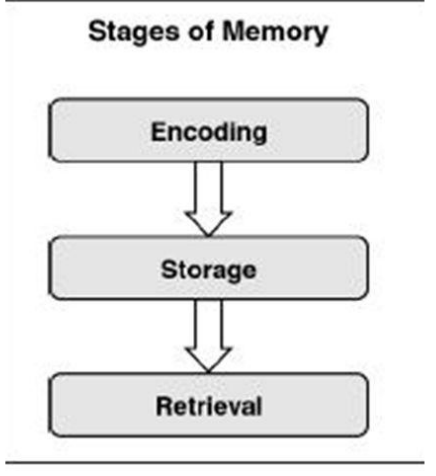
Encoding (1st step)
allows item of interest to be changed to construct that can be stored (mentally processing)
Storage (2nd step)
holding info for period of time in short or long term memory depending on the importance, attitude or experience
Retrieval (3rd step)
accessing or recalling memories when needed
Types of memory
STM
LTM
Semantic memory
Episodic memory
Procedural memory
Perceptual memory
STM/Working memory model (WMM)
STM is a system for storing information for short periods of time
see STM as a temporary storage depot for incoming information before being forgotten or stored in LTM
If sensory info is recognized or considered important, it is coded + sent to STM
STM capacity
has limited capacity → supposed to last only 15 - 30 seconds
LTM
If info is rehearsed, it is transferred into LTM → unlimited capacity → may last forever
However, when we appear to have forgotten → can be due to problems with retrieval
Semantic memory
factual + general knowledge → e.g. the capital of China is Beijing
Episodic memory
autobiographical memories → e.g. graduation day, memories of childhood events, or personal encounters
Procedural memory
perform skills + actions → automatic + unconscious -→once
learned, you can perform the skill without actively thinking about each
step → e.g. riding a bike
Perceptual memory
helps you recognize things based on sensory input → often without conscious effort
What makes models useful
clear framework for understanding parts of a system
easily categorises observations
breaks complex concepts into small parts that may be easier to study
Multi-store memory model (MSM)
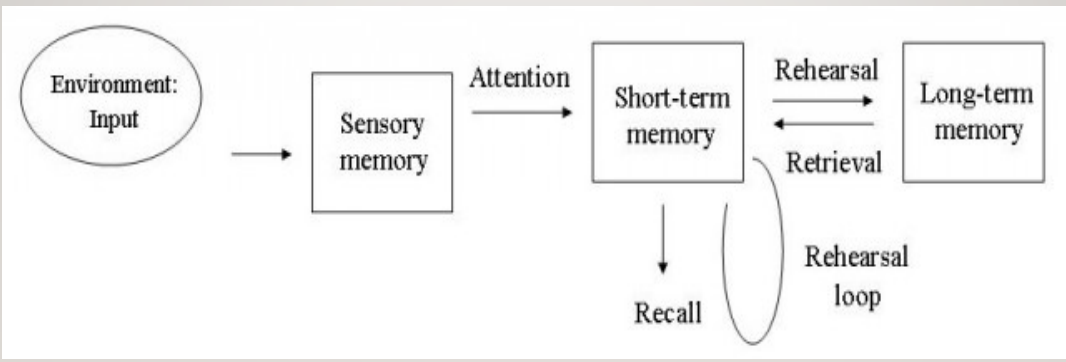
MSM process
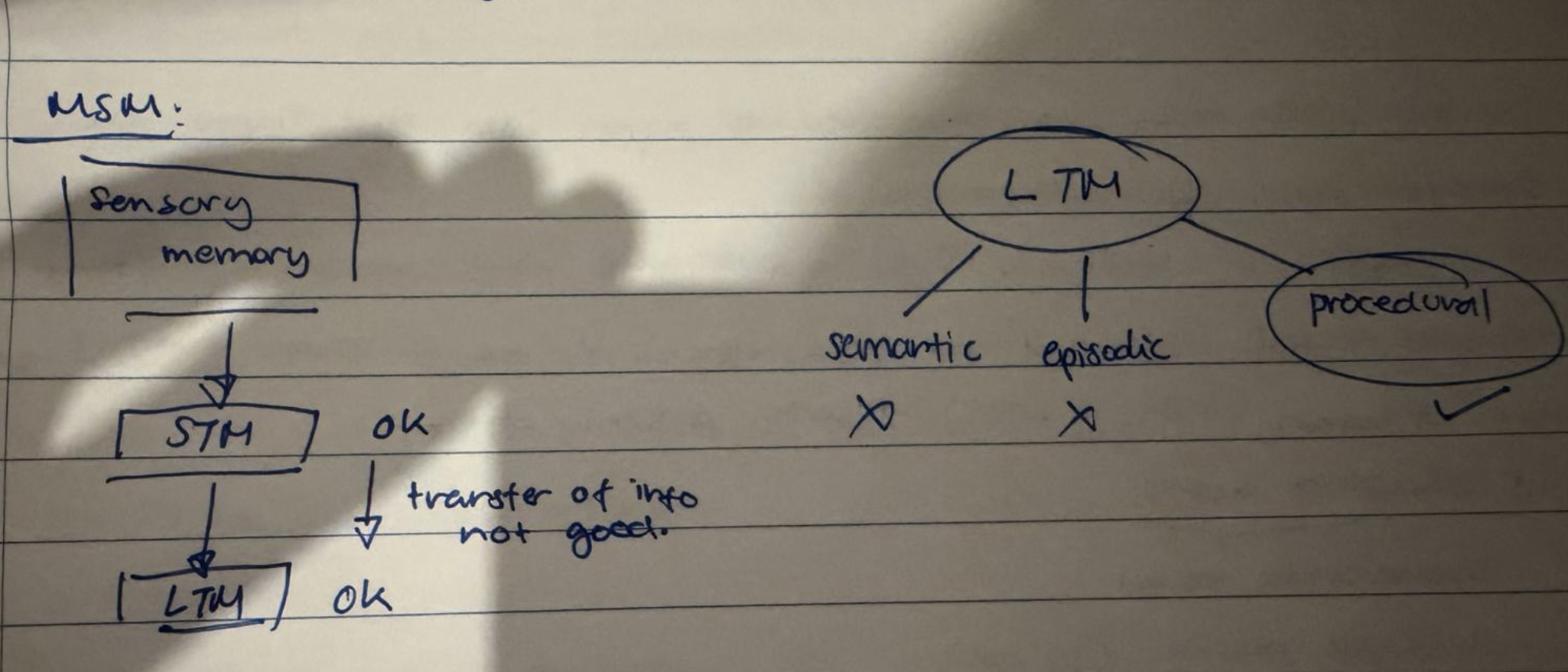
According to MSM, info travels from sensory memory through STM to LTM. Rehearsal (mental repetition of the stimulus) is the main means of transferring information into LTM → stored indefinitely. However, not all info that is stored in LTM is easily retrievable.
MSM assumptions
model argues that memory consists of a no. of separate location in which info is stored (1. sensory memory 2. STM 3. LTM)
memory processes are sequential
each memory store operate in a single, uniform way
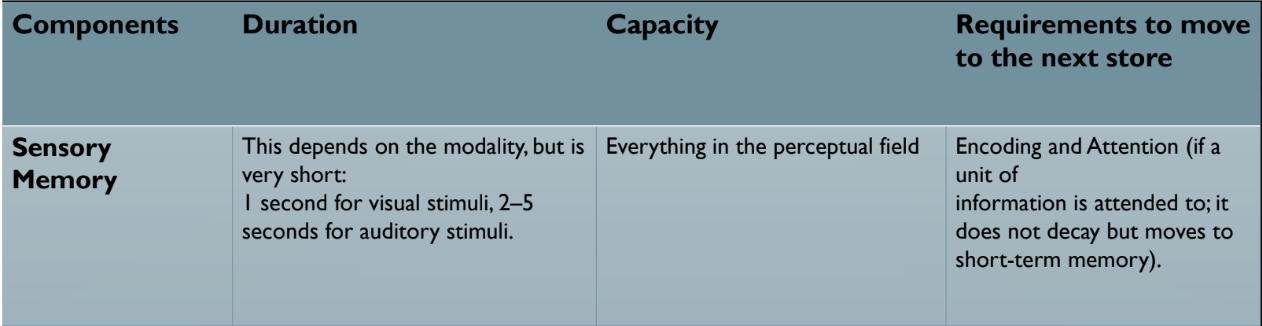
Sensory memory
When we are paying attention and may lead to a memory trace
Sensory memory (duration, capacity and requirements to move to the next store)
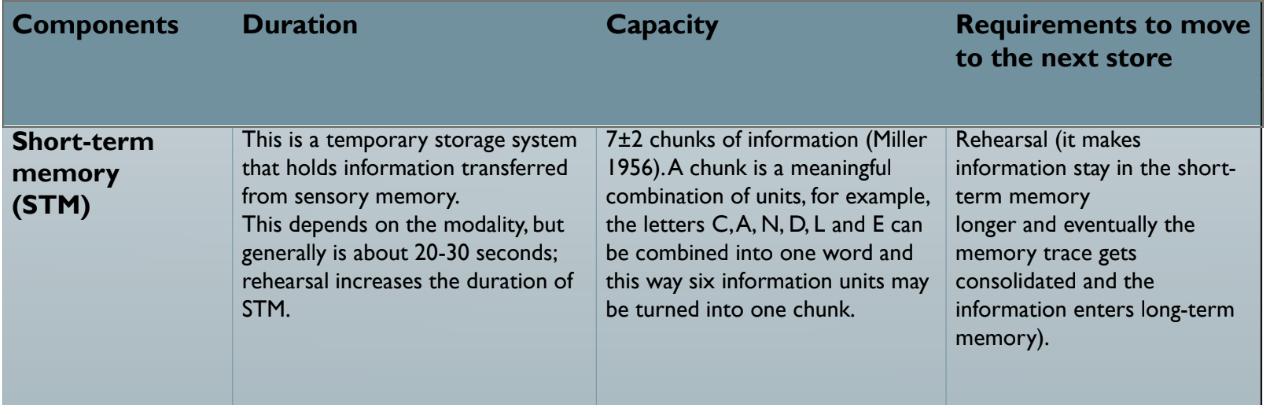
STM (duration, capacity and requirements to move to the next store)
LTM (duration, capacity and requirements to move to the next store)

Miller’s magic no.
7±2 items
Miller’s magic no. 7
MSM argues that STM is limited in both capacity + duration → a limited amount of info can be held in STM for a limited amount of time
After tests seeing how many no. an individual can recall in a sequence of numbers, Miller (1956) proposed the "Magic Number 7" ±2
However Miller suggested that we can use “chunking” in order to remember more info (this has to be meaningful)
Chunking memory
groups separate pieces of info into larger, meaningful units
Case study - HM
provides a strong evidence for the distinction between STM + LTM proposed by MSM
HM underwent brain surgery to reduce severe epilepsy, during which hippocampus were removed
Following surgery, HM developed profound anterograde amnesia + was unable to form new LT memories
However, STM remined largely intact, as he could hold information for short periods if he wasn’t distracted
Clear separation between STM + LTM, hence supporting that they were separate memory stores as suggested by MSM
HM’s MSM
gave deeper understanding of memory than MSM can explain
although he couldn’t create new semantic + episodic memories, he could still create + retrieve procedural memories
Research supporting MSM
Serial position effect
HM case study
Serial position effect
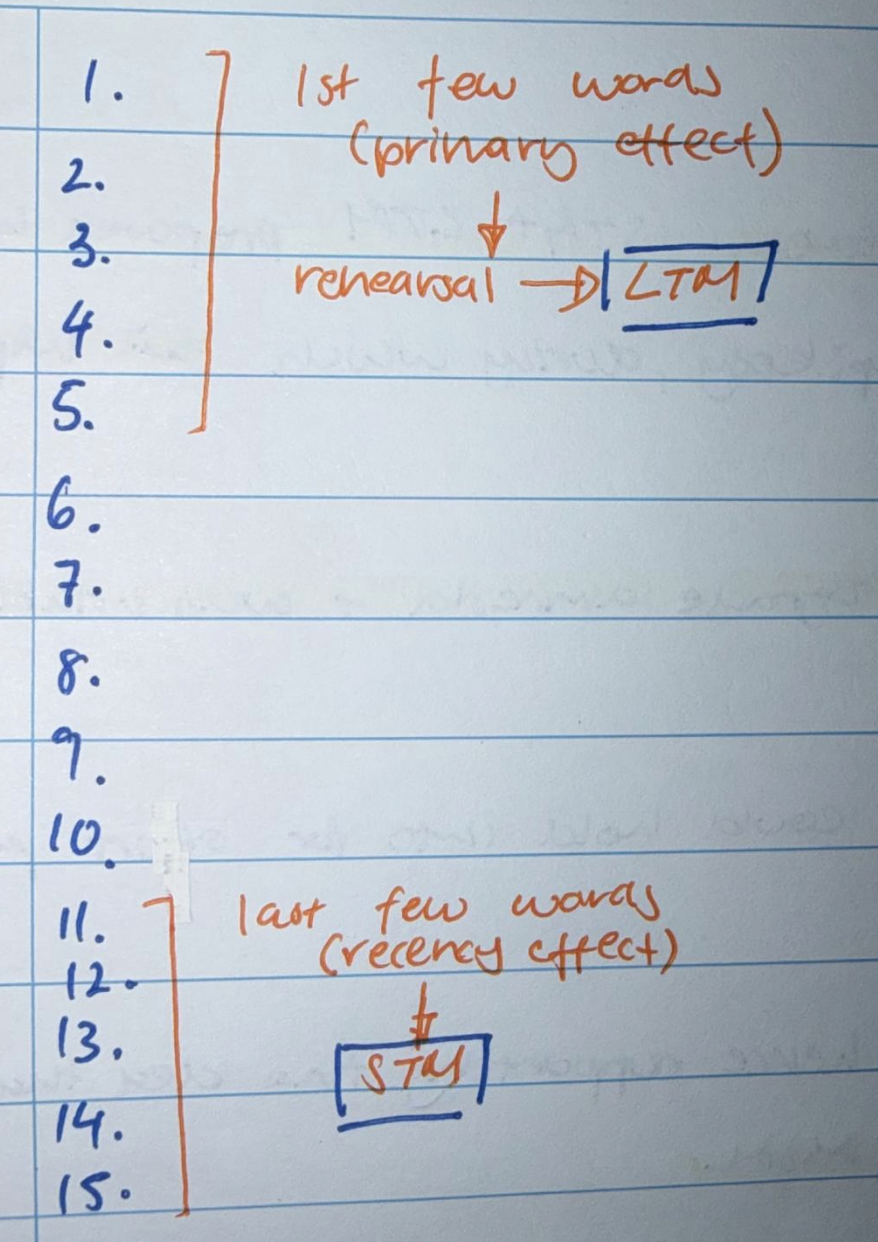
cognitive phenomenon where people tend to remember the first (primacy) and last (recency) items in a series of items → when asked to recall a list of items in any order people tend to begin recall with the end of the list, recalling those items best → known as recency effect → among earlier list items, the first few items are recalled more frequently than the middle items → known as the primacy effect → shows separate stores for LTM and STM
Glanzer and Cunitz (1966)
investigate the way the position of words can influence recall (focused on the recency effect) → see if there are 2 separate memory stores (STM + LTM) → serial positioning effect
Glanzer and Cunitz (1966) conditions
Immediate recall
Delayed recall (10 seconds)
Delayed recall (30 seconds)
Glanzer and Cunitz (1966) results
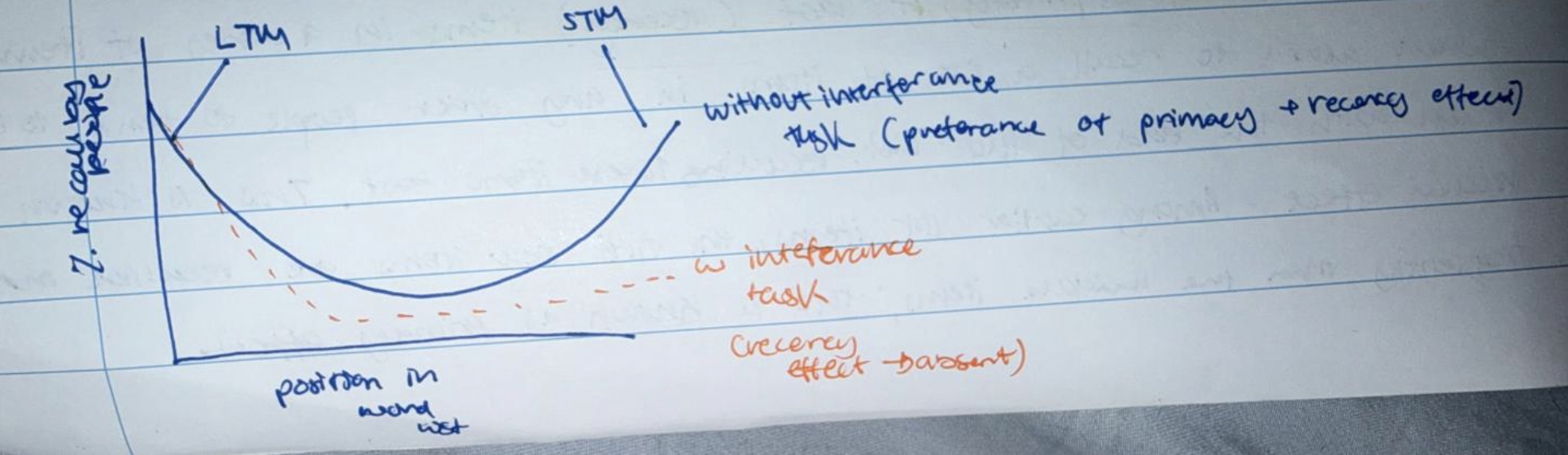
Delaying recall by 30 seconds destroys the recency effect causing recall of later words to be similar to the ones in the middle, however it does not influence primacy effect
Suggests that later words were held in STM → were lost due to interference whereas the earlier words had been passed to LTM
How Glanzer and Cunitz (1966) supports MSM
As Ps hear words on the list 1 by 1, they may start rehearsing them sub - vocally. As they are getting closer to the middle of the list, it becomes impossible to repeat all the words, so the 1st words on the list are repeated more often → enter LTM → why primacy effect does not disappear even after the interference task
The researcher observed primacy effect in all of the conditions. However, when the distractor task was introduced the recency effect disappeare
Shows that rehearsal is necessary for memory to be transferred from STM to LTM. The distractor task didn’t allow Ps to rehearse the words, so they were displaced from STM
Hence this supports MSM that there are 2 separate stores (STM + LTM) in memory
Strength of Glanzer and Cunitz
conducted in a well-controlled lab experiment → causation conclusions to be drawn
Limitation of Glanzer and Cunitz
Lacks ecological validity because it was conducted in an artificial environment with highly controlled variables to study STM + LTM → therefore, it is difficult to generalize the findings beyond the study as it may not reflect how memory works in daily life
Why use a cognitive model
provide clear + simplified framework for explaining complex mental processes that cannot be observed directly
By breaking memory down into stages → e.g. input, processing + output, models help researchers generate testable hypotheses + design experiments
allow comparisons between typical + atypical functioning → e.g. memory impairments → helps improve understanding of how memory works in both healthy + damaged brains
MSM’s strengths
Offers a clear structured explanation of memory, which made it highly influential + easy to understand that has stimulated a lot of research
useful in real-world applications → e.g. improving learning strategies by highlighting the importance of rehearsal in transferring info to LTM
MSM’s limitations
oversimplifies memory by assuming STM + LTM are each single, unitary stores → which research has shown the LTM consist of different types of memory (episodic, semantic and procedural) → not explained in MSM
over-emphasizes one-way linear flow of info → there is evidence to suggest that info flows backwards from LTM to STM and/or the sensory store → therefore the flow of info should perhaps be interactive rather than sequential
emphasized on maintenance rehearsal as the main method for transferring info into STM into LTM → some research suggest that elaborative rehearsal is more effective
doesn’t explain the role of emotion in the creation of memory
doesn’t explain how memory is distorted, as we often see in eye witness testimonies
What is schema
used to organise our knowledge, to assist recall, to guide our behaviour, to predict what to expect + to help us to make sense of current experiences
Schemas are cognitive structures that are derived from prior experience and knowledge.
process + organize large amounts of info swiftly + economically
What is schema pt2.
Referred to as “pockets of knowledge” as they are a way of enabling us to orientate around our environments in a more cognitively economic way
simplify the world because they, help us interpret new information based on what we already know
help with retrieving consistent info → enable the individual to know what to expect in social situations + help guide us
Schemas are mental shortcuts → AKA heurisitics
Shortfalls of schema
carries assumptions that leads to biases → based on pre-existing beliefs + values → e.g. stereotypes + confirmation bias
Assimilation
process of integrating new knowledge into existing schemas without changing the original schema too much
Accommodation
defined as an acquisition of knowledge or learning which challenged an existing schema → sometimes new info cannot be added to an existing schema → instead, we must create a new one
Scripts
Behavior patterns learned through our interaction with the environment → e.g. we have scripts for the appropriate way to eat a plate of spaghetti
Scripts are developed within a cultural context - they are not universal
Cognitive scripts
save time + energy by telling us how to behave or act in certain situations based on prior experiences or social observations → tell us how to behave at a meeting or throw a dinner party
Memory distortion in schema
Bartlett was among the 1st to argue that memory is not a passive process but an active retrieval. Instead, he argued that memory is reconstructed - in the act of retrieval, our memory is influenced by perception, imagination, motivation, semantic memory + belief
Since memories are only partially stored in our brains, we rely on past knowledge + schemas to reconstruct an experience/event
Bartlett (1932)
investigated how previous knowledge affects the memory of a story. He wanted to see if cultural background + unfamiliarity with a text would distort memory when the story is recalled
What did Bartlett (1932) do
told British Ps a Native American legend; “The war of the ghost”
1 of the techniques he used was serial reproduction → P A reads a story and then reproduces it to P B, who then reproduces it to P C, and so on until 6-7 reproductions have been created
A second technique used was repeated reproduction → Ps learns the material + recalls it repeatedly over various testing occasions → same person recalls the same story each time
NO SIGNIFICANT DIFFERENCE BETWEEN THE RESULTS OF THE TECHNIQUES
Bartlett (1932) results
Found 3 distortion patterns:
The story became more consistent with PS’ cultural expectations → details were unconsciously changed to fit the norms of British culture.
became shorter (omission of info) as it was seen as not important
changed the order of the story to make sense of it using terms more familiar to the PS' culture. They also added detail and/or emotions.
Link to schema
shown that we tend to remember information best when it is congruent with our schema → we remember info that matches what we already know + believe
When info is incongruent with our schema, there are 3 potential outcomes → shows higher tendency of memory distortion
we could assimilate the info into our current schema, adding to our understanding + knowledge
Soft determinism
the idea that I can change my behavior if I think differently.
Concept of change in schema
Schema theory argues that behaviors can be changed by assimilation or accommodation → the cognitive approach argues that behavior can be changed by changing how we think and/or process information
Called soft determinism - the idea that I can change my behavior if I think differently → directly contrasts with biological determinism, which argues that biological factors will determine my behavior and that this is mostly beyond my control → bio, cog, enviorn factors can influence out behaviour but we are also capable of making meaningful decisions
Evaluating schema theory
Causality is difficult to establish → it is only viewed as a correlational study
Depression (mental health)
Schema theory has been applied in abnormal psychology (therapy for depression + anxiety), relationships (theories of mate selection), → health psychology (health campaigns to change unhealthy behaviors)
Robust theory with many applications across many fields of psychology
Testable
Is testable → by priming one's schema, we are able to determine whether the schema helps or interferes with learning
Applications
been applied to help us understand how memory works → also helps us to understand memory distortion
been applied to explain a wide range of behaviours from dating to depression to art appreciation
Predictive validity
theory helps to predict behavior → e.g. predicting what types of info will be best recalled when given a list of words → trends → e.g omitting info not highly relevant to the individual, are commonly seen in individuals recalling a news story. However, we cannot predict exactly what a specific individual will recall.
Construct validity
Cohen (1993) argued that the concept of schema is too vague + hypothetical to be useful. Schema cannot be observed. Even the use of fMRI simply show brain activity, they do not clarify what exactly the individual is processing at the time → every individual has different schemas, hence base lines vary from person to person
General criticism of schema
not entirely clear how schemas are acquired in the first place + how they influence cognitive processes. It is not possible to actually observe schema processing taking place within the brain.
Conclusion on schema
Nevertheless, there is enough research to suggest schemas do affect how memory processes information, both in a positive + negative lens
They do simplify reality + help us to make sense of current experiences. Schemas are useful concepts in helping us understand how we organize our knowledge
Bias in psychology
As a field, psychology has traditionally shown a Western bias. Western psychology has developed tests for intelligence, memory, and problem-solving focused on the typical Western white middle- class experience. The application of these tests cross-culturally has often led to negative conclusions about the intelligence of other cultures + working-class people
Western psychologists believed that memory was a universal process and that everyone worldwide learned and remembered information in the same way. When tests were given to samples made up of people from non-Western cultures, they often did poorly
Culture bias
individualistic culture (go centric, less family oreintated)
collectivities culture (interdependence, group dynamics are highly focused on)
Wester psychologists
believed that memory was a universal process + that everyone worldwide learned and remembered information in the same way. When tests were given to samples made up of people from non-Western cultures, they often did poorly, why?
Culture influences memory by shaping what we pay attention to + how we interpret experience
Kearins (1981)
investigated how Indigenous children's spatial memory compared to white Australian children’s
Results from Kearins (1981)
Indigenous children correctly relocated more objects than did white Australian children → appears that their way of life significantly impacts how and what they remember
Why the Kearins (1981) is a quasi-experiment
pre-determined characteristics, cannot establish causality, data correlational
How Australian Indigenous children are enculturated
Indigenous Australian children are introduced to wayfinding techniques from a young age. As they accompany adults on journeys, they learn to navigate their way using natural landmarks. This practice enhances their spatial memory and ability to use mental maps.
Indigenous Australian languages use fundamental directions (N, S, E, W) instead of terms like left or right to describe locations. This means that speakers are continuously aware of directionality
deep knowledge of the night sky + use it for navigation, ceremonies, and storytelling. Learning to read star-maps reinforces their spatial skills.
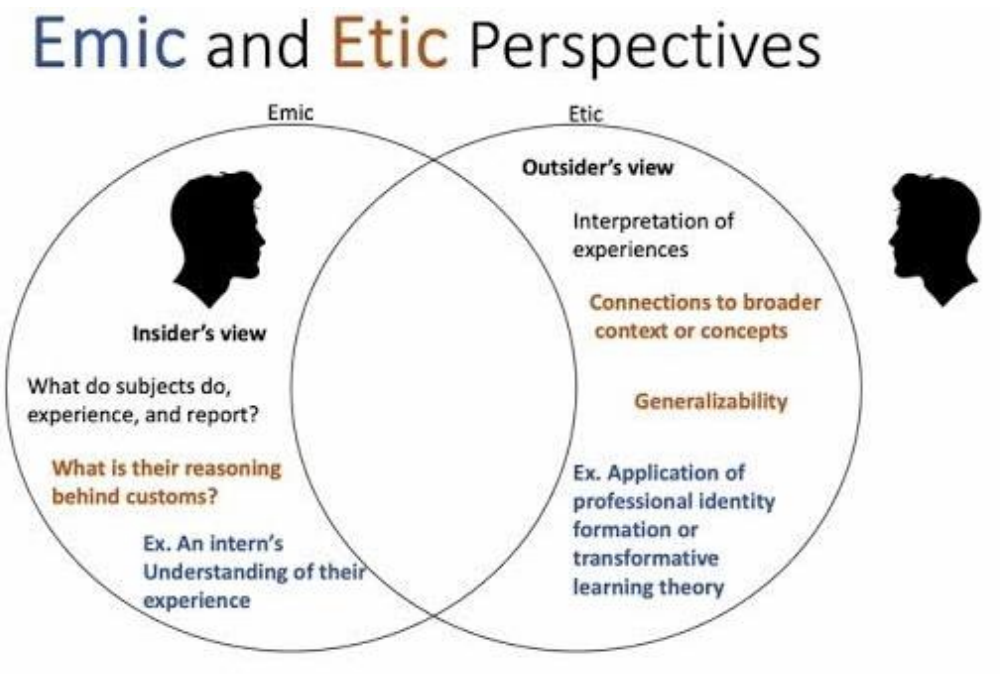
Etic approach (outsider POV)
Plans out research before arriving in the field
Applies their research findings globally; assumes that behaviors are universal
Uses standardized tests + theories from their own culture + applies them to the local people
Begins gathering data as soon as they arrive in the field
With the intention to generalize
Emic approach (insider POV)
Develops the research question after spending time with the local community
Applies their findings to the local community that is being investigated
Develops tests in consultation with local experts to apply to the community. Theories are generated after spending time within the culture
Collects data only after they are familiar with the local culture
Without intention to generalize
Advantages of etic approach
Allows researchers to compare behaviors, traits, or phenomena across different cultures using the same measures + criteria
Can help identify universal principles of human behavior that apply broadly across cultures
Uses standardized tools + methods with established reliability
From an external viewpoint, it may reduce cultural bias from within a single group
Disadvantages of etic approach
Risk of imposing external concepts that may not align with local beliefs, values, or practices
Behaviors may be misunderstood or taken out of context if local meanings are not considered
Findings may not accurately reflect real-life cultural situations if cultural context is ignored
May assume all cultures are similar enough to apply the same framework, which can lead to flawed conclusions.
Advantages of emic approach
The unique aspects of a culture, leading to deeper + more meaningful interpretations of behavior
Research findings are more likely to reflect real-world experiences and cultural realities
Reduces the risk of imposing the researcher's own cultural biases on the group being studied
Gives voice to individuals within the culture + acknowledges their worldview as valid and important.
Disadvantages of emic approach
Findings may only apply to the specific culture studied + not be relevant to others. Since methods and concepts are tailored to one culture, comparing results across cultures becomes challenging
Requires more time to carry out research. Requires deep immersion, language understanding, and cultural competence
Close involvement with the culture can lead to bias or over-identification with participants, reducing objectivity
Etic and emic POVs
How can ethnocentrism limit our understanding of memory?
Standardized memory tests + experimental designs may reflect Western cultural norms + values, thus failing to capture memory processes accurately in different cultural contexts → etic (w/o considering culture diverisity)
When researchers interpret data through an ethnocentric lens, they might misinterpret cultural differences in memory as cognitive deficits or anomalies
Ethnocentrism can hinder cross-cultural collaboration + exchange of ideas among researchers from different cultural backgrounds. A lack of cultural sensitivity can create barriers to meaningful dialogue + integration of diverse perspectives in psychological research
By prioritizing Western perspectives + marginalizing non-Western viewpoints, the field of psychology risks perpetuating cultural biases + inequalities
Ethnocentrism can lead to the creation of strategies that are less effective (treatment strategies) or even inappropriate for non-Western populations
Different cultures have unique ways of encoding, storing + retrieving memories, often influenced by social norms, practices + environmental factors. Ethnocentrism can cause researchers to overlook these diverse memory practices, resulting in a narrow understanding of memory
Positive environmental influences on 1 cognitive process
computers + digital tools have reshaped the educational landscape, offering unprecedented opportunities for interactive + personalized learning
Technology can influence memory, a key cognitive process/human behaviour, by fostering deeper engagement + enhancing critical thinking, creativity + problem-solving skills.
Negative environmental influences on 1 cognitive process
However, as an environmental factor, its use in the classroom also presents challenges → e.g. digital distraction, unequal access + risk of information overload → info overload when you’re exposed to more info than your cognitive system can manage - cognitive overload → STM becomes overstimulated → may negatively impact how effectively information is encoded + retained
Environmental effects on memory
Many environmental factors may affect our memory → e.g. tech may impair or improve our memory
role of smartphones, social media + Internet on our memory capacity is highly debated
Transactive memory
suggested that transactive memory systems have always existed. We know where information can be found → e.g. who knows what + how to access it. We often see this type of memory in relationships → helps us in cognitive offloading due to cognitive overload
If you are like most people, there are some things that you do not remember but that you rely on others to recall
Cognitive load
the total amount of mental effort used in the working memory
What is cognitive load theory
argues that human have limited working memory capacity → info overload occurs if they are presented with information that exceeds this capacity
Sana et al (2013)
to see how increasing cognitive load by asking students to multitask may compromise their performance
Sana et al (2013) experiment
C1 listened to the powerpoint
C2 was asked to solve problems whilst using their computers and listening to the lecture
Sana et al (2013) results
Students who multitasked → had a higher cognitive load, scored lower on a test of comprehension of the lecture. In the 2nd part of the study, they wanted to see what would happen if students didn't use social media in class but could see others using it during a lecture → shows that simply being able to see someone else using technology during a lecture is enough of a distraction to compromise student learning
Problems with measuring cognitive load (subjectivity)
Cognitive load varies from person to person + task to task. What might be mentally taxing for 1 individual might not be as challenging for another → makes it difficult to develop universal metrics for measuring cognitive load
Problems with measuring cognitive load (multiple components)
involves STM, attention + processing speed. These components interact in complex ways, making isolating + measuring each one challenging
Problems with measuring cognitive load (external loads)
Environmental factors → e.g. noise, distractions + stress can influence cognitive load → make it hard to attribute changes in cognitive load solely to the task at hand
Problems with measuring cognitive load (measurement techniques)
Common techniques for measuring cognitive load include self-report questionnaires, physiological measures → e.g. heart rate + performance-based measures →e.g. reaction time → each technique has limitations + may not capture the full complexity of cognitive load
Types of external loads
Intrinsic load
Extraneous load
Germane load
Intrinsic load
level of difficulty associated with a task (already have the information) → e.g. solving a calculus problem has a higher intrinsic cognitive load than simple arithmetic
Extraneous load
difficulty of the processing information due to the factors that are extraneous to the task → people talking while you are reading
Germane load
effort needed to process information in working memory → learning new info/schema → too high a cognitive load makes it difficult to move information from STM to LTM
Factors that increase cognitive load
complexity
difficulty
pressure
distractions
Positive of technology (environmental factor) and cognitive load
organizes information clearly → e,g, concept maps + interactive timelines
serves as transactional memory → it is a store for content knowledge so that we don’t have to remember anything
also known as cognitive offloading → can reduce mental effort + free up cognitive resources → can enhance efficiency, it may also lead to weaker memory retention for info we rely on technology to recall
chunks content into digestible formats → e.g. short videos
offers multimodal input → allows for dual coding, creating both visual + auditory memory traces for info → making it easier to recall in future
Negatives of technology (environmental factor) and cognitive load
presents too much information at once → e.g. cluttered slides, pop-up ads
distracts → e.g. notifications, multitasking
Poor design or overuse of animation, sounds + interactive features → adds extraneous load
rely on technology to find answers without processing or understanding them → does not help to build the background info that allows for better germane load → shallow processing
Google effect/digital amnesia
the tendency to forget information that is readily available through search engines → e.g. Google → do not commit this info to our memory because we know that this info is easy to access online
Goggle effect and transactive memory
can be applicable under transactive memory, but digital amnesia is DIGITAL
Causes of digital amnesia
We are better at remembering where info is stored + how to retrieve it than we are at remembering itself → proved to be a more effective mode of work
Relying on search engines + digital storage of info is often easier, faster, more efficient + convenient than relying on our own memory → frees up our cognitive resources
Conclusion
be aware of our tendency, identify situations that best fit our needs. We create a balance to get the good effects + minimize the risk