C2: The periodic Table
 Call Kai
 Learn
Learn Practice Test
 Spaced Repetition
 Match
Match Flashcards
 Knowt Play
1/29

There's no tags or description
Looks like no tags are added yet.
Name | Mastery | Learn | Test | Matching | Spaced | Call with Kai | Chat |
|---|
No analytics yet
Send a link to your students to track their progress
30 Terms
What ion are the metals on the periodic table?
The metals are positive ions
What ion are the non-metals on the periodic table?
The non-metal elements are negative ions.
What were the elements in the early periodic table ordered by?
They were ordered by atomic mass/weight.
What are the elements in the modern periodic table ordered by?
They're ordered by atomic/proton number
What is atomic mass?
The average mass of the isotopes of that element, taking into account their abundance in nature.
How do you calculate the atomic mass?
Mass1 x percentage1 + Mass2 x percentage2 = a
a/100 = percentage atomic mass
Who was Johann Dobereiner? What did he do with the periodic table?
The 1st. He is the oldest
He sorted elements in threes known as triads. The atomic weight of the middle element was half way between the other 2.
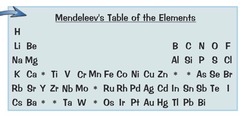
Who was Dmitri Mendeleev? What did he do with the periodic table?
2nd most RECENT.
Ordered the elements by atomic weight and periodic pattern with similar chemical properties and left gaps for undiscovered elements.
Who was Henry Moseley? What did he do with the periodic table?
Most RECENT.
Knowledge about protons and neutrons led to elements being sorted by atomic number and use of electron configuration to group elements.

Who was Joh Newlands? What did he do with the periodic table?
2nd to last OLDEST.
Noticed that every 8th element was similar but had to put 2 elements in a box to make the pattern work. Did not leave gaps for undiscovered elements. Placed the metal and non-metal elements together.

Why is it easier to lose electrons than to gain them for G1 elements?
Group 1 elements have 1 electron on the outer shell. It is easier to lose 1 electron (meaning full outer shell) than gaining 7 electrons (would also mean full outer shell)
List some properties of Group 1 metals.
Silvery coloured metals, soft (easy to cut with a knife), shiny surface (dulls with oxidation), highly reactive metals, reactivity increases down the group, low melting points and boiling points, low densities, closer similarity between the elements in the group than any other group of the periodic table.
metal + oxygen --> ?
metal oxide
lithium + water --> what observations?
fizzing - bubbles slowly, floating solid moving around slowly, solid dissolved
sodium + water --> what observations?
bubbles very slowly, melts into a ball, floats, moves very quickly
potassium + water --> what observations?
floats - moves on the surface very quickly, melts, spar and a lilac flame seen, fizzes/bubbles very quickly
alkali metal + water --> ?
alkali metal + water --> alkali metal hydroxide + hydrogen
All halogens are: (physical properties)
Non-metals, coloured, smelly and poisonous
All halogens exist as ___ What does ___ mean?
Halogens all exist as diatomic molecules. Diatomic means the elements need to be bonded to something else i.e. itself
Does the boiling/melting point get higher/lower down group 7 and why?
The boiling and melting points get higher down the group because the inter-molecular forces get stronger.
When halogens react: ?
They gain an electron (or lose one most likely to gain) --> halogen becomes halide e.g. fluorine --> fluoride
What happens going down group 7?
Bigger atoms, more shielding, greater distance between nucleus and outer shell, decrease in reactivity, increase in points, harder to gain an electron
Why is it harder to gain an electron going down group 7?
The electrostatic attraction is weaker for the electrons on the outermost shells - bigger distance between nucleus and outer shell, more shielding
What is displacement? (halogen terms)
If a halogen is added to a solution of a compound containing a less reactive halogen, it will react with the compound and form a new one.
The more reactive halogen...? Displacement
The more reactive halogen will push out the less reactive halogen from its compound
Name the physical properties of transition metals.
High melting points, high density, malleability, ductility, good conductivity of heat and electricity
Name the chemical properties of transition metals
Variable oxidation states, formation of coloured compounds, catalytic properties, complexion formation
Use of platinum and why
In catalytic converter because it has resistance to corrosion and catalytic properties
Uses of copper and why
Used for electrics and plumbing. Resists cutting forces of abrasives. Good conductivity + malleability
Uses of iron and why
Used in construction because of its strength + durability, high boiling point (3000C)