Bony Pathology & Joint Replacement of the Shoulder not done
 Call Kai
 Learn
Learn Practice Test
 Spaced Repetition
 Match
Match Flashcards
 Knowt Play
1/49

There's no tags or description
Looks like no tags are added yet.
Name | Mastery | Learn | Test | Matching | Spaced | Call with Kai | Chat |
|---|
No analytics yet
Send a link to your students to track their progress
50 Terms
True
TRUE or FALSE: The Majority (50-65%) of proximal humerus fractures are non-displaced/minimally displaced
- Greater tuberosity
- Lesser tuberosity
- Humeral head
- Humeral shaft
What are the 4 Neer Classifications for proximal humerus fractures
Additional screen for muscle/nerve/arterial structures
What is a consideration for screening proximal humerus fractures
- Non-displaced/minimally displaced fractures
- 2-part fractures considered
When are non-operative management strategies for proximal humerus fractures considered
- Two-four-part fractures
- ORIF
- Hemiarthroplasty
- Total shoulder arthroplasty
- Reverse total shoulder arthroplasty
When are operative management strategies for proximal humerus fractures considered
- Complexity of fracture
- Comorbid conditions
- Bone stock
what factors are included to determine if a patient should have a Reverse total shoulder arthroplasty
- Medical Intake Comorbid Conditions
- Radiograph report, Op note (if relevant)
- Functional limitations, aggs, eases
- Pain qualifying questions
- Screen for neurologic, vascular symptom involvement
- Precaution/Contraindications (if relevant)
What information is typically included in a subjective history for a patient following a proximal humerus fracture
- Falls
- Osteoporosis/osteopenia
- Comorbid conditions that may result in balance deficits
What are medical Intake Comorbid Conditions that are associated with proximal humerus fractures
- Observation
- Function
- Neurological exam
- Peripheral pulses
- A/PROM
- Resistance test (as appropriate)
What information is typically included in an objective history for a patient following a proximal humerus fracture
- Sling 4-6 weeks (until healing evident)
- Isometrics, PROM techniques early in care
- Impairment based approach
- Progressive loading
- Function-focused
What does non-operative PT management of proximal humerus fractures look like?
isometrics and PROM
With non-operative PT management of proximal humerus fractures, what techniques are used early in care
- Specific to technique performed (protocol followed if available)
- Leverage bone healing, patient-specific factors, and initiating care
What does operative PT management of proximal humerus fractures look like?
Pain management, progressive ROM (adherent to precautions)
What are early phases of operative PT management of proximal humerus fractures
Impairment-based, progressive loading, function-specific
what is the late phase look like for operative PT management of proximal humerus fractures
- Similar results at 2 years re: patient reported outcomes comparing op vs. non-op for 2 parts nondisplaced fractures
- High-quality evidence: no difference at 1, 2 years for self-reported function
- Surgery with higher rate of secondary surgery
Based on recent research, is operative management or non-operative management of proximal humerus fractures more effective
What are key points about Early v. Late Programs for non-displaced fractures
- Low-quality evidence favoring early mobilization
- Fewer PT visits, less pain, and better quality of life at 16 weeks
- Low-quality evidence of no difference between early and delayed mobilization in physical and pain aspects of quality of life at one year
What are key points about Early v. Late Programs for displaced fractures
- Very low-quality evidence of no clinically important between group differences in quality of life
- Very low-quality evidence of little difference between the two groups in shoulder complications and fracture displacement and non‐union; the incidences of individual complications were low.
What are some possible consequences or presentations that can be seen with Proximal humeral fractures
- Often quite painful
- Medical comorbidities often present
- Can develop a frozen shoulder
- May have RTC tear (pre-existing or from same injury)
- Screen for neurologic, vascular elements
- Likely not to regain full AROM, target functional range of motion
- Balance between allowing fracture healing and achieving ROM/function
What are some key points about the incidence of Glenohumeral OA
- 3rd most common major joint affected by OA after the hip and knee
- 16-20% over the age of 65 with GHJ OA on radiograph
- Societal implications for healthcare cost and disability
- Frequency of surgical procedures may increase given societal age demographics
what are risk factors associated with glenohumeral OA
- Primary: Female, Caucasian, obesity
- Secondary: AVN, infectious or crystalline arthropathies, prior trauma, prior surgery
GHJ Characteristics of the Aging Shoulder
- Degenerative joint changes
- +/- RTC tear, labral tear
- Fatty infiltration/muscle atrophy of RTC complex
- Cartilage defects
Key points about Rotator Cuff Arthropathy
- Degenerative changes of the GH joint in addition to a large--massive rotator cuff tear
- Variable in presentation and symptoms may be minimal
- Consider additional holistic elements (see MSK I) on OA contributing factors
- Considerable functional limitations and pseudoparalysis may significantly impact QoL
What is found in a typical patient history for rotator cuff pain
- Deep shoulder pain, posterior shoulder pain
- Stiffness
- Weakness
- Night pain, difficulty sleeping
- Functional limitation due to loss of motion, pain, or both
- Crepitus
- PMHx: trauma, RA
what is included in an objective exam for rotator cuff disorders
- Functional limitations with UE reach, lift, push/pull tasks
- A/P ROM limitations
- Strength deficits (Pain, RTC FT tear)
- GH joint hypomobility
- +/- FT RTC tear Lag Signs
what does non-operative management of rotator cuff disorders entail
- Medication (NSAIDs, Topical)
- Corticosteroid Injections
- Physical Therapy
what does operative management of rotator cuff disorders entail
- Total shoulder arthroplasty (TSA)
- Reverse total shoulder arthroplasty (RTSA)
What is included in the Multimodal impairment-based approach to PT for rotator cuff disorders
- Progressive loading, ROM program
- RTC and scapular strengthening
- Manual therapy (GH mobilizations, peri-GH mobs, spine)
- Functional, patient-specific program
What are referral considerations for patients with rotator cuff disorders
- Younger, traumatic may be referred immediately for surgery
- 6 month trial, reassessment, conservative v. surgery for older populations
- Collin 2015: Clinically meaningful gains in ROM and self reported outcome at 1.5 years with conservative program
key points about Shoulder arthroplasty
- Not nearly as common as hip or knee replacement (~50,000 versus 900,000 per year)
- Frequency of seeing these can vary (e.g., surgeon in network performs many TSA/RTSAs yearly)
conventional shoulder arthroplasty
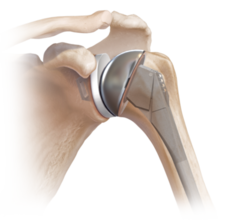
reverse shoulder arthroplasty

what are key points about total shoulder arthroplasty
- End stage arthritic shoulder conditions with intact RTC and sufficient glenoid bone stock
- Primary GH OA
- AVN with chondral wear
- Inflammatory arthritis with intact RTC
- Failure to improve with conservative measures
what are key points about reverse total shoulder arthroplasty
- Massive RTC tear
- OA
- Complexities post proximal humerus fracture
- ⅓ of all shoulder arthroplasties in US
- Gradually expanding criteria for use so many diagnoses may be considered for RTSA
- Failure to improve with conservative measures
what does post-op management for total shoulder arthroplasty entail
- A considerable amount of variability exists for post-op rehabilitation for TSA and RTSA (low quality evidence, largely expert opinion)
- Obtain post-op protocol if available
- Balance of tissue healing and rehabilitation techniques to address impairments
what are the key aspects of the total shoulder arthroplasty rehabilitation guidelines
- Wide variety of rehab program phases
- Sling use: Range 3-8wk 7/10 studies
- Full shoulder ROM by 8wk 7/10 studies
what are the key aspects of the total shoulder arthroplasty rehabilitation guidelines is there is a Subscapularis repair (tenotomy, peel-back, osteotomy)
- No consensus on timetable for protection (+/- AROM early)
- Limitation on ER (passive stretch of SubS)
- Limitation in Active IR
what are the key aspects of the reverse total shoulder arthroplasty rehabilitation guidelines
- May benefit from a prehab session outlining POC
- Wide variety of studies providing recommendations for sling use, when to initiate A/PROM
- Sling use 4-6wk 4/6 studies
- Shoulder PROM and resisted ex (delt and scap) by 6wk
- Subscap function less critical, but may have similar precautions seen with TSA
what are total shoulder arthroplasty guidelines for sling use
0-4/6wk
what are total shoulder arthroplasty guidelines for precautions
- No active IR x 12 wk
- Avoid extension past mid-axillary line, horizontal add
- Subscap passive/active/load consideration
what are total shoulder arthroplasty guidelines for resistance exercises
- Early: Shoulder, delt, scap iso/isoc/CKC
- Late: Prog. loading
what are reverse total shoulder arthroplasty guidelines for sling use
0-4wk
what are reverse total shoulder arthroplasty guidelines for PROM
Ranges from early/late stages to as tolerated/by protocol (limit horiz ADD/IR)
what are reverse total shoulder arthroplasty guidelines for AROM
- Early: limitations at flx or ER
- Late: As tolerated
what are reverse total shoulder arthroplasty guidelines for resistance exercises
- Respect tissue healing times
- Early isometrics
- Late progressive loading 6/8wk+
what are reverse total shoulder arthroplasty guidelines for precautions
Subscap passive/active/load consideration
key points comparing TSA v. RTSA
- Similar complication rates, patient functional outcome, and radiographic follow up at 2 years (Kiet et al 2015, Hao et al 2024)
- >95% reported clinically meaningful improvement across both techniques re: pain, self-reported, and clinically measured outcome tools at 6months
- Full improvement by 2 years, but majority of improvement occurs within first 6 mo.
- ROM gains favored TSA over RTSA
What are key points about Early v. Late Rehab Programing for reverse total shoulder arthroplasty
- Similar outcomes for early RTSA v. delayed RTSA group re: patient reported outcomes and objective measures at 3, 6, 12 months (Collins et al, 2020). Improved active flexion and patient reported outcomes at 3-6 months in early group
- Similar outcomes for early RTSA v. delayed RTSA group re: pain, function, and objective measures (Hagan et al, 2020). Supports safety of early mobilization programs in elderly populations
What are different types of bony shoulder conditions
- Proximal Humeral fractures
- Shoulder OA
- Shoulder arthroplasty
What is the primary cause of Proximal Humeral fractures
Falls in people of older age with osteoporosis
What are key points about PT management of shoulder OA
- May mimic frozen shoulder
- Can attempt non-operative management