Biology Ecology (Alberta) 2
 Call Kai
 Learn
Learn Practice Test
 Spaced Repetition
 Match
Match Flashcards
 Knowt Play
1/29

Earn XP
Description and Tags
Second half of the unit (chapter 3 and 4)
Name | Mastery | Learn | Test | Matching | Spaced | Call with Kai | Chat |
|---|
No analytics yet
Send a link to your students to track their progress
30 Terms
Cycling of matter (digestion)
Complex organic molecules broken down to simple ones
Absorbed into body
Cycling of matter (decay)
Decomposers break down organic matter
Nutrients added to ecosystem
The Value of Water
Absorbs, releases and moderates
thermal energy
▪ Medium for metabolic reactions (metabolism)
▪ Universal solvent
▪ >60% of cell’s mass
▪ Is Polar
▪ Positive and negative ends
▪ Hydrogen bonds

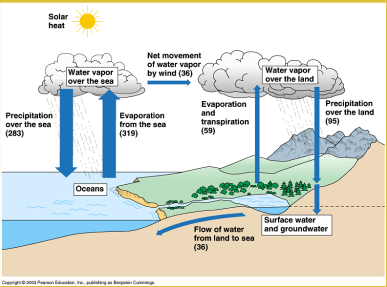
Hydrologic (Water) Cycle steps
Overall water volumes in biosphere are constant, amount in specific phases is variable
Transpiration (Plants releasing water through their leaves)+ Evaporation (water turns to gas) —>
Condensation (gas turns to water) —>Precipitation (the falling of rain)
Sources of Fresh Water (surface)
Precipitation above ground
Sources of fresh water (ground)
Percolation
▪ Water percolates through
larger soil particles
▪ Fills lower levels of soil
▪ Water table above impermeable bedrock/clay
Leaching
Leaching
▪ Seeping H2O carries dissolved organic matter and minerals to lower layers of soil
▪ Plants reduce leaching by extending long branch roots deep into soil
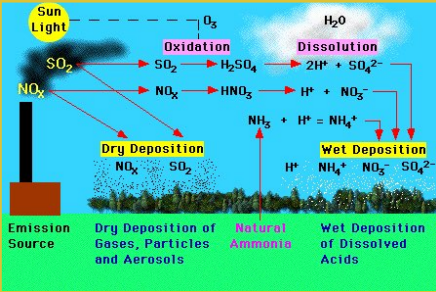
Acid rain (how does it happen)
Plants, refineries, exhaust release sulfur (SO2) and nitrogen oxides (NOx) during combustion
▪ SO2 gas is toxic
Both gasses combine with H2O to form acids
Acid droplets precipitate (acid rain)
Acid rain (What does it affect and how is it combatted)
Affects fish, soil bacteria, plants, crops. Acid rain leaches heavy metals from soil (mercury) and brings into lakes/rivers
Alkaline soils minimize impact of acids
Scrubbers in smoke stacks filter emissions
Lime added to lakes to neutralize acids
What PH is normal
▪ pH 5.5-5.9 is “normal”
What is an Acid surge?
▪ Short intense acid deposition
▪ Snow melt, heavy rain
▪ 3 reservoirs for inorganic Carbon
▪ Atmosphere
▪ Crust
▪ Ocean
Oceans as a reservoir for inorganic carbon
Gas reacts with H2O and forms inorganic calcium carbonate (CaCO3)
Used for shellfish shells
Huge carbon sink
Organic reservoirs of Carbon
Carbon containing molecules are called Organic molecules, when sourced from living organisms
Includes
1) Bodies of living and dead things
2) Ecosystems
3) Fossil Fuels
Organic reservoirs of Carbon
1) Bodies of living and dead things
Plants (photosynthesis) and Animals
▪ Photosynthesis CO2 + H2O + energy → C6H12O6(glucose) + O2
▪ Cellular Respiration C6H12O6 + O2 → CO2 + H2O + energy (heat and ATP)
Organic reservoirs of carbon 2) Ecosystems
Bogs – Decomposition of peat (plant matter)
▪ Peat is when waterlogged areas lack oxygen and can’t fully decompose organic material, leaving high concentration of organic matter
Organic reservoirs of carbon 3) Fossil Fuels
Carbon from dead organism millions of years ago
Combustion
Climate change
The carbon and oxygen cycle (The oxygen cycle. What is it involved with and apart of?)
Integral part of Photosynthesis and
Cellular Respiration
▪ Oxygen involved with
▪ Ozone (O3)
▪ CO2
▪ Rocks
▪ Decomposition

Human Impact on the Carbon Cycle (The greenhouse effect—natural)
▪ Greenhouse Effect (is natural)
▪ Wavelengths strike Earth’s surface and are reflected
▪ Some of the waves are trapped via atmospheric gas (greenhouse gasses), as a blanket of heat
▪ Canada produces lots of CO2
▪ Greenhouse gasses increased 25% since 19th Century

Human Impact on the Carbon Cycle (Enhanced greenhouse effect)
Enhanced Greenhouse effect
▪ Not natural
▪ Avg global temp is 15oC, increased by 1oC in last 40 years
▪ Melting ice caps could raise sea level by 3 meters
▪ Increased severity in weather events
Human Impact on the Carbon Cycle (albedo affect)
Albedo Effect
▪ Describes extent to which a material can reflect sunlight
▪ Albedo of 0.08 means 8% of light is reflected
▪ Higher albedo, more sunlight reflected, less heat absorbed on Earth
▪ High albedo of snow contributes to low winter temperatures
▪ Cloud cover results in higher albedo
▪ “nuclear winter” involves high albedo cloud coverages
Equilibrium and the Earth’s Atmosphere
▪ “primitive” Earth had high concentration of CO2
▪ 3.5 billion years ago (bya)
▪ Microscopic marine life consumed CO2 and released CH4
▪ Fossils of these bacteria found in stromatolites (banded limestone)
▪ Evidence of warm planet
▪ CO2 and CH4 trapped heat while allowing sunlight to penetrate
▪ Increased temp increased water cycle aggressiveness
▪ Water “grabbed” and absorbed CO2 from the atmosphere, leaving behind CH4
▪ The methane (CH4) haze blocked sunlight, cooling Earth
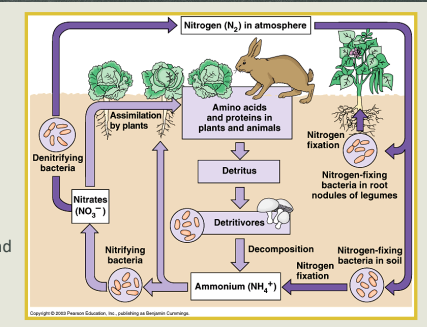
3.3 The Nitrogen Cycle (the 4 main process)
4 main process
▪ Nitrogen Fixation
▪ Nitrification
▪ Ammonification
▪ Denitrification
▪ Nitrogen(N) makes up 78% of atmosphere, inaccessible to plants and animals in the form
▪ N is important for proteins, DNA and as nitrate ions (NO3- )
Nitrogen Cycle: Nitrogen Fixation
Nitrogen Fixation
▪ N2 is converted to NO3- (Nitrate)
▪ NH4+ ions (Ammonium) also released into the soil
▪ 90% of Nitrogen fixation is performed by nitrogen-fixing bacteria
▪ 10% of nitrogen fixation is the result of lightning
Nitrogen Cycle: Nitrification
▪ Nitrification
▪ NH4+ ions changed to NO3-
▪ Nitrifying bacteria in the soil convert Ammonium (NH4-) to nitrite (NO2-) to nitrate (NO3-)
▪ Most organisms utilize (NO3-) but some can use (NH4-) directly
▪ Nitrates are used for organic functions like proteins
▪ We get our nitrogen from the food we eat
Nitrogen Cycle: Ammonification
▪ Ammonification
▪ Performed by decomposers in the soil
▪ Organic Nitrogen waste and remains are converted into Ammonium (NH4+)
Nitrogen Cycle: Denitrification
▪ Dentification
▪ Denitrifying Bacteria convert NH4+,NO2-, NO3- into free N2 gas.
▪ Returns Nitrogen back to the atmosphere
Phosphorus Cycle
Phosphorus (P) is a component of
▪ Cell membranes
▪ DNA
▪ ATP
▪ Bones
-Phosphate (PO4 3-) is usually found in rock
- Fast track
- Slow track

Agriculture: Nitrogen and Phosphorus Cycles
▪ Fertilizer contains N and P
▪ Manure contains N, used as fertilizer
▪ Commercial Fertilizers
▪ 1st number - % nitrogen by weight
▪ 2nd number - % phosphorus by weight
▪ 3rd number - % potassium by weight
▪ Harvesting crops removes N and P form soil
▪ Disrupts natural cycles
▪ Fertilizing soil restores this disruption
▪ Irresponsible fertilizing makes land acidic
▪ Can lead to Eutrophication
Eutrophication
▪ N and P from fertilized soils is leached out from spring run off
▪ N and P end up into lakes
▪ Promotes aquatic growth
▪ Algae blooms
▪ Algae dies
▪ Bacteria decomposes the massive amounts of algae which depletes oxygen levels
▪ Fish begin to die due to low oxygen