Facial growth
 Call Kai
 Learn
Learn Practice Test
 Spaced Repetition
 Match
Match Flashcards
 Knowt Play
1/67

There's no tags or description
Looks like no tags are added yet.
Name | Mastery | Learn | Test | Matching | Spaced | Call with Kai | Chat |
|---|
No analytics yet
Send a link to your students to track their progress
68 Terms
3 Growth control theories?
Bone
Cartilage matrix
Soft tissue matrix
Bone:
Innate growth potential
Growth of bones?
Lack innate growth potential - does not grow when transplanted
Growth at sutures responds to outside influences (bones pulled apart = new bon formed
Cartilage
2 structures and their growth potential
Naso-maxillary
Some innate growth potential - transplanting nasal septum does produce growth
Mandibular condyle - less growth when transplanted, considered a growth site
Soft tissue matrix
what is it?
3 evidences for it?
Bone and cartilage react to growth of soft tissues
Cranial vault responds to size of brain
Enlargement of nasal and oral cavities in response to functional needs
Mandibular growth greatly impaired by ankylosis TMJ
Growth theories that control growth? (2 main)
Genetic - Homeobox - hox and non-hox genes - control genetic blueprint of growth for an individual (growth predetermined
Epigenetic/environment
Original Moss functional matrix theory - capsular and periosteal matrix
Updated to functional matrix theory

Explain the capsular matrix in the original functional matrix theory?
2 examples
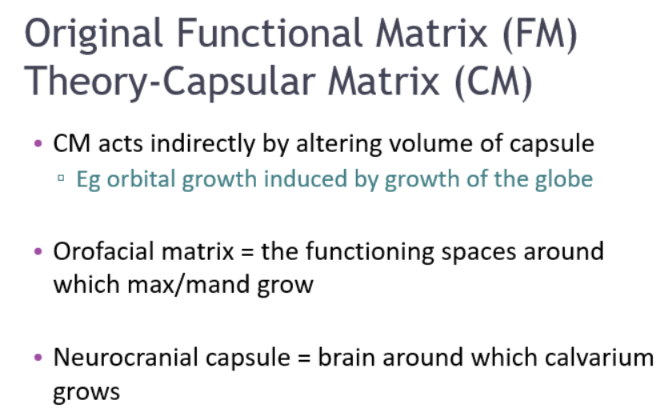
CM acts indirectly by altering volume of capsule
Orofacial matrix - the functioning spaces around which max/mand grow
Neurocranial capsule - brain around which calvarium grows
by altering the volume of the capsules
Explain the theory-periosteal matrix in the original functional matrix theory?
1 example
PM acts on the skeleton in a direct manner
Muscle regulates growth of skeleton e.g coronoid process fails to develop in absence of temporalis
Updated functional matrix theory - periosteal matrix
centres around periosteum
explain it
Mechanical loading influences gene expression
Mechano-sensing enables cells to sense and respond to extrinsic loading by mechanoreception and mechanotransduction
Bone loaded dynamically (muscle contraction) and statically (gravity)
Bone deforms
Osteoblasts and osteoclasts electrically activated - mechanoreception
responding - mechanotransduction (either depositing or resorbing bone)
muscles/ortho appliances deform bone and alter gene expression
Conclusion
Development and facial patterning influenced by combination/controlled of 2
Primary determinants are most likely 2
growth only occurs in presence of adequate x x titre
environmental forces on homeobox genes
cartilage and soft tissues
growth hormone
Facial growth follows what growth pattern?
Somatic
Most structures follow this pattern
4 main points about craniofacial growth
rate
females/males
facial convexity
indefinite growth?
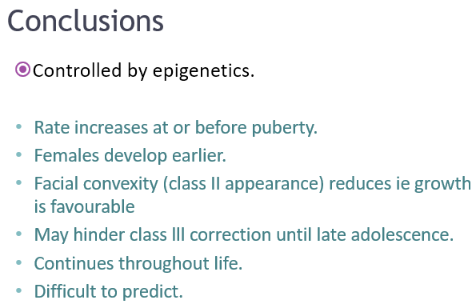
Rate increases at or before puberty
Females develop earlier
Facial convexity - class 2 appearance - reduces
continues throughout life
4 Areas of facial growth and what type of growth Intramembranous or endochondral
Cranial vault - IM
Cranial v-base - E
Nasomaxillary - IM
Mandible - IM?
Changes in the proportion of the head and face during growth at birth and adult
what is underdeveloped at birth (2)
postnatally - which has more growth - the facial or cranial structures?
the face 1/8 and ½ volume of skull compared to adult
at birth the face and jaws are underdeveloped compared to their extent in adult
facial

Cranial vault:
3 main components
flat bones
fontanelles and structures
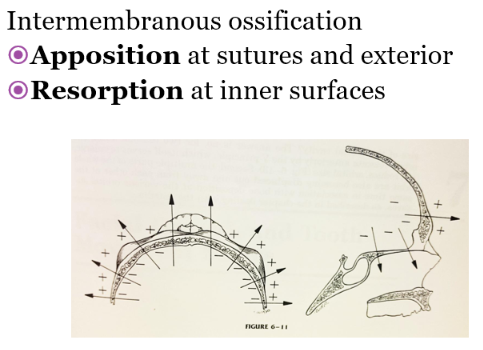
IM ossification
Apposition and resorption where?
Apposition at sutures and exterior surfaces
Resorption at inner surfaces
Cranial base EO
Spheno-occipital synchondrosis - affects A-P relationship
Surface remodelling

Embryology of the maxilla?
23rd day iu
7 th week iu
mesenchyme from neural crest forms branchial arches, 1st forms maxilla, mandible and muscles of mastication
2 Ossification centres - anterior forms premaxilla and posterior forms maxilla proper
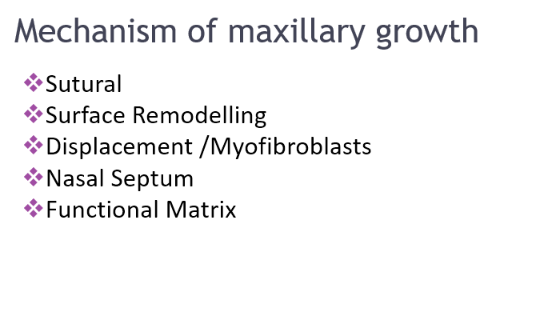
Mechanisms of maxillary growth (5)
Sutural growth
Surface remodelling
Displacement
Nasal septum
Functional matrix
Sutural growth:
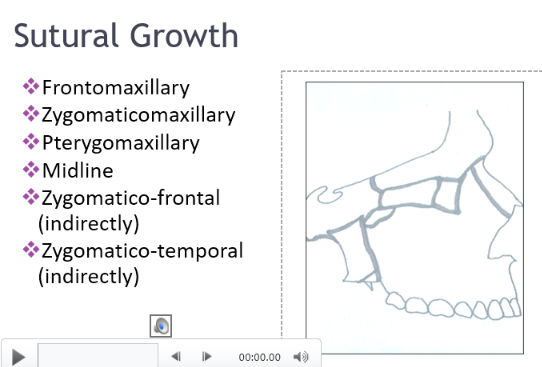
Where does it take place? (6)
Frontomaxillary
zygomaticomaxillary
Pterygomaxillary
Midline
Zygomatico-frontal
Zygomatico-temporal
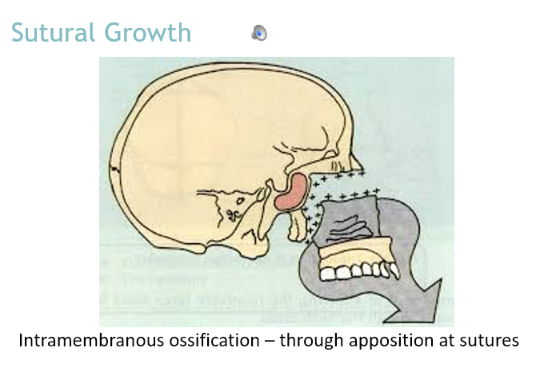
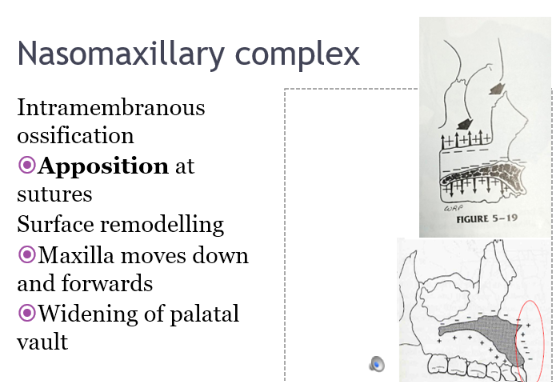
What is the result of sutural growth through intramembranous ossification?
Downwards forwards translation of the maxilla
apposition at the sutures
Surface remodelling
what direction does surface remodelling occur in in relation to the translation of the maxilla (as a result of sutural growth?)
Opposite direction in which the bone is being translated


surface remodelling:
Where is resorption and apposition occurring
overall, what happens to the maxilla and palatal vault?

Displacement?
At what age?
Displacement is associated with what?
Rotational component is masked by what?
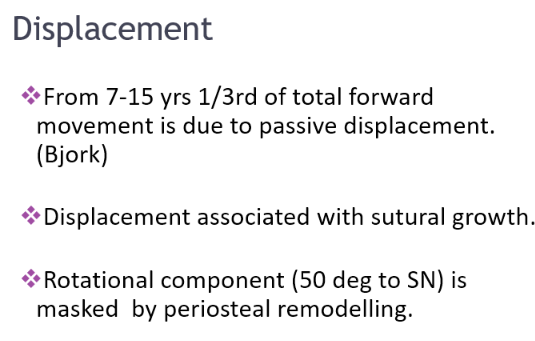
From 7-15 years 1/3 of the total forwards movement is due to passive displacement
Displacement associated with sutural growth
Masked by periosteal remodelling
Nasal septum:
What type of growth is it?
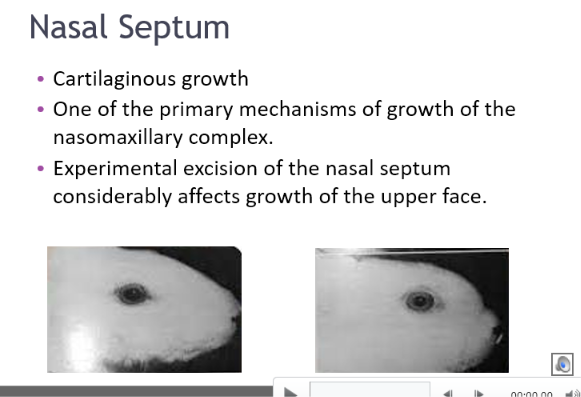
Cartilaginous growth
one of the primary mechanisms of growth of the nasomaxillary complex
experimental excision of the nasal septum considerably affects growth of the upper face
Nasomaxillary complex
IM or E?
overall what happens to the maxilla and palatal vault?
Mandible:
formed from what in the embryo
what arch does it form?
what happens at 6 weeks
Neural crest
First pharyngeal arch
Ossification Meckels cartilage 6 weeks
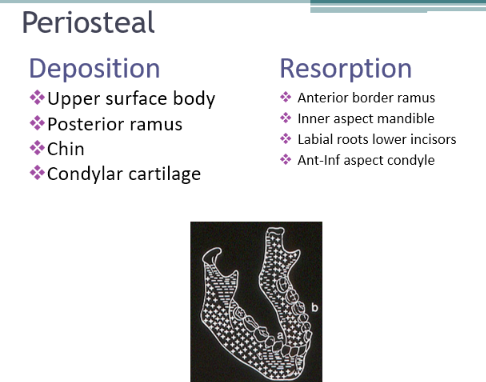
Deposition (4) and resorption (4) at which aspects of the mandible?
Endochondral ossification and surface remodelling
deposition - chin, upper surface body, posterioir ramus, condylar cartilage
resorption - anterioir border of ramus, inner aspects of mandible, labial roots lower incisors, anterioir inf aspect condyle
EO and Surface remodelling of what parts of the mandible
which accounts for the majority of the growth?
the mandible is displaced how?`
EO - condylar growth to elongate the mandible
SR - majority of growth and ramus remodelling
mandible displaced anterioir and downwards due to EO

Growth rotations
is determined by 2 things which are in turn determined by 2 things reach
Posterior face height - Condyles and Synchondroses
Anterior face height - Tooth eruption and Soft tissue growth
Growth rotations can be either?
Forwards
Backwards
Forwards growth rotation is associated with? (2)
Backwards growth is associated with? (2)
reduced anterioir face height and increased overbite
Increased anterioir face height and reduced overbite/anterioir open bite

What are signs of growth rotations? (7)
Inclination of the condylar head
Curvature of the mandibular canal
Shape of lower border of the mandible
Inclination of the symphysis
interincisal angle
Intermolar angle
AFH (anterioir face height)
cephalograms

Methods of predicting maximum facial growth?
Secondary sexual characteristics
Standing height
Chronological age
Skeletal maturity cvm/hand wrist
Dental age

Explain the correlation between secondary sezual characteristics and maximum facial growth?
and what are the characteristics looked at? (2)
Menstruation in females and voice change in males
Low correlation
Standing height
what is being measured and correlation?
Measured height at 4 monthly intervals
the graphs follows facial growth changes
No correlation

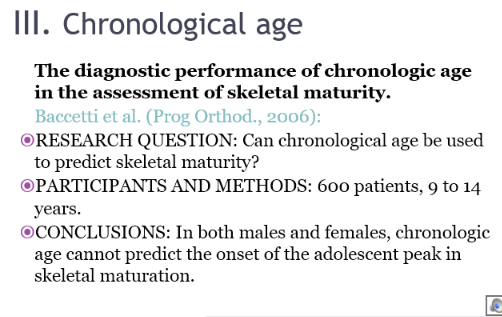
Chronological age?
is there correlation
Cannot predict the onset of the adolescent peak in skeletal maturation
Skeletal maturity - hand wrist rx
correlation?
hand-wrist radiographs - limited value even when taken on a 3 monthly basis
experience was a problem in interpreting such rx


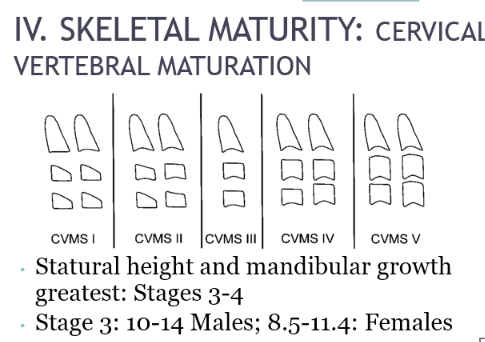
Skeletal maturity - CVM cervical vertebral maturation
Correlation?
Using lat ceph
Statural height and mandibular growth greatest at stages 3-4 of CVM which coincides with ages 10-14 in males and 8.5-11.4 in females
but reliability is variable, low inter and intra observer variability
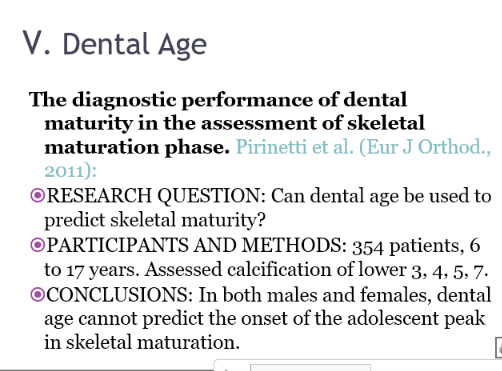
Dental age:
Dental age cannot predict the onset of adolescent peak in skeletal maturation
3 Approaches of predicting growth
Longitudinal
Metric
Structural approach
Longitudinal approach:
How is it carried out?
Good for what and not so useful for what?
an individual evaluated over a period of time in to determine pattern of growth
predicting population averages
not useful in predicting changes in single individuals

Metric approach
What is it
reliable?
measuring structures on a radiograph at one point in time then relating these to future growth changes
Not accurate

Structural approach:
what is it for?
Developed by Bjork, predicting mandibular growth direction from superimposition on metallic implants
What were the 7 areas to be evaluated on a ceph?
Inclination of the condyle
Curvature of the mandibular canal
Inclination of the symphysis
shape of the lower border of the mandible
interincisal angle
intermolar and interpremolar angle

Velocity of growth and puberty relationship?
Growth velocity curve rises to a maximum and then falls again at puberty

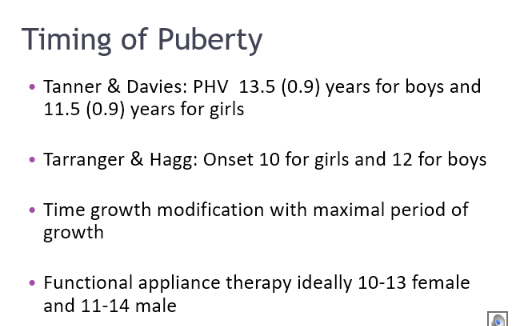
What is the onset of puberty for girls and boys?
What is the age of PHV peak height velocity for girls and boys
Onset of puberty - 10 girls and 12 for boys
Peak height velocity - 13.5 for boys and 11.5 for girls
Functional appliance therapy should ideally be at what age for females and males?
females - 10-13
11-14 for males
It has been found that other factors can affect puberty?
pubertal growth spurt vs PHV occurring?
Genetic factors, seasonal factors, cultural factors
Pubertal growth spurt can happen up to 12 months before PHV

Post-pubertal growth skeletal 1
mandibular and maxillary growth relativity?
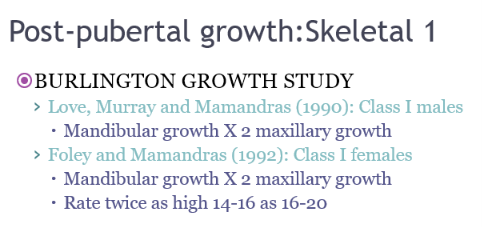
Skeletal 1 - mandibular growth x2 maxillary growth post pubertal period
rate of growth diminishing with age?
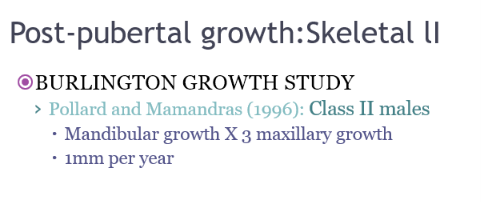
Post pubertal growth skeletal 2?
in the same period, skeletal 2 patients, mandibular growth is is 3x maxillary growth
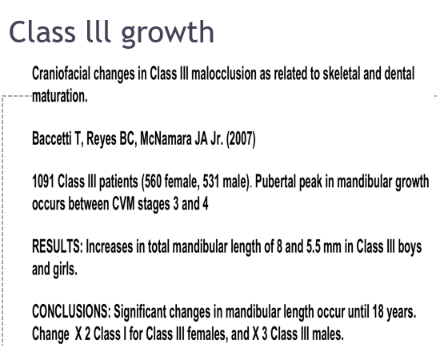
Post-pubertal growth - Skeletal 3
demonstrate what?
Demonstrated the greatest degree of mandibular growth up to the age of 18 years
2 theories as to why does growth of facial skeleton continue into adulthood?
sutural theory: patent (sutures that remain patent continue to be growth sites)
Remodelling: Loss of teeth and changes in function

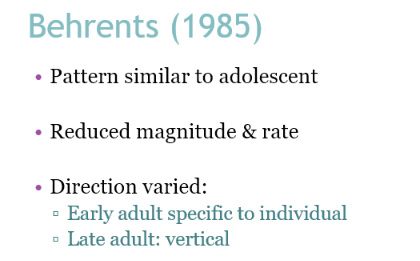
Adult growth compared to adolescent growth
Pattern and magnitude and rate
Pattern is similar to adolescent
reduces magnitude and rate
how is direction of growth varied in adult growth in early and late adult?
Early - specific to individual
Late adult - vertical
Adult males vs females

What happens to the midface in adult?
palatal sutures
nose
anterioir palate
alveolus
palatal sutures relocate posteriorly and inferiorly
as the nose develops
anterior aspect of palate moves forwards and downwards
alveolus lengthens

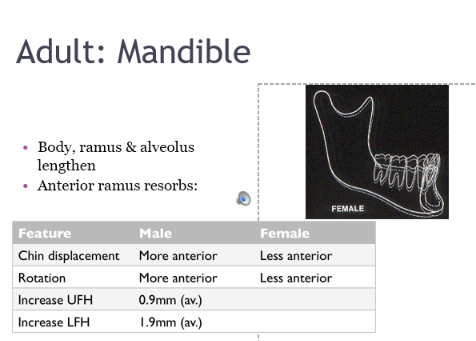
What are the changes to the mandible? (2 main things)
body, ramus and alveolus lengthen
anterioir ramus resorbs
Adult soft tissue changes?
related more to what?
nose?
upper lip?
incisors?
dentition
more extensive than but related to osseous change
nose grows, tip angle down
upper lip lengthened and flattened
less upper incisor show
dentition less prominent

Relevance in orthodontics?
orthodontics is quicker when?
advantageous in what cases?
can facilitate what? (4)
Orthodontics is quicker in the presence of growth
In XTN cases as you get spontaneous closure
OB reduction, space closure, settling of the occlusion and functional appliances and rapid maxillary expansion rx
Implications of growth in timings of? (3)
orthognathic surgery
timing implant placement
stability

Timing orthognathic intervention, avoid operating on what class below what age?
in skeletal 3 patients under age 18- avoid operating until growth has ceased
and if there is mandibular asymmetry


An example of what?
class 3 and mandibular asymmetry
How can you monitor changes? (5)
prone to late growth and exacerbating asymmetry
so monitoring growth is important to determining cessation of growth prior to orthognathic surgery
Is early orthognathic surgery usually done?
rare especially in class 3 cases with or without mandibular asymmetry
sometimes early in skeletal 2
must be strong social or psychosocial reasons for undertaking early orthognathic surgery

other dental implications of late growth outside of ortho? (1)
Postpone implant placement


Why are implants delayed?
upper left implant appears intruded compared to the upper right central incisor
which has continued to erupt with vertical dev of the alveolus

Conclusion