Anatomy and Physiology Exam 4
 Call Kai
 Learn
Learn Practice Test
 Spaced Repetition
 Match
Match Flashcards
 Knowt Play
1/58

There's no tags or description
Looks like no tags are added yet.
Name | Mastery | Learn | Test | Matching | Spaced | Call with Kai |
|---|
No analytics yet
Send a link to your students to track their progress
59 Terms
What is the central nervous system?
Brain and spinal cord
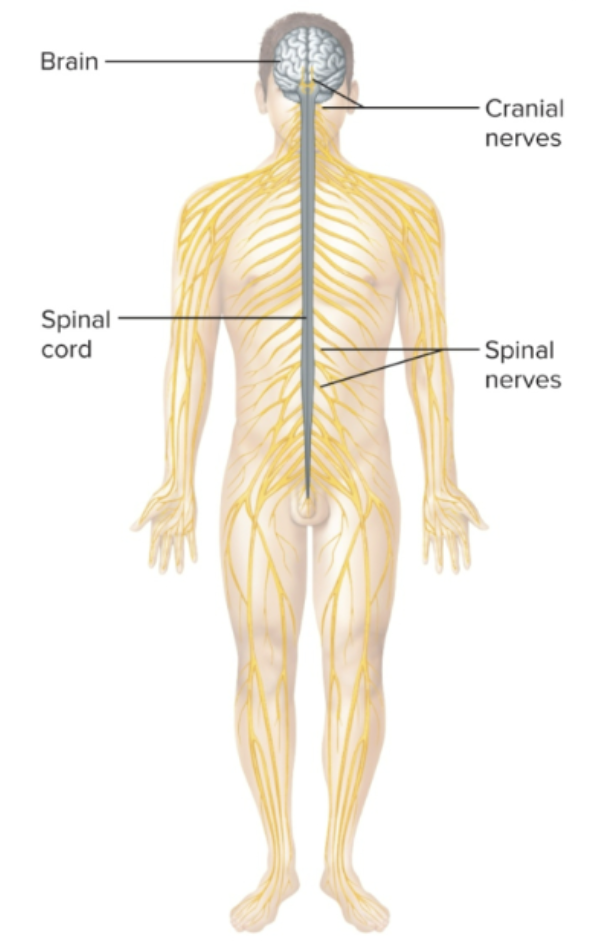
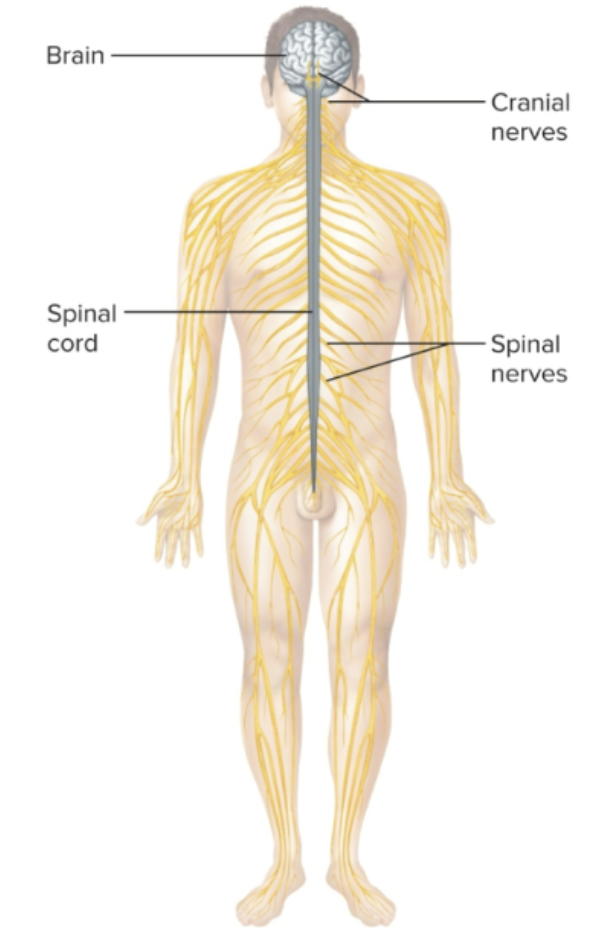
What is the peripheral nervous system?
Cranial and spinal nerves: split into sensory division (sensory receptors) and motor division (somatic nervous system = skeletal muscle, autonomic nervous system = smooth and cardiac muscle)
What are neurons?
Excitable cells that initiate and transmit electrical signals, distinguished by their cell body, dendrites, and axon
What are glial cells? (Or neuroglia)
Supporting cells that do not transmit nerve impulses but instead are responsible for protection, nourishment, and support of the neurons
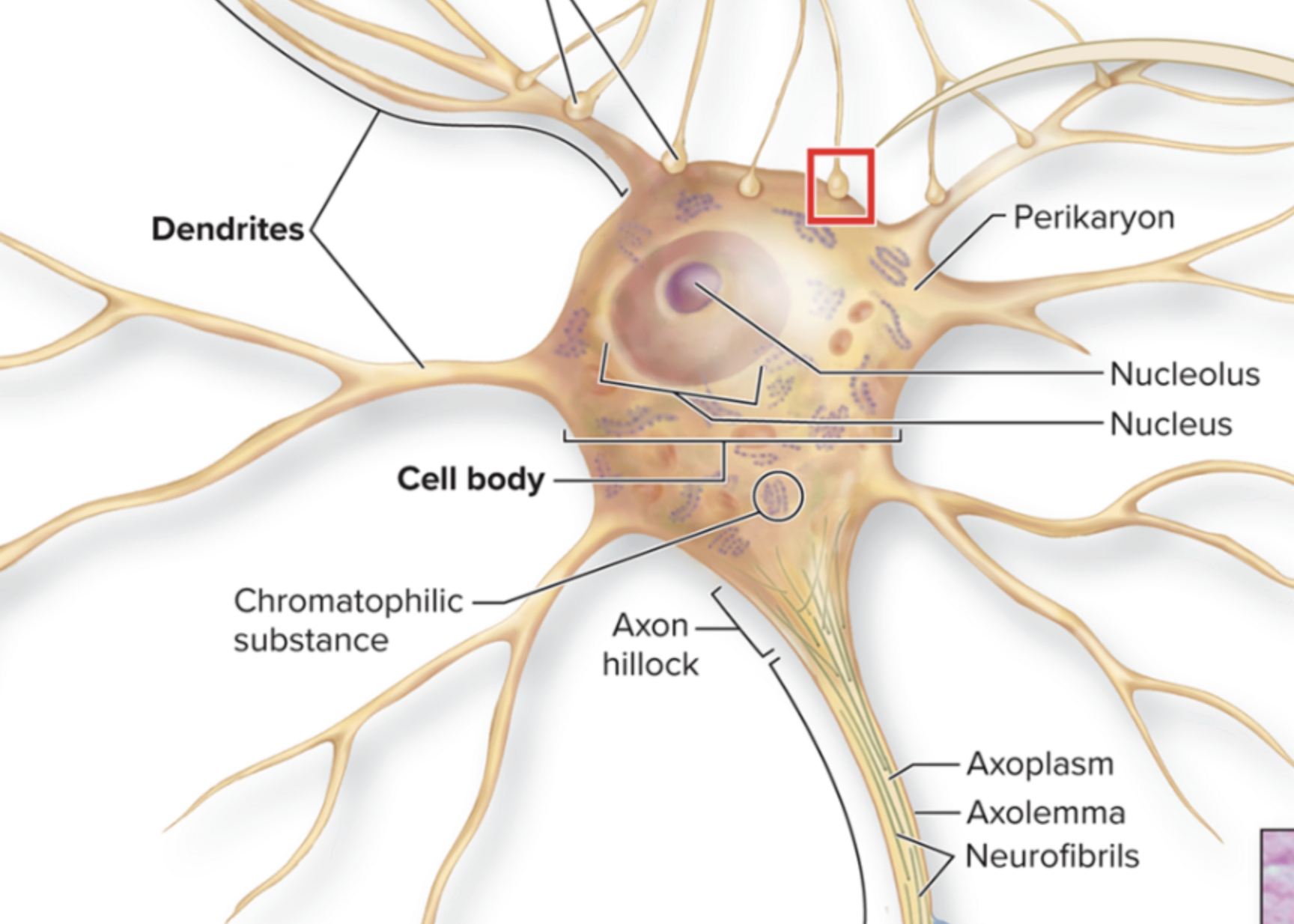
Where is the cell body?
The neuron cell body houses nucleus and cytoplasm, it contains a large number of ribosomes. It serves as the neuron’s control center and transmits electrical changes in membrane potential along its plasma membrane to the axon
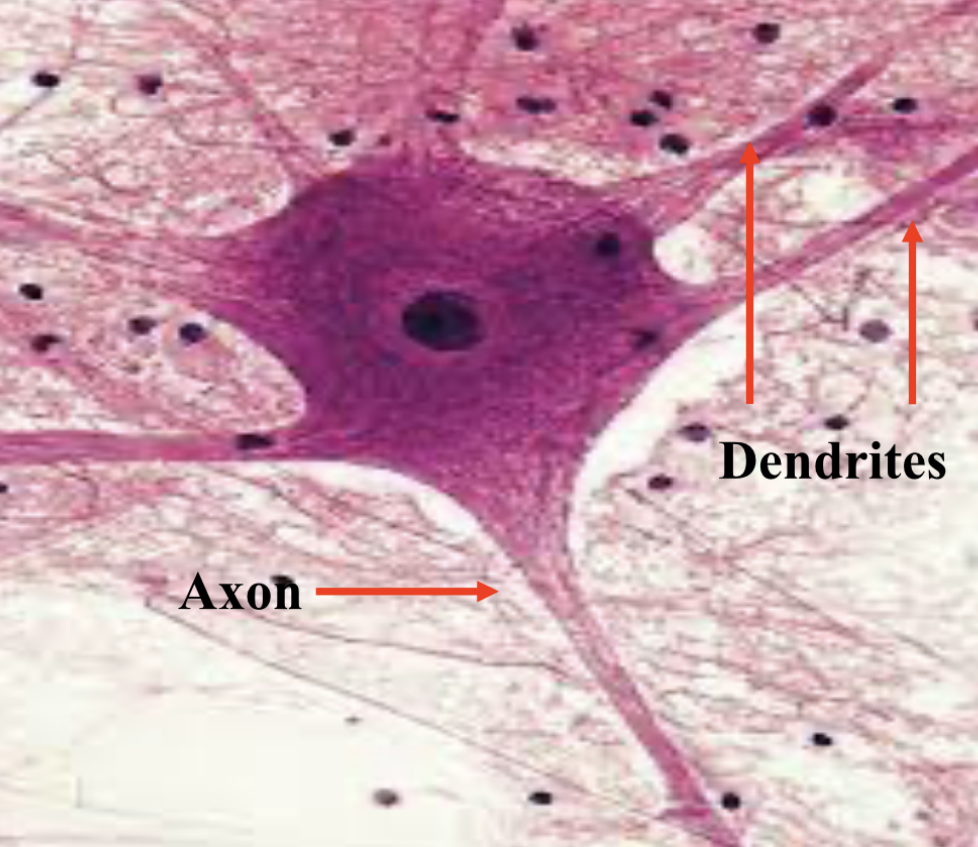
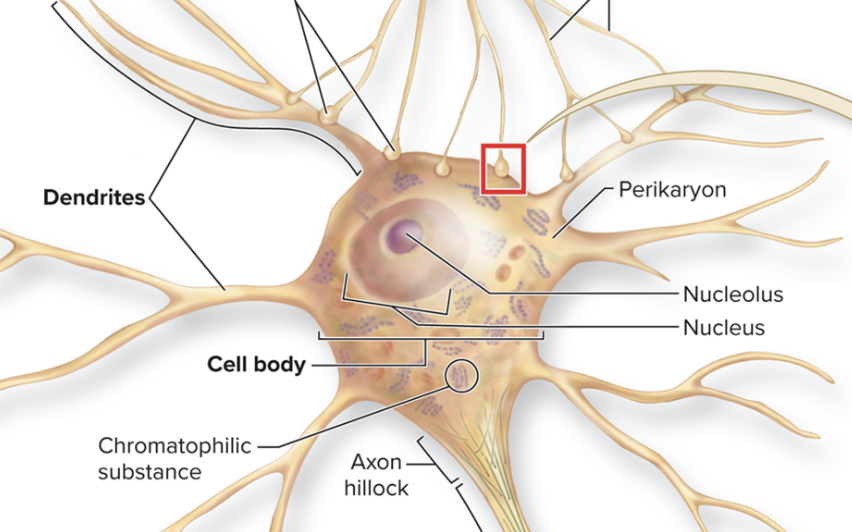
Where is the nucleus?
Contains chromatin and a nucleolus (cell control center)
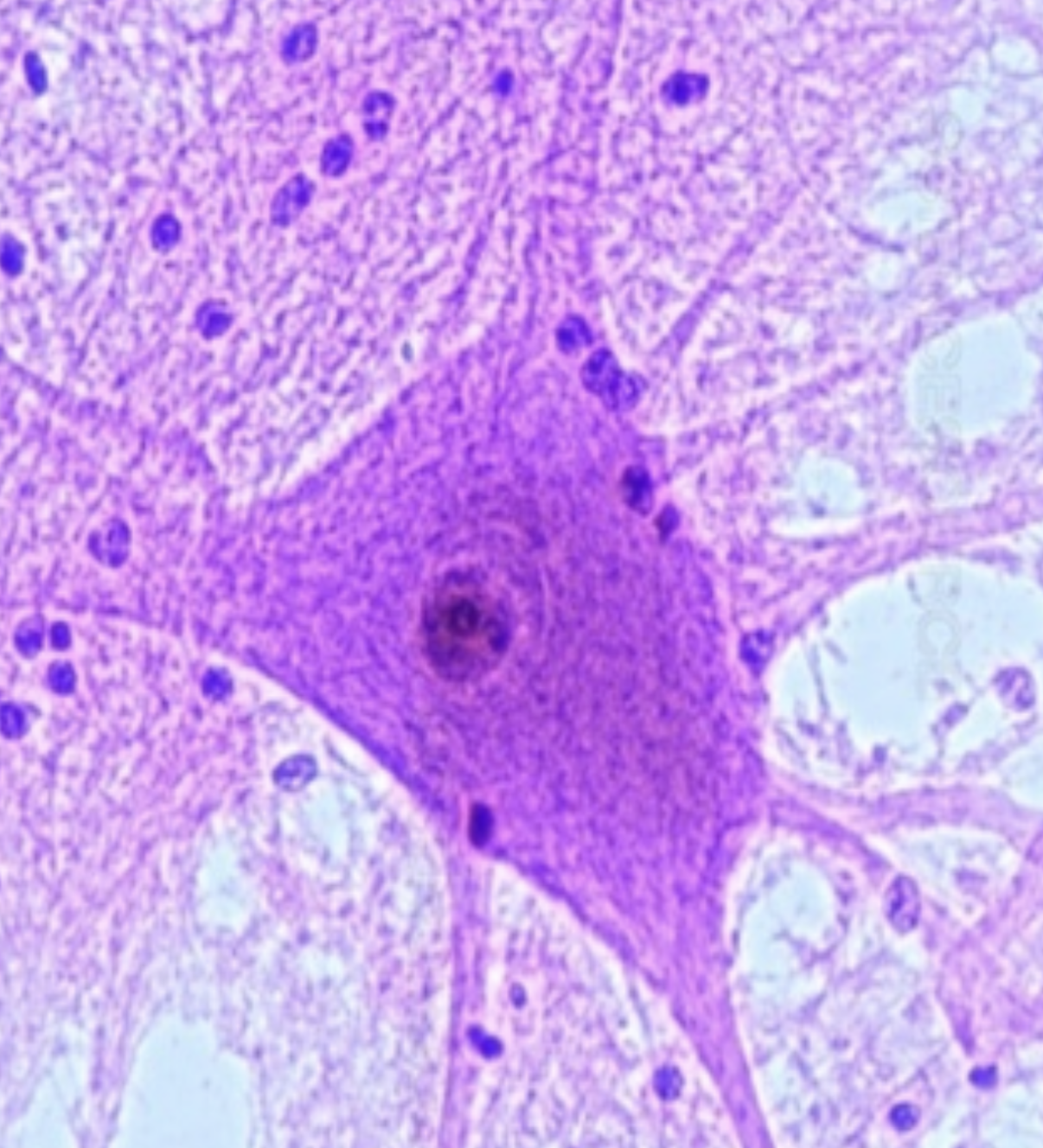
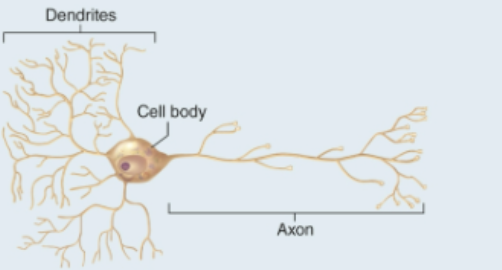
Where are the dendrites?
Short tapering processes that branch off the cell body, they are not insulated by myelin and transmit graded potentials along their plasma membrane toward the cell body, the greater number of dendrites, the more input a neuron may receive
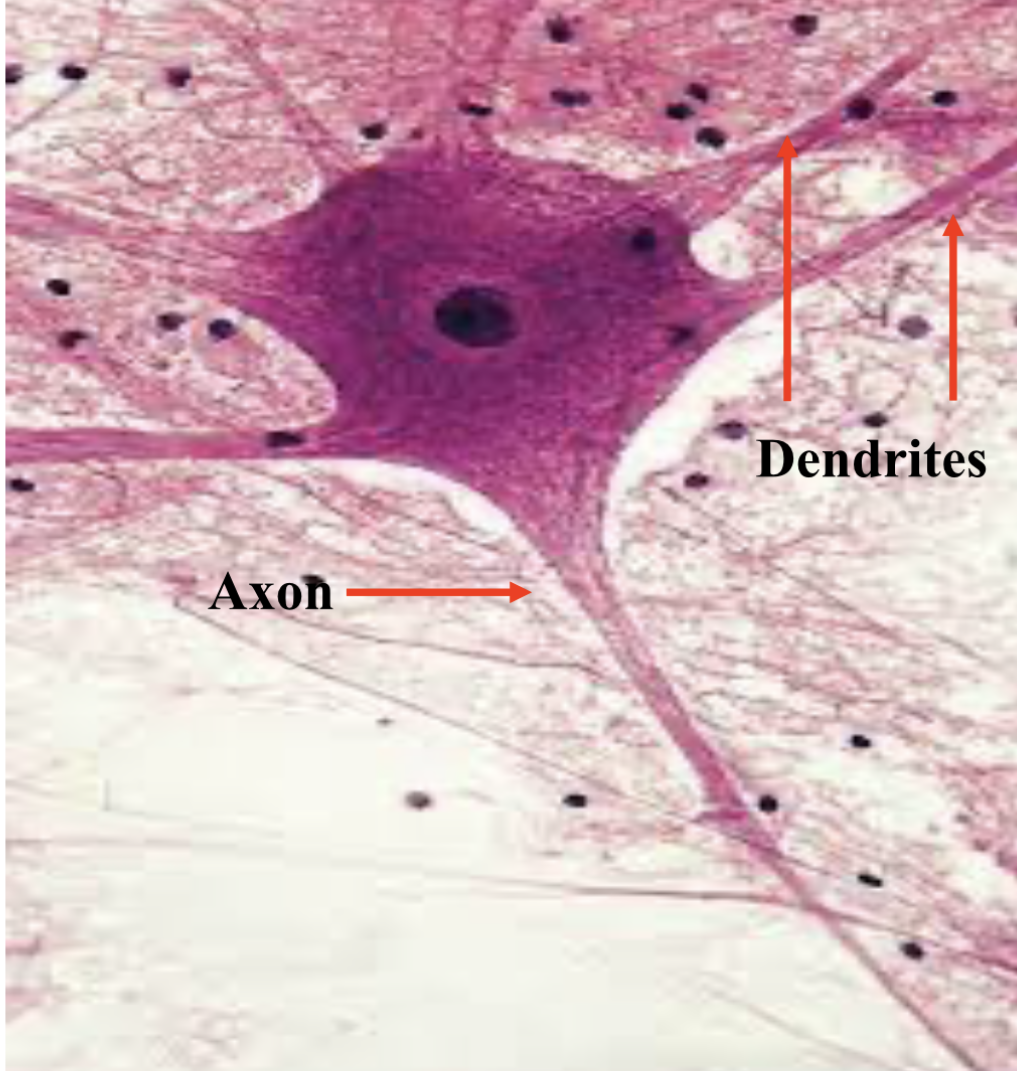
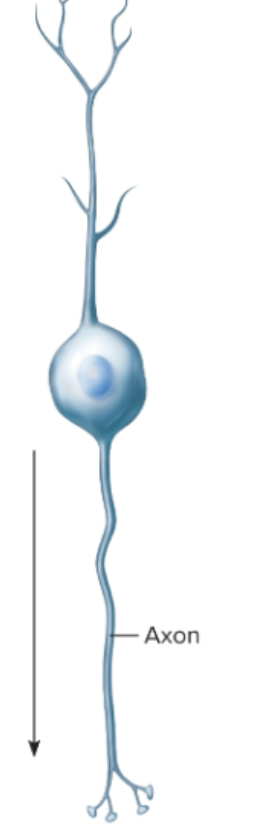
Where is the axon?
A longer process emanating from the cell body to make contact with other neurons, muscle cells, or gland cells. It does not contain chromatophilic substances, but may be insulated by the myelin sheath, they are responsible for the initiation and propagation of action potentials (large electrical charges)
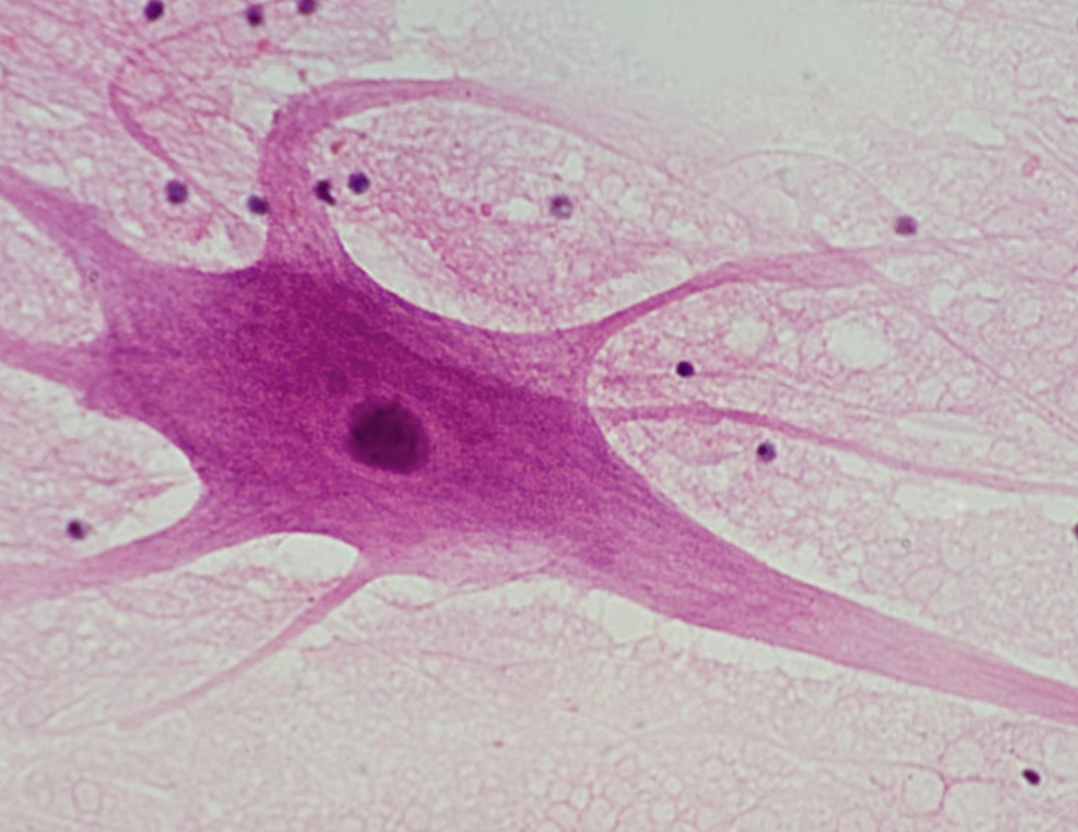
What are the two processes on a neuron?
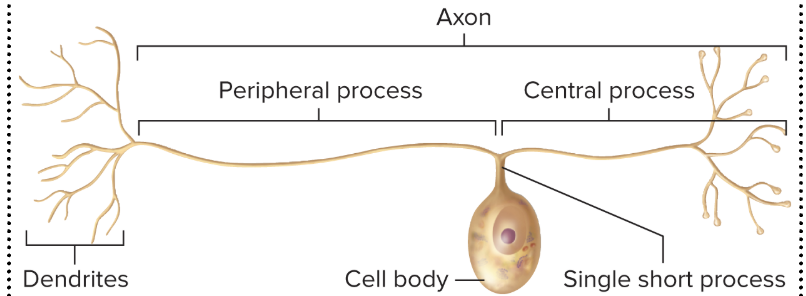
Dendrites and axons: axons are split into peripheral and central process depending on where it extends to in unipolar neurons only
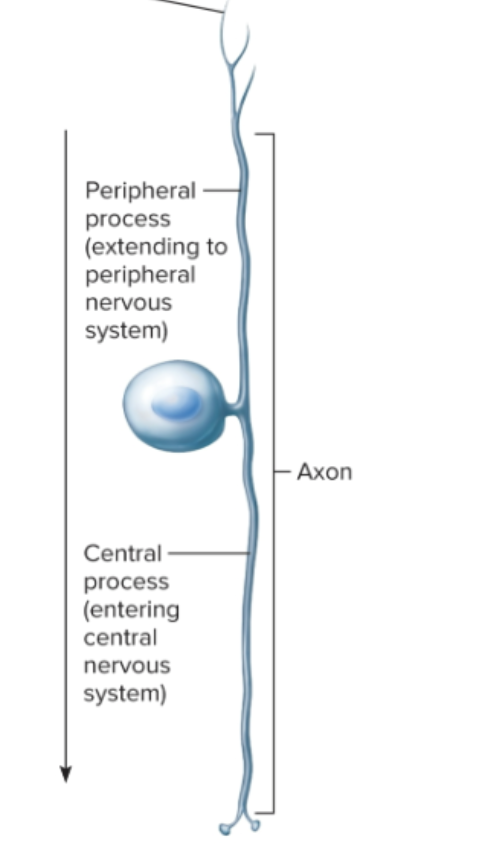
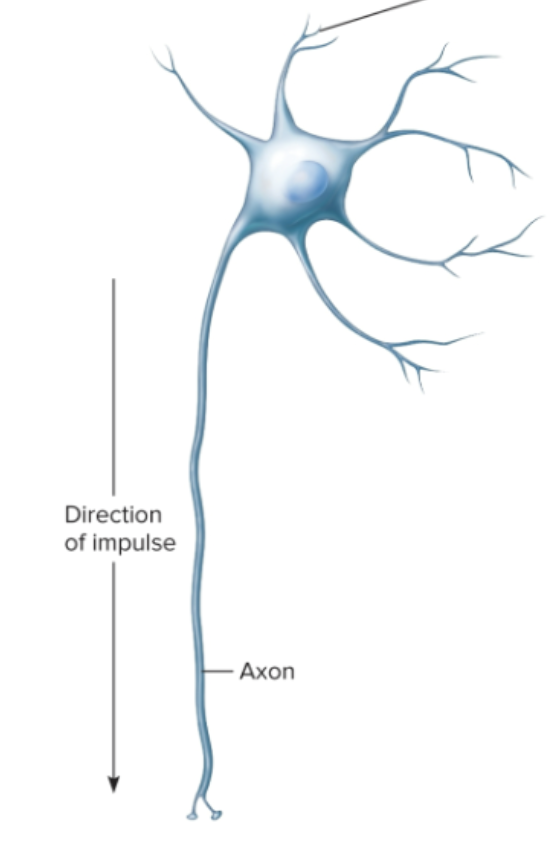
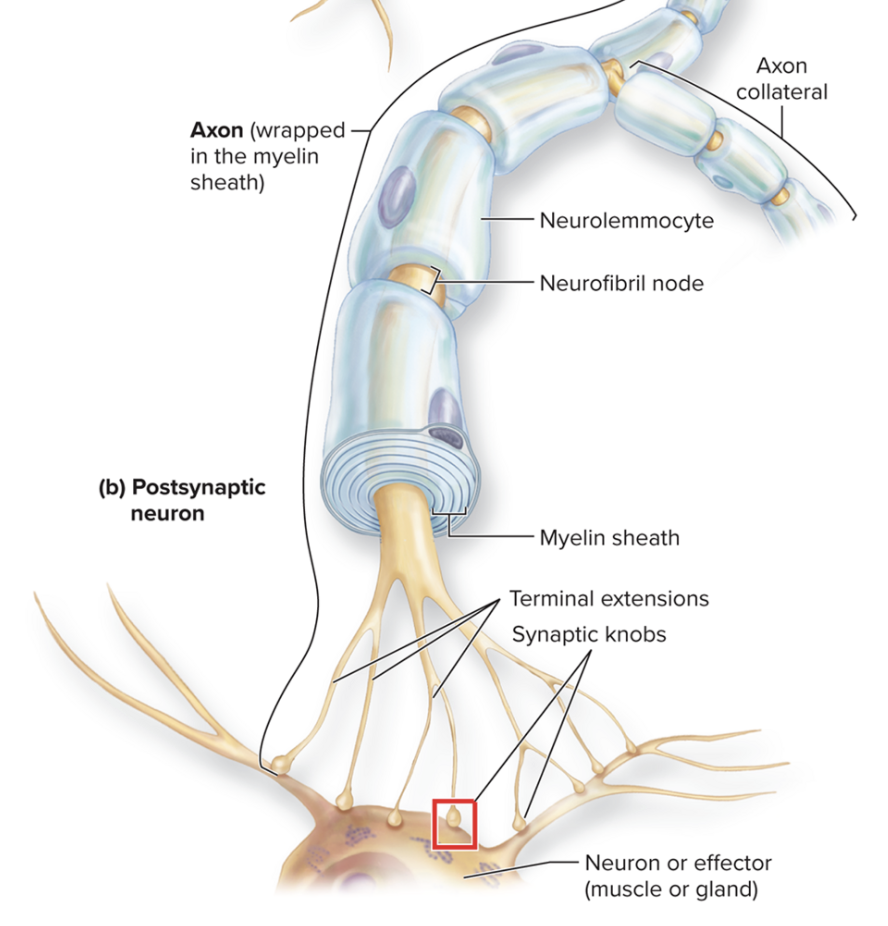
Where is the synaptic terminal?
The knob-like ending of an axon, responsible for converting electrical nerve impulses into chemical signals by releasing neurotransmitters to communicate with target cells
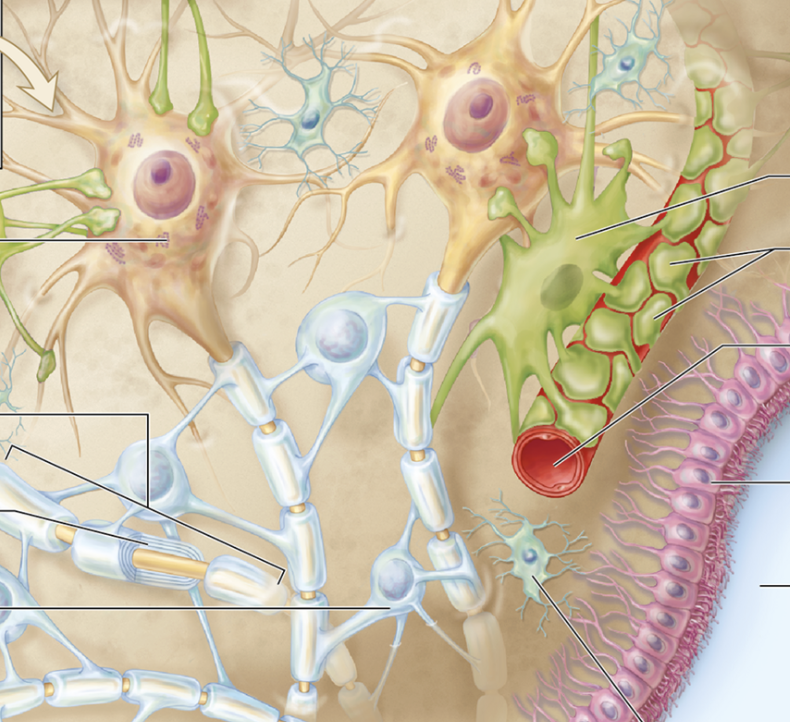
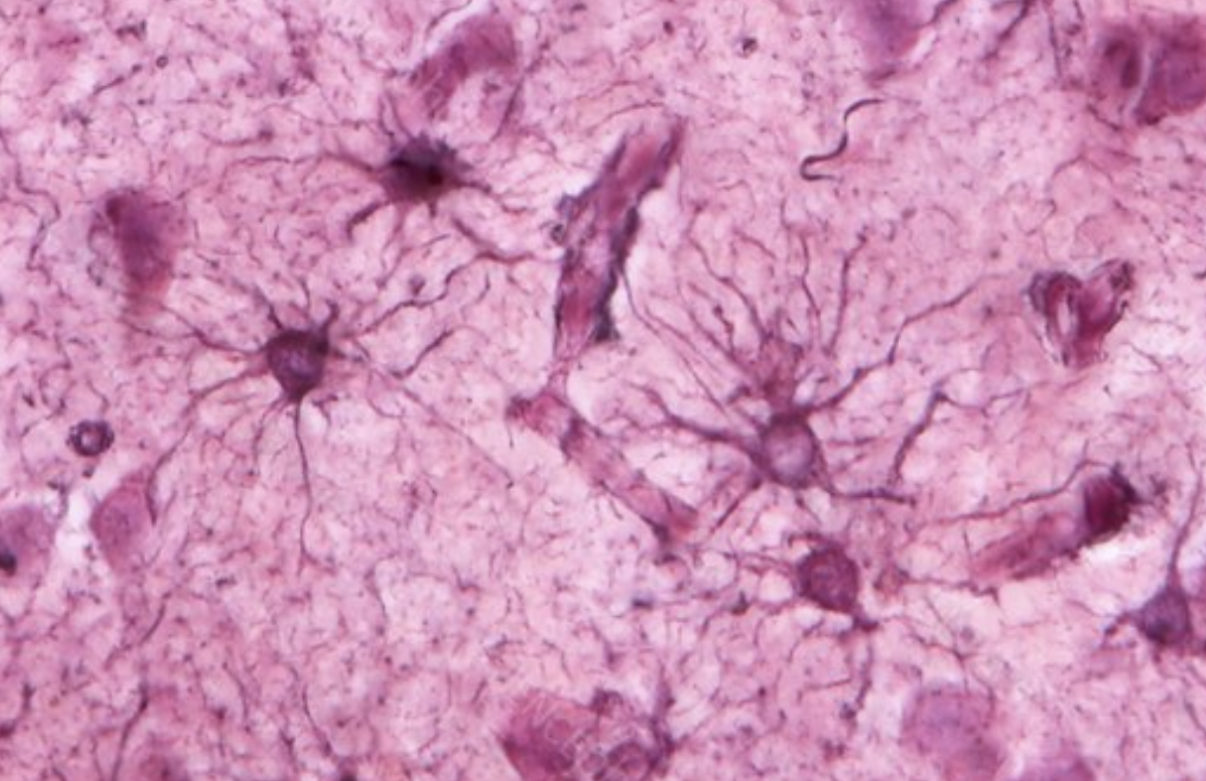
What are astrocytes?
They are one of four different types of CNS glial cells and are the most abundant
Functions include:
help form blood-brain barrier
regulate interstitial fluid composition
form structural support
assist neuronal development'
alter synaptic activity
occupy the space of dying neurons
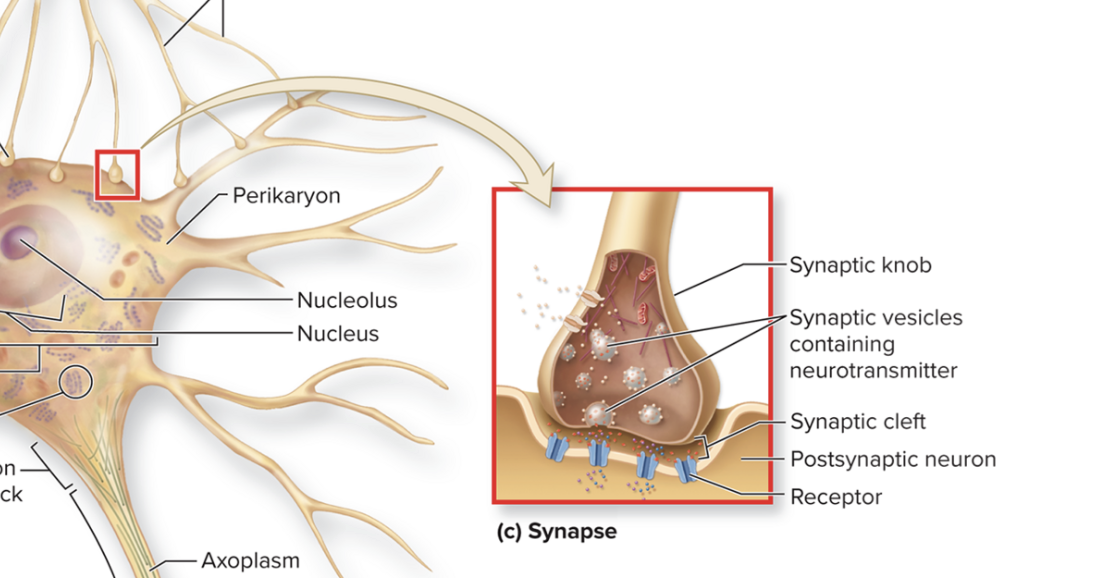
What is the synaptic cleft?
A narrow, fluid filled gap that separates two neurons
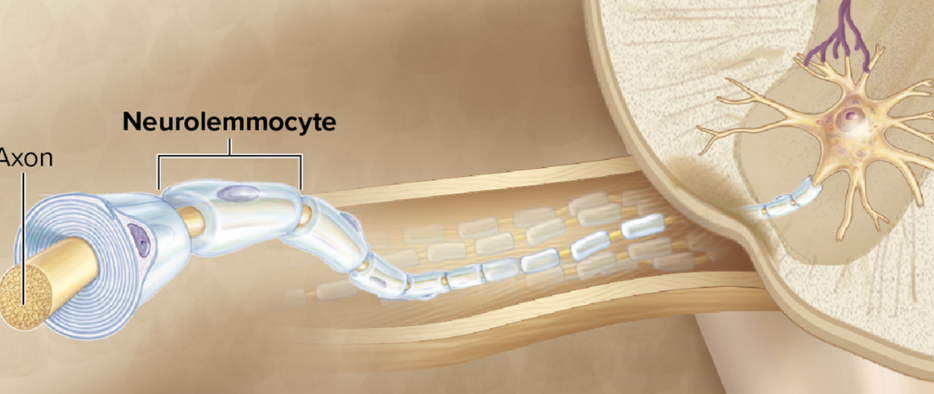
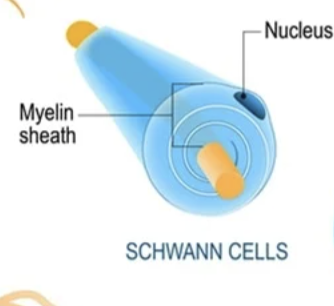
What is this?
Schwann cells which are elongated, flattened cells that wrap around and insulate axons within the PNS to form a myelin sheath through myelination, allowing faster action potential propagation along an axon
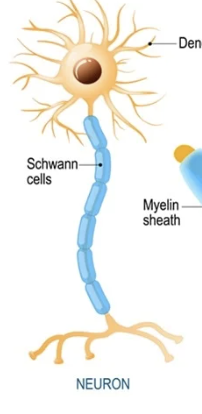
What is myelin?
A glistening coat formed by insulating cells which speeds up electrical impulses and protects fragile nerve fibers from damage
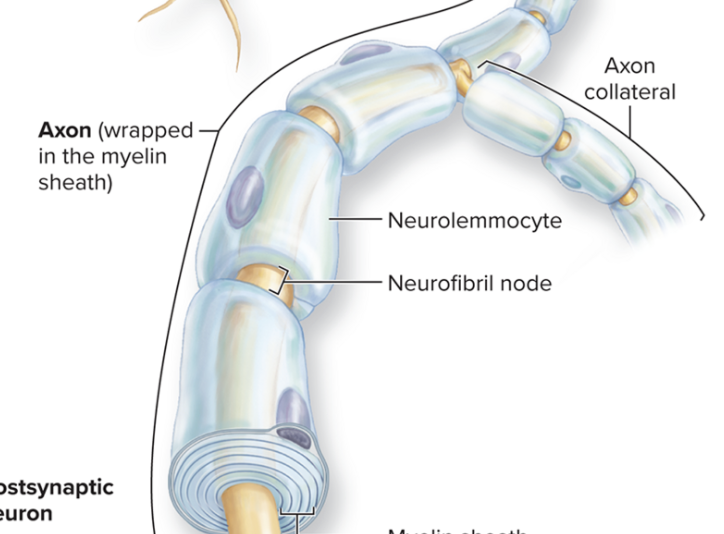
What are nodes?
Uninsulated regions of the axon between the myelin sheaths
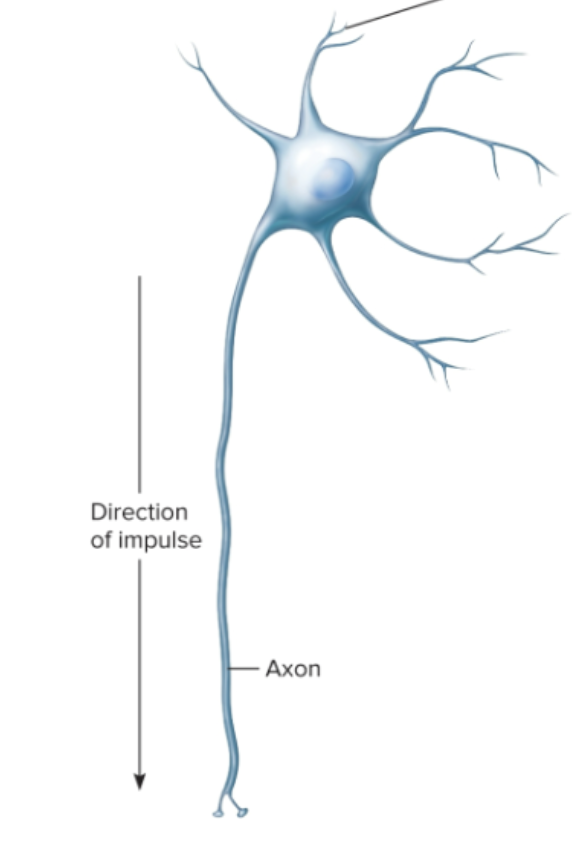
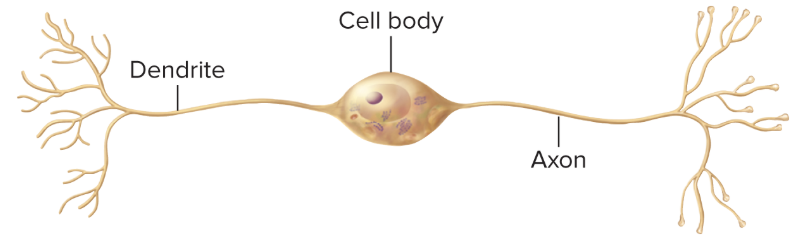
What is a multipolar neuron?
The most common type of neuron, many dendrites and one axon, multiple processes extend directly from cell body (all motor neurons)
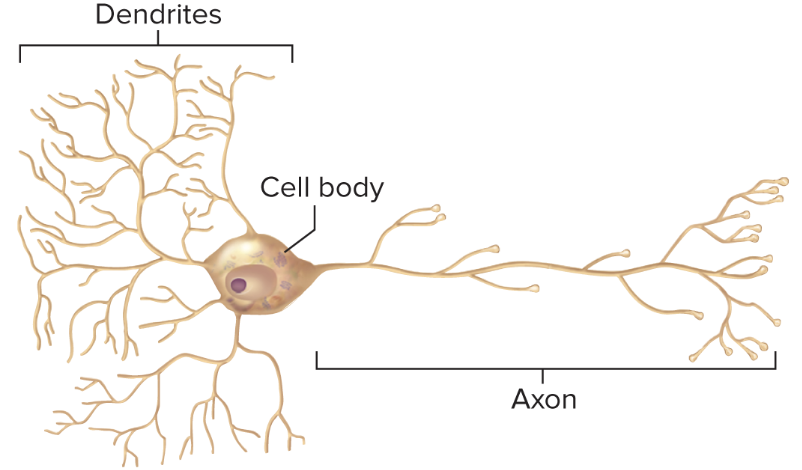
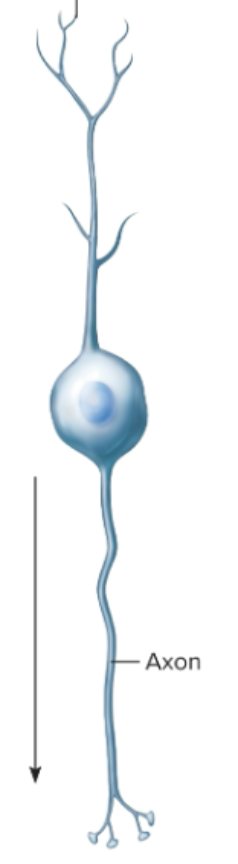
What is a bipolar neuron?
A neuron with two processes extending directly from the cell body, has one dendrite, and one axon, and are relatively limited in where they are located. They are some special sense neurons such as retina of eye, olfactory epithelium in nose)
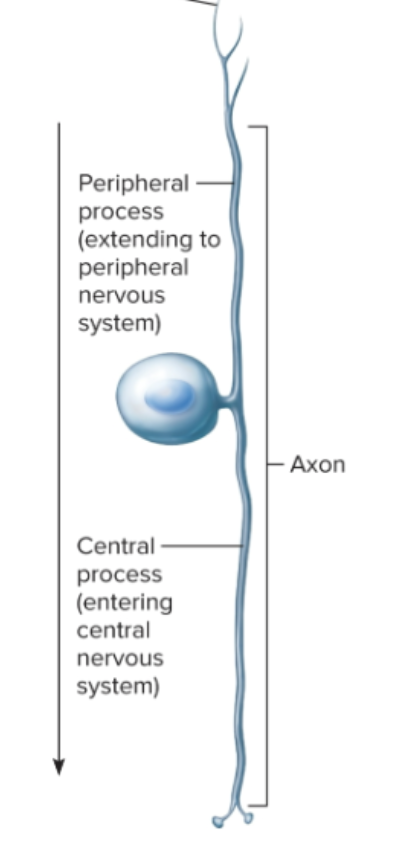
What is a unipolar neuron?
This is most sensory neurons, it includes a single short process that extends directly from the cell and and looks like a T as a result of the fusion of two processes into one long axon
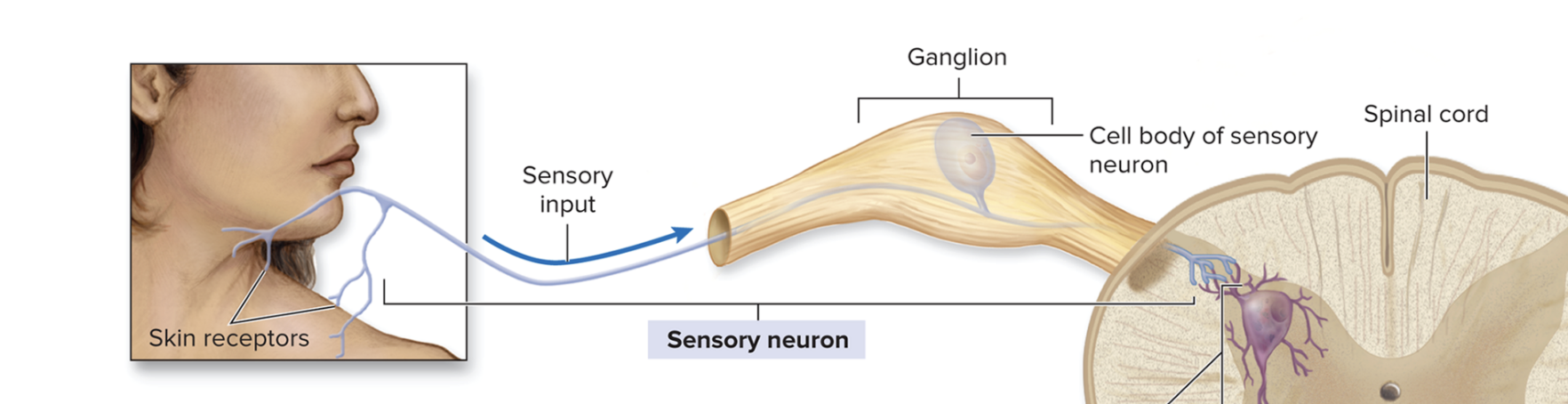
What are sensory (afferent) neurons?
Neurons of the sensory nervous system: responsible for conducting sensory input from somatic and visceral sensory receptors toward the CNS (most are unipolar, some are bipolar)
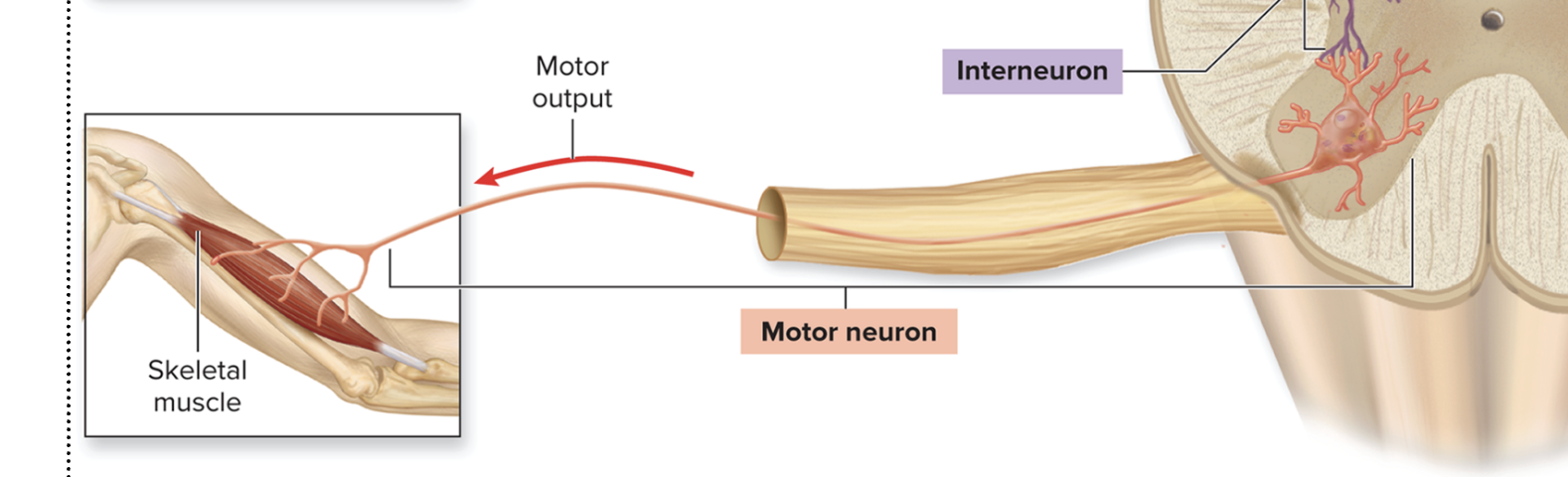
What are motor (efferent) neurons?
Neurons of the motor system which conduct motor output away from the CNS to both somatic effectors (skeletal muscle) and autonomic effectors (cardiac and smooth muscles, glands). All motor neurons are multipolar
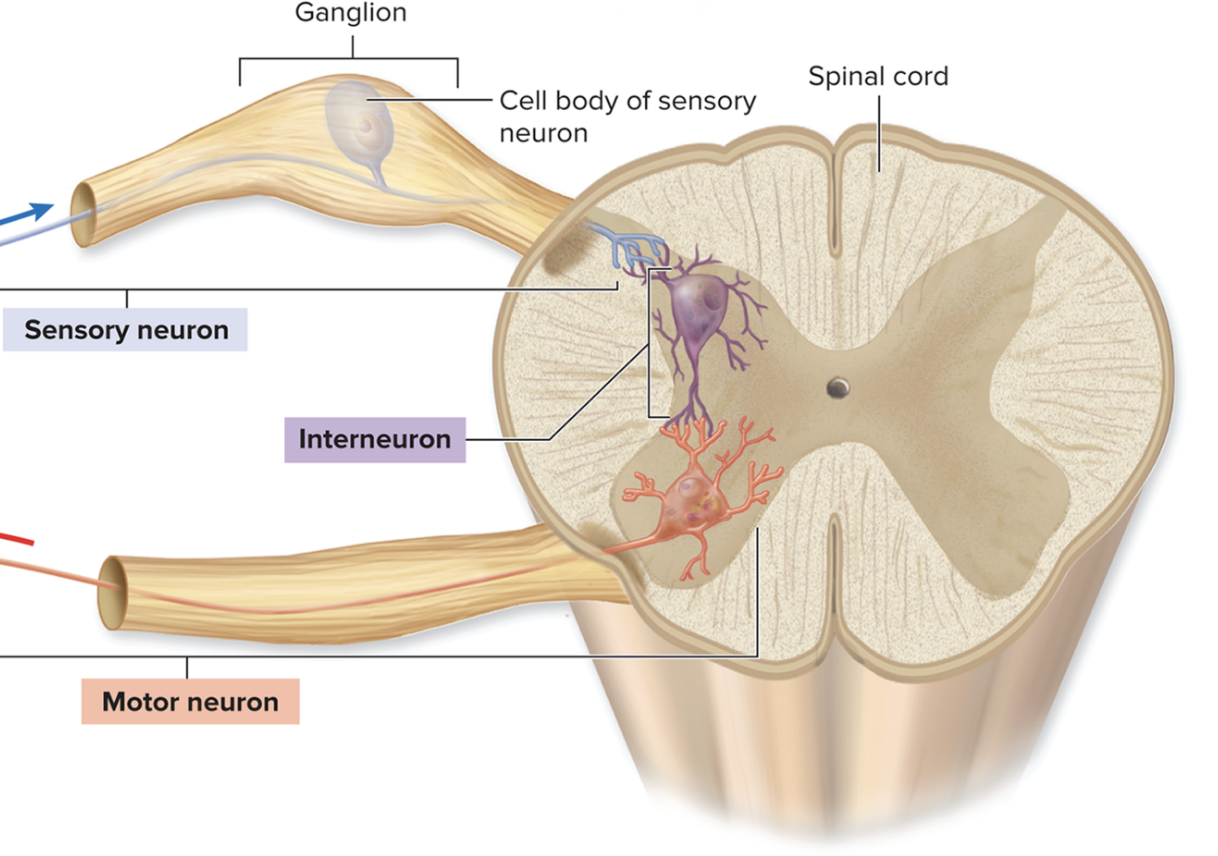
What are interneuron or association neurons?
They lie entirely within the CNS and receive stimulation from many other neurons which they then process, store information, and decide how the body responds to stimuli. They are responsible for communication between sensory and motor neurons, they are either multipolar or anaxonic and outnumber all other types of neurons
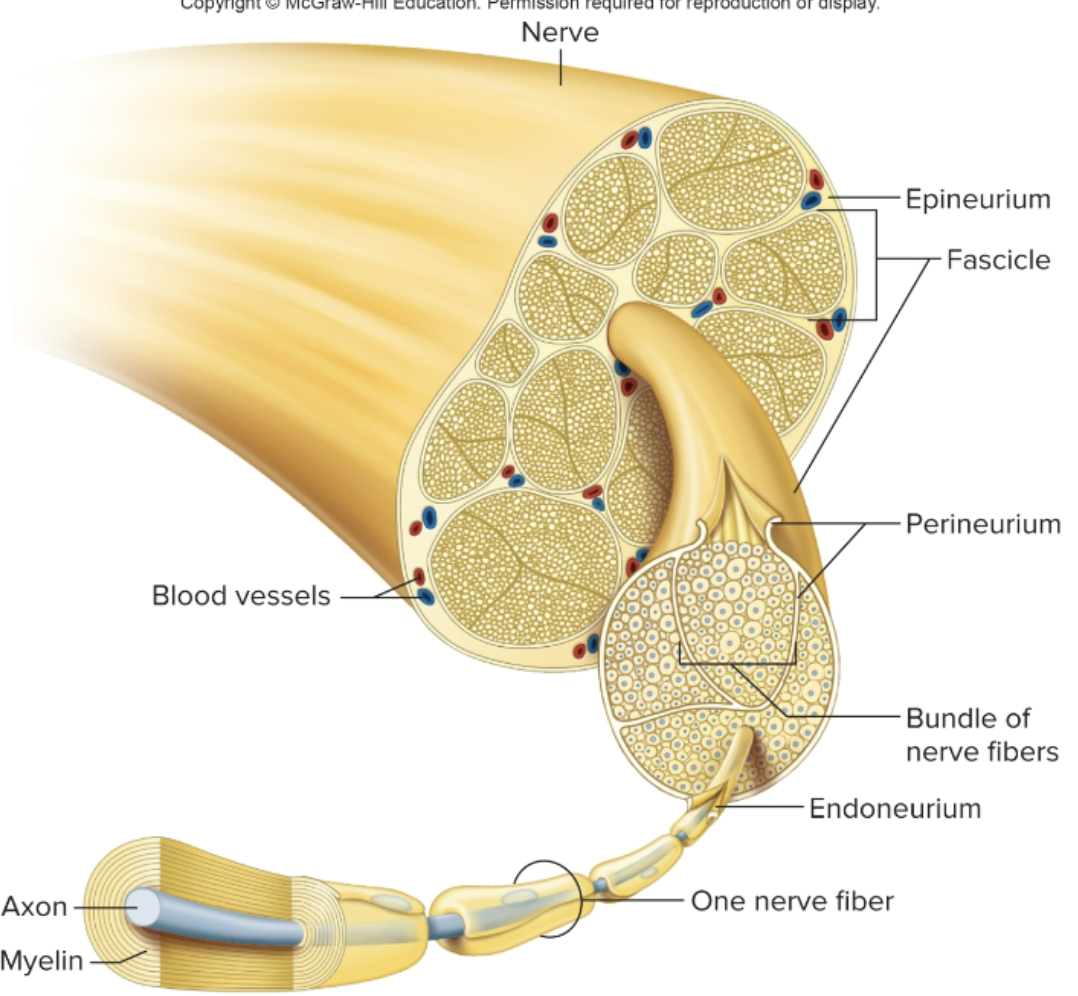
What is perineurium?
A layer of dense irregular connective tissue that wraps each fascicle. These tough, fibrous connective tissue sleeves also provide protection and support, but to each bundle of axons. This layer supports blood vessels.
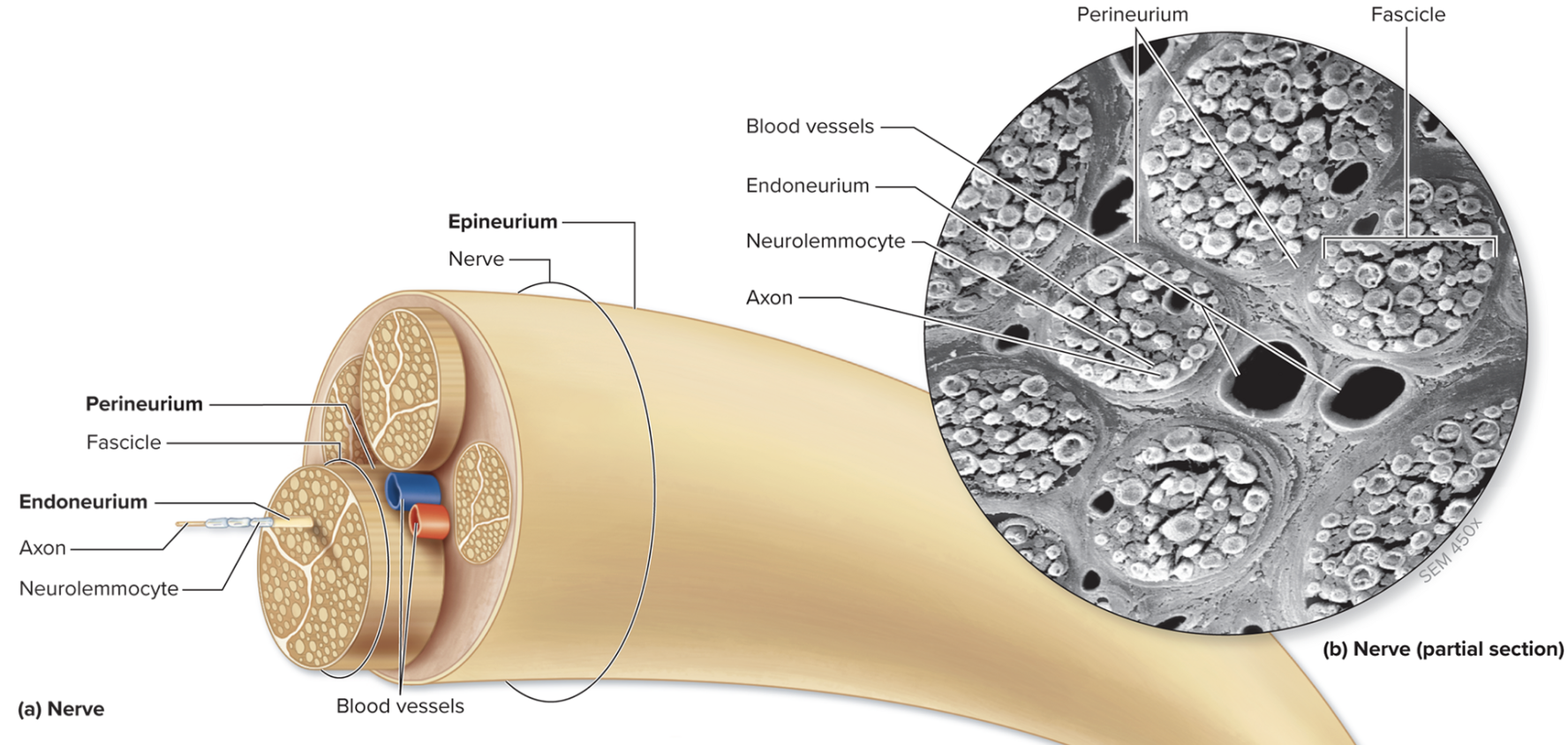
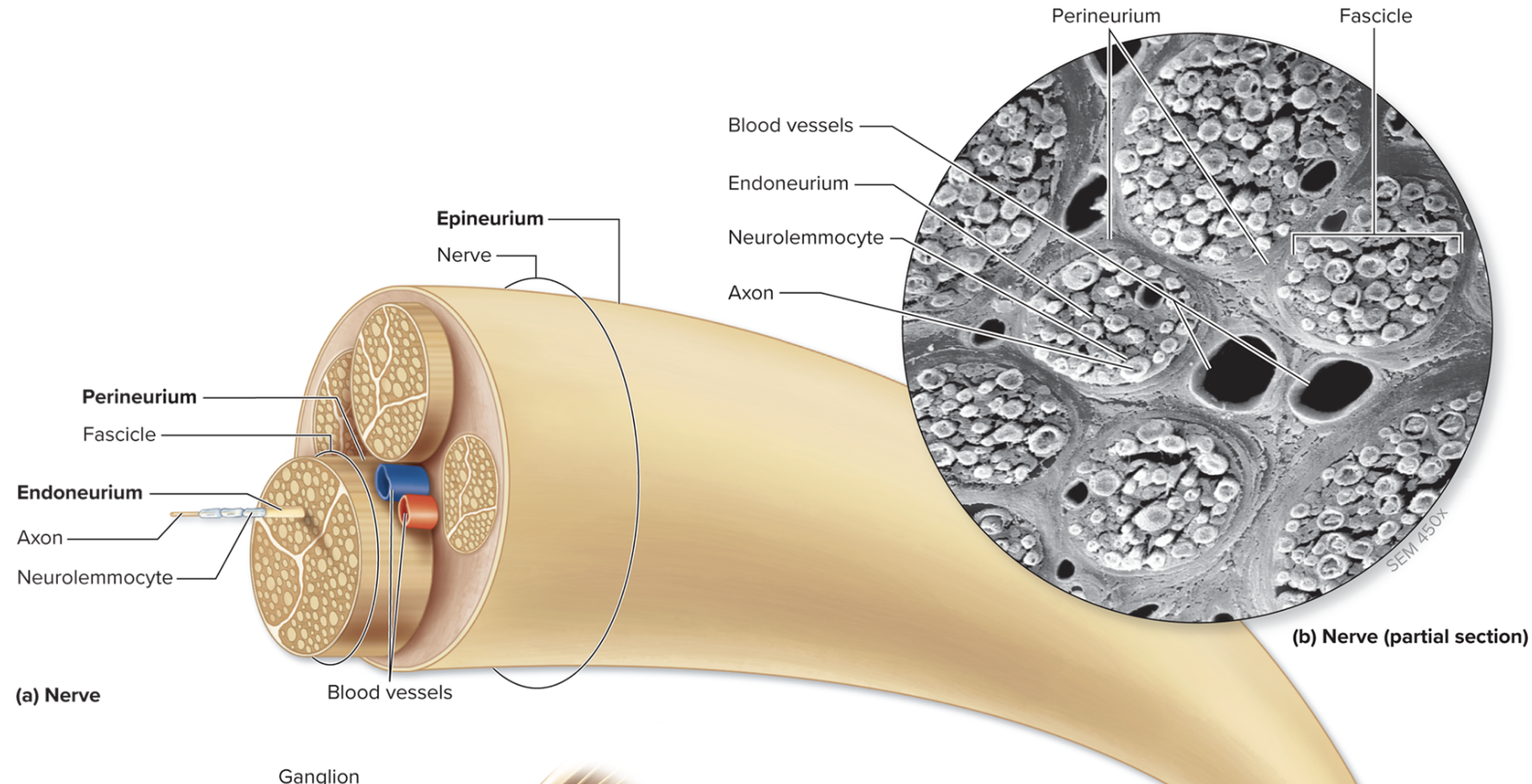
What is a fascicle?
The bundled structure of many axons within the nerve (numerous fascicles are present within the whole nerve)
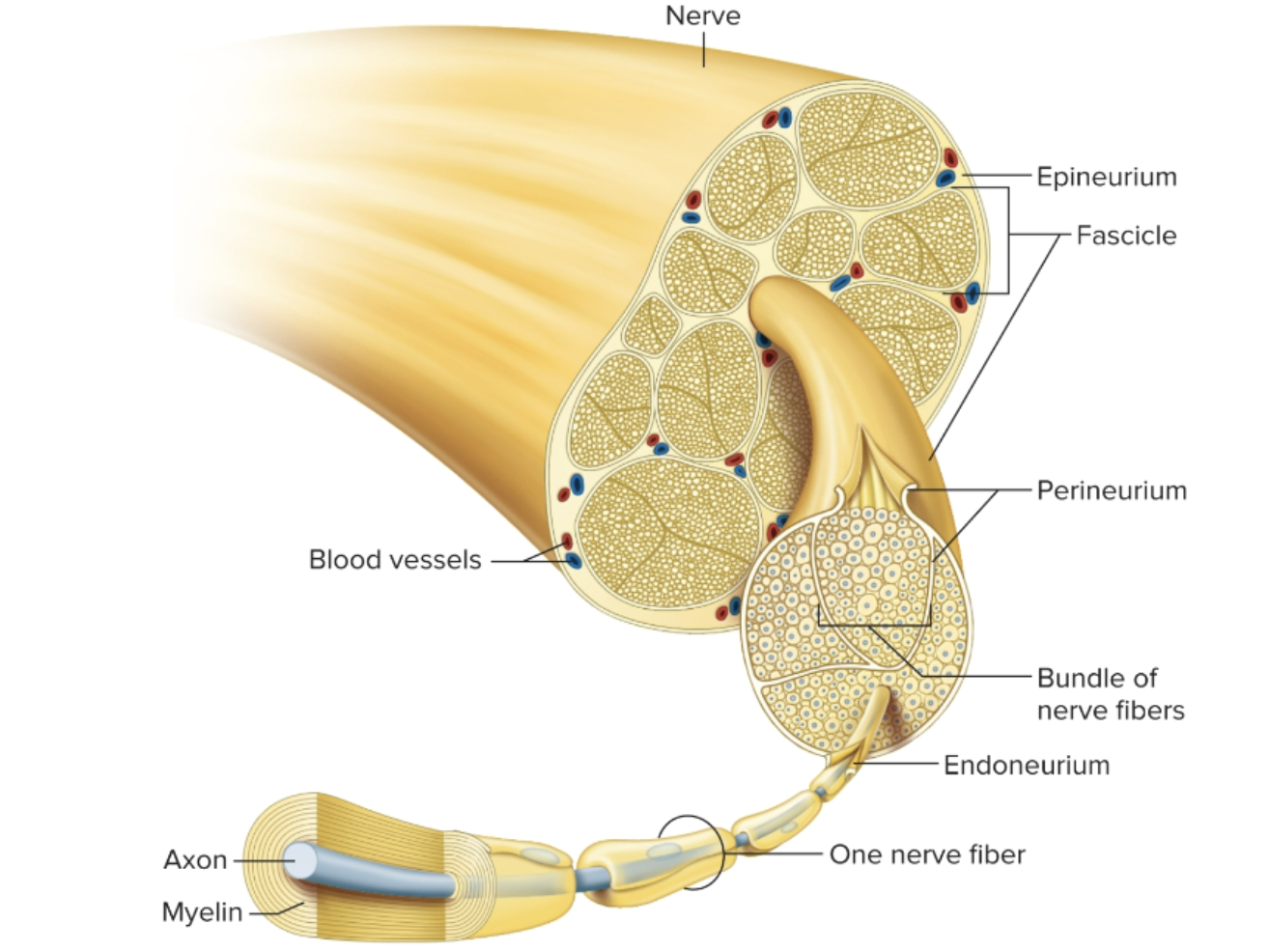
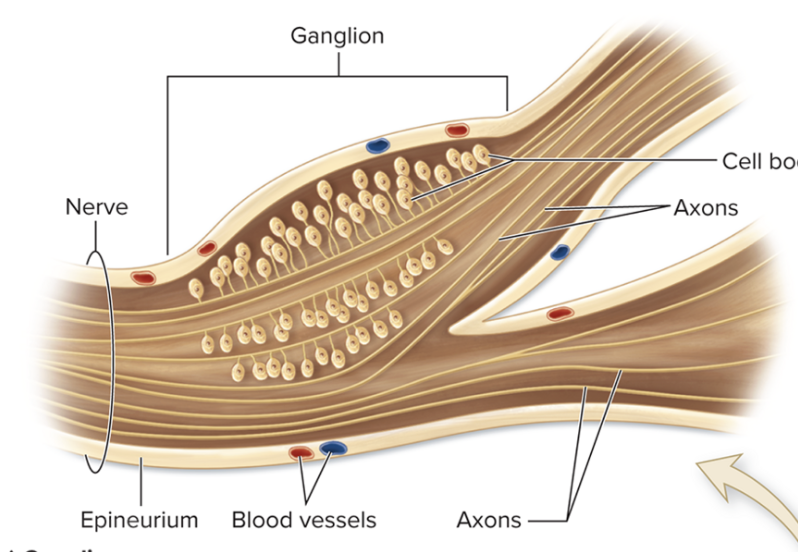
What is epineurium?
A thick layer of dense irregular connective tissue that encloses the nerve. This fibrous tissue ensheathes the entire nerve to protect and support it like a tough leather sleeve
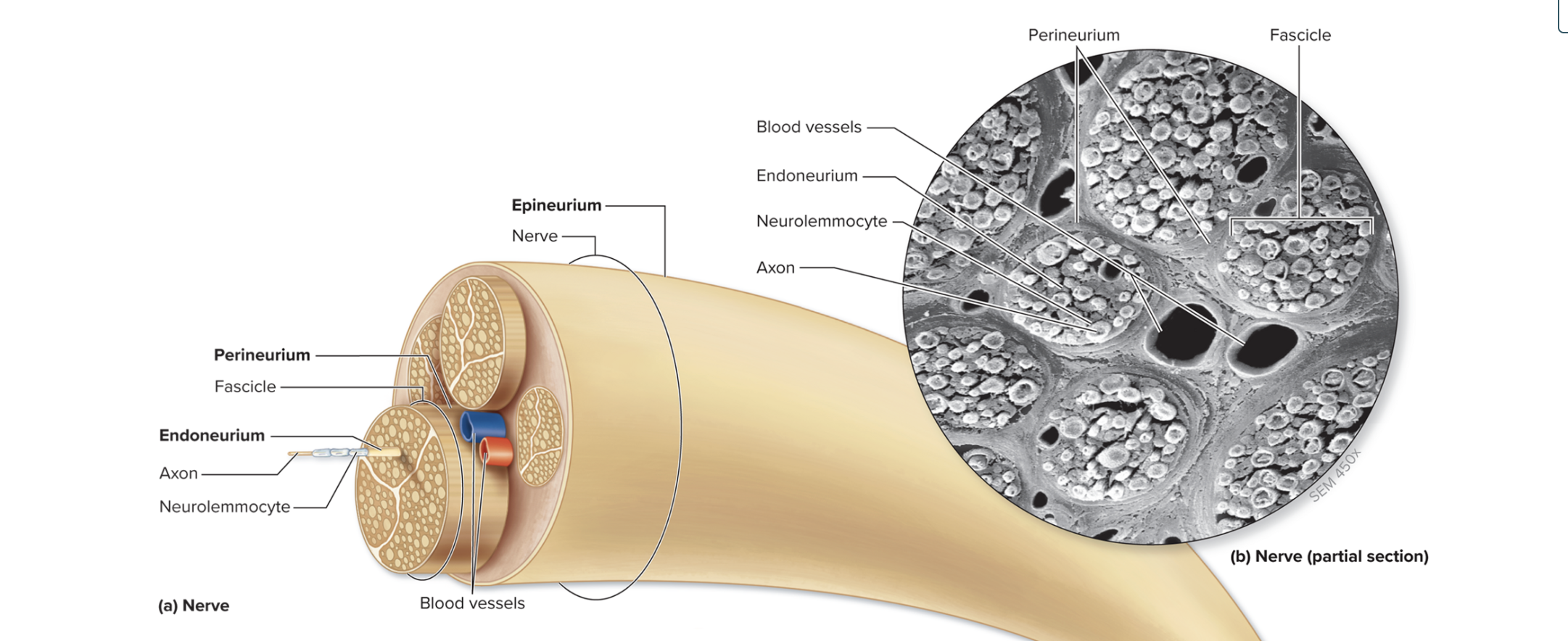
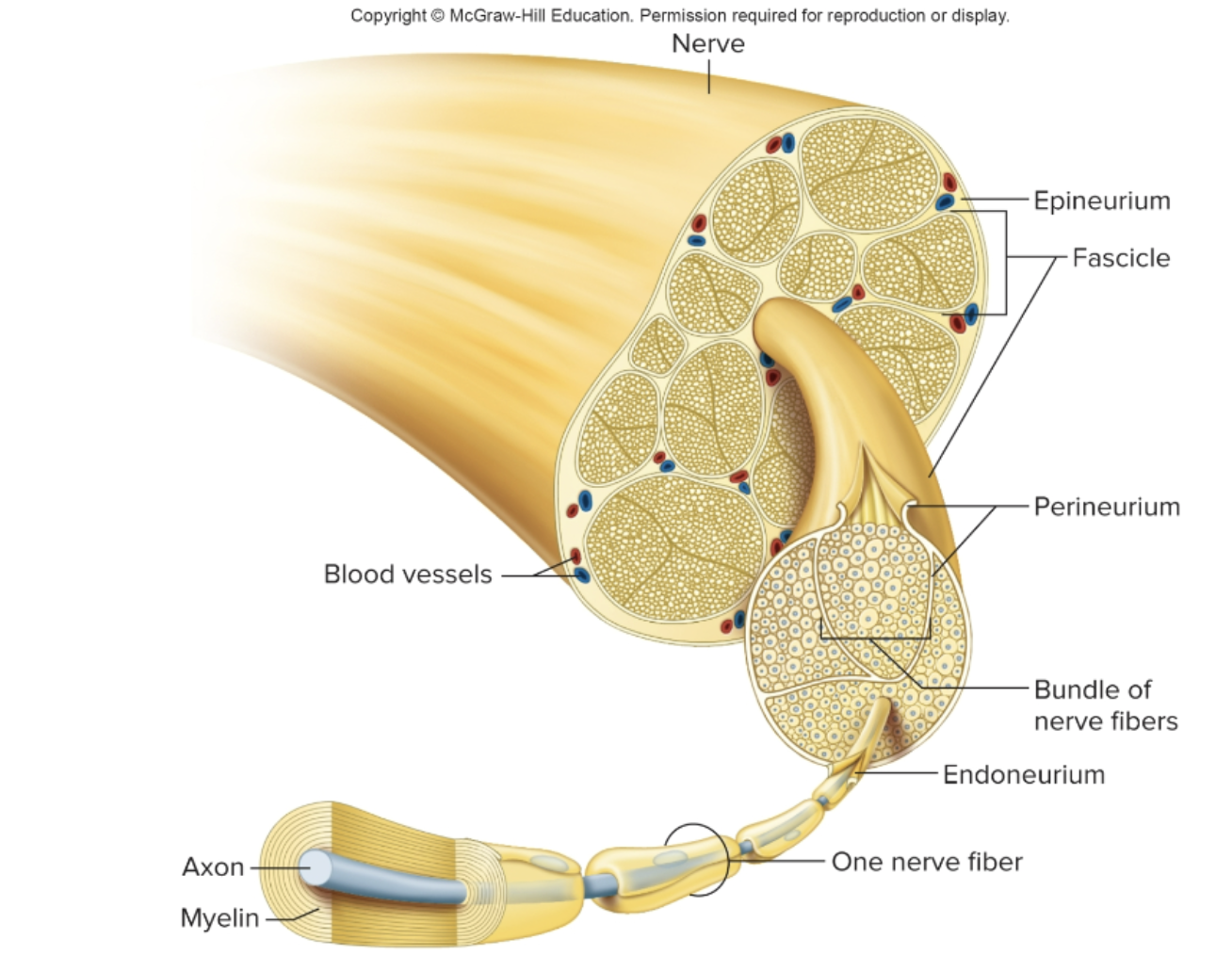
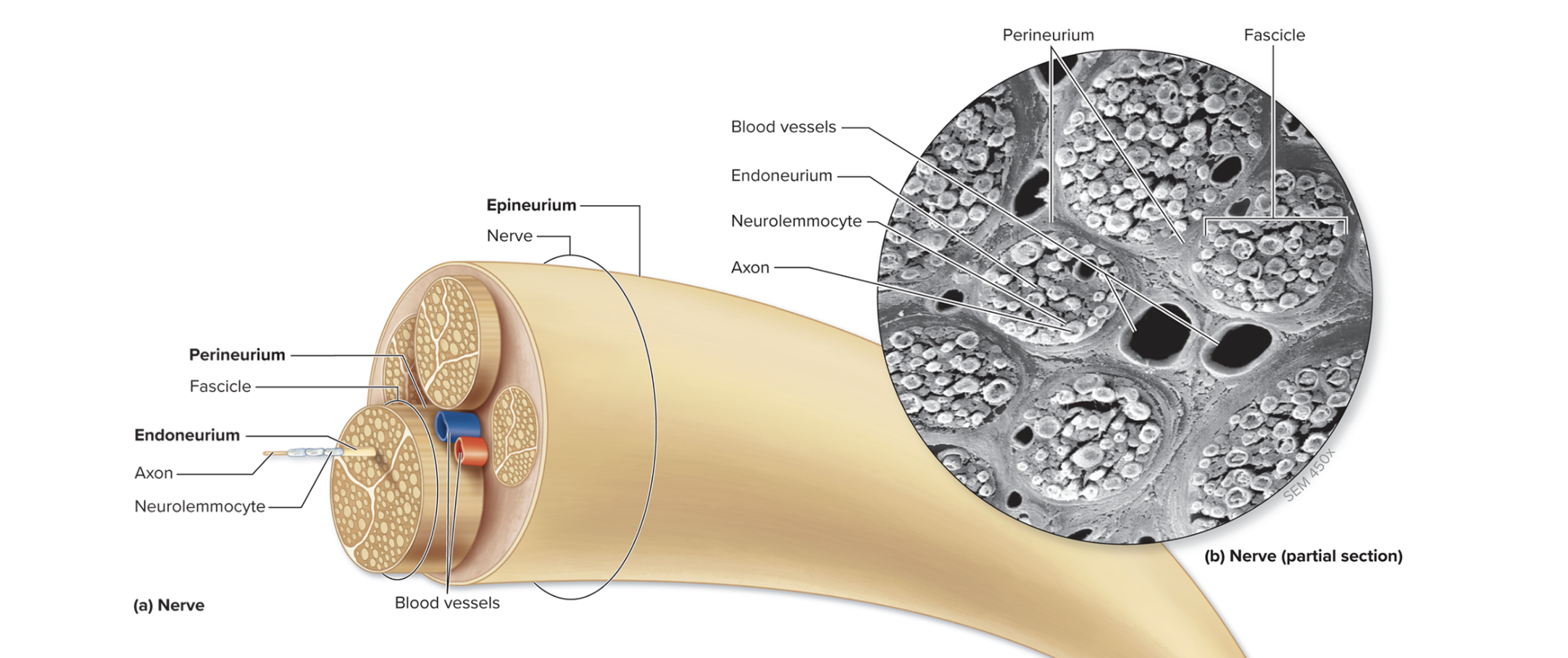
What is endoneurium?
A delicate layer of areolar connective tissue that surrounds each axon, they separate and electrically insulate each axon
What is the difference between mixed nerves, sensory nerves, and motor nerves?
Mixed nerves contain both sensory and motor neurons (allows signals to flow in both dir.)
Sensory nerves contain only sensory neurons that relay information toward the CNS
Motor nerves contain only motor neurons that relay information away from the CNS
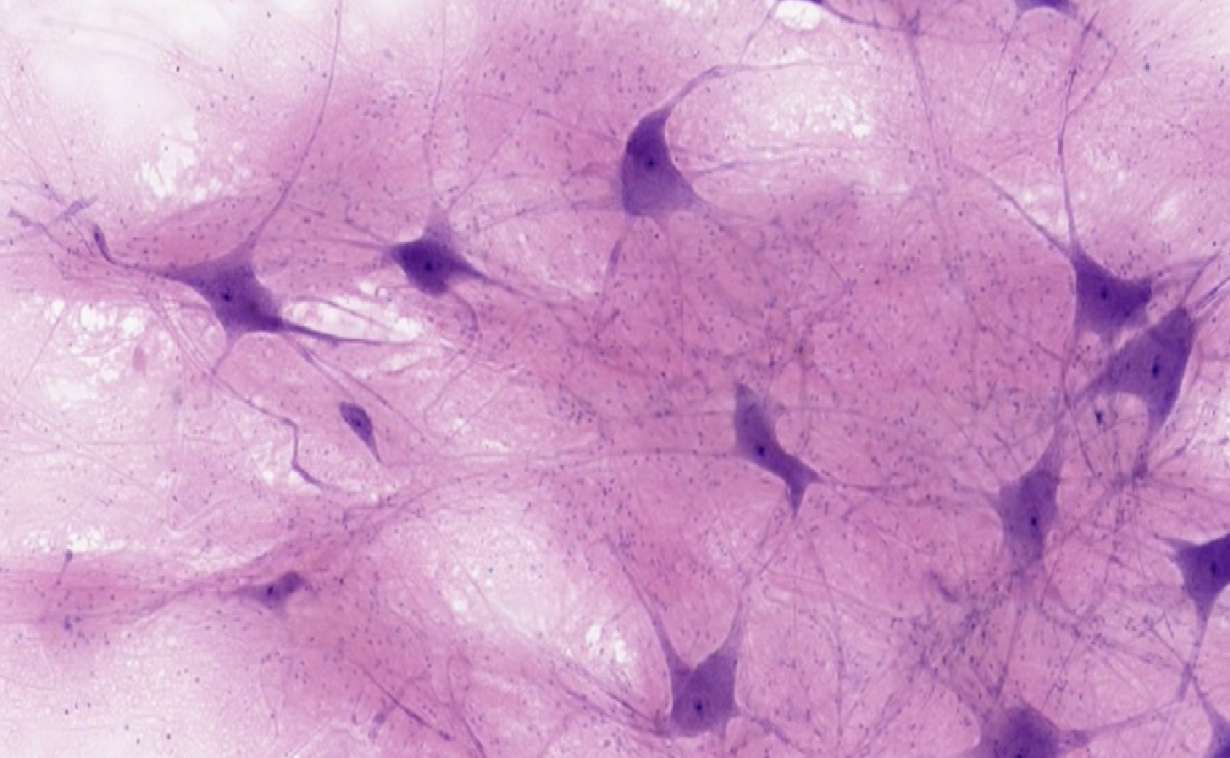
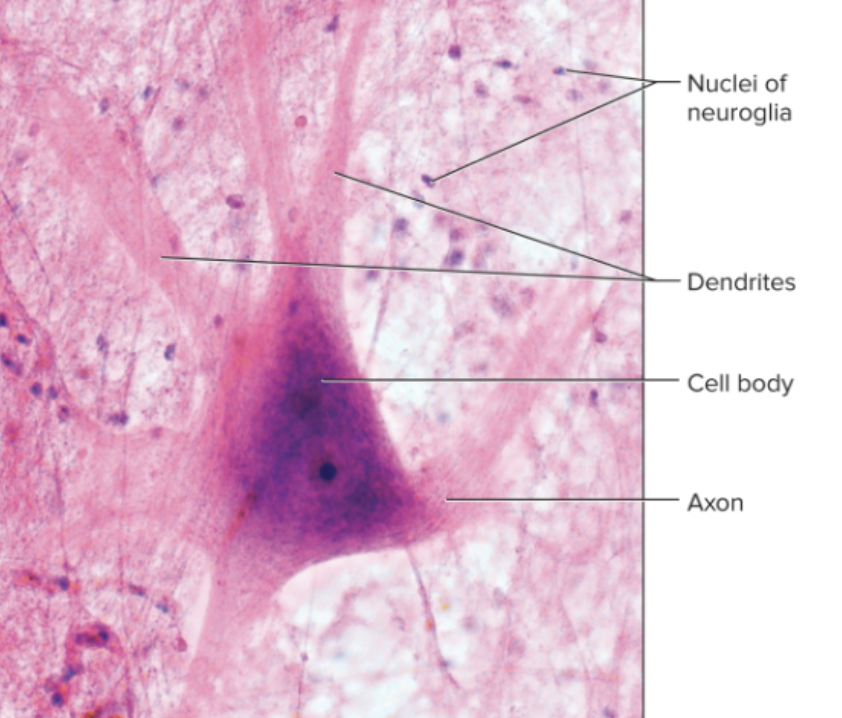
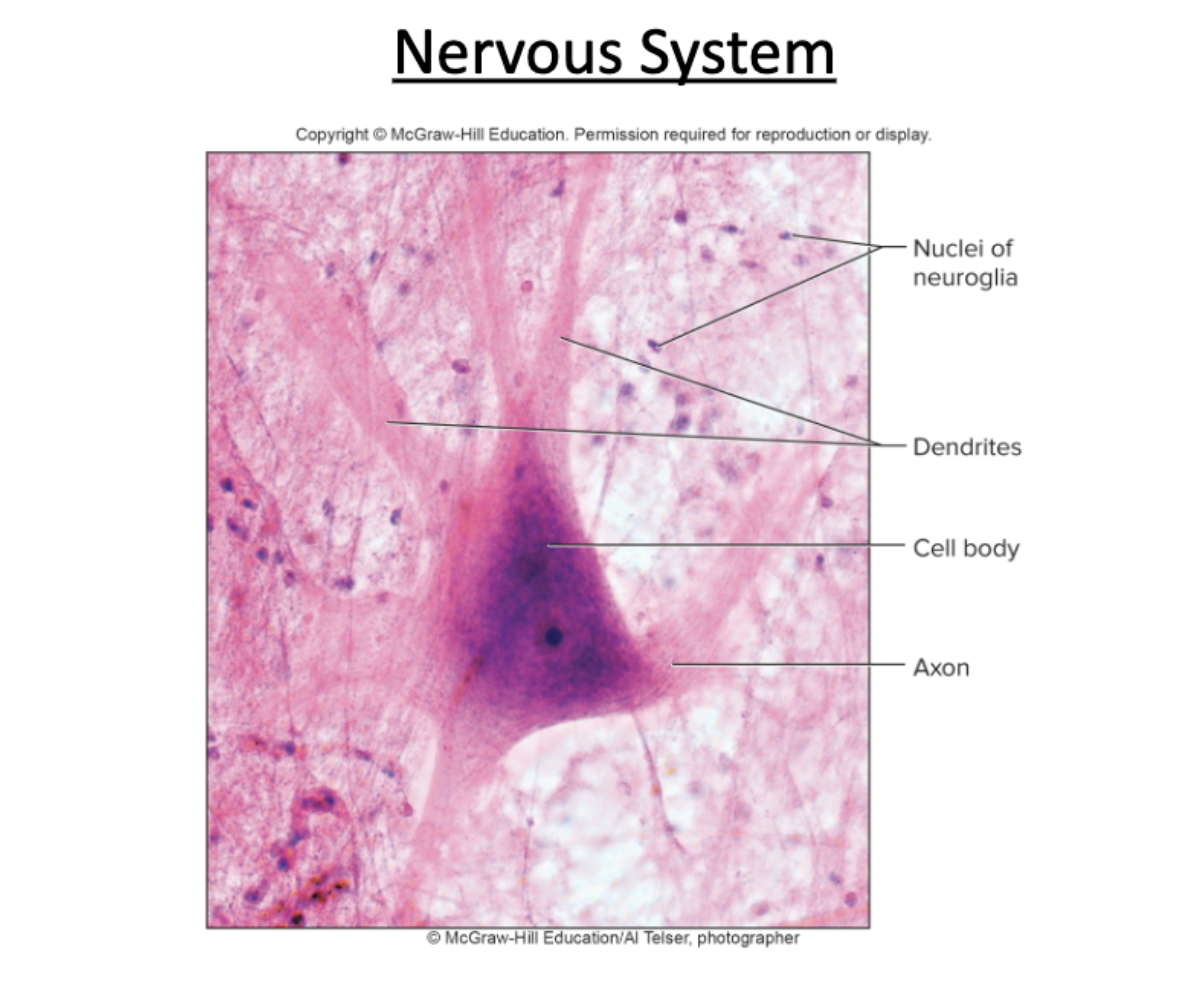
What is this?
Multipolar nuerons
Many dendrites
Cell nucleus appears as a dark spot in cell body
Many tiny dark purple spots = nuclei of glial cells
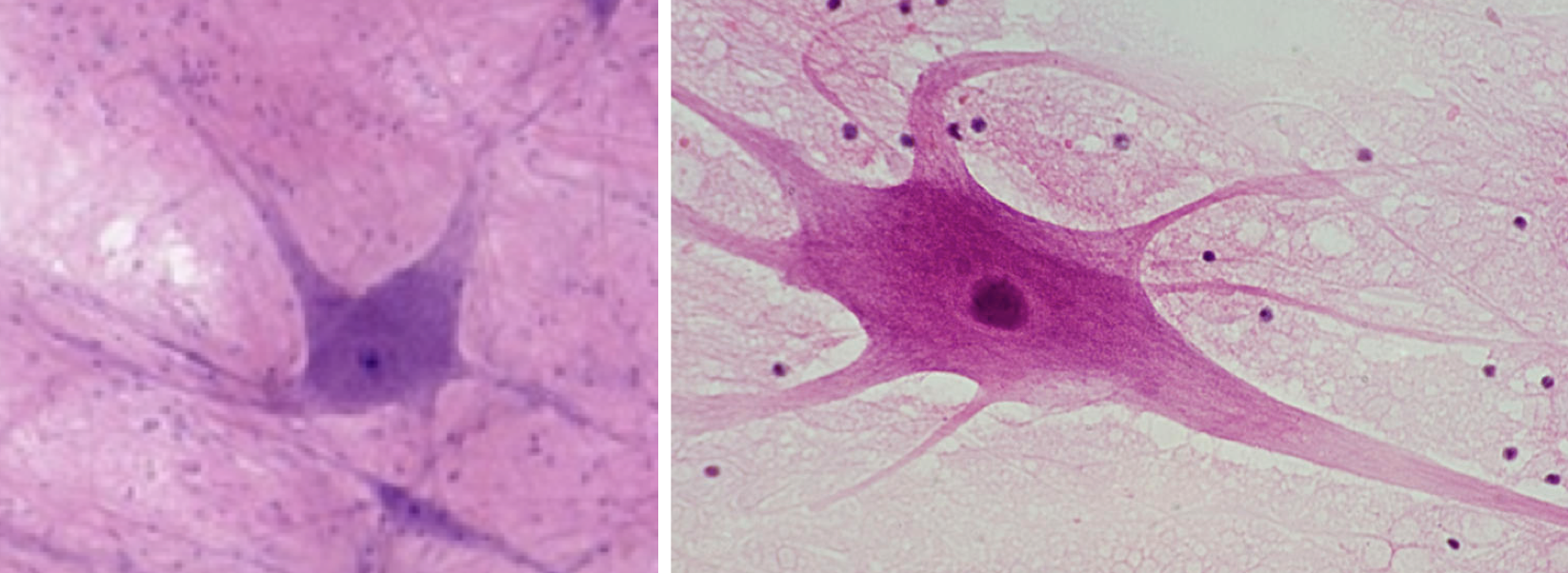
What is this?
Multipolar neuron
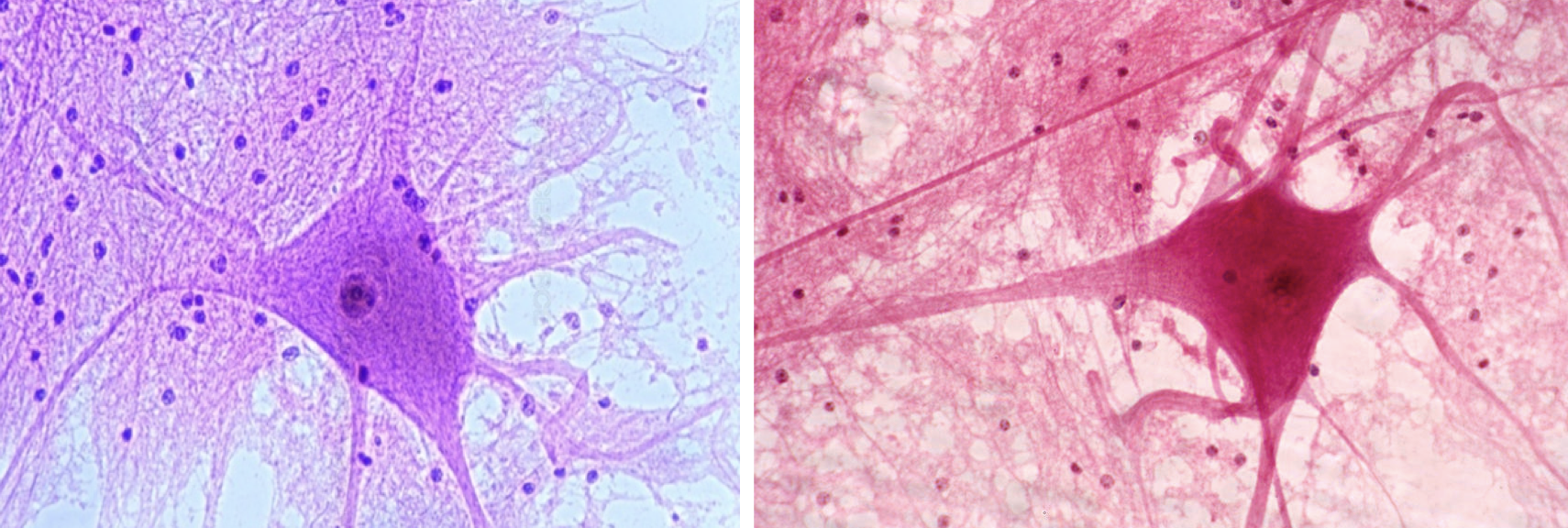
What is this?
Multipolar neuron
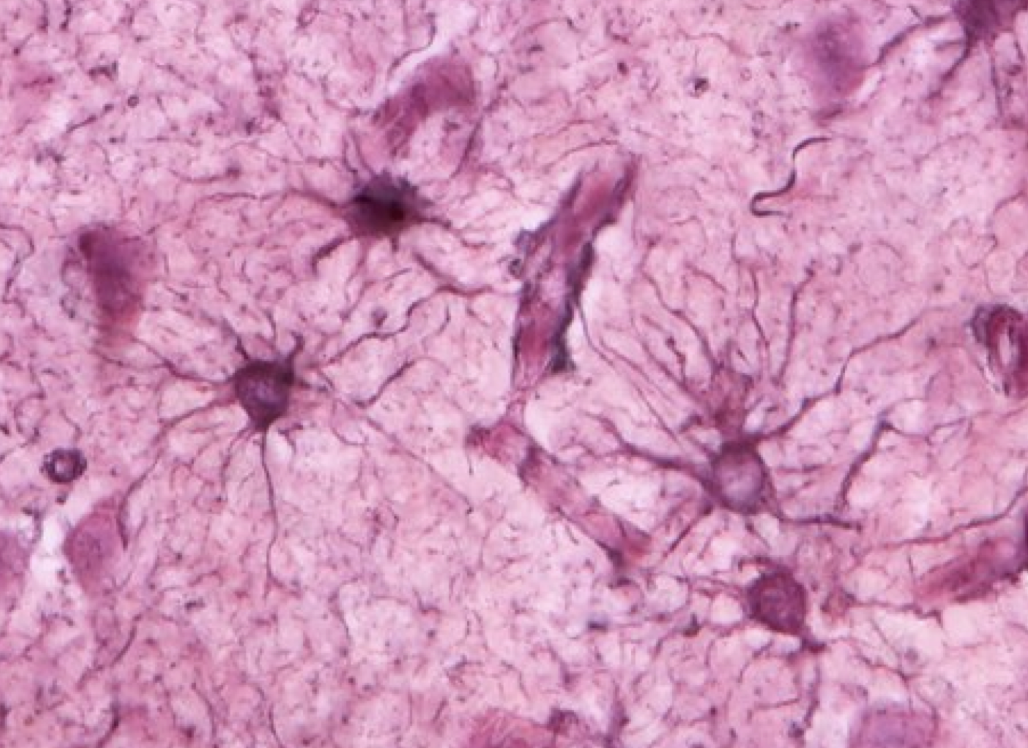
What is this?
Astrocyte
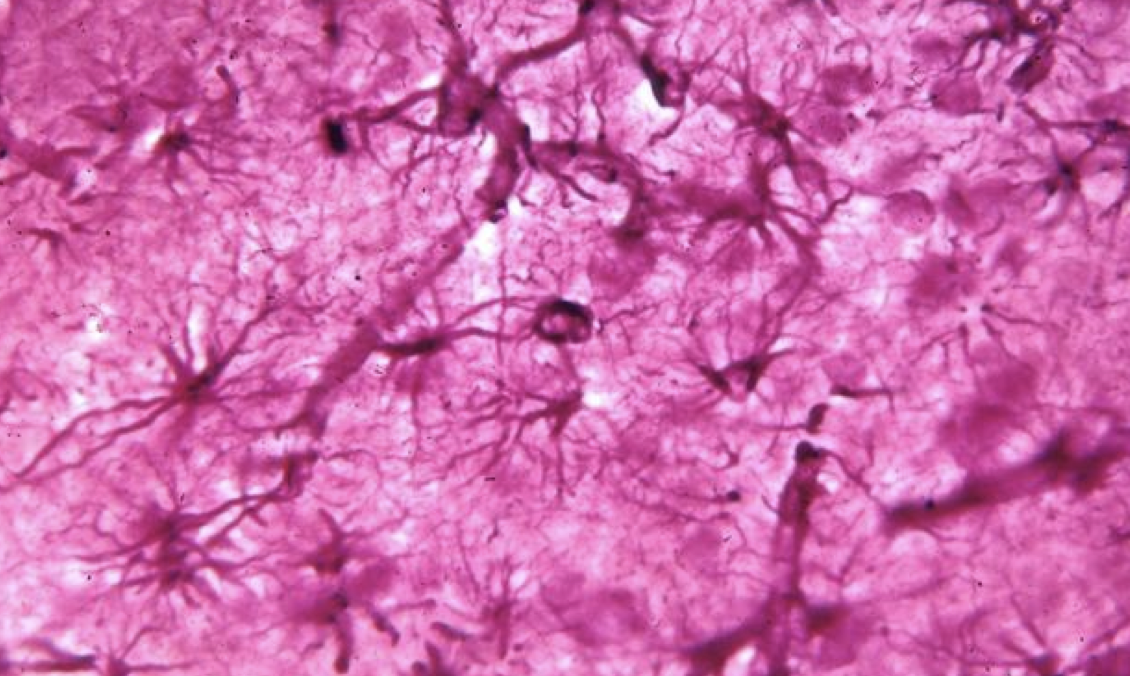
What is this?
Astrocyte
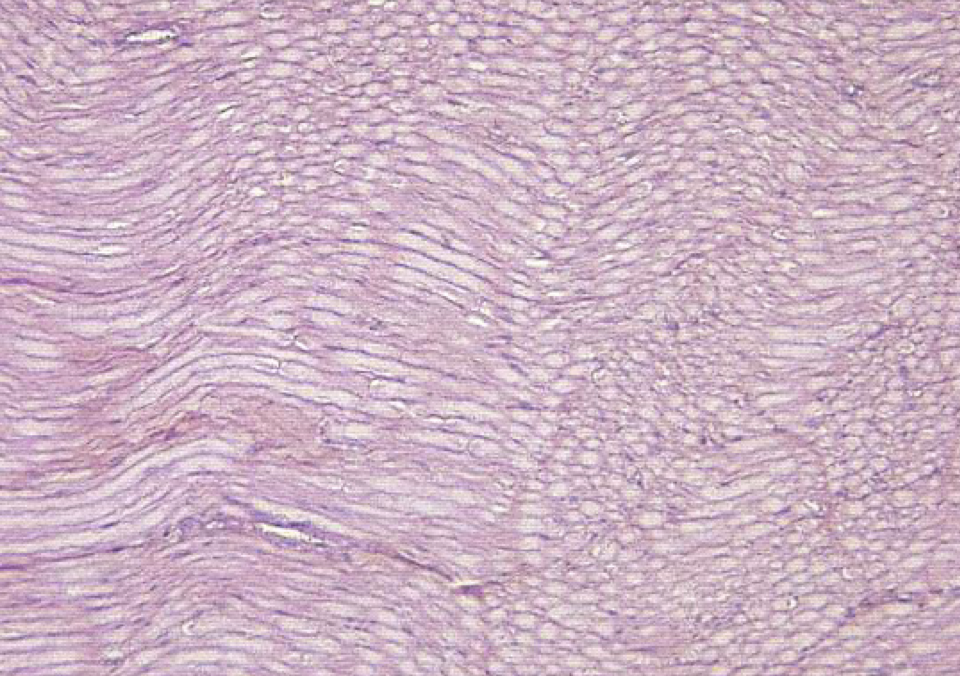
What is this?
Peripheral nerve
Linear arrangements of myelinated nerve fibers with their outer layer of Schwann cells
The membranes of the Schwann cells from the myelin sheath
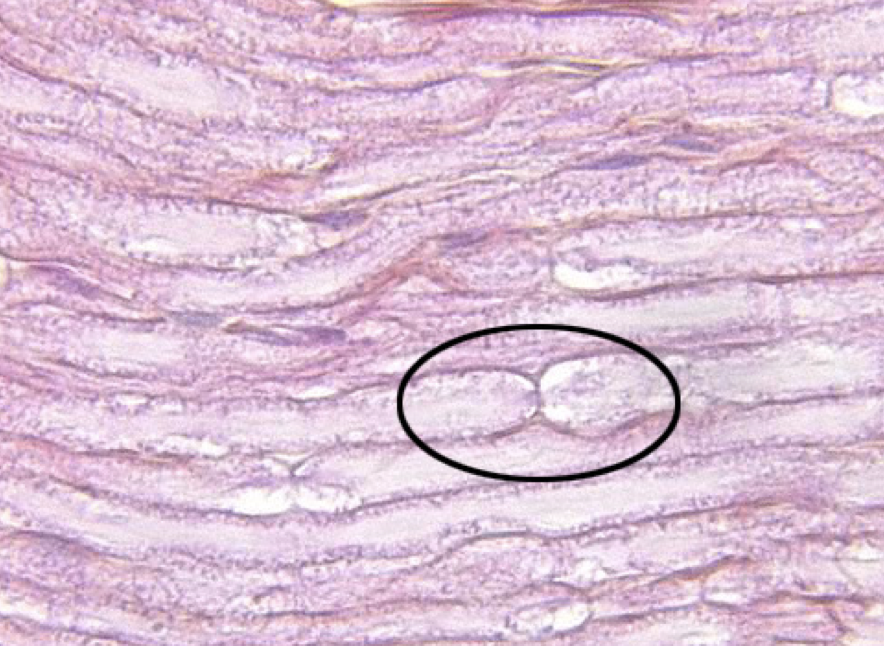
What is this?
The node of the peripheral nerve (notice the linear schwann cells)
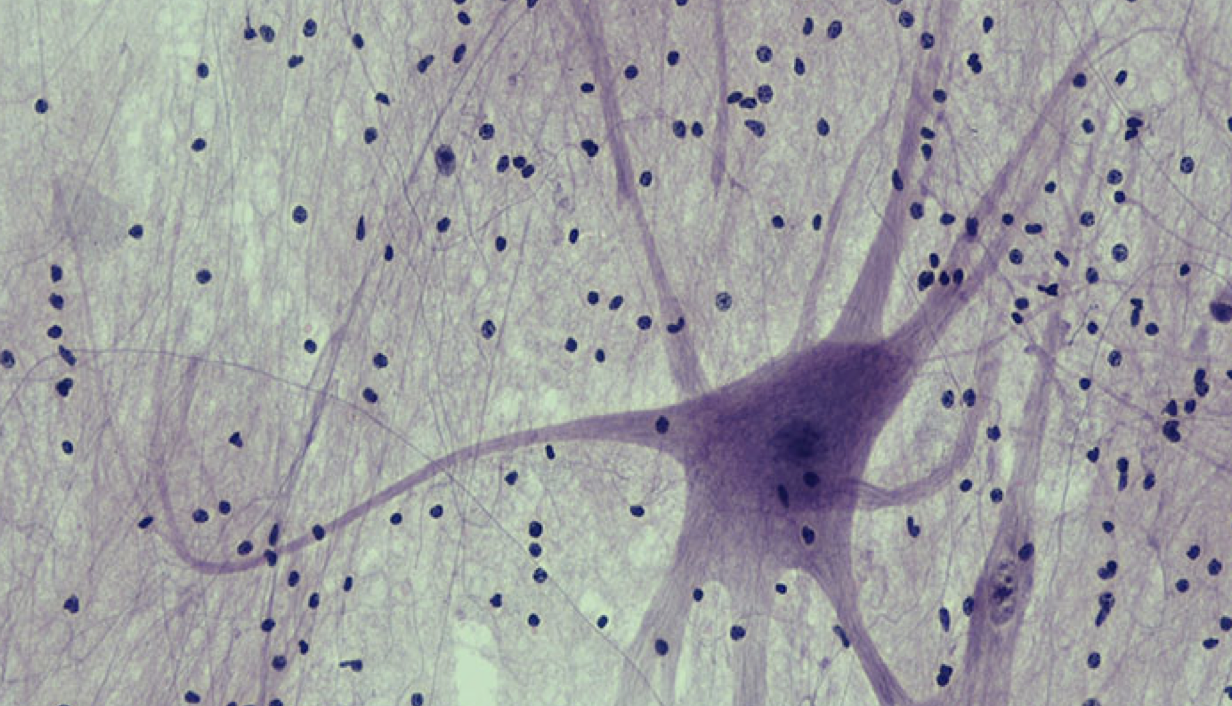
What is this?
Multipolar neuron
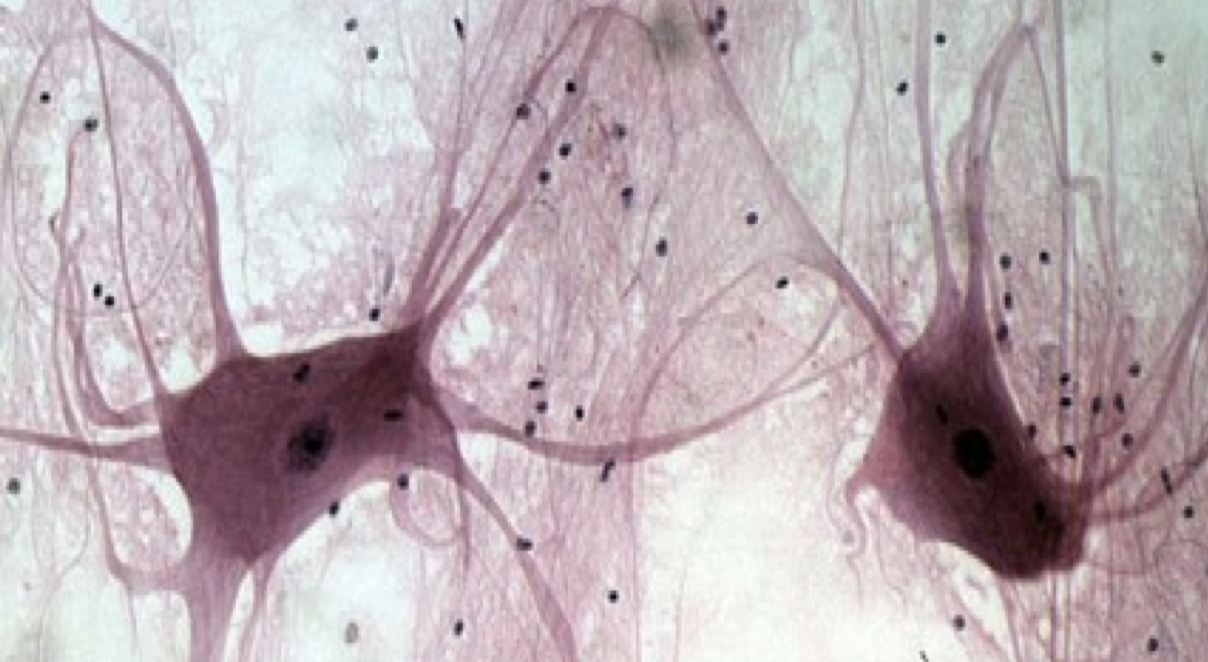
What is this?
Multipolar neuron
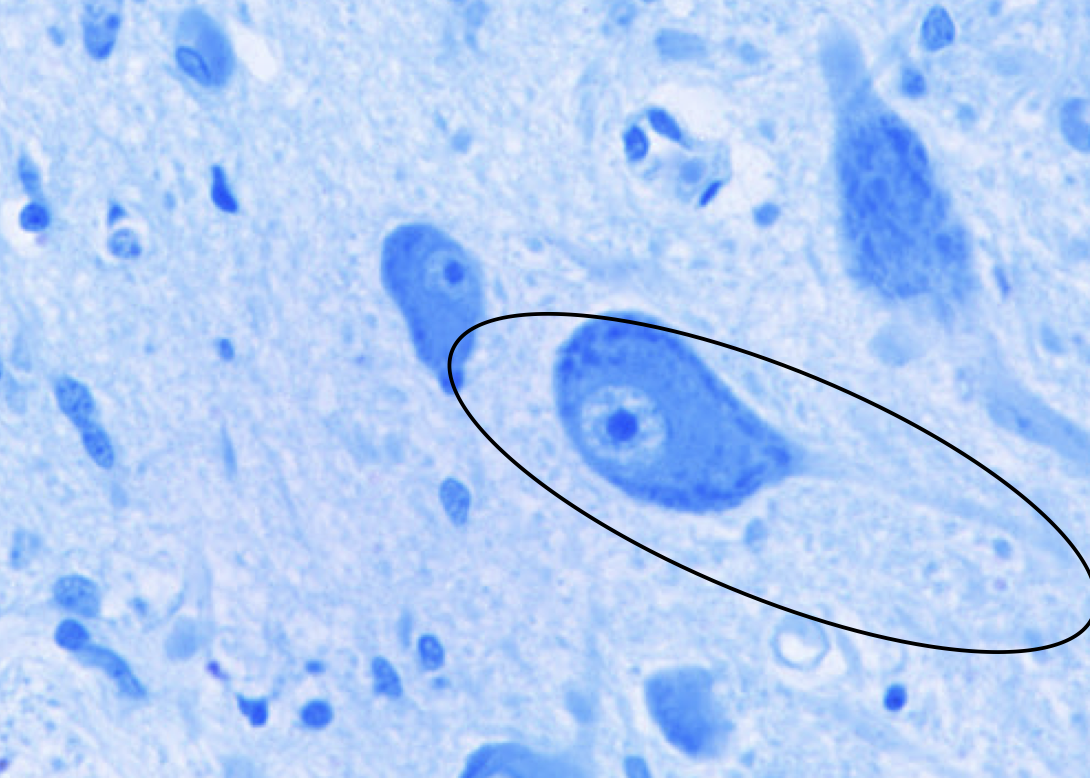
What is this?
Unipolar neuron
single process attached to cell body
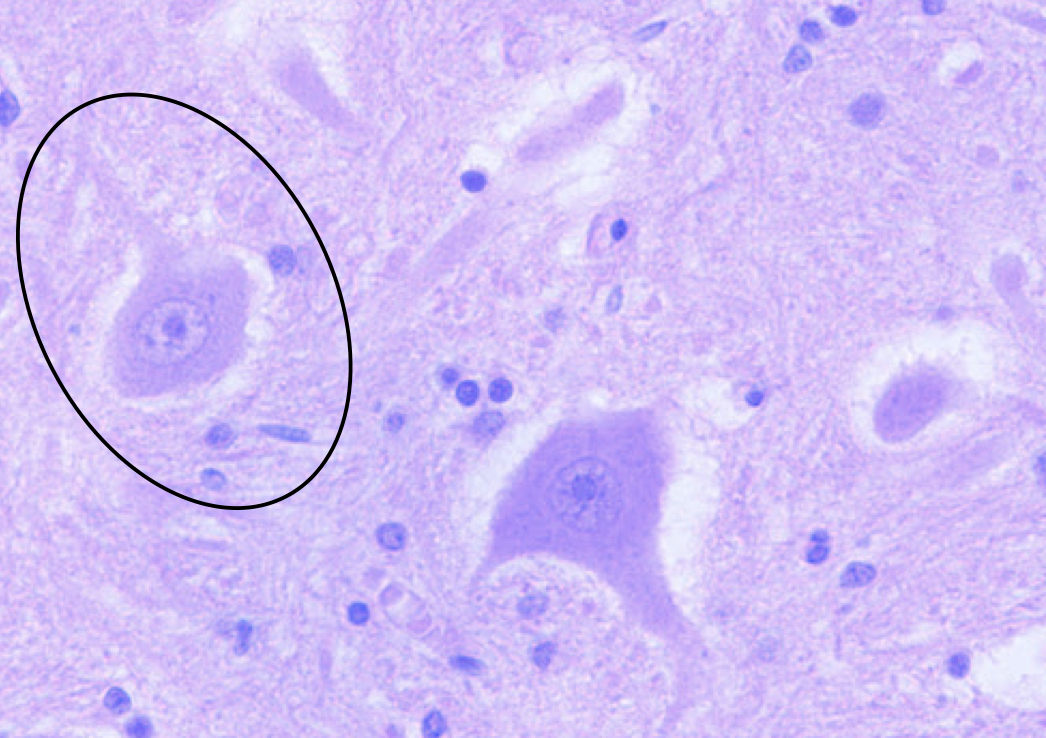
What is this?
Unipolar neuron
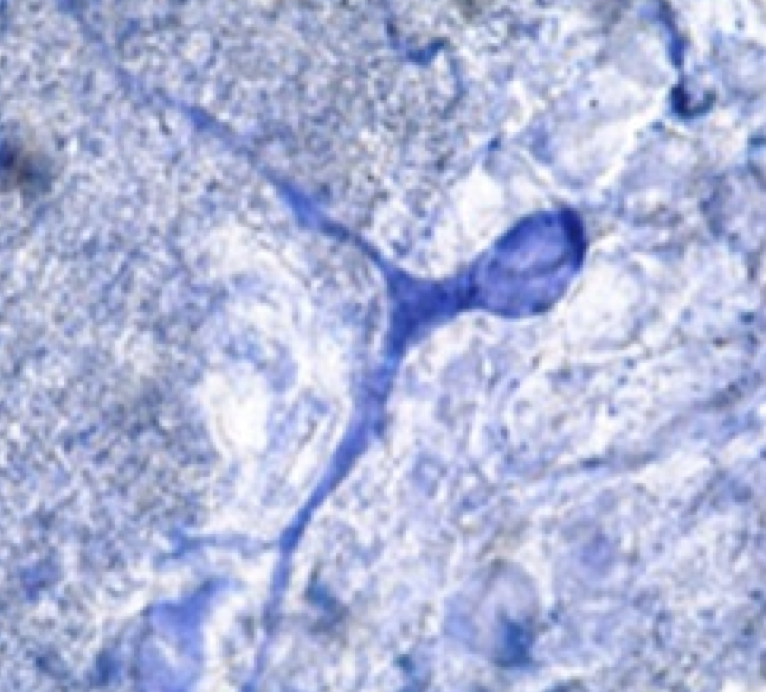
What is this?
Unipolar neuron
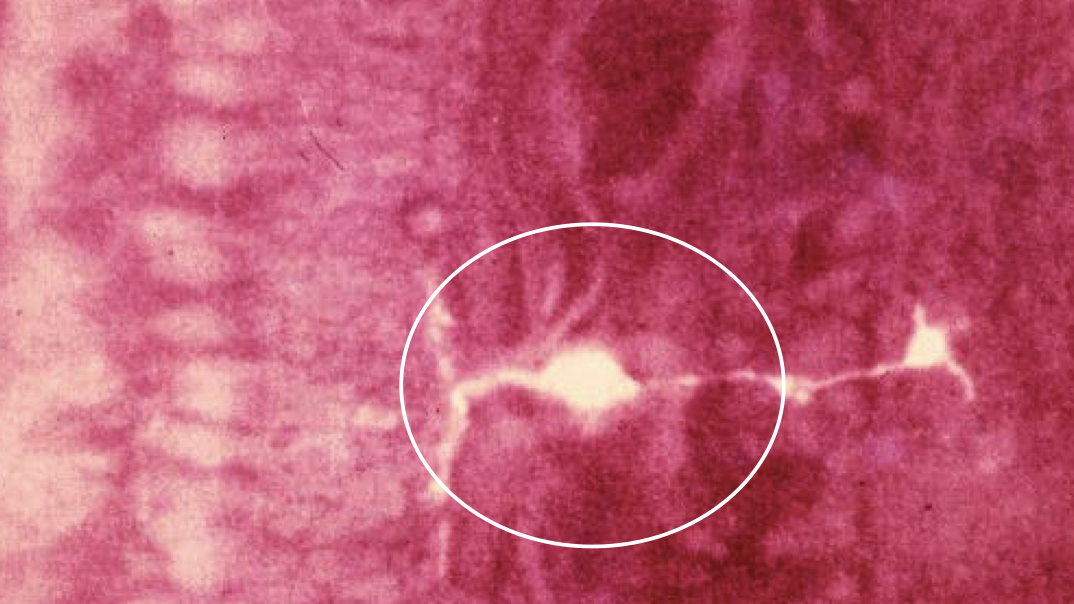
What is this?
Bipolar neuron
Two processes attached to the cell body
What is cranial nerve 1?
Olfactory: sense of smell (sensory)
What is cranial nerve 2?
Optic: sense of vision (sensory)
What is cranial nerve 3?
Oculomotor: controls inferior rectus, superior rectus, medial rectus, and inferior oblique (motor)
What is cranial nerve 4?
Trochlear: controls superior oblique (external eye muscle) (motor)
What is cranial nerve 5?
Trigeminal: carries sensory information from scalp, forehead, nose, cheeks, jaw, gum, and teeth as well as controls mastication muscles (mixed)
What is cranial nerve 6?
Abducens: controls lateral rectus (external eye muscle) (motor)
What is cranial nerve 7?
Facial: facial expression and autonomic control of lacrimal and salivary glands, sense of taste (mixed)
What is cranial nerve 8?
Vestibulocochlear: sense of hearing and equilibrium (sensory)
What is cranial nerve 9?
Glossopharyngeal: swallowing, salivation, gagging, control of blood pressure and respiration (mixed)
What is cranial nerve 10?
Vagus: swallowing, speech control in larynx and pharynx, controls heart, respiration, digestion, urinary system (mixed)
What is cranial nerve 11?
Accessory: control of head, beck, and shoulder movement (motor)
What is cranial nerve 12?
Hypoglossal: control of tongue movements for speech, food manipulation and swallowing (motor)
What is the mnuemonics for the cranial nerves (both name and kind of neuron)
Name: Oh Oh Oh To Touch And Feel Virgin Girls Vaginas AH
Neuron: Some Say Money Matter But My Brother Say Big Brains Matter More
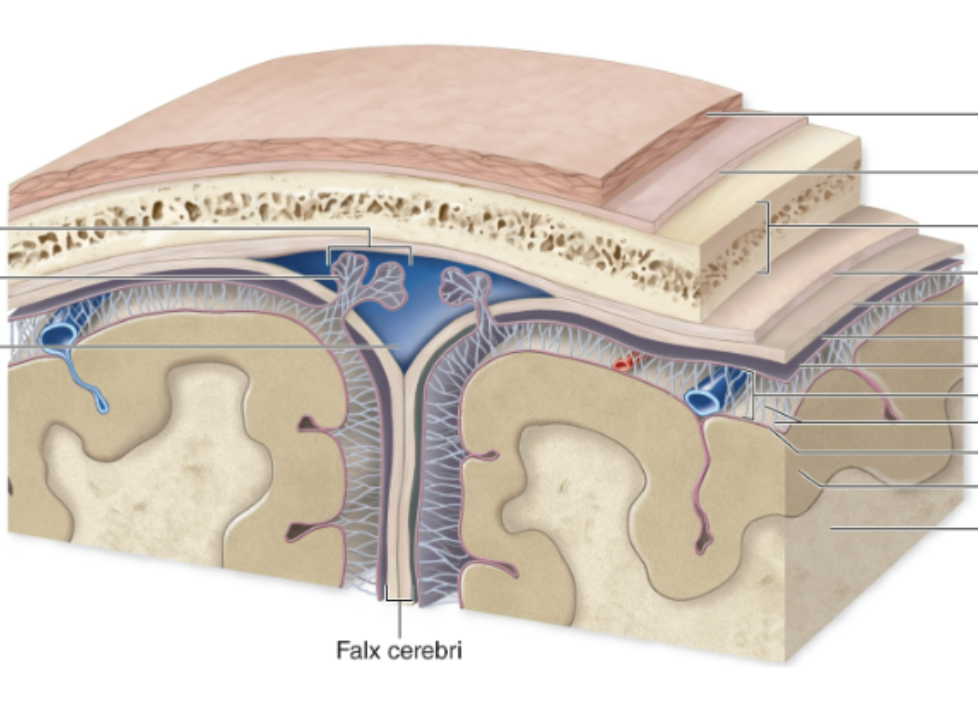
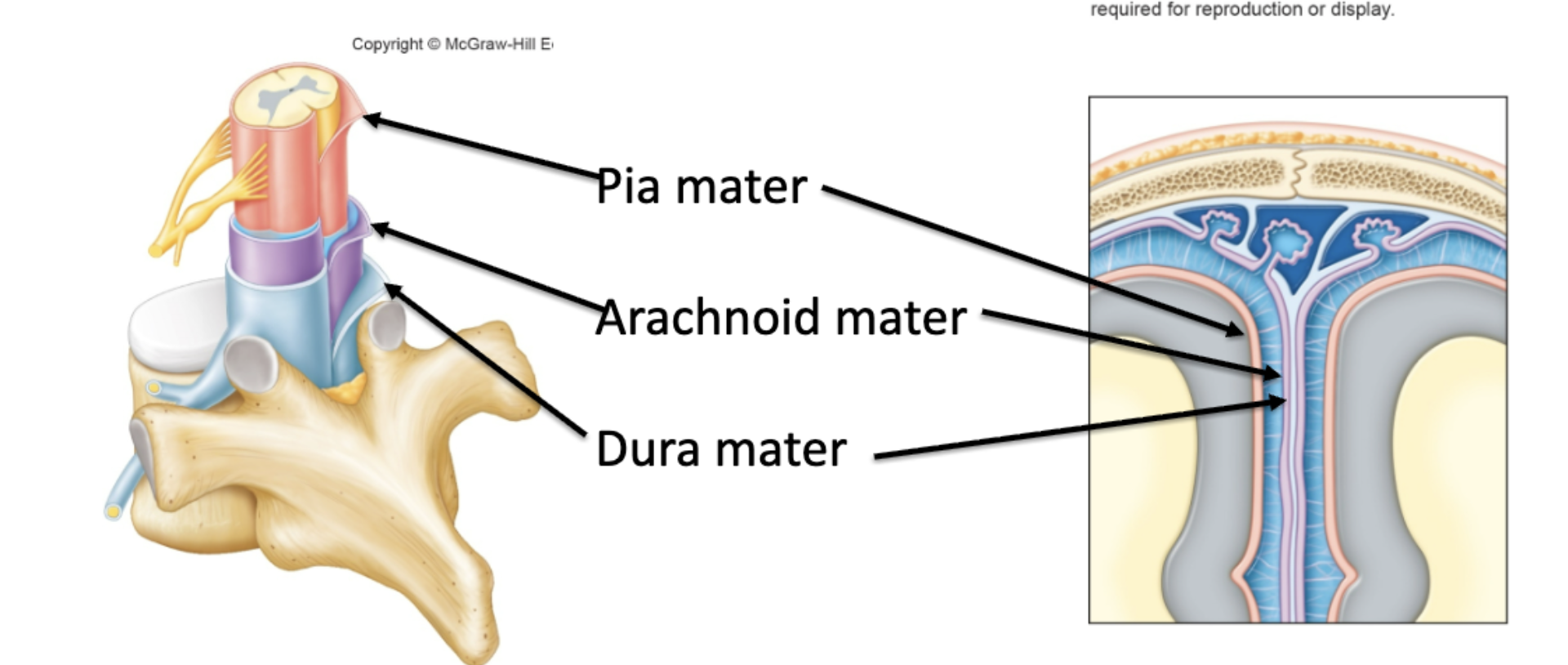
Identify the pia mater, dura mater, arachnoid mater
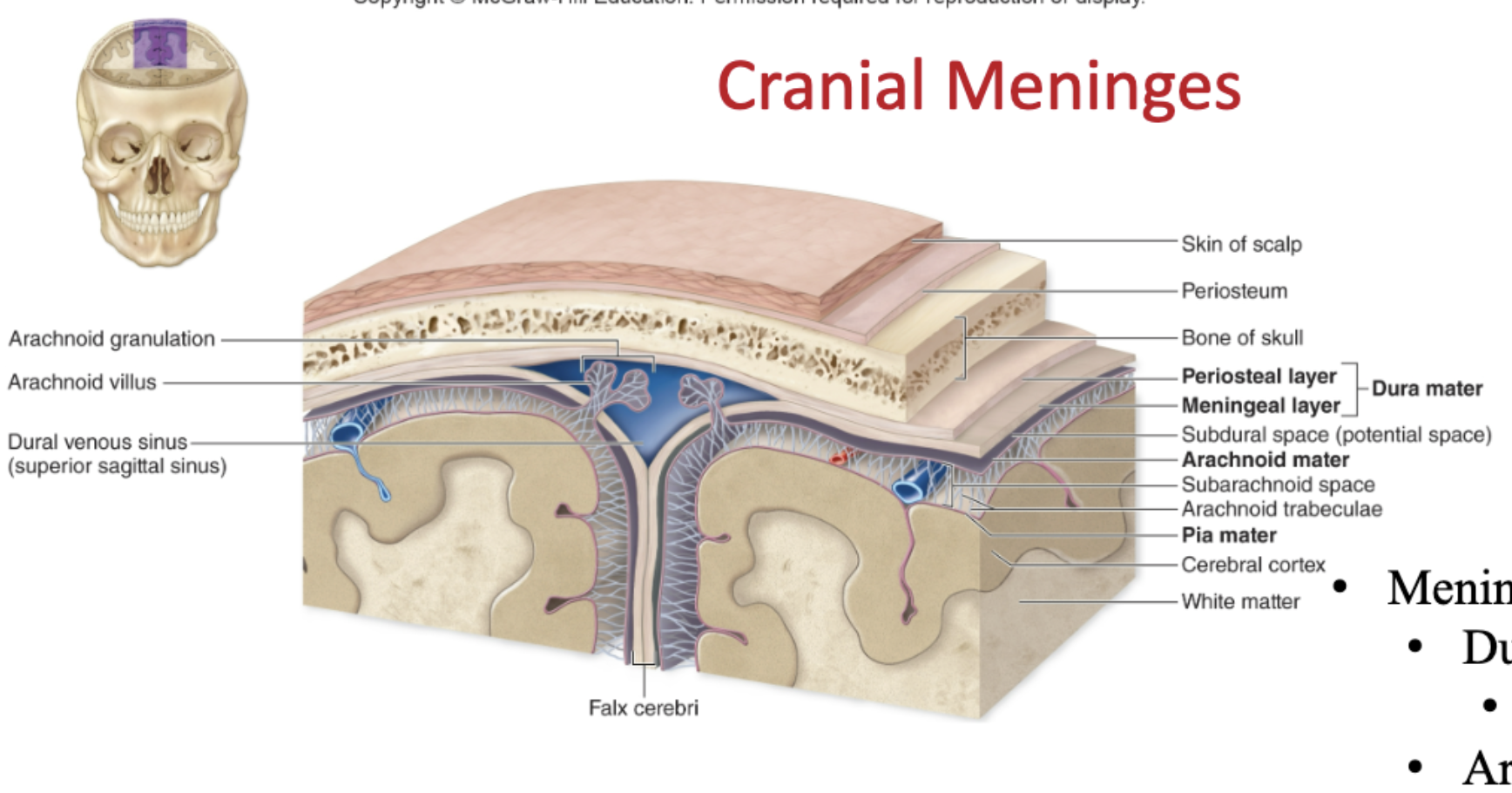
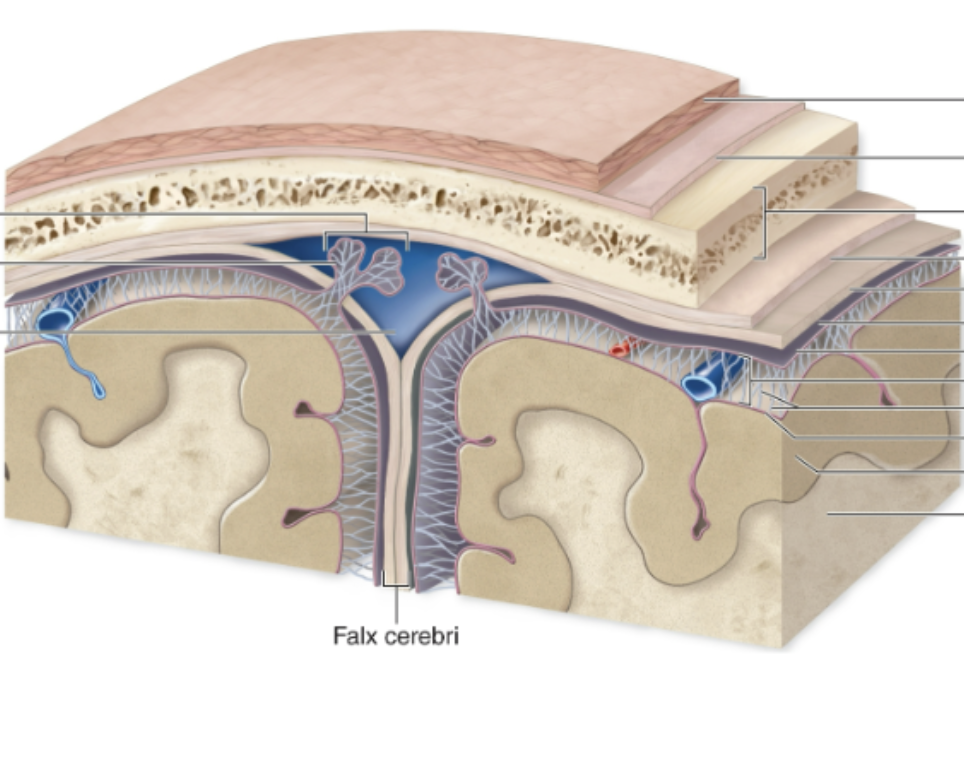
Identify the subarachnoid space
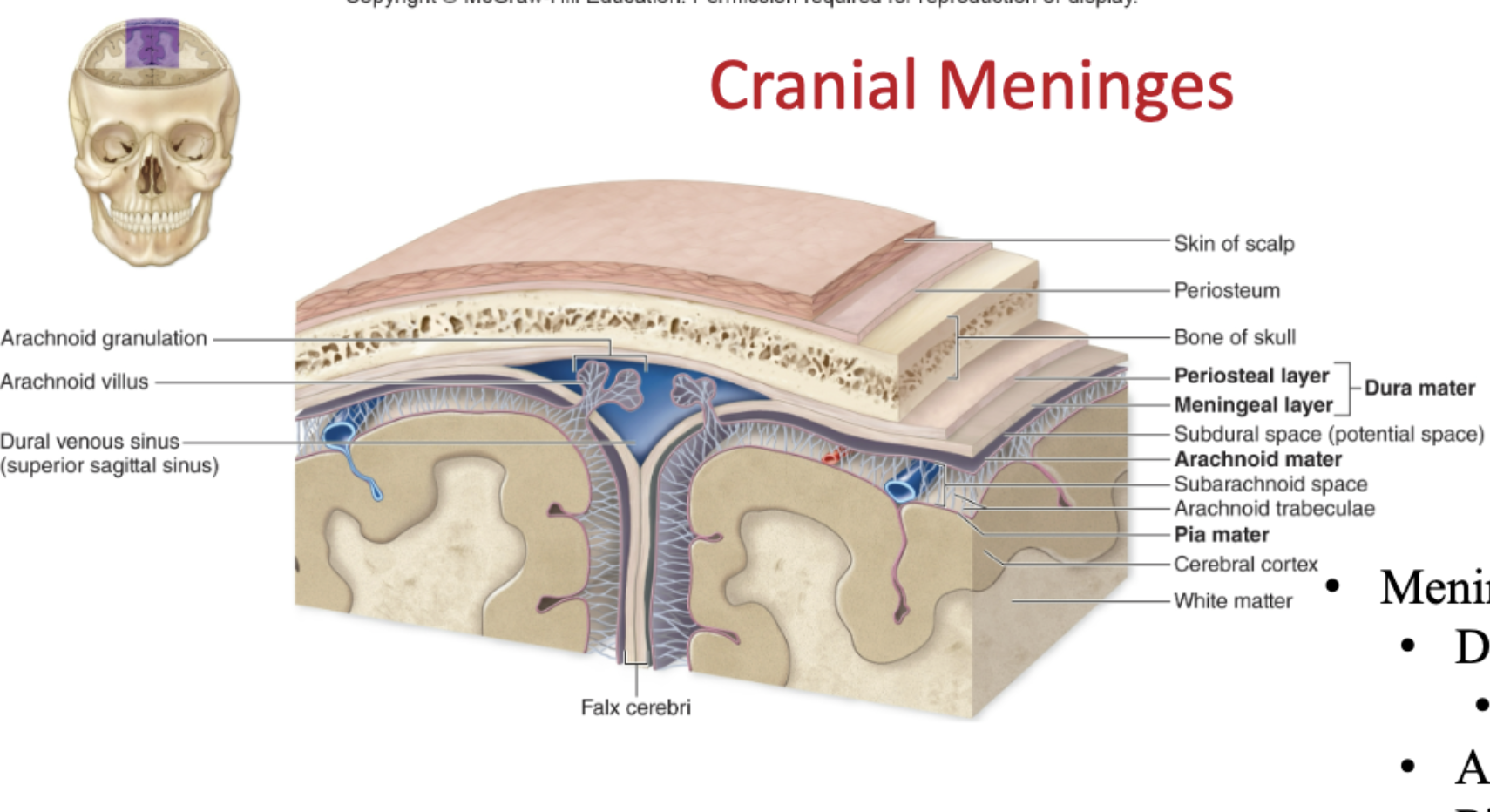
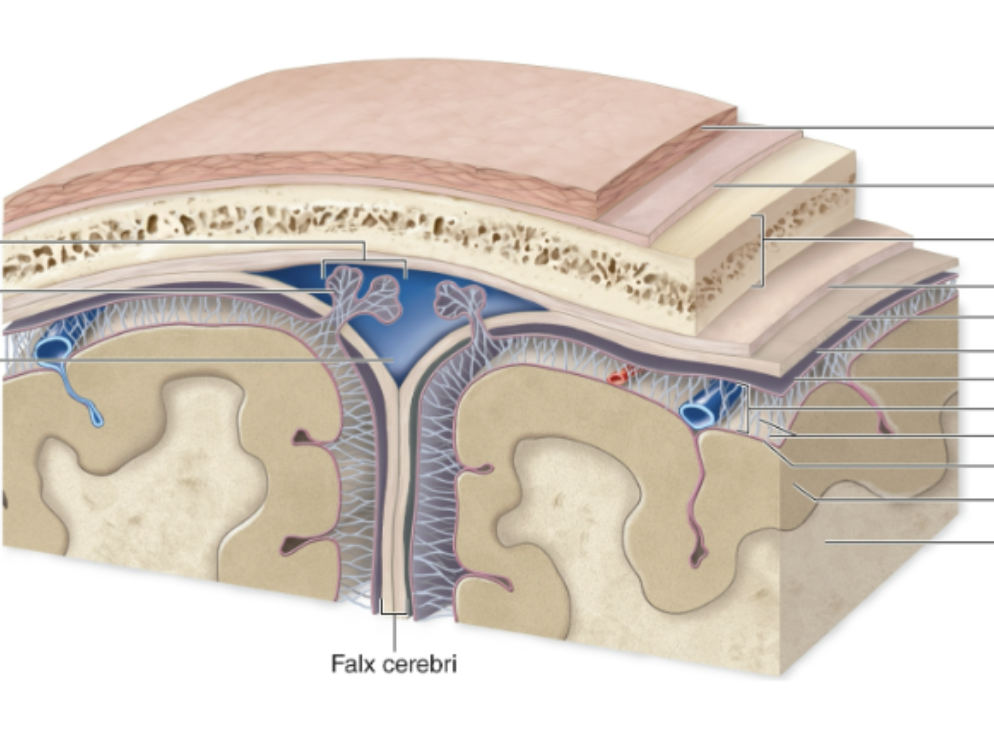
Identify the subdural space
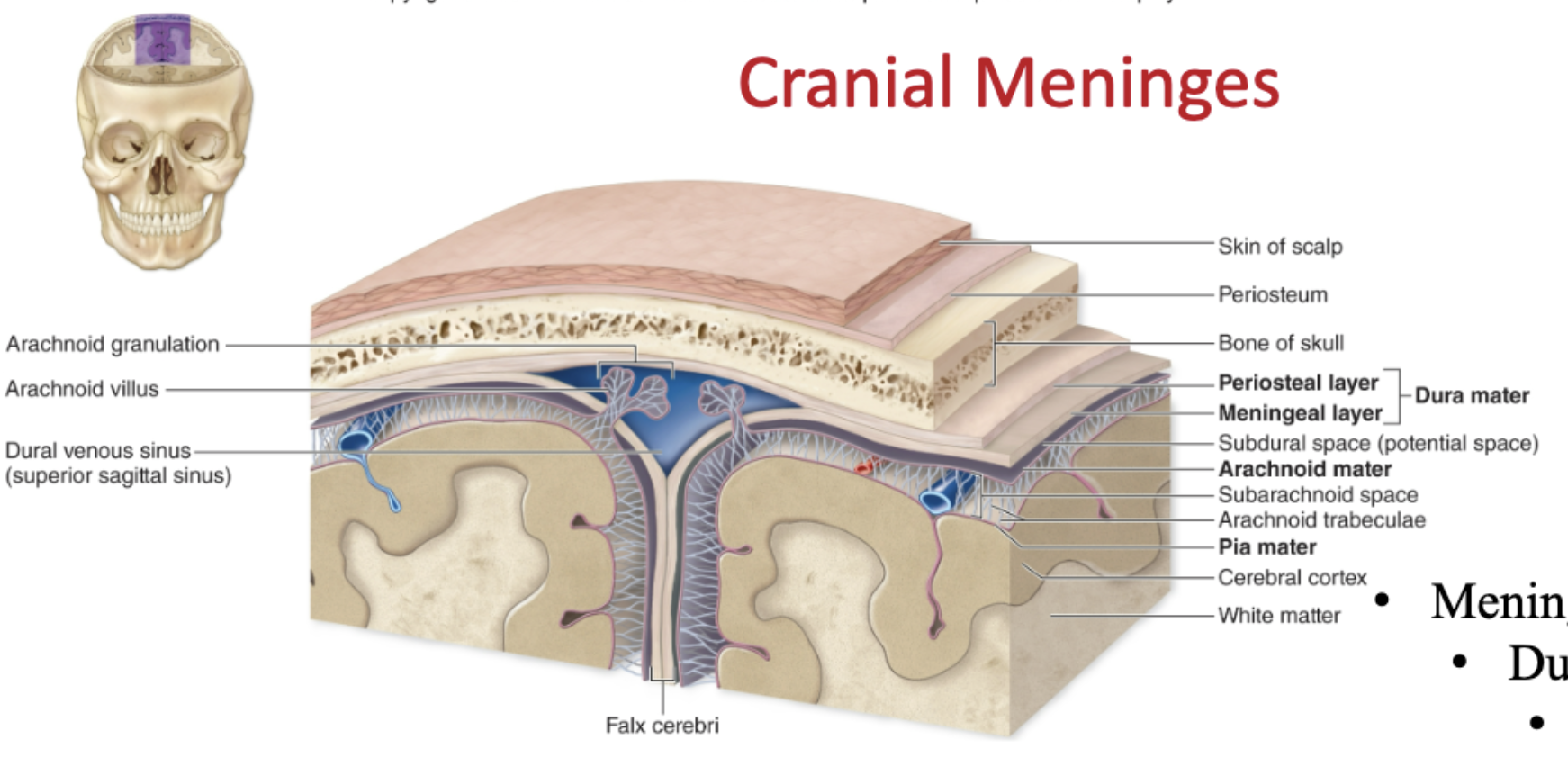
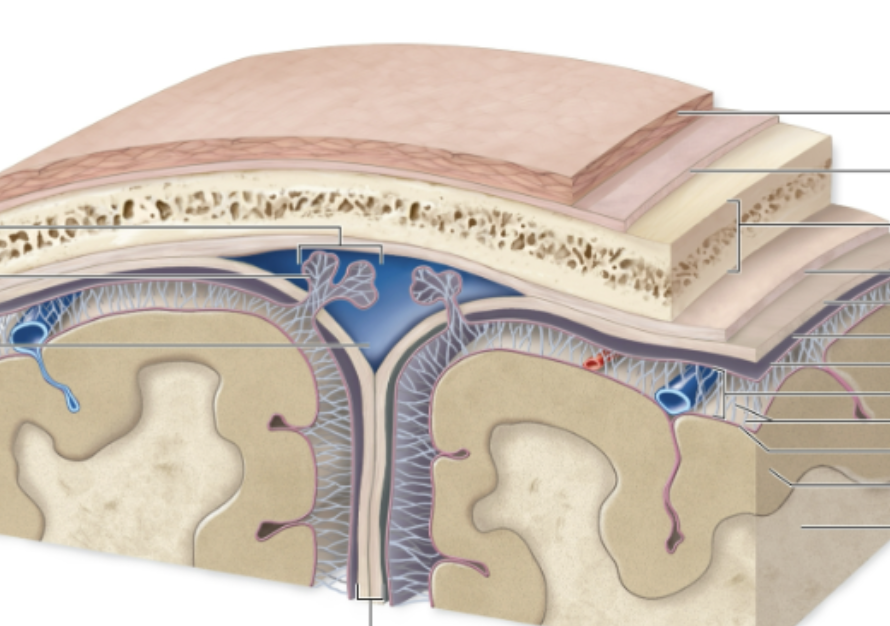
Identify the falx cerebri
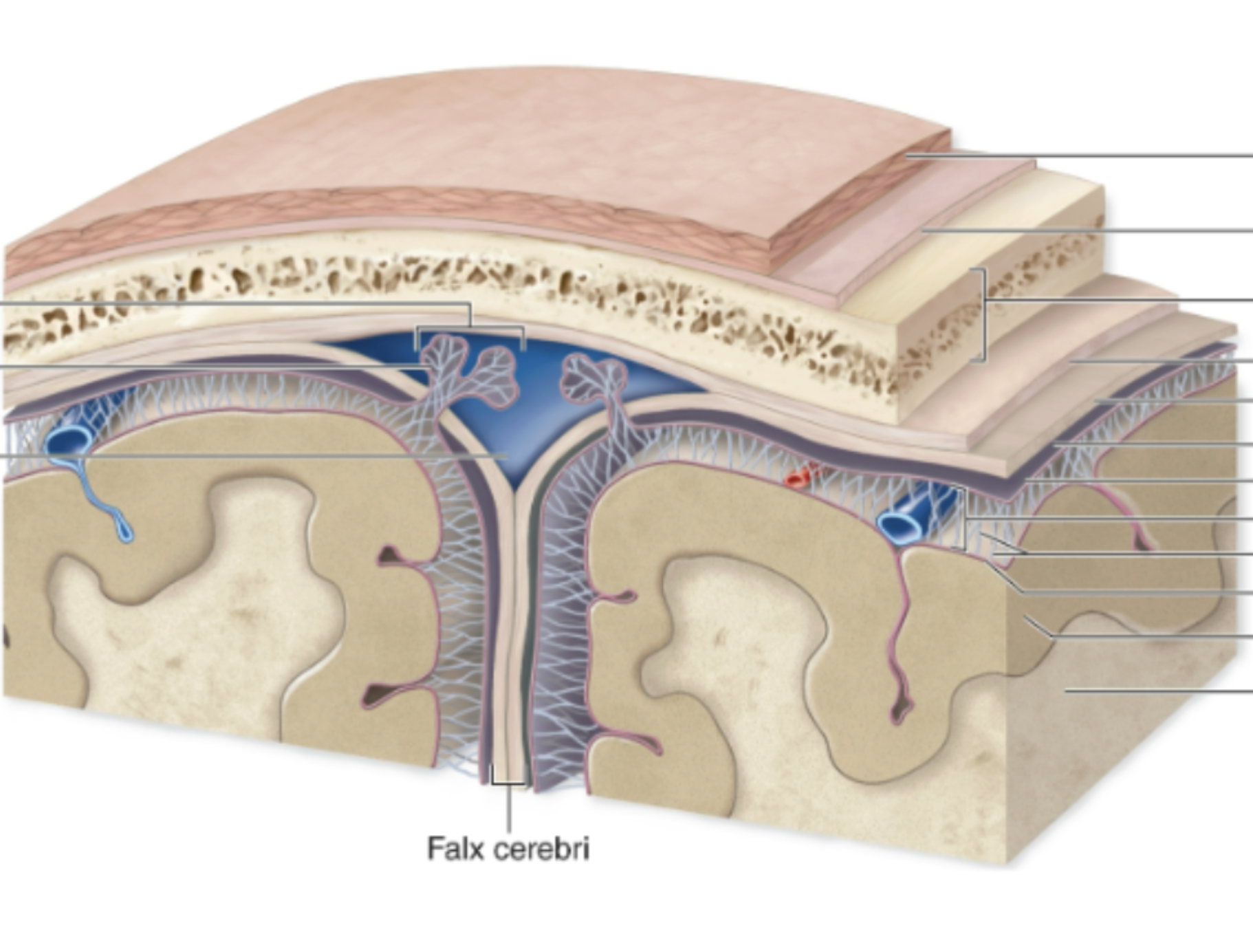
What are the meninges?
Three protective layers of tissue (pia mater, arachnoid mater, dura mater) that cover and protect the brain and spinal cord
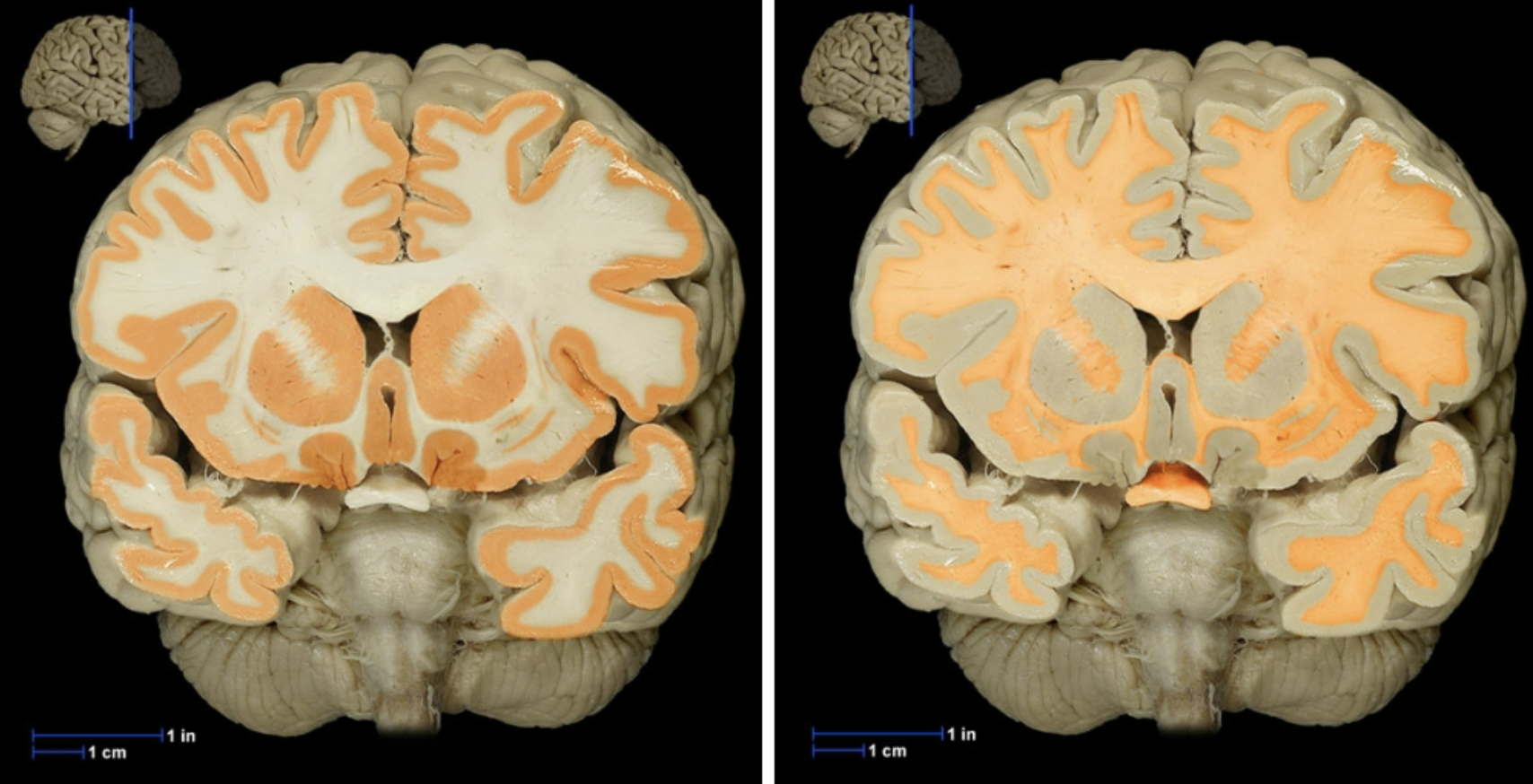
What is this?
Grey and white matter