Anatomy Chapter 4: The living fabric Tissue

0.0(0)
Studied by 0 people
call kaiCall Kai
Locked
learnLearn
examPractice Test
spaced repetitionSpaced Repetition
heart puzzleMatch
flashcardsFlashcards
GameKnowt Play
Card Sorting

1/34

encourage image

There's no tags or description

Looks like no tags are added yet.

Last updated 1:46 AM on 9/1/26
Name
Mastery
Learn
Test
Matching
Spaced
Call with Kai
Chat

No analytics yet

Send a link to your students to track their progress

35 Terms

1
New cards

Definition and Histology of tissue

  • Groups of cells similar in structure that perform common or related function 

  • Study of tissues 

  • Tissue transplantations


2
New cards

Four types of primary tissue

  • Epithelial tissue

  • connective tissue

  • muscle tissue

  • nerve tissue


<ul><li><p>Epithelial tissue</p></li><li><p>connective tissue</p></li><li><p>muscle tissue</p></li><li><p>nerve tissue</p></li></ul><p></p>
3
New cards

Epithelial Tissue

  • Functions

    • Cover: protection, absorption, filtrations, diffusion, excretion, secretion, sensory reception 

  • Locations

    • Line the cavities 

    • Covers the surfaces 

    • Lining of digestive tract organs and other hollow organs: capillaries, kidney, lung

    • Skin surface (epidermis) and organ surface (serosa) 

    • Interface tissue which results upon connective tissue 

  • Characteristics

    • Polarity

      • Apical surface: microvilli or cilia

      • Basal surface: connective tissue

    • Abundant cell junctions 

      • Tight junction

      • Adgerens junction

      • Desmosome 

      • Gap junction 

      • Hemidesmosome 

    • Supported by connective tissues 

    • Avascular, but innervated 

      • No blood vessels in epithelial tissue

        • Must be nourished by diffusion from underlying connective tissue 

      • Is supplied by nerve fibers 

    • Can regenerate 

      • Contain stem cells


<ul><li><p><span style="background-color: transparent;">Functions</span></p><ul><li><p><span style="background-color: transparent;">Cover: protection, absorption, filtrations, diffusion, excretion, secretion, sensory reception&nbsp;</span></p></li></ul></li><li><p><span style="background-color: transparent;">Locations</span></p><ul><li><p><span style="background-color: transparent;">Line the cavities&nbsp;</span></p></li><li><p><span style="background-color: transparent;">Covers the surfaces&nbsp;</span></p></li><li><p><span style="background-color: transparent;">Lining of digestive tract organs and other hollow organs: capillaries, kidney, lung</span></p></li><li><p><span style="background-color: transparent;">Skin surface (epidermis) and organ surface (serosa)&nbsp;</span></p></li><li><p><span style="background-color: transparent;">Interface tissue which results upon connective tissue&nbsp;</span></p></li></ul></li><li><p><span style="background-color: transparent;">Characteristics</span></p><ul><li><p><span style="background-color: transparent;">Polarity</span></p><ul><li><p><span style="background-color: transparent;">Apical surface: microvilli or cilia</span></p></li><li><p><span style="background-color: transparent;">Basal surface: connective tissue</span></p></li></ul></li><li><p><span style="background-color: transparent;">Abundant cell junctions&nbsp;</span></p><ul><li><p><span style="background-color: transparent;">Tight junction</span></p></li><li><p><span style="background-color: transparent;">Adgerens junction</span></p></li><li><p><span style="background-color: transparent;">Desmosome&nbsp;</span></p></li><li><p><span style="background-color: transparent;">Gap junction&nbsp;</span></p></li><li><p><span style="background-color: transparent;">Hemidesmosome&nbsp;</span></p></li></ul></li><li><p><span style="background-color: transparent;">Supported by connective tissues&nbsp;</span></p></li><li><p><span style="background-color: transparent;">Avascular, but innervated&nbsp;</span></p><ul><li><p><span style="background-color: transparent;">No blood vessels in epithelial tissue</span></p><ul><li><p><span style="background-color: transparent;">Must be nourished by diffusion from underlying connective tissue&nbsp;</span></p></li></ul></li><li><p><span style="background-color: transparent;">Is supplied by nerve fibers&nbsp;</span></p></li></ul></li><li><p><span style="background-color: transparent;">Can regenerate&nbsp;</span></p><ul><li><p><span style="background-color: transparent;">Contain stem cells</span></p></li></ul></li></ul></li></ul><p></p>
4
New cards
<p>Types of Epithelial tissue </p>

Types of Epithelial tissue

  • simple squamous epithelium

  • simple cuboidal epithelium

  • simple columnar epithelial

  • stratified squamous epithelium

  • stratified cuboidal epithelial

  • stratified columnar epithelial


5
New cards

Characteristics Simple Squamous Epithelium

  • A single layer of thin, flattened cells (width >> height)

  • Diffusion or filtration >> protection 


<ul><li><p><span style="background-color: transparent;">A single layer of thin, flattened cells (width &gt;&gt; height)</span></p></li><li><p><span style="background-color: transparent;">Diffusion or filtration &gt;&gt; protection&nbsp;</span></p></li></ul><p></p>
6
New cards

Characteristics of Simple Cuboidal Epithelium

  • A single layer of cube shaped cells with centrally located nuclei (width = height)

  • Absorption and secretion 


<ul><li><p><span style="background-color: transparent;">A single layer of cube shaped cells with centrally located nuclei (width = height)</span></p></li><li><p><span style="background-color: transparent;">Absorption and secretion&nbsp;</span></p></li></ul><p><br></p>
7
New cards

Characteristic of simple Columnar epithelium

  • A single layer of tall cells (width < height); with microvili or cilia

  • Absorption, secretion and protection 

  • GI tract: stomach and intestine 


<ul><li><p><span style="background-color: transparent;">A single layer of tall cells (width &lt; height); with microvili or cilia</span></p></li><li><p><span style="background-color: transparent;">Absorption, secretion and protection&nbsp;</span></p></li><li><p><span style="background-color: transparent;">GI tract: stomach and intestine&nbsp;</span></p></li></ul><p></p>
8
New cards

Characteristics of stratified squamous epithelium

  • Layers of flattened cells (width > height) 

  • Widely distributed 

  • Strong protection 

  • Function: protection in mouth, esophagus and vagina 


<ul><li><p><span style="background-color: transparent;">Layers of flattened cells (width &gt; height)&nbsp;</span></p></li><li><p><span style="background-color: transparent;">Widely distributed&nbsp;</span></p></li><li><p><span style="background-color: transparent;">Strong protection&nbsp;</span></p></li><li><p><span style="background-color: transparent;">Function: protection in mouth, esophagus and vagina&nbsp;</span></p></li></ul><p><br></p>
9
New cards

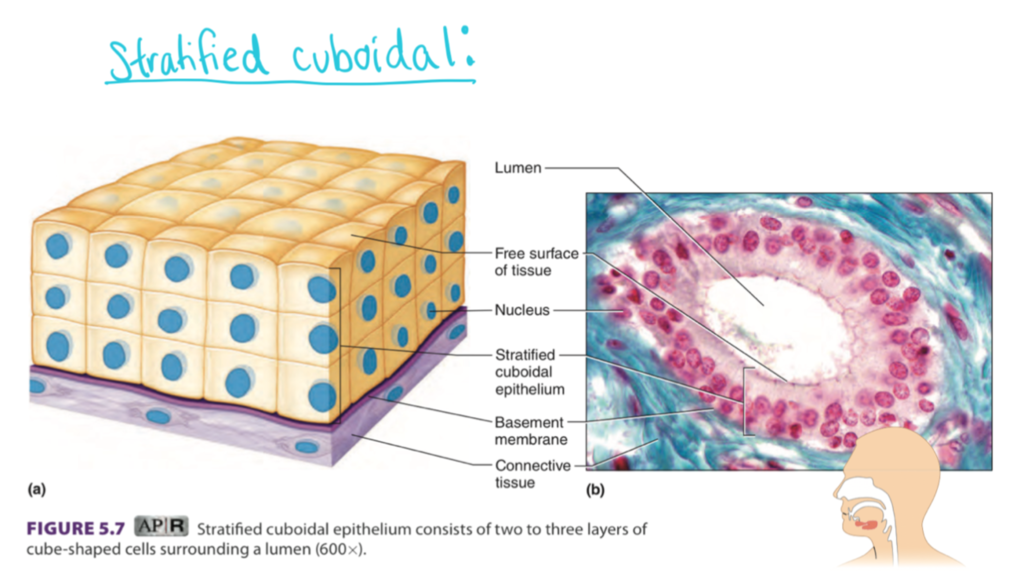
Characteristics of Stratified cuboidal epithelium 

  • Layers of cuboidal cells (width = height); rare 

  • 2-3 layer


<ul><li><p><span style="background-color: transparent;">Layers of cuboidal cells (width = height); rare&nbsp;</span></p></li><li><p><span style="background-color: transparent;">2-3 layer</span></p></li></ul><p></p>
10
New cards

Characteristics of stratified columnar epithelium 


  • Top layer of columnar cells (width < height); limited 

  • 2-3 layer 

  • Function: protection in male ductus deferens and urethra; transitional areas 


<ul><li><p><span style="background-color: transparent;">Top layer of columnar cells (width &lt; height); limited&nbsp;</span></p></li><li><p><span style="background-color: transparent;">2-3 layer&nbsp;</span></p></li><li><p><span style="background-color: transparent;">Function: protection in male ductus deferens and urethra; transitional areas&nbsp;</span></p></li></ul><p></p>
11
New cards

Characteristics of pseudostratified columnar epithelium 

  • Single layer with cell nuclei at different levels

  • Appears stratified, but is not 

  • Simple epithelium 

  • Function: protection and secretion in upper respiratory tract (trachea) with cilia 
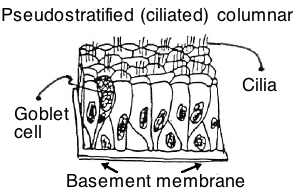

<ul><li><p><span style="background-color: transparent;">Single layer with cell nuclei at different levels</span></p></li><li><p><span style="background-color: transparent;">Appears stratified, but is not&nbsp;</span></p></li><li><p><span style="background-color: transparent;">Simple epithelium&nbsp;</span></p></li><li><p><span style="background-color: transparent;">Function: protection and secretion in upper respiratory tract (trachea) with cilia&nbsp;</span></p></li></ul><p></p>
12
New cards

Characteristics of Stratified cuboidal epithelium 

  • Layers of cuboidal cells (width = height); rare 

  • 2-3 layer 


<ul><li><p><span style="background-color: transparent;">Layers of cuboidal cells (width = height); rare&nbsp;</span></p></li><li><p><span style="background-color: transparent;">2-3 layer&nbsp;</span></p></li></ul><p></p>
13
New cards

Characteristics of stratified columnar epithelium 

  • Top layer of columnar cells (width < height); limited 

  • 2-3 layer 

  • Function: protection in male ductus deferens and urethra; transitional areas 
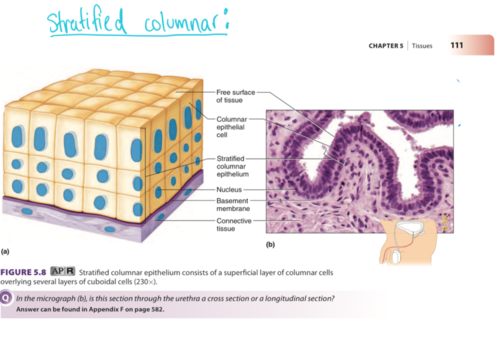

<ul><li><p><span style="background-color: transparent;">Top layer of columnar cells (width &lt; height); limited&nbsp;</span></p></li><li><p><span style="background-color: transparent;">2-3 layer&nbsp;</span></p></li><li><p><span style="background-color: transparent;">Function: protection in male ductus deferens and urethra; transitional areas&nbsp;</span></p></li></ul><p></p>
14
New cards

Keratinized stratified squamous epithelium 

  • Protection in skin 

  • Strongest protection physically


<ul><li><p><span style="background-color: transparent;">Protection in skin&nbsp;</span></p></li><li><p><span style="background-color: transparent;">Strongest protection physically</span></p></li></ul><p></p>
15
New cards

Transitional epithelium 

  • Protection in urinary bladder


<ul><li><p><span style="background-color: transparent;">Protection in urinary bladder</span></p></li></ul><p></p>
16
New cards

Four types of primary tissue

Epithelial tissue 

  • Covers 

Connective Tissue

  • Supports and connects 

Muscle tissue

  • Moves 

Nerve tissue 

  • Controls 


<p><span style="background-color: transparent;">Epithelial tissue&nbsp;</span></p><ul><li><p><span style="background-color: transparent;">Covers&nbsp;</span></p></li></ul><p><span style="background-color: transparent;">Connective Tissue</span></p><ul><li><p><span style="background-color: transparent;">Supports and connects&nbsp;</span></p></li></ul><p><span style="background-color: transparent;">Muscle tissue</span></p><ul><li><p><span style="background-color: transparent;">Moves&nbsp;</span></p></li></ul><p><span style="background-color: transparent;">Nerve tissue&nbsp;</span></p><ul><li><p><span style="background-color: transparent;">Controls&nbsp;</span></p></li></ul><p></p>
17
New cards

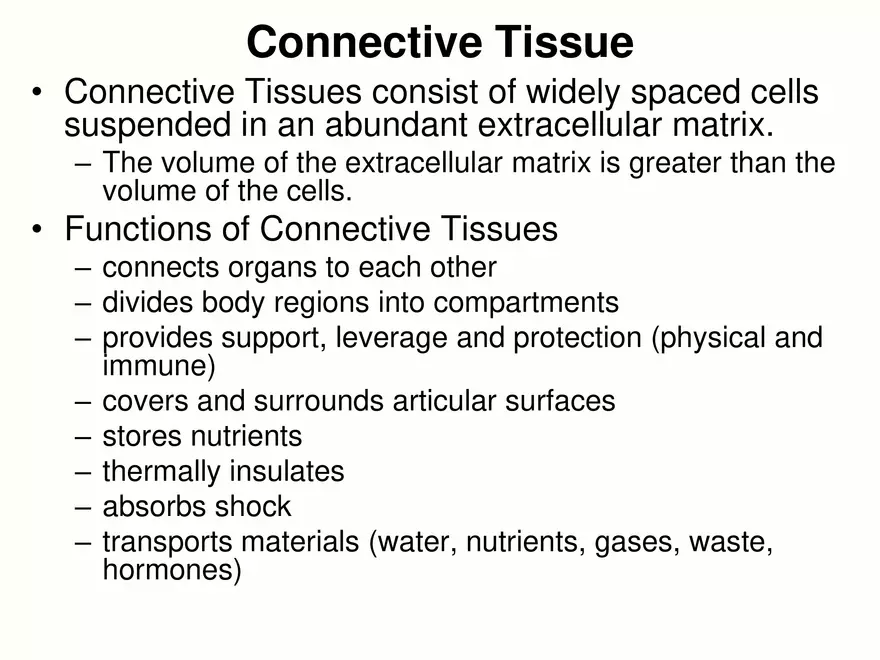
Major functions of connective tissue

  • Binding and support

  • Protecting

  • Insulating 

  • Storing reserve fuel 

  • Transporting substances 

  • Most abundant and widely distributed; most durable 


<ul><li><p><span style="background-color: transparent;">Binding and support</span></p></li><li><p><span style="background-color: transparent;">Protecting</span></p></li><li><p><span style="background-color: transparent;">Insulating&nbsp;</span></p></li><li><p><span style="background-color: transparent;">Storing reserve fuel&nbsp;</span></p></li><li><p><span style="background-color: transparent;">Transporting substances&nbsp;</span></p></li><li><p><span style="background-color: transparent;">Most abundant and widely distributed; most durable&nbsp;</span></p></li></ul><p></p>
18
New cards

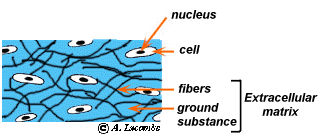
Three elements of connective tissue 

  • Ground substance 

  • Fibers 

  • Cells 


  • Matrix = Ground substance + Fibers 

  • Ground Substance: gelatinous, liquid, solid 

  • Fibers: collagen, elastic and regular fibers 

  • Cells: blast, cyte, and other cells 


<ul><li><p><span style="background-color: transparent;">Ground substance&nbsp;</span></p></li><li><p><span style="background-color: transparent;">Fibers&nbsp;</span></p></li><li><p><span style="background-color: transparent;">Cells&nbsp;</span></p></li></ul><p></p><ul><li><p><span style="background-color: transparent;">Matrix = Ground substance + Fibers&nbsp;</span></p></li><li><p><span style="background-color: transparent;">Ground Substance: gelatinous, liquid, solid&nbsp;</span></p></li><li><p><span style="background-color: transparent;">Fibers: collagen, elastic and regular fibers&nbsp;</span></p></li><li><p><span style="background-color: transparent;">Cells: blast, cyte, and other cells&nbsp;</span></p></li></ul><p><br></p>
19
New cards

Characteristics of Connective tissue

  • Origin: mesenchyme

  •  good blood supplies 

    • Except cartilage, ligament and tendon 

  • Have extracellular matrix 

  • Under epithelium tissue 


<ul><li><p><span style="background-color: transparent;">Origin: mesenchyme</span></p></li><li><p><span style="background-color: transparent;">&nbsp;good blood supplies&nbsp;</span></p><ul><li><p><span style="background-color: transparent;">Except cartilage, ligament and tendon&nbsp;</span></p></li></ul></li><li><p><span style="background-color: transparent;">Have extracellular matrix&nbsp;</span></p></li><li><p><span style="background-color: transparent;">Under epithelium tissue&nbsp;</span></p></li></ul><p></p>
20
New cards

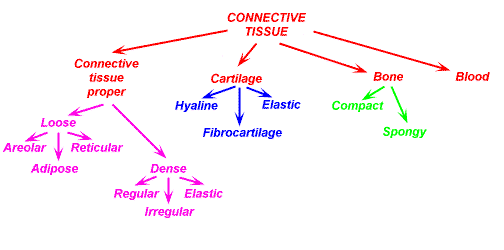
Four Classes of connected tissue

  • Connective tissue proper 

  • Cartilage 

  • Bone

  • Blood


<ul><li><p><span style="background-color: transparent;">Connective tissue proper&nbsp;</span></p></li><li><p><span style="background-color: transparent;">Cartilage&nbsp;</span></p></li><li><p><span style="background-color: transparent;">Bone</span></p></li><li><p><span style="background-color: transparent;">Blood</span></p></li></ul><p></p>
21
New cards

Connective tissue proper 

  • Loose connective tissue:areolar, adipose, reticular

  • Dense/fibrous connective tissue: regular, irregular, elastic 


22
New cards

Areolar connective tissue

  • Fibroblast and fibrocytes 

  • Under epithelium to form serous membrane

  • Serosa, Not mucosa 

  • Most common 


<ul><li><p><span style="background-color: transparent;">Fibroblast and fibrocytes&nbsp;</span></p></li><li><p><span style="background-color: transparent;">Under epithelium to form serous membrane</span></p></li><li><p><span style="background-color: transparent;">Serosa, Not mucosa&nbsp;</span></p></li><li><p><span style="background-color: transparent;">Most common&nbsp;</span></p></li></ul><p></p>
23
New cards

Reticular connective tissue 

  • Reticular fibers form internal skeleton for liver, spleen and lymph nodes


<ul><li><p><span style="background-color: transparent;">Reticular fibers form internal skeleton for liver, spleen and lymph nodes</span></p></li></ul><p></p>
24
New cards

Regular dense connective tissue 

  • Fibers in a parallel fashion, which resist pulling forces in one direction 

  • Ligament 

  • Tendon

  • Aponeurous: flattened tendon 


25
New cards

Irregular dense connective tissue 

  • Fibers not in a parallel fashion, which resist pulling forces in multiple directions 


26
New cards

Elastic connective tissue 

  • Full of elastic fibers (elastin)

  • Aorta 

  • Vocal cord

  • Ligament flava 

  • Lung 


27
New cards

cartilage

  • Chondroblast and chondrocytes 

  • Without nerve and without blood supply 

  • Up to 80% water - can rebound after compression/reduce friction at joints 


28
New cards

Cartilage Types: three

  • Hyaline cartilage 

  • Elastic cartilage 

  •  Fibrocartilage 


29
New cards

Hyaline cartilage 

  • Most abundant 

  • Costal cartilage

  • Nose

  • Ends of long bone 

  • Trachea


30
New cards

Elastic Cartilage 

  • Most springy and flexible 

  • Ears; epiglottis 


31
New cards

Bone functions

  • Supports and protects body structures 

  • Synthesisizes blood cells in cavities 

  • More collagen than cartilage; strongest 

  • Has inorganic calcium salts 

  • Osteoblast produce matrix 

  • Osteocytes maintain the matrix 

  • Osteons - structural units 

  • Richly vascularized 


32
New cards

Blood

  • Most atypical connective tissue - fluid 

  • Red blood cells most common cell type

  • Fibers are soluble proteins: fibrinogen from liver 


33
New cards

Muscle Tissue types: Three 

  • Skeletal muscle tissue

  • Cardiac muscle tissue 

  • Smooth muscle tissue 


34
New cards

Nerve tissue types: two

  • Central nerves: brain and spinal cord 

  • Peripheral nerves: cranial nerves and spinal nerves; somatic and automatic nerve


35
New cards

Covering and Lining membranes types: three

  • Cutaneous 

    • Epidermis: keratinized stratified squamous epithelium

    • Dermis: thick layer of connective tissue; innate immune 

  •  Mucous membranes 

  • Serous membranes