ANAPHY LECTURE MIDTERM
 Call Kai
 Learn
Learn Practice Test
 Spaced Repetition
 Match
Match Flashcards
 Knowt Play
1/252

There's no tags or description
Looks like no tags are added yet.
Name | Mastery | Learn | Test | Matching | Spaced | Call with Kai | Chat |
|---|
No analytics yet
Send a link to your students to track their progress
253 Terms
Stimuli (or stimulus)
Terms used to describe changes occurring inside and outside the body monitored by sensory input.
Integration
The nervous system function responsible for processing and interpreting sensory input to decide if action is needed.
Muscles or glands
The primary structures activated by motor output as a response to integrated stimuli.
Sensory input
The nervous system function that gathers information by monitoring internal and external body changes.
Motor output
The response generated by the nervous system to integrated stimuli.
Central nervous system (CNS)
The structural classification of the nervous system that includes both the brain and the spinal cord.
Outside the brain and spinal cord
The anatomical location of the nerve structures that compose the Peripheral Nervous System.
Sensory (afferent) division
The division of the peripheral nervous system composed of nerve fibers that carry information to the central nervous system.
Afferent division
Alternate medical term for the sensory division of the peripheral nervous system.
To the central nervous system
The specific direction in which sensory nerve fibers transport information relative to the central nervous system.
Sensory receptor
The structure in the functional diagram that detects stimuli before sending sensory input to the central nervous system.
Effector
The terminal structure in the functional diagram that receives motor output to produce a response.
Motor (efferent) division
The division of the peripheral nervous system composed of nerve fibers that carry impulses away from the central nervous system.
Efferent division
Alternate medical term used to refer to the motor division of the peripheral nervous system.
Away from the central nervous system
The specific direction nerve fibers carry impulses relative to the central nervous system within the motor division.
Somatic nervous system
The voluntary subdivision of the motor (efferent) division.
Autonomic nervous system
The involuntary subdivision of the motor (efferent) division.
Skeletal muscle
The muscle type noted as voluntary under the somatic nervous system.
Smooth muscle
The muscle type noted as involuntary under the autonomic nervous system.
Central Nervous System (brain and spinal cord)
The central unit that houses the brain and spinal cord.
Cranial and spinal nerves
The specific nerve types that constitute the Peripheral Nervous System.
Sense organs
The structures that serve as the origin of input for the Sensory (afferent) division.
Sympathetic division
The division of the Autonomic Nervous System responsible for involuntary control over internal effectors alongside the parasympathetic division.
Parasympathetic division
The division of the Autonomic Nervous System listed alongside the sympathetic division.
Receptor - integrator - effector
What biological concept in biology this diagram is related?
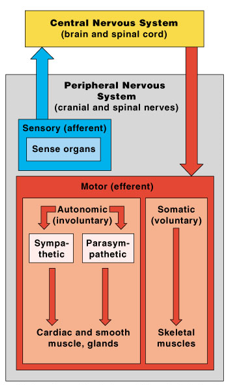
Cardiac and smooth muscle, glands
The specific target effectors regulated by the Autonomic (involuntary) nervous system.
Skeletal muscles
The specific target effectors controlled by the Somatic (voluntary) nervous system.
Astrocytes
Abundant, star-shaped neuroglial cells in the central nervous system that brace neurons and control the chemical environment of the brain.
Blood-brain barrier
The protective structure formed by astrocytes together with tight junctions that filters what enters the brain.
Microglia
Specialized central nervous system support cells characterized as spider-like phagocytes that dispose of debris.
Ependymal cells
Supporting cells in the central nervous system that line the cavities of the brain and spinal cord to circulate cerebrospinal fluid.
Oligodendrocytes
Central nervous system glia responsible for producing myelin sheaths around nerve fibers.
Cerebrospinal fluid
The fluid circulating within the brain and spinal cord cavities moved by ependymal cells.
Brain's bodyguards + cleaners
Descriptive term used to summarize the defense function of microglia.
Glia
Alternative term for neuroglia.
Gliomas
The specific term for most brain tumors resulting from abnormal division of glia.
Neuroglia
The type of nervous tissue cells capable of undergoing cell division.
Neurons
The specialized nerve cells that lack the ability to divide.
Cell division
The fundamental cellular process to consider regarding the development of cancer.
Satellite cells
Support cells in the Peripheral Nervous System responsible for protecting neuron cell bodies.
Schwann cells
Support cells in the Peripheral Nervous System responsible for forming myelin sheaths around nerve fibers.
Barrier
The function of satellite cells.
Neurons
Specialized nerve cells that function to transmit messages.
Cell body
The major region of a neuron containing the nucleus and serving as the metabolic center of the cell.
Processes
Fibers that extend from the neuron cell body, such as dendrites and axons.
Electrical signal
The specific nature of the messages transmitted by neurons.
Large nucleolus
The prominent sub-nuclear structure within the neuron cell body indicated to contain lots of ribosomes.
Dendrites
The neuron extensions that conduct impulses toward the cell body.
Axons (or Axon)
The single neuron process that conducts impulses away from the cell body.
Axonal terminal
The branching structures at the distal end of an axon.
Vesicles (or vesicles with neurotransmitters)
The membrane-bound sacs within axonal terminals that store neurotransmitters.
Neurotransmitters
The chemical substances contained within vesicles inside axonal terminals.
Synaptic cleft
The fluid-filled space or gap separating adjacent neurons at a junction.
Synapse
The functional junction connecting nerves to one another.
Schwann cells
The supportive cells responsible for producing myelin sheaths around axons in a jelly-roll like fashion.
Nodes of Ranvier
The structural gaps within the myelin sheath located at intervals along the axon.
Multiple Sclerosis (or MS)
The specific neurological condition in which the myelin sheath is destroyed.
Scleroses
The hardened tissue structure formed when the myelin sheath undergoes degradation in Multiple Sclerosis.
Autoimmune disease
The disease classification assigned to Multiple Sclerosis based on the body's immune system attacking its own tissues.
Myelin sheath
The neural structure targeted and destroyed during the progression of Multiple Sclerosis.
Gray matter
The central nervous system region comprised of cell bodies and unmyelinated fibers.
Nuclei
Clusters of cell bodies located specifically within the white matter of the central nervous system.
Ganglia
Collections of cell bodies located outside the central nervous system.
Central nervous system
The primary system where most neuron cell bodies are found.
Peripheral Nervous System (PNS)
The location of ganglia clusters.
Proprioceptors
Specialized sensory receptors responsible for detecting stretch or tension.
Cutaneous sense organs
Sensory organs located in the skin that receive external stimuli.
Sensory (afferent) neurons
Functional class of neurons responsible for carrying impulses from sensory receptors.
Motor (efferent) neurons
Functional class of neurons responsible for carrying impulses from the central nervous system.
Interneurons (or association neurons)
Neurons located within neural pathways of the central nervous system that link sensory and motor neurons.
Muscle joints inner ear (detects changes in body position)
The specific body regions/structures associated with proprioceptors.
Multipolar neurons
The structural classification of neurons characterized by having many extensions extending from the cell body.
Motor neurons or interneurons
The functional roles usually filled by multipolar neurons.
Motor neuron
The specific type of neuron that controls skeletal muscle and serves as an example of a multipolar neuron.
Integrate lots of input from other neurons and send out a single, coordinated output
The primary computational task performed by multipolar neurons.
Bipolar neurons
The structural classification of neurons characterized by having one axon and one dendrite.
Unipolar neurons
The structural classification of neurons characterized by having a short single process leaving the cell body.
Rare, specialized
The descriptive terms used to characterize bipolar neurons.
Dorsal root ganglion
The location where the cell body of a unipolar sensory neuron is found.
Central branch
The branch of a unipolar neuron that carries signals from the cell body and enters the spinal cord (CNS).
Peripheral branch
The branch of a unipolar neuron that carries signals from the receptor to the cell body.
Irritability
The physiological property defined as the ability to respond to stimuli.
Conductivity
The physiological property defined as the ability to transmit an impulse.
Polarized
The state of the plasma membrane at rest.
Inside the cell is less positive (or fewer positive ions inside than outside)
The relative charge state inside the cell at rest.
Depolarization
The process initiated when a stimulus acts upon and alters the resting potential of the neuron's membrane.
Sodium (Na+)
The specific ion allowed to flow inside the membrane once depolarization occurs.
Action potential
The electrical event in the neuron initiated by the exchange of ions across the membrane.
Less negative (more positive)
The ionic state condition inside the cell during depolarization.
Potassium ions
The specific ions that rush out of the neuron after sodium ions rush in to repolarize the membrane.
Repolarization (or repolarizes the membrane)
The membrane process restored by potassium ions rushing out of the neuron.
Sodium-potassium pump
The cellular mechanism responsible for restoring the original ion configuration across the membrane.
ATP
The energy currency molecule required for the sodium-potassium pump to restore the original configuration.
Nerve impulse
The alternative term listed for an action potential.
Myelin sheath
The axonal coating that allows impulses to travel faster along nerve fibers.
Propagation of the action potential
The stage showing the movement of the action potential down the axon.
Repolarization
The stage where potassium ions (K+) move outward to restore the negative internal charge.
Toward the cell body
The directional movement of the impulse.
Neurotransmitter
The chemical messenger released from a nerve's axon terminal to bridge the gap to another neuron.
Dendrite
The receiving neuronal structure of the adjacent neuron that contains receptors stimulated by neurotransmitters.