Biodiversity ENVS141
0.0(0)
Studied by 0 people Call Kai
 Learn
Learn Practice Test
 Spaced Repetition
 Match
Match Flashcards
 Knowt Play
Card Sorting
1/20

Earn XP
Description and Tags
Last updated 1:29 AM on 10/7/22
Name | Mastery | Learn | Test | Matching | Spaced | Call with Kai | Chat |
|---|
No analytics yet
Send a link to your students to track their progress
21 Terms
1
New cards
What is biodiversity
the variety of life in the world or in a particular habitat or ecosystem.
Short for biological diversity
Genes/life/ecosystem on the planet
The complete variety of species and genes within all of the ecosystems on earth
Short for biological diversity
Genes/life/ecosystem on the planet
The complete variety of species and genes within all of the ecosystems on earth
2
New cards
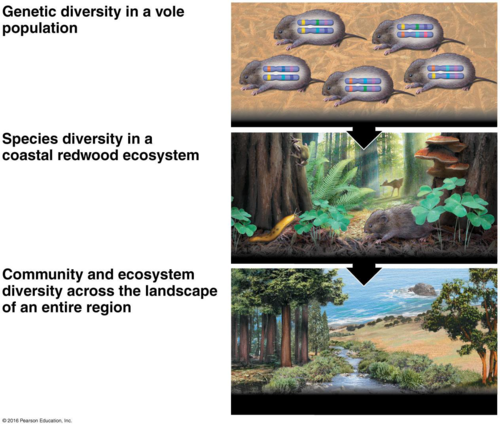
Three levels of biodiversity are:
Genetic, species, ecosystem diversity
3
New cards
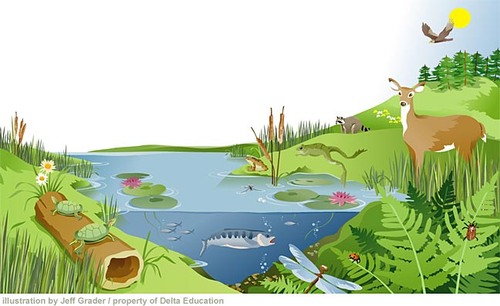
Ecosystem
The interaction between living and non-living things within an area.
4
New cards
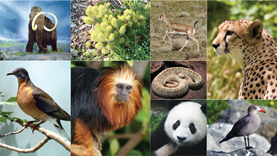
Species diversity
All of Earth's species
- Reflects evolutionary history of life
- Each species plays a unique role in the ecosystem
Ex. food web
- Provides resources for people
- Pollinators - allow agriculture to thrive/bring food
- Forest helps - soil stability, lumber,
- Reflects evolutionary history of life
- Each species plays a unique role in the ecosystem
Ex. food web
- Provides resources for people
- Pollinators - allow agriculture to thrive/bring food
- Forest helps - soil stability, lumber,
5
New cards
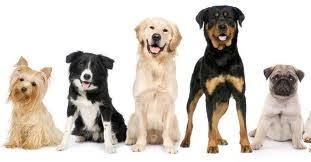
genetic diversity
Variation in genes within a species, for all species
- Ex. rabbits with different genetic traits (breeds)
- Reflected in variation among individuals
- Determines evolutionary potential and species' ability to adapt to new environmental conditions
- Reflects adaptations/natural selection
- Ensures resources for people in the future
- Disease resistance within species used for food and other resources
- Ex. rabbits with different genetic traits (breeds)
- Reflected in variation among individuals
- Determines evolutionary potential and species' ability to adapt to new environmental conditions
- Reflects adaptations/natural selection
- Ensures resources for people in the future
- Disease resistance within species used for food and other resources
6
New cards
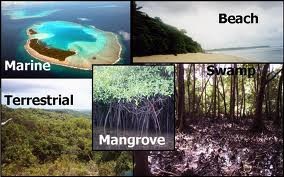
ecosystem diversity
All of the different biological communities on Earth result from their associations with the non-living components (geology, chemistry...) in their local environments
- Provides ecological services for people
- Clean air, clean water, climate control, storm protection
- Ex. salt marshes, mangroves
- Provides ecological services for people
- Clean air, clean water, climate control, storm protection
- Ex. salt marshes, mangroves
7
New cards
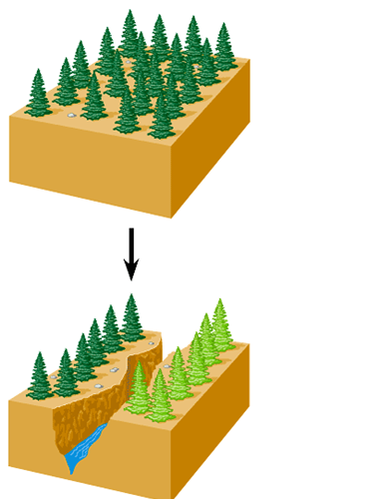
Speciation
Evolution of new species
Increases biodiversity by adding new species
Increases biodiversity by adding new species
8
New cards
Extinction
- Loss of species (or genus, family, or other higher taxonomic group)
- Decreases biodiversity by eliminating species
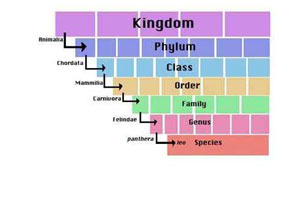
- (1) Kingdom; (2) Phylum or Division; (3) Class; (4) Order; (5) Family; (6) Genus; (7) Species
- Decreases biodiversity by eliminating species
- (1) Kingdom; (2) Phylum or Division; (3) Class; (4) Order; (5) Family; (6) Genus; (7) Species
9
New cards
How many mass extinctions have there been?
5 mass extinctions
10
New cards
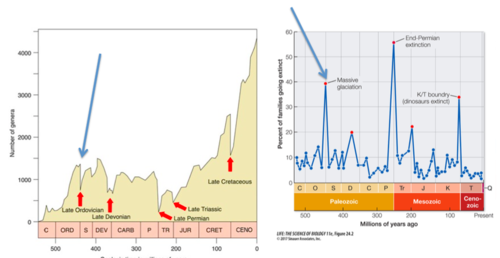
Late Ordovician Extinction
- 447-443 million years ago
- 49% of genera went extinct
- Global cooling, glaciation, and sea level decline are associated with the major land mass movement
- 49% of genera went extinct
- Global cooling, glaciation, and sea level decline are associated with the major land mass movement
11
New cards
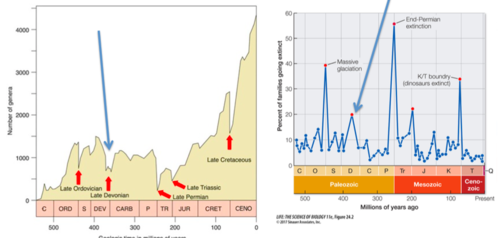
Late Devonian Extinction
- 375-360 million years ago
- 50% of all genera went extinct
- Cause is unclear but related to environmental changes (Climate, air composition)
- 50% of all genera went extinct
- Cause is unclear but related to environmental changes (Climate, air composition)
12
New cards
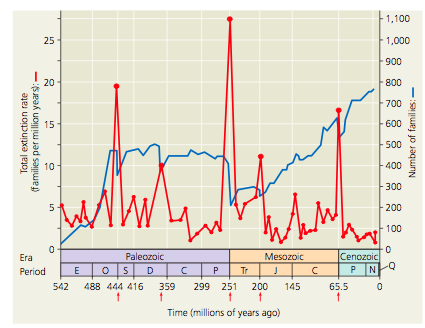
Late Permian Extinction
- 252 million years ago
- Largest known extinction
- 83% of all genera went extinct
- Cause is unclear but likely includes meteor impact/s, increases in greenhouse gases leading to climate change, and sea level rise
- Similar to now, We are increasing the rate, making this the fastest mass extinction known
- This happened over a very long time period
- Largest known extinction
- 83% of all genera went extinct
- Cause is unclear but likely includes meteor impact/s, increases in greenhouse gases leading to climate change, and sea level rise
- Similar to now, We are increasing the rate, making this the fastest mass extinction known
- This happened over a very long time period
13
New cards
Late Triassic Extinction
- 201 million years ago
- At least 50% of all species went extinct
- Cause unclear
- Ushered in the age of the dinosaurs
- At least 50% of all species went extinct
- Cause unclear
- Ushered in the age of the dinosaurs
14
New cards
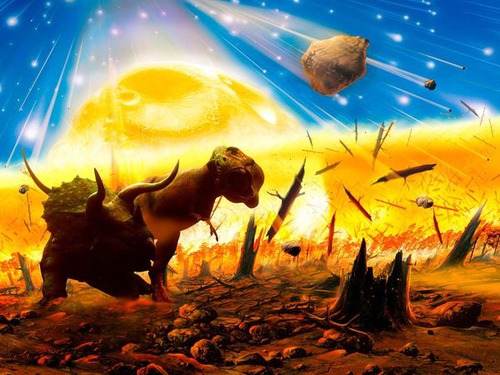
Late Cretaceous
- 66 million years ago
- >75% of all species went extinct including all non-flying dinosaurs
- Astroid collision
- Ushered in the age of the mammals
- >75% of all species went extinct including all non-flying dinosaurs
- Astroid collision
- Ushered in the age of the mammals
15
New cards
Current mass extinction event
- biodiversity crisis
- 60% decline in animals on Earth in the last 40 years
- Cause: people
- 60% decline in animals on Earth in the last 40 years
- Cause: people
16
New cards
Species extinction rates
> 1000 times background rate
17
New cards
Major drivers of wildlife decline
Exploitation - 37%
Climate change - 7%
Habitat degradation/change - 31%
Habitat loss - 13%
Other - 11%
Climate change - 7%
Habitat degradation/change - 31%
Habitat loss - 13%
Other - 11%
18
New cards
3 goals of conservation biology
1. Document biodiversity
2. Determine our impacts on biodiversity
3. Determine how to protect and conserve biodiversity
2. Determine our impacts on biodiversity
3. Determine how to protect and conserve biodiversity
19
New cards
Conservation biology
Value-driven, multidisciplinary science
20
New cards
Ethical principals of conservation biology
- Biodiversity should be conserved
- Human-driven extinctions should be prevented
- Maintain ecological complexity
- Maintain evolutionary capacity
- Biodiversity has intrinsic value
- Human-driven extinctions should be prevented
- Maintain ecological complexity
- Maintain evolutionary capacity
- Biodiversity has intrinsic value
21
New cards
Human population growth
- Rapid growth
- More people = more resource consumption
+ Ecological footprint
- Biodiversity loss = bad for people
- We can't survive without other species
- Poorest people hurt the most
+ Environmental justice
- More people = more resource consumption
+ Ecological footprint
- Biodiversity loss = bad for people
- We can't survive without other species
- Poorest people hurt the most
+ Environmental justice