Further Mechanics
 Call Kai
 Learn
Learn Practice Test
 Spaced Repetition
 Match
Match Flashcards
 Knowt Play
1/20

There's no tags or description
Looks like no tags are added yet.
Name | Mastery | Learn | Test | Matching | Spaced | Call with Kai | Chat |
|---|
No analytics yet
Send a link to your students to track their progress
21 Terms
Angular Speed
The angle an object rotates per second (radians per second).
Frequency (Hz)
Number of complete revolutions per second.
Period
Time taken for a complete revolution (seconds).
Centripetal Acceleration
Acceleration which is always directed towards the center of the circle.
Centripetal Force
Force that always acts towards the center of the circle.
Simple Harmonic Motion of an object
Oscillation of an object from either side of equilibrium. Equilibrium is the midpoint of the object’s motion.
Displacement
Distance of the object from equilibrium.
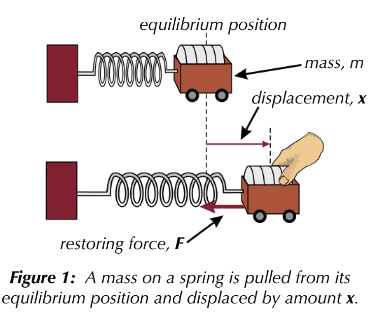
Restoring Force
Force pulling/pushing the object back towards equilibrium. This makes the object accelerate towards equilibrium.
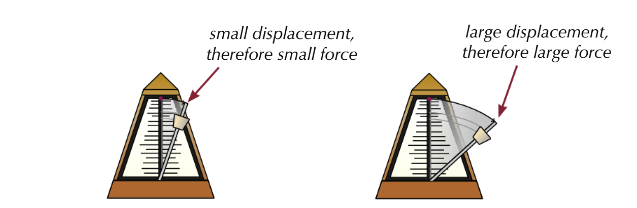
Simple Harmonic Motion
An oscillation in which the acceleration of an object is directly proportional to it’s displacement (from eq), directed towards eq. So the displacement is the opposite direction of the acceleration.
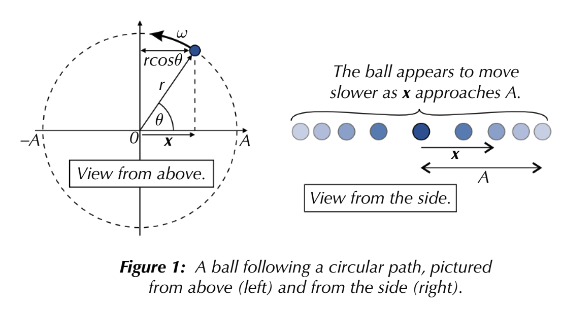
SHM Graph
Displacement (Y-axis) varies as a cosine or sine wave with Amplitude as the max/min.
Velocity is the gradient of the displacement/time graph. Max value of ωA.
Acceleration is the gradient of the velocity time graph. Max value of ω²A.
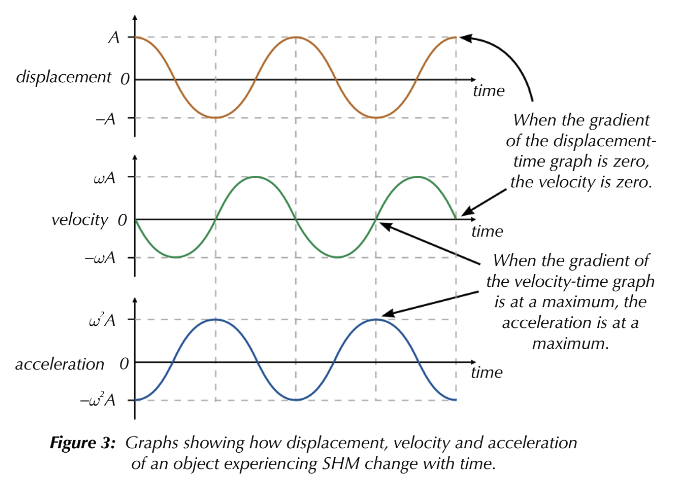
When is the acceleration max in SHM?
When there’s zero velocity (which is also when the displacement is at its maximum, negative relative to acceleration).
Phase difference of x, v, a.
Velocity is π/2 radians out of phase (1/4 cycle in front of displacement). Acceleration is another π/2 radians ahead of velocity.
Oscillation (1 Cycle)
Max displacement from right to left to right(+ —> - —> +) or vice versa.
Frequency and period in SHM.
In SHM, frequency and period are independent of the amplitude (constant for given oscillation).
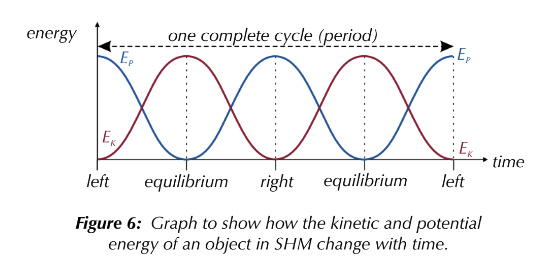
Mechanical Energy
Sum of potential and kinetic energy. This stays constant (as long as the motion is not damped).
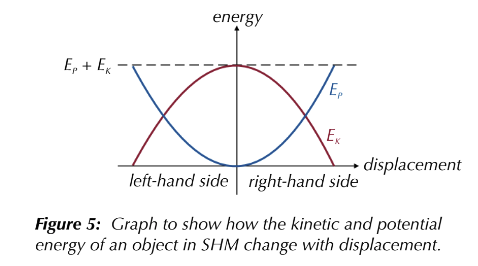
Simple Harmonic Oscillator
Mass on a spring: When the mass is pushed/pulled either side of eq, there’s a restoring force exerted on it. (Size and direction of force is found by Hooke’s law).
Free Vibrations
No transfer of energy to or from surroundings. The object will oscillate at its resonant frequency.
Forced Vibrations
Occurs when an external driving force is present. The frequency of said force is called the Driving Frequency.
Driving Frequency < Natural Frequency
Both the driver and oscillator are in phase.
Driving Frequency > Natural Frequency
Oscillator wont be able to keep up, therefore driver is in antiphase with oscillator.