Graphing
 Call Kai
 Learn
Learn Practice Test
 Spaced Repetition
 Match
Match Flashcards
 Knowt Play
1/28

There's no tags or description
Looks like no tags are added yet.
Name | Mastery | Learn | Test | Matching | Spaced | Call with Kai | Chat |
|---|
No analytics yet
Send a link to your students to track their progress
29 Terms
independent variable
The experimental factor that is manipulated/set to a particular value; the variable whose effect on dependent is being studied.
dependent variable
The measurable effect, outcome, or response in which the research is interested. changes based on the independent
often after a physiological signal is turned on or shut off the system changes how?
exponentially
exponential example: ion channels
- when ion channels open the voltage difference across the membrane increases exponentially to a new value
- when ion channels close, the voltage difference across the membrane decays exponentially back to the resting value
exponential decay
V = Ae^(-t/T)
A is a constant describing the amplitude
T is the time constant
the time constant is related to?
related to (but not equal to) the rate at which the dependent variable changes
t=1T
0.37, % steady state = 37%
t=2T
0.14, % steady state = 14%
t=3T
0.05, % steady state = 5%
t=4T
0.018, % steady state = 1.8%
t=5T
0.007, % steady state = 0.7%
t=6T
0.002, % steady state = 0.2%
when t=0, voltage =?
Amplitude
when tis very large, voltage =?
0
for an exponential decay the amplitude determines the?
starting value at time = 0
time constant is a measure of? if t is large/small?
how fast the dependent variable is changing
large - dependent changes slowly
small - dependent changes quickly
relationship between the time constant and the time tells you?
how much the signal has decreased
exponential increase
V = A(1-e^(-t/T))
steady state values for exponential rise
t=1 0.63 63%
t=2 0.85 85%
t=3 0.95 95%
t=4 0.98 98%
t=5 0.993 99.3%
t=6 0.997 99.7%
amplitude is the final value at?
steady state
if the exponential rise described the rise in voltage after an ion channel opened up, then A would be the?
voltage a long time after the ion channel had opened up
amplitude for an exponential rise describes what?
how high the signal rises after an infinite amount of time
dependent variable of S-shaped curve
changes slowly at low values of the independent variable, then changes more quickly at moderate values of the independent variable and then finally saturates (does not change) at high values of the independent variable
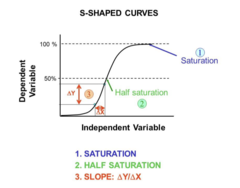
S-shaped curve example
dependence of O2 bound to hemoglobin (dependent variable, Y-axis) on the concentration of O2 in the blood (independent variable, X-axis).
- At low concentration of O2 in the blood very little O2 is bound to hemoglobin.
- Hemoglobin binds 4 oxygens, so as the amount of O2 in the blood increases, the amount of O2 bound to hemoglobin increases, until all of the hemoglobin is bound up with O2.
- Once all the oxygen sites on hemoglobin are full, increasing the O2 concentration will have no effect so the curve will saturate
important features to S-shaped curve
1. the point at which the dependent variable saturates
2. the value at which the dependent variable reaches half its maximum value.
3. the slope of the curve. The slope is different at different points along the curve, but is maximum where the dependent variable reaches half of its maximum value.
common changes of S-shaped curves
1. change in slope - consider at half max (ΔY/ΔX)
2. shift in the curve
shift in the curve is measured by?
an increase or a decrease in the value of the independent variable at half maximum (X50%)
curves can shift in what ways?
1. left or right: max value remains the same, value at half max changes
2. up or down: max value changes, can sometimes also shift left/right
Calcium binding to the channel in a way that requires a more positive voltage to open will result in a ___ shift. The ___ ____ value will remain the same. If calcium blocks the channel, then the total number of possible open channels will be ...?
right; 100% saturating; reduced, resulting in a shift down