Cells and Tissue
 Call Kai
 Learn
Learn Practice Test
 Spaced Repetition
 Match
Match Flashcards
 Knowt Play
1/40

There's no tags or description
Looks like no tags are added yet.
Name | Mastery | Learn | Test | Matching | Spaced | Call with Kai | Chat |
|---|
No analytics yet
Send a link to your students to track their progress
41 Terms
Tissue
A group of similar cells that combine to perform the same function
Organs
2 or more tissue working together to complete a certain job
Epithelial Tissue
A body tissue that covers the surfaces of the body, inside and out Major tissue of glands. Lacks blood vessels. Anchored to connective tissue by a basement membrane
Epithelial Tissue Examples
Skin, Inside of blood vessels and heart, Digestive & Respiratory tracts
Simple Squamous Epithelial
For absorption or diffusion Lung alveoli, Linings of cavities
Stratified Squamous Epithelia
Protects from mechanical stress Top layer of skin and top of mouth
Simple Cuboidal Epithelia
Secretion and absorption Glands and portions of kidney tubules
Stratified Cuboidal Epithelia
Relatively rare. Located along the ducts of sweat glands and in larger ducts of the mammary glands.
Transitional Epithelia
Tolerate repeated cycles of stretching without damage Appearance changes as stretching occurs Found in urinary bladder Cells appear cuboidal when relaxed
Simple Columnar Epithelia
Absorption, protection and secretion Found in stomach, small intestine, large intestine Associated with goblet cells and microvilli
Stratified Columnar Epithelia
Relatively rare. Provide protection in pharynx, anus, urethra, epigottis
Pseudostratified Columnar Epithelia
Typically have cilia Found in nasal cavity, trachea, bronchi (Resp Tract) Associated with goblet cells. Appears layered but is only one layer
Connective Tissue Functions
Interconnecting one tissue to another and protects organs
Connective Tissue Componenets
Specialized cells (bloodcells), extracellular protein fibers, ground subtance
Matrix
Mixture of protein fibers and ground substance, makes up most of the tissue volume
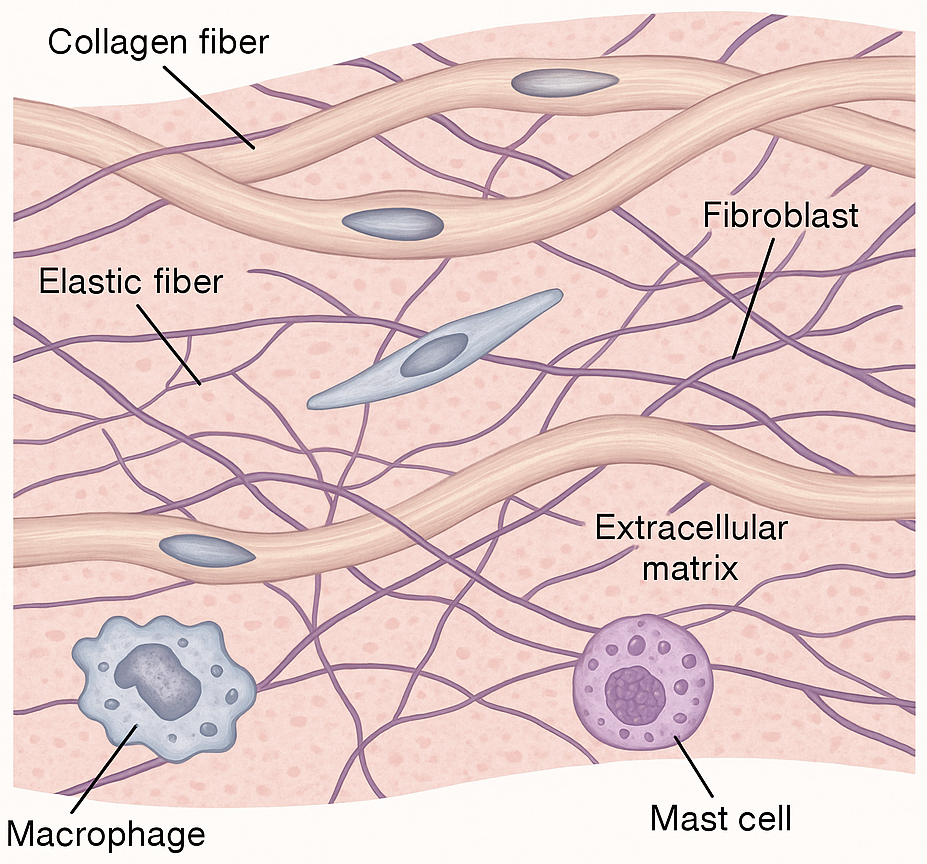
Connective Tissue Proper
Viscous matrix, lots of protein fiber
Fluid Connective Tissue
Watery matrix with dissolved proteins
Supporting Connective Tissue
Matrix with densely packed fibers
Fibroblasts
Proper
Secrete ground substance and protein fibers
Most common

Fibrocyte
Proper
2nd most common
Maintain protein fibers
Adipocyte
Proper
Fat cells
Mesenchymal Cells
Immune
Respond to injury/infection
Stem cells
Differentiate into fibroblasts, macropluges, etc
Mastcells
Immune
Release histamine (inflammatory response) and Heparin (anticoagulant)
White bloodcells
Immune
Areolar Tissue
Loose Connective
Within dermis of the skin
Deep to epithelial lining of digestive
Cushioning and support but allows movement
Adipose Tissue
Loose Connective
Cushions, stores energy, insulation
Contains adipocytes
Reticular Tissue
Loose Connective
Supporting framework for liver, kidneys, Spleen
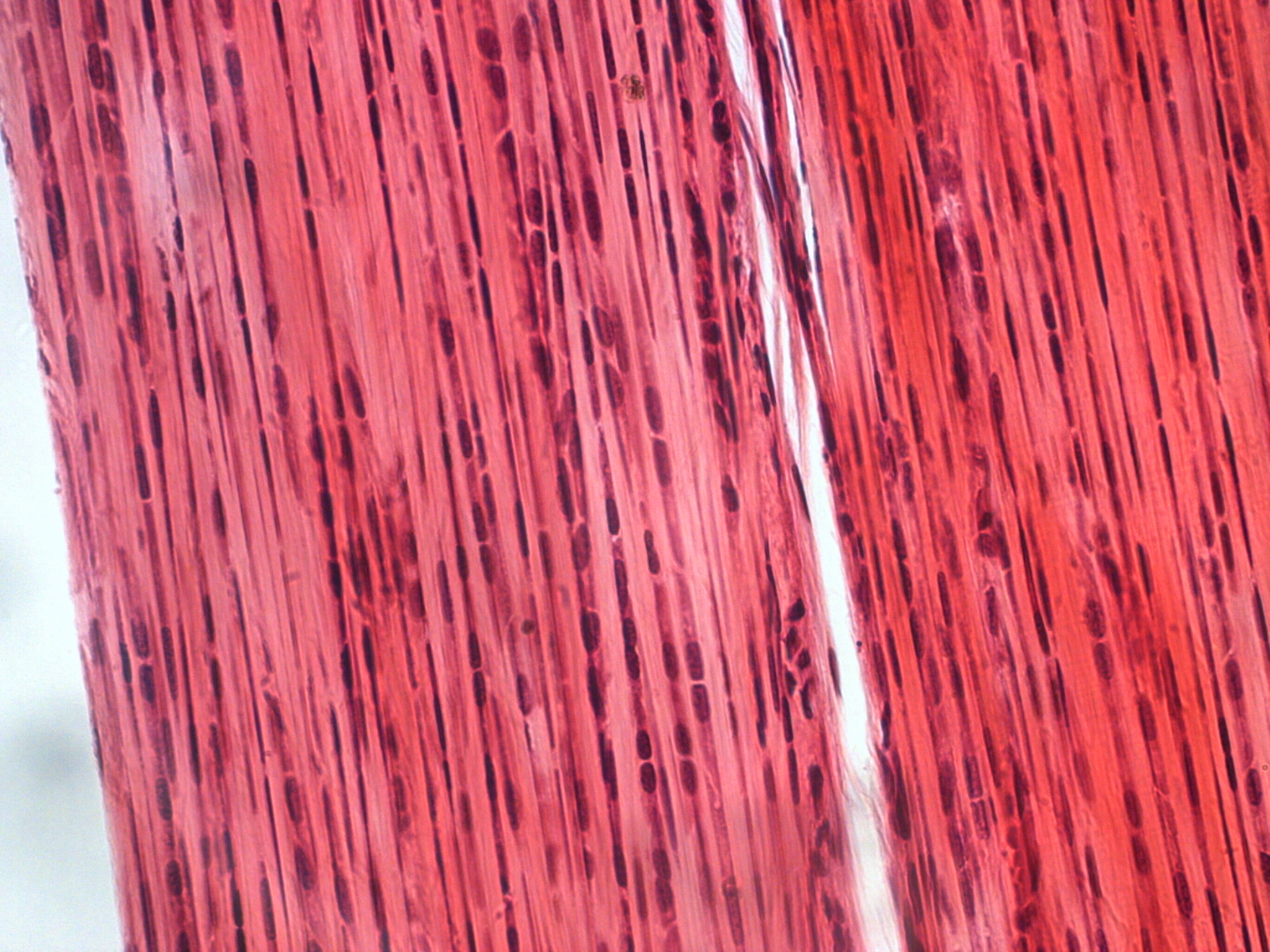
Desne Regular Connective Tissue
(AKA Collagenous Tissue)
Parellel, tightly packed collagen fibers
Exp: Tendons, ligaments
Elastic Connective Tissue
Dense tissue made up of mostly elastic fibers
Between vertebrae

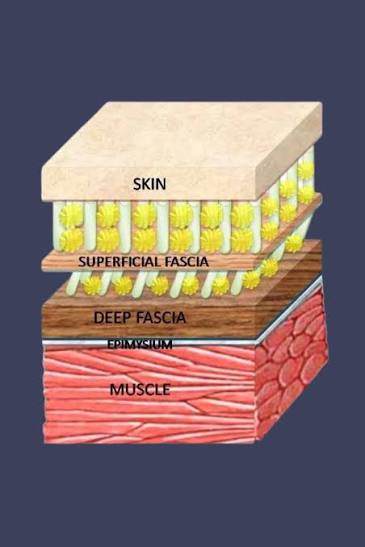
Fascia Connective Tissue
Wraps around and supports organs
Fluid Connective Tissue : Blood
Plasma : fluid matrix of blood
Contains RBC, WBC, and platets
Hyaline Cartialge Supporting Connective Tissue
Most common type of cartilage
Reduces friction between bones at joint surfaces
Shock absorbtion/protection
Nasal septum, sterno-costal joints

Elastic Cartilage Supportive Connective Tissue
Supportive but flexible
Elastic fibers
External ear, larnyx
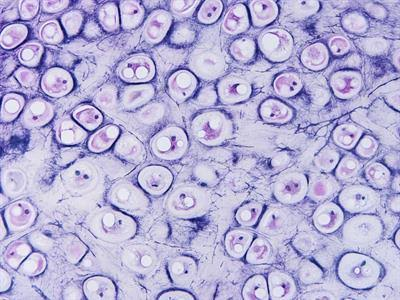
Fibrocartilage Supportive Connective Tissue
Densly interwoven collagen fibers
Limits movement provides connection
Between pubic bones and vertebral bodies
Bone Supporting Connective Tissue
Matrix has collagen fibers and is calcified
Collagen - strong and somewhat flexible
Calcium - hard and rigid
Skeletal Muscle Tissue
Attached to bones
Cells are long and multinucleated
Arranged neatly and parellel
Straitened (alternating light and dark)
Controlled voluntarily
Cardiac Muscle
Heart only
Controlled involuntarily
Striated
Cells are short, branching, semi-parellel
Cells connected by intercollated disks
Smooth Muscle Tissue
Walls of hollow organs (digestive, reproductive, respiratory organs)
Controlled involuntary
Cells are small and spindle shaped
Nervous Tissue
Associated with Brian, spinal cord, and nerves
Specialized in conducting electrical impulses
Contains Neurons and Neuroglia
Parts of a Neuron
Cell body: contains organelles
Dendrites : Short branches, receive incoming signals
Axon (Nerve Fiber) : Long processes, carries outgoing signals
Neuroglia
DO NOT conduct impulses
Maintain physical structure of tissues
repair tissue framework after injury
Perform phagocytosis
Provide nutrients to neurons
regulate the composition of the interstitila fluid surrounding neurons