TEN STEPS CH3: Supporting Details
 Call Kai
 Learn
Learn Practice Test
 Spaced Repetition
 Match
Match Flashcards
 Knowt Play
1/17

There's no tags or description
Looks like no tags are added yet.
Name | Mastery | Learn | Test | Matching | Spaced | Call with Kai |
|---|
No analytics yet
Send a link to your students to track their progress
18 Terms
Supporting details are
reasons, examples, facts, steps, or other kinds of evidence that explain a main idea.
In the paragraph below, three major details support the main idea that the penny should be phased out of our economy. As you read the paragraph, try to identify the three major details. “A penny saved is a penny earned,” the old saying goes. But there are now good reasons for our government to phase the penny out of the economy, allowing the nickel to stand as the lowest-valued coin. For one thing, pennies take up more space than they are worth. We can all recall a time when we needed a nickel, dime, or quarter to make an important phone call, buy a vending machine snack, or make a photocopy, and all we could come up with was a fistful of useless pennies. Pennies are also a nuisance to the business community. According to the National Association of Convenience Stores, 5.5 million hours and 22 million dollars are wasted by businesses on the extra time and effort it takes to handle pennies. Finally, keeping pennies in circulation costs the nation as a whole. The manufacturing, storage, and handling expenses involved in a penny’s production and distribution add up to considerably more than the one cent it is worth.”
Supporting detail 1: Pennies take up more space than they are worth.
Supporting detail 2: Pennies are a nuisance to the business community.
Supporting detail 3: Pennies cost the nation as a whole.
Preparing an outline of a passage will help you
understand and see clearly the relationship between a main idea and its supporting details. Outlines start with a main idea (or a heading that summarizes the main idea), followed by supporting details.
There are often two levels of supporting details,
major and minor. The major details explain and develop the main idea. In turn, the minor details help fill out and make clear the major details.
Now reread the paragraph and try to pick out the three major supporting details. “Many people feel that violence on television is harmless entertainment. However, we now know that TV violence does affect people in negative ways. One study showed that frequent TV watchers are more fearful and suspicious of others. They try to protect themselves from the outside world with extra locks on the doors, alarm systems, guard dogs, and guns. In addition, that same study showed that heavy TV watchers are less upset about real-life violence than non-TV watchers. It seems that the constant violence they see on TV makes them less sensitive to the real thing. Another study, of a group of children, found that TV violence increases aggressive behavior. Children who watched violent shows were more willing to hurt another child in games where they were given a choice between helping and hurting. They were also more likely to select toy weapons over other kinds of playthings.”
Supporting major detail 1: Frequent TV watchers are more fearful and suspicious of others.
Supporting Minor detail 1: Protect themselves with extra locks, alarms, dogs, and guns.
Supporting major detail 2: Heavy TV watchers are less upset about real-life violence than non-TV watchers.
Supporting Minor detail 2: Constant violence on TV makes them less sensitive to the real thing.
Supporting major detail 3: TV violence increases aggressive behavior in children.
Supporting Minor detail 3: Children watching violent shows are more likely to choose toy weapons instead of other playthings.
Notice that just as the main idea is more general than its supporting details, so major details are more general than minor ones. For instance,
the major detail that “Frequent TV watchers are more fearful and suspicious of others” is more general than the minor details about people protecting themselves with “extra locks on the doors, alarm systems, guard dogs, and guns,” which illustrate the major detail.
Outlining Tip 1: Look for words that tell you a list of details is coming.
“But there are now good reasons for our government to phase the penny out of the economy.” “In fact, we now know that TV violence does affect people in negative ways.” You will not always be given such helpful signals that a list of details will follow. However, you will want to note such words when they are present, because they help you to understand quickly the basic organization of a passage.
Outlining Tip 2: Look for words that signal major details.
Such words are called addition words. Here are some common addition words: first, secondly, finally, additionally.
Which words introduce the first major detail? For one thing
Which words introduce the second major detail? also
Which words introduce the third major detail? Finally,
Outlining Tip 3: When making an outline, put all supporting details of equal importance at the same distance from the left margin.
In the model outline below, the three major supporting details all begin at the same distance from the margin. Likewise, the minor supporting details are all indented at the same distance from the margin.
Main idea
1. Major detail
a. Minor detail
2. Major detail
a. Minor detail
3. Major detail
a. Minor detail
Outlining Tip 4: some major details can have a differing amount of minor details.
Main idea
1. Major detail
a. Minor detail
b. Minor detail
2. Major detail
a. Minor detail
b. Minor detail
3. Major detail
a. Minor detail
b. Minor detail
c. Minor detail
Maps, or diagrams, are highly visual outlines in which
circles, boxes, or other shapes show the relationships between main ideas and supporting details. Each major detail is connected to the main idea. If minor details are included, each is connected to the major detail it explains.
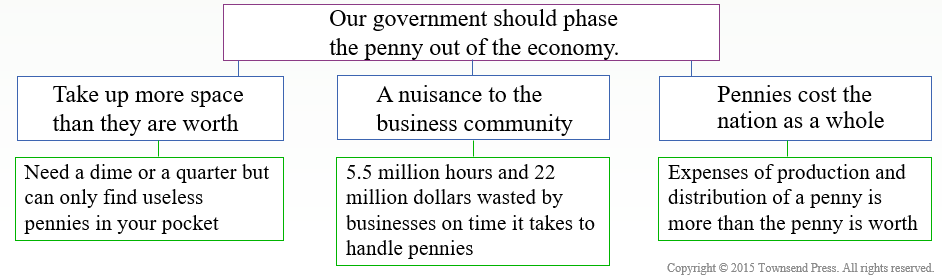
Here is how you might create a map of this paragraph. “A penny saved is a penny earned,” the old saying goes. But there are now good reasons for our government to phase the penny out of the economy, allowing the nickel to stand as the lowest-valued coin. For one thing, pennies take up more space than they are worth. We can all recall a time when we needed a nickel, dime, or quarter to make an important phone call, buy a vending machine snack, or make a photocopy, and all we could come up with was a fistful of useless pennies. Pennies are also a nuisance to the business community. According to the National Association of Convenience Stores, 5.5 million hours and 22 million dollars are wasted by businesses on the extra time and effort it takes to handle pennies. Finally, keeping pennies in circulation costs the nation as a whole. The manufacturing, storage, and handling expenses involved in a penny’s production and distribution add up to considerably more than the one cent it is worth.”
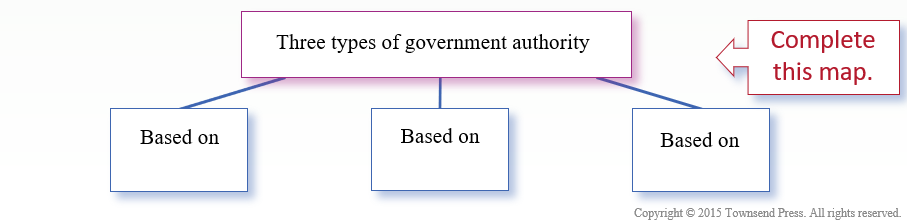
As you read this paragraph, try to pick out the major details and Complete this map. “Weber says that there are three types of authority from which governments gain their right to command. One type of authority is based on tradition. Kings, queens, feudal lords, and tribal chiefs do not need written rules in order to govern. Their authority is based on long-standing customs and is handed down through generations from parent to child. People may also submit to authority because of charisma, the exceptional personal quality of an individual. Such leaders as Napoleon and Gandhi illustrate authority that derives its legitimacy from charismatic personalities. The political systems of industrial states are based largely on a third type of authority: legal authority. These systems derive legitimacy from a set of explicit rules and procedures that spell out the ruler’s rights and duties. Typically, the rules and procedures are put in writing. The people grant their obedience to “the law.” It specifies procedures by which certain individuals hold offices of power, such as governor or president or prime minister. But the authority is vested in those offices, not in the individuals who temporarily hold the offices.”
1: Based on tradition
2: Based on charisma
3: Based on law
A summary is the
reduction of a large amount of information to its most important points. As a general guideline, a paragraph might be reduced to a sentence or two, an article might be reduced to a paragraph, and a textbook chapter might be reduced to about three pages of notes.
One of the most common types of summarizing occurs when you are
taking study notes on textbook material. Very often you will find it helpful to summarize examples of key terms.
Read the textbook passage below and choose a summary of the passage. “People under severe stress may react to their problems with regression, a return to childlike behavior and defenses. Adults who cry when their arguments fail may expect those around them to react sympathetically, as their parents did when they were children. Other adults may use temper tantrums in a similar way. In both examples, people are drawing on childish behaviors to solve current problems, in the hope that someone will respond to them the way adults did when they were children. Inappropriate as it may seem, such immature and manipulative behavior often works—at least for a while.”
“Regression—a return to childlike behavior and defenses to solve current problems. For example, an adult whose argument fails may cry to get sympathy.” Note that a textbook definition of a key term (such as regression) should generally not be summarized, but should be worded in the language chosen by the author. On the other hand, it usually makes sense to summarize the supporting information.
Summarizing often involves two steps:
Select one example from several that might be given. Condense the example if it’s not already very brief.
Summarizing this paragraph. “The tendency for members to be so intent on maintaining group agreement that they overlook or put aside the flaws in their decision is called groupthink. Once a tentative decision has been made, members withhold information or opinions that might cast doubt on that course of action. They do not want to be seen as criticizing their colleagues or as “rocking the boat.” If outside experts raise questions about the wisdom of their decision, members unite in opposing and discrediting the new information. A classic example of “groupthink” occurred more than 50 years ago, during President Kennedy’s administration. Kennedy sought the advice of a small group of trusted advisers in deciding whether to support the Bay of Pigs invasion of Cuba in 1961—an attempt by a force of Cuban exiles to overthrow the government of Fidel Castro. Although several advisers had strong objections to the plan, not one expressed doubts. As far as Kennedy knew, his advisers were unanimously in favor. The invasion was a military and public relations disaster.”
Groupthink - the tendency for members to be so intent on maintaining group agreement that they overlook or put aside the flaws in their decision.
Example - Kennedy went ahead with the disastrous Bay of Pigs invasion because advisors withheld their objections. (includes the idea that advisers withheld their objections in order to seem unanimously in favor of the Bay of Pigs invasion, which turned out to be a disaster.)