Manufacturing Extravaganza 2: Electric Boogaloo
 Call Kai
 Learn
Learn Practice Test
 Spaced Repetition
 Match
Match Flashcards
 Knowt Play
1/190

Earn XP
Description and Tags
FINAL
Name | Mastery | Learn | Test | Matching | Spaced | Call with Kai | Chat |
|---|
No analytics yet
Send a link to your students to track their progress
191 Terms
What is joining?
Welding, brazing, soldering, and adhesive bonding forming a permanent joint between parts
What is assembly?
Mechanical methods (usually) of fastening parts together; Some allow for easy disassembly
What is welding?
A joining process in which two (or more) parts are coalesced at teir contacting surfaces by applying heat and/or pressure
What are some key characteristics of welding?
Provides a permanent join
Usually most economical way to join parts
Not restricted to a factory environment
What are some limitations of welding?
Performed manually with high labor costs
Utilize high energy and are inherently dangerous
Do not allow for convenient diassembly
Joints can have quality defects that can be difficult to detect
What are the two types of welding?
Fusion & solid state welding
What is fusion welding?
Joining processes that melt the base metals
What is arc welding (AW)?
Melting of the metals by an electric arc (ie. stick welding, TIG, MIG)
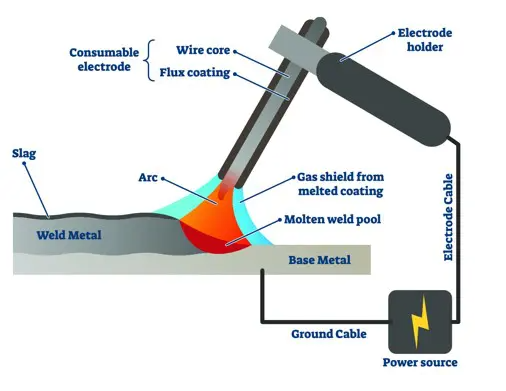
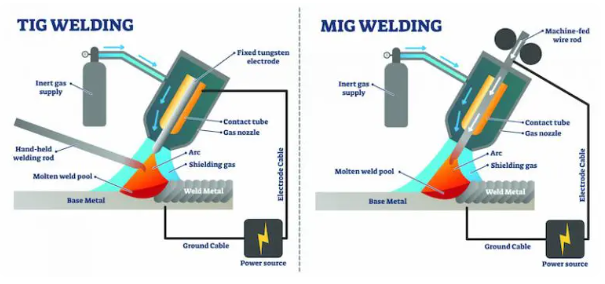
What is the difference between TIG and MIG welding?
TIG (Tungsten Inert Gas) uses a non-consumable tungsten rod to make the arc.
MIG (Metal Inert Gas) uses a consumable wire electrode that becomes the filler metal.
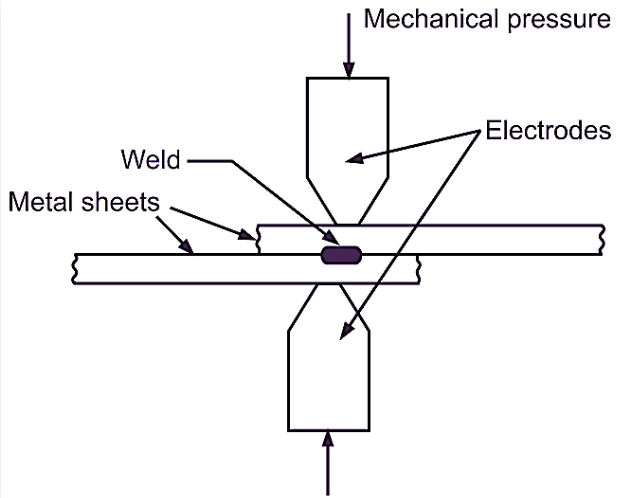
What is resistance welding (RW)?
Melting by heat from resistance to an electric current between faying surfaces held together under pressure (ie. spot welding)
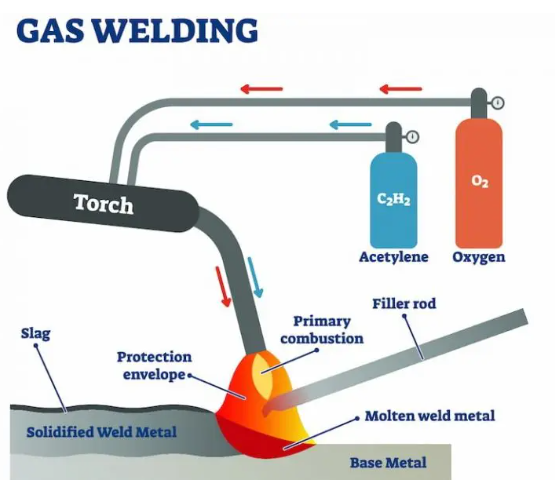
What is oxyfuel gas welding (OFW)?
Melting by an oxyfuel gas like acetylene
How does arc welding work?
During the weld, the base metal is melted and filler metal is added to the motel pool, protected by a shielding gas like argon
What is diffusion welding (DFW)?
Solid state diffusion between two surfaces held together under pressure at elevated temperature
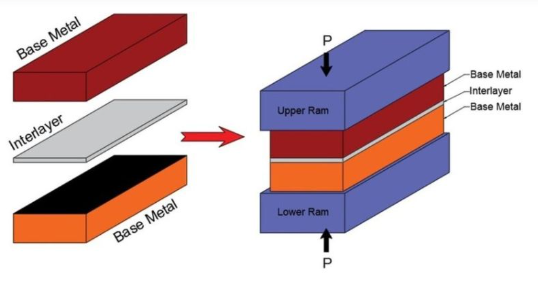
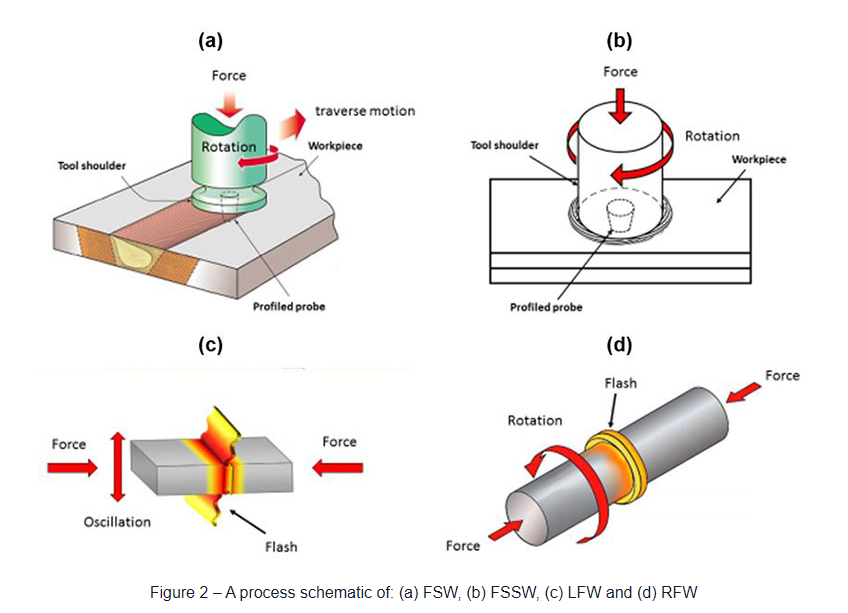
What is friction welding (FRW)?
Using heat of friction to join two surfaces together
What is the welder & fitter?
Welder manually controls path & placement of welding gun
Fitter arranges parts prior to welding
What are some safety hazards with welding?
High temperatures of molten metals
Certain processes use fuels (acetylene in OFW) that are fire hazards
High electrical power can cause risk of shock
UV radiation from arc welding can be dangerous to eyes (requires welding helmet)
Sparks, smoke, fumes from metal & flux must be ventilated properly
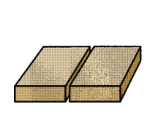
What kind of joint is this?
Butt joint
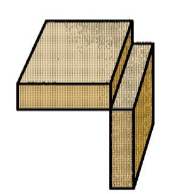
What kind of joint is this?
Corner joint
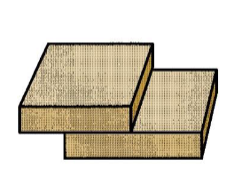
What kind of joint is this?
Lap joint
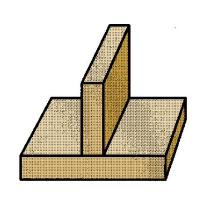
What kind of joint is this?
Tee joint
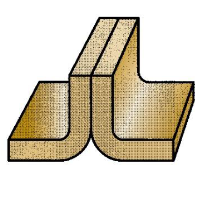
What kind of joint is this?
Edge joint
How does fusion work with welding?
Fusion requires high density heat energy to cause localized melting of base metals with the least amount of energy possible
What is power density?
Power transferred to workpiece per unit surface area [W/mm²]
What happens if the power density is too high? Too low?
If it’s too high, localized temperatures vaporize metal in the affected region.
If it’s too low, heat is conducted into workpiece so melting never occurs.
What are the features of a fusion welded joint?
Fusion zone, weld interface, heat affected zone (HAZ), unaffected base metal zone
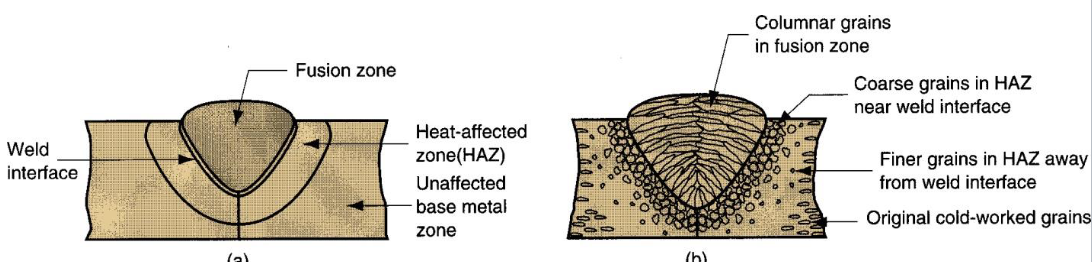
What is the heat affected zone?
Metal has experienced temps below melting but high enough to change the microstructure
Heat treated region that typically negatively affects the mechanical properties.
What is fusion welding?
Melting two parts to be joined & adding filler metal to the joint in some cases (ie. arc welding, resistance spot welding, oxyfuel gas welding)
What is solid state welding?
Using heat and/or pressure to join two parts together without any melting or filler metal being added (ie. forge welding, diffusion welding, friction welding)
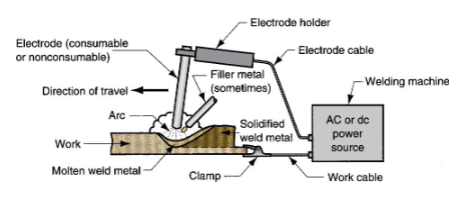
What is Arc Welding (AW)?
Fusion process where coalescence of metals is done by heat from an electric arc between an electrode & the workpiece
Most AW processes add filler metal to increase volume & strength of joint
What are some problems with arc welding?
Weld joint quality & productivity can vary greatly
What is arc time?
Time the arc is on / hours worked
Manual Welding AT = 20%
Machine Welding AT = ~50%
What is a consumable electrode? Nonconsumable electrode?
Consumable electrodes are expended during welding process whereas nonconsumable electrodes are not
What are some forms of consumable electrodes?
Welding rods 9-18 & 3/8” or less in diameter
Welding wire continuously fed from spools with long lengths of wire
What are some forms of nonconsumable electrodes?
Made of tungsten which resists melting
Filler metal must be supplied by a separate wire fed into the weld pool
What is arc shielding?
Shielding gases like argon, helium, CO2 & flux react to protect the arc from surrounding air in AW processes
What is flux?
A substance that prevents contaminants from reacting during the welding process by providing a protective atmosphere, stabilizing the arc, and reducing spattering
What are some application methods of flux?
Pouring granular flux onto the welding area
Stick electrode coated with flux material that melts during welding
Tubular electrodes where flux is contained in the core and released during welding
What power sources are used in arc welding?
Direct current (DC) used on all metals & generally has better arc control
Alternating current (AC) is cheaper to buy & operate but restricted to ferrous metals (Iron)
What are some consumable electrode AW processes?
Shielded Metal AW, Gas Metal AW, Flux-Cored AW, Submerged AW
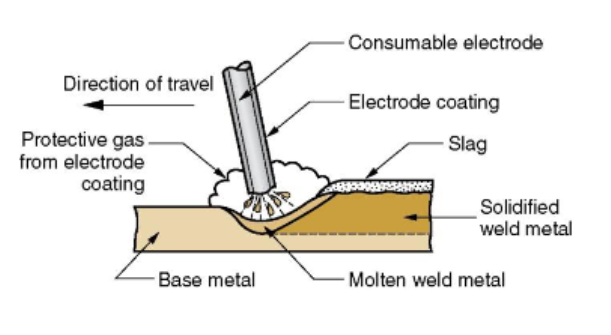
What is Shielded Metal Arc Welding (SMAW)?
Uses consumable electrode consisting of filler metal rod coated with chemicals that provide flux & shielding
A.K.A. stick welding
What is the welding stick made of in SMAW?
Composed of filler metal close in composition to the base metal coated with a powdered cellulose mixed with oxides & carbonates held by a silicate binder
What are some disadvantages of stick welding?
Sticks must be changed periodically
High current levels may melt the exterior coating prematurely
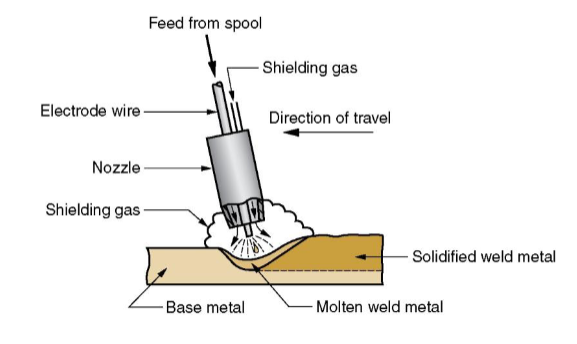
What is Gas Metal Arc Welding (GMAW)?
Uses consumable bare metal wire as electrode shielded by flooding arc with a gas
Wire is fed continuously and automatically from a spool through the welding gun
A.K.A. Metal Inert Gas (MIG) welding
What are some advantages of GMAW (Gas) over SMAW (Shielded)?
GMAW has better arc time with continuous wire electrode (Doesn’t need to constantly swap sticks out)
More efficient use of electrode filler than SMAW (End of stick is tossed)
Higher deposition rates
Doesn’t need slag removal
Easy to automate
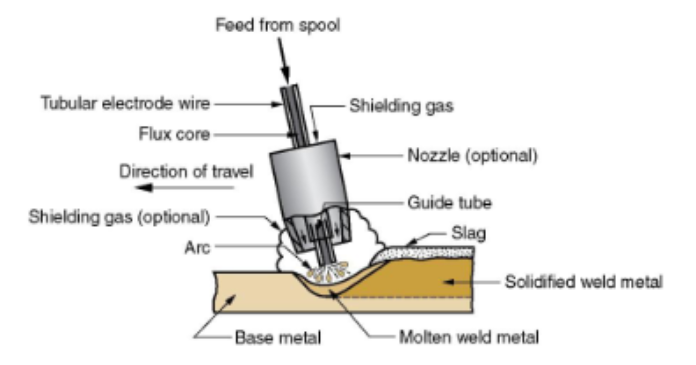
What is Flux-Cored Arc Welding (FCAW)?
Continuous consumable tubing containing flux in its core
Variation of SMAW (Shielded)
Self-Shielded FCAW - core of electrode has flux
Gas-Shielded FCAW - uses external shielding gas
What is Submerged Arc Welding (SAW)?
Uses continuous, consumable bare wire electrode with arc shielded by cover of granular flux that completely submerges operation
Flux introduced slightly ahead of joint by gravity from a hopper
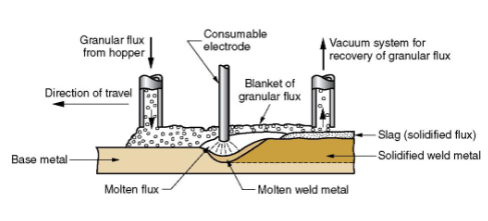
What is Gas Tungsten Arc Welding (GTAW)?
Uses nonconsumable tungsten electrode and an inert gas for arc shielding
A.K.A. Tungsten Inert Gas (TIG) Welding
Filler metal is added externally but does not require filler for thin metals & thin gaps
What are the advantages & disadvantages of GTAW / TIG?
Advantages:
High quality welds
No splatter
Little to no post-weld cleaning without flux
Disadvantages:
Generally slower & more expensive than consumable electrode arc welding processes
What is Resistance Welding (RW)?
Fusion welding processes that use heat and pressure to join parts together
Heat is generated by electric resistance to current flow at junction
Principal RW process is Resistance Spot Welding (RSW)
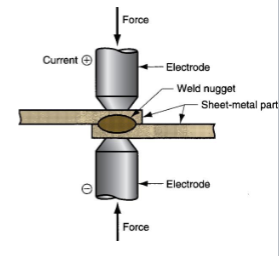
What are the advantages & disadvantages of resistance welding (RW)?
Advantages:
No filler required
High production rates
Easy to automate with good repeatability & reliability
Low operator skill required compared to arc welding
Disadvantages:
High initial equipment cost
Limited to lap joints for most RW processes
What is Resistance Spot Welding (RSW)?
Fusion of faying surfaces of a lap joint is done at one location with opposing electrodes
Mainly used for joining sheet metal
What is the spot welding cycle?
Electrodes push two parts together → Current is turned on & off → Creates weld nugget between two joints
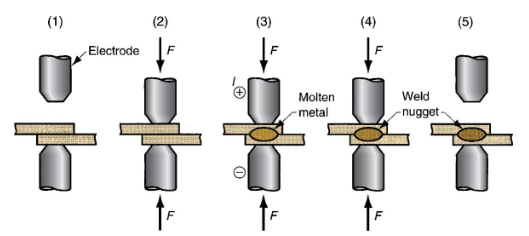
What is Resistance Seam Welding (RSEW)?
Uses rotating wheel electrodes to produce overlapping spot welds along a lap joint
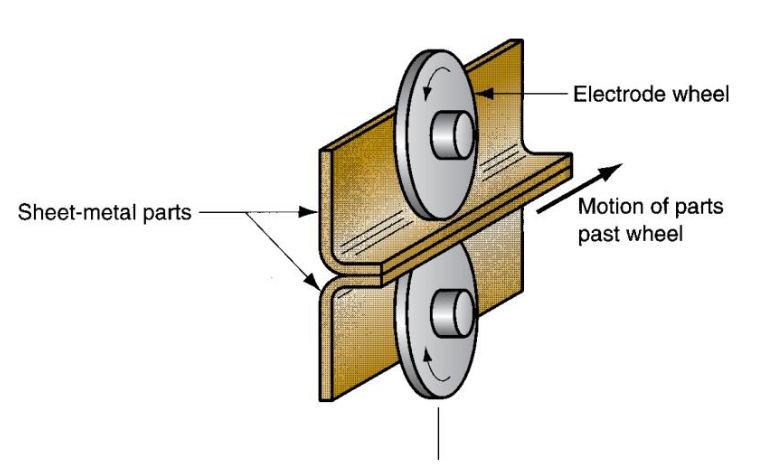
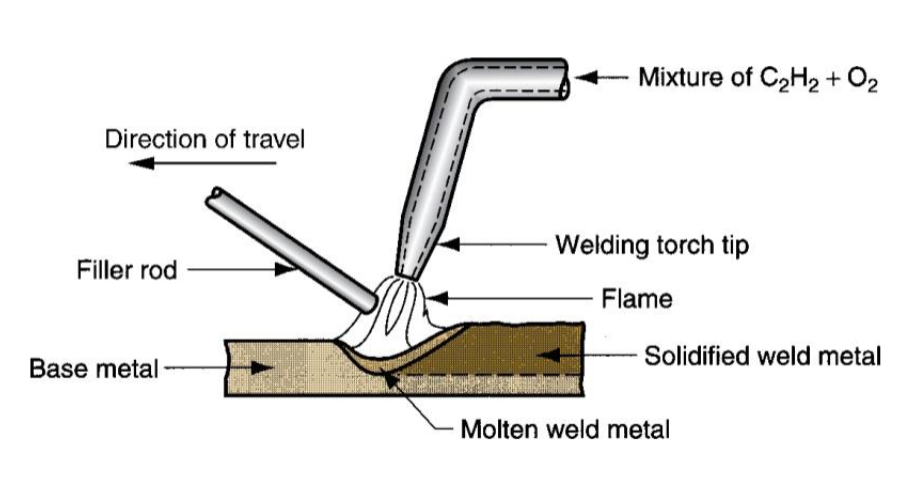
What is Oxyfuel Gas Welding (OFW)?
Fusion welding operations that burn various fuels mixed with oxygen to join parts
What is Oxyacetylene Welding (OAW)?
Fusion performed by high temperature flame from combustion of acetylene and oxygen
What is Electron Beam Welding (EBW)?
Fusion performed by focusing high-intensity stream of electrons striking work surface
What are the advantages & disadvantages of electron beam welding (EBW)?
Advantages:
High-quality welds with deep narrow profiles
Limited heat affected zone & low thermal distortion
No flux / shielding gases needed
Disadvantages:
High equipment cost
Precise joint preparation & alignment is required
Needs vacuum chamber
EBW generates x-rays which can be dangerous
What is Laser Beam Welding (LBW)?
Fusion achieved by energy of concentrated, coherent light beam focused on joint
Normally performed with shielding gases to prevent oxidation
What is are the main advantages of LBW over EBW?
LBW doesn’t require a vacuum chamber or emit x-rays
Lasers can be focused & directed by optical lenses & mirrors
BUT EBW provides deeper & high depth-to-width ratio welds than LBW
What is Solid State Welding (SSW)?
Joining of part surfaces by pressure alone or with pressure & heat
Time is typically a factor
No filler metal is added
What are the advantages of solid-state over fusion welding processes?
Melt around joints retains original properties if no heat is used (only for some SSW)
SSW joints bond entire contact interface between parts instead of at specific spots or seams
Some SSW can be used to bond dissimilar metals more easily than FW
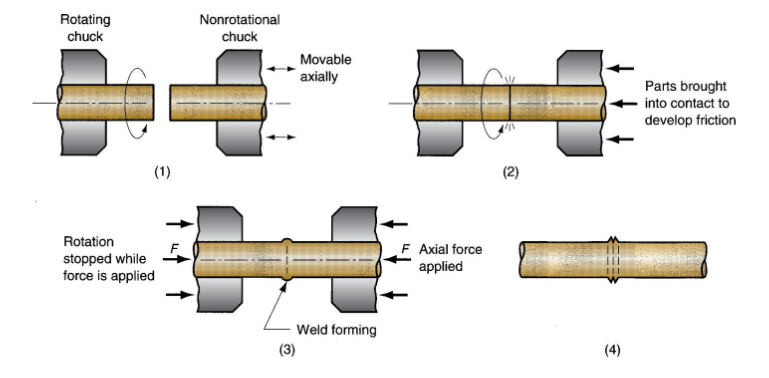
What is Friction Welding (FRW)?
SSW process using frictional heat & pressure to join parts together
Can be used to join dissimilar metals & easy to automate
Steps: Rotating part w/out contact → parts generate friction → rotation stopped when axial pressure applied → weld complete
What are the limitations of friction welding?
One of the parts must be in rotation
Flash (bulging) must be machined / removed afterwards
Upsetting reduces part lengths
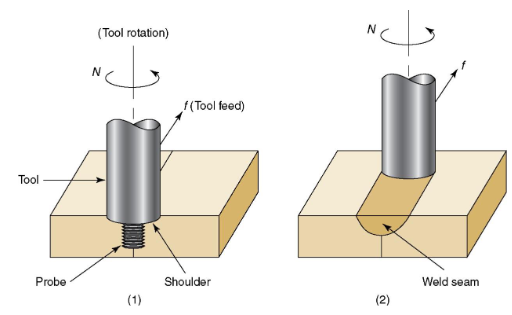
What is Friction Stir Welding (FSW)?
Rotating tool is fed along joint line generating heat & stirring metal to form weld seam
What are the advantages & disadvantages of friction stick welding (FSW)?
Advantages:
Good mechanical properties in joint
No toxic fumes, warping, shielding issues
Little distortion or shrinkage
Good weld appearance
Disadvantages:
Exit hole is produced when tool is withdrawn
Heavy clamping of parts required
What do you look for when determining weld quality?
Looking for defects like:
Residual stress & distortion
Welding defects / cracks
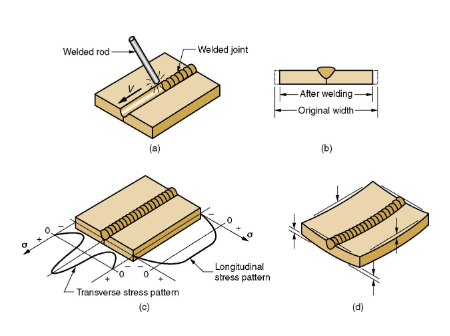
What causes residual stress & distortion?
Rapid heating & cooling in localized regions during fusion welding leads to thermal expansion & contraction that causes residual stress
Leads to distortion & warpage
What are some ways to minimize warping?
Welding fixtures to physically restrain parts
Using heat sinks to remove heat
Tack welding at points to create rigid structure before seam welding
Changing speed, filler metal (amount & type) to reduce warpage
Preheating base parts
Heat treating after welding to relieve stresses
What are some examples of welding defects?
Cracks
Cavities
Solid Inclusions
Imperfect shape / contour
Incomplete fusion
What is metal forming?
Using plastic deformation to change the shape of metal workpieces using dies to form the desired geometry
What is bulk deformation?
Significant deformations and massive shape changes w.r.t. workparts with low surface area-to-volume ratios
What are the types of bulk deformation processes?
Rolling
Forging
Extrusion
Wire & Bar Drawing
What is rolling?
Slab is heated in a furnace & rolled between powered rollers until at desired thickness
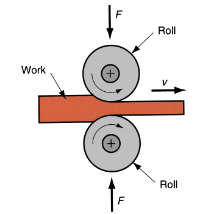
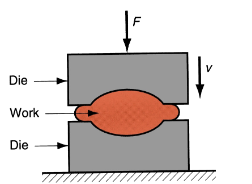
What is forging?
Forming metal by impacting and/or squeezing a preheated part between two halves of a die
Multiple dies may be needed to achieve final shape
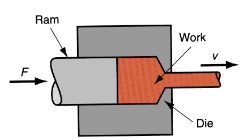
What is extrusion?
Billets are preheated and forced by a ram through one or more dies to achieve the desired cross-section
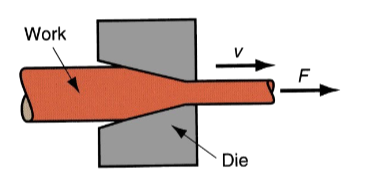
What is wire / bar drawing?
Cross-section of solid rod, wire, tubing is reduced or changed by pulling it through a die
What is sheet metalworking?
Forming operations done on metal sheets, strips, and coils
High surface area-to-volume ratio of starting metal
Also called pressworking as operations use presses creating stampings using punches & dies
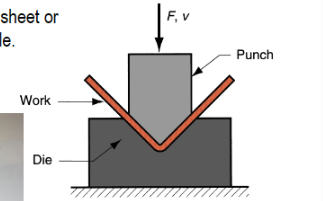
What is sheet metal bending?
Straining of metal sheet or plate to create a specific angle
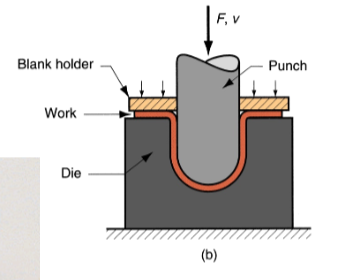
What is deep drawing?
Forming of flat metal sheet into hollow or concave shape by stretching the metal
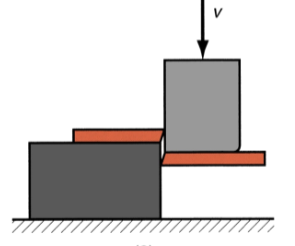
What is shearing?
Cuts the workpiece using a punch and die
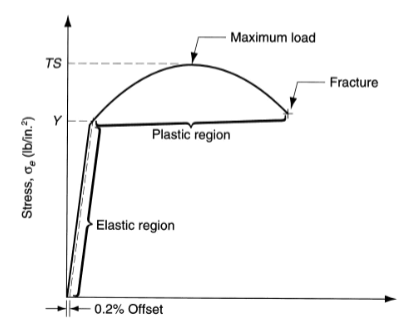
What is the flow curve?
Plastic region of stress-strain curve expressed as a curve using true stress & strain
σ = Kεn
K - strength coefficient
n - strain hardening exponent
What is flow stress?
Instantaneous value of stress required to continue deforming the material
Strength increases due to strain hardening
Yf = Kεn
Yf - flow tress (yield strength as a function of strain)
What is the average flow stress?
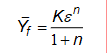
How does temperature affect the flow curve?
As temperature increases, strength (K) & strain hardening (n) exponents are reduced
Ductility is increased at higher temperatures
Any deformation operation can occur with lower forces & power at higher temperatures
What are the temperature ranges in metal forming?
Cold working
Warm working
Hot working
What is cold working?
Plastic deformation that typically occurs at room temperature
What are some advantages & disadvantages of cold working?
Advantages:
Better accuracy, surface finish & closer tolerances
Strain hardening increases strength & hardness
Grain flow during deformation can improve directional properties
No heating required
Disadvantages:
Higher forces & power required for deformation
Surfaces must be smooth & free of scale (black coating of oxide when heated) and dirt
Ductility & strain hardening can limit amount of forming possible
May require annealing to allow further deformation
Some metals might not be ductile enough to do cold forming
What is warm working?
Plastic deformation carried out at above room but below recrystallization temperatures (~30% of melting)
Compromise between cold & hot working
What are the advantages of warm working?
Advantages:
Lower forces than cold working
More complex geometries possible
Reduced need for annealing (can even be eliminated)
What is hot working?
Plastic deformation done above recrystallization temperature (above ~50% of melting)
Why would you use hot working?
Higher ability for plastic deformation of metal than cold & warm working
Lower strength coefficient (K) and strain hardening exponent (n) is almost zero improves ductility
What are the advantages & disadvantages of hot working?
Advantages:
Significant alteration possible
Lower force & power required
Metals that fracture in cold working can be hot formed
Strength properties are generally isotropic (not directionally dependent)
No strain hardening / strengthening
Disadvantages:
Lower dimensional accuracy
Higher total energy required from needing to heat the workpiece
Work surface oxidation (scale) results in poor surface finish
Shorter tool life
What is bulk deformation?
Metal forming operations that cause significant shape change by deforming metal parts with an initial bulk form rather than sheet
What is rolling?
Deformation process where work thickness is reduced by compressive forces exerted by two opposing rolls
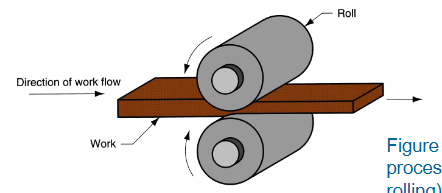
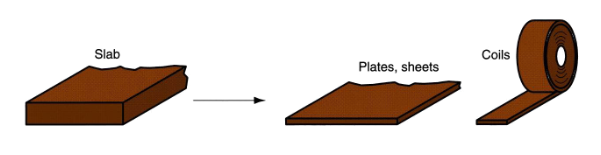
What is flat rolling?
Used to reduce thickness of rectangular cross-section
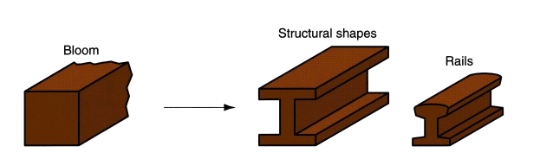
What is shape rolling?
Workpiece is deformed into a contour cross section than flat (rectangular)
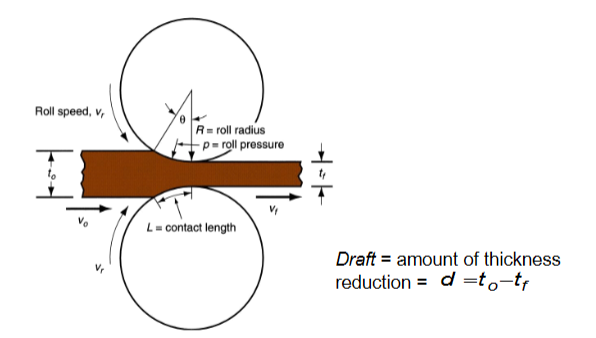
What is the draft?
Amount of thickness reduction
d = t0 - tf
What is the difference between hot & cold rolling?
Hot rolling - most common due to large amount of deformation possible
Cold rolling - produces finished sheet & plate stock
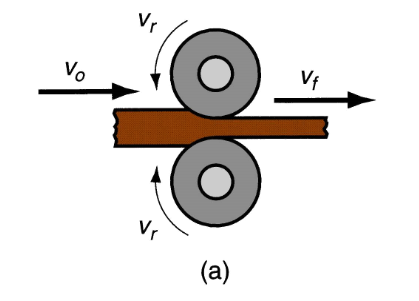
What type of rolling mill is this?
Two-high rolling mill
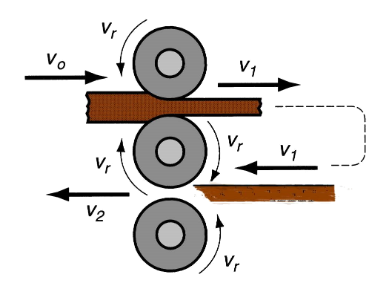
What type of rolling mill is this?
Three-high rolling mill