DAT Bootcamp General Chemistry
 Call Kai
 Learn
Learn Practice Test
 Spaced Repetition
 Match
Match Flashcards
 Knowt Play
1/226

There's no tags or description
Looks like no tags are added yet.
Name | Mastery | Learn | Test | Matching | Spaced | Call with Kai | Chat |
|---|
No analytics yet
Send a link to your students to track their progress
227 Terms
atom
smallest unit of an element
molecule
atom bonded to at least one other atom
ion
atom that has lost or gained an electron (charged)
allotrope
elemental molecule with different formulas,
example: O2 and O3
ionic compound
metal + nonmetal. high MP, high BP, brittle, hard.
held together by ionic interactions (lattice energy). ex) NaCl or MgO
molecular compound
2+ nonmetals. low MP, do not conduct electricity. held together by intermolecular forces. ex) H2O or Cl2 or CH2
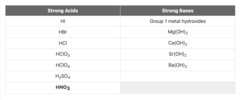
SA and SB
Percent error
actual - theoretical / theoretical
yield of reaction
experimental yield/theoretical yield
Beer-Lambert Law
absorbance = (molar absorptivity)(c)(l)
mass number
protons + neutrons
atomic number
number of protons
Bohr Model
model of an atom that shows electrons in circular orbits around the nucleus
Paramagnetic
unpaired electrons, attracted to magnets ex. O2
Diamagnetic
paired electrons, slightly repelled by magnets ex. N2
principal quantum number
n
shell (distance from nucleus)
(l, infinity)
azimuthal quantum number
l
subshell
l=0 s, l=1 p, l=2 d, l=3 f
magnetic quantum number
ml
specific orbital
-l,...,+l
spin quantum number
ms
electrons up or down
-1/2, +1/2
Aufbau principle
electrons fill the lowest energy orbitals first
Hund's rule
don't pair electrons until needed
Pauli exclusion principle
no 2 electrons in the same atom can have the same 4 quantum numbers
Heisenberg uncertainty
impossible to determine particles position and momentum with perfect accuracy
ionic bonds
transfer electrons between elements with large difference in electronegativity
covalent bonds
sharing of electrons between 2 elements with similar electronegativity
octet rule
every atom wants 8 electrons
octet rule exceptions
H = 2e-, Be = 4e-, B & Al = 6e-, 3rd row and lower can have more than 8
Lattice energy
energy required to completely separate an ionic compounds cations from its anions. larger charge = larger _______ ______. shorter bond distance = larger _______ ______.
single bond
1 sigma bond
double bond
1 sigma and 1 pi bond
triple bond
1 sigma and 2 pi bonds
bond order
The average number of bonds per atom covalently bonded to a central atom
sp
180º bond angle
linear
sp2
120º bond angle
trigonal planar
sp3
109.5º bond angles
tetrahedral
sp3d
90º and 120º bond angles
trigonal bipyramidal
sp3d2
90º bond angle
octahedral
Alkali metals
group 1A
low ionization energy
form ionic bonds
v reactive w water
Alkaline earth metals
group 2A
low ionization energy
reactive w water (increasing reactivity down a column)
Halogens
highly electronegative
high electron affinity
highly reactive with metals
good oxidizing agent
Noble Gases
inert gases
Transition metals
partially filled d-orbitals
several oxidation states
Have high melting and boiling points
hard and have high densities
Can form compounds that are paramagnetic
Can form compounds that are excellent catalysts
Can form colored compounds
Electronegativity
how much something wants to accept an electron.
increases up and to the right
Electron Affinity
energy given off when atom gains an electron
increases up and to the right
Ionization energy
energy required to remove an electron from an atom.
increases up and to the right
Ideal Gas Assumptions
1) volume or size of each individual gas molecule is insignificant
2) gas molecules collisions with each other are perfectly elastic, no IM forces
3) average KE of a gas depends only on the system temperature
gases like what temp and what pressure
high temp low pressure
Boyle's Law
P1V1=P2V2
Charle's Law
V1/T1=V2/T2
Avogadro's Law
V1/n1=V2/n2
Ideal Gas Law
PV=nRT
R
0.0821 L atm / mol K
STP
1atm, 273 K
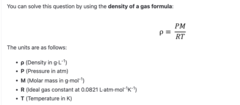
Gas density equation
Dalton's Law of Partial Pressure
Pt=Pa+Pb+Pc+....
Pa=XaPt
Graham's Law of diffusion
rate a/rate b=square root of molar mass a/ square root of molar mass b
Ion-dipole bond
intermolecular force between ions and polar substances
Hydrogen bonding
N-H, F-H, O-H
Dipole-dipole bond
IM force between polar molecules
London-dispersion force
between all molecules
greater weight = greater force
intermolecular forces (strongest to weakest)
1. Ion dipole
2. hydrogen bonding
3. dipole-dipole
4. dipole induced dipole
5. london disperson/vanderwaals
Intramolecular forces (strongest to weakest)
1. ionic
2 polar covalent bonds
3. metallic
4. non polar covalent bonds
higher IM forces lead to...
higher BP
higher heat of vaporization
higher viscosity
higher surface tension
lower vapor pressure
simple cubic
A unit cell that consists of a cube with one atom at each corner.
body-centered
atoms at corners and one in the center.
face-centered
there are atoms or ions at the corners and the center of each face of the imaginary cube, 4 atoms
Sublimination
solid to gas
Fusion
solid to liquid
Vaporization
liquid to gas
Deposition
gas to solid
Condensation
gas to liquid
Crystallization
liquid to solid
solution
uniform mixture of 2+ substances
solvent
substance present in a larger amount
solute
substance present in a smaller amount
unsaturated solution
less than max amount of solute is dissolved in solvent
saturated solution
max amount of solute is dissolved in solvent
Molarity
mol solute/L solution
molality
mol solute/kg solvent
Freezing point depression
ΔTf= -iKfm
Boiling point elevation
ΔTb= iKbm
osmotic pressure
=iMRT
k unit 0 order
M1s-1
k unit 1st order
s-1
k unit 2nd order
M-1 s-1
k unit 3rd order
M-2s-1
Collision theory
both molecules must collide
both must collide with enough energy
both must collide in correct 3D orientation
catalyst
speed up rxn without being consumed
lowers activation energy
provides alternate pathway
does NOT shift equilibrium
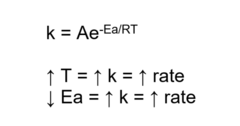
Arrhenius equation
Kc
[products]/[reactants]
Kp
P products/P reactants
Keq
Kforward/Kreverse
Keq>1
products favored
Keq
reactants favored
Q
shift towards product, no ppt
Q>K
shift towards reactants, ppt formed
Q=K
at equilibrium
Arrhenius acid
H+ donor in water
Arrhenius base
OH- donor in water
Bronsted Lowry acid
H+ donor