CNA CHAPER 8
 Call Kai
 Learn
Learn Practice Test
 Spaced Repetition
 Match
Match Flashcards
 Knowt Play
1/59

There's no tags or description
Looks like no tags are added yet.
Name | Mastery | Learn | Test | Matching | Spaced | Call with Kai | Chat |
|---|
No analytics yet
Send a link to your students to track their progress
60 Terms
Nutrition
How the body uses food to maintain health.
Nutrient
A necessary substance that provides energy, promotes growth, and regulates metabolism.
Metabolism
The process of breaking down nutrients for energy, growth, and maintenance.
Water
The most essential nutrient for life, needed by every body cell.
Carbohydrates
Nutrients that supply the body with energy and help use fat efficiently.
Complex carbohydrates
Carbohydrates found in bread, cereal, potatoes, rice, pasta, vegetables, and fruits.
Simple carbohydrates
Carbohydrates found in sugars, sweets, syrups, and jellies.
Proteins
Nutrients needed for tissue growth and repair, which also supply energy.
Saturated and trans fats
Fats that increase cholesterol levels and risk of cardiovascular disease.
Monounsaturated and polyunsaturated fats
Fats that can decrease the risk of cardiovascular disease.
Fat-soluble vitamins
Vitamins A, D, E, and K, which are stored in body fat.
Water-soluble vitamins
Vitamins B and C, which are eliminated in urine and feces.
Minerals
Nutrients that maintain body functions, build bones, and help blood formation.
MyPlate
USDA tool developed to help people build a healthy plate at mealtimes.
MyPlate plate composition
Vegetables and fruits should make up half of a person's plate.
Whole grains
Grains containing the entire grain kernel: bran, germ, and endosperm.
Refined grains
Grains that retain only the endosperm after processing.
Dairy choices
Most choices should be fat-free (skim) or low-fat (1%) dairy products.
Calorie balance
Relationship between calories consumed and calories used by the body.
High-sodium foods
Cured meats, processed cheese, salted snacks, and foods preserved in brine.
Vegan diet
Eliminates all animal-derived foods, including eggs, dairy, gelatin, and honey.
Lacto-ovo vegetarian
Excludes meat, fish, and poultry, but allows eggs and dairy.
Lacto-vegetarian
Excludes meat, fish, poultry, and eggs, but allows dairy.
Ovo-vegetarian
Excludes meat, fish, poultry, and dairy, but allows eggs.
Pescatarian
Excludes meat and poultry, but allows fish, eggs, and dairy.
Therapeutic diets
Special diets prescribed by doctors to manage illnesses or health conditions.
Low-sodium abbreviations
Low Na or NAS (No Added Salt).
Fluid balance
When fluid intake equals fluid output.
Fluid-restricted diet abbreviation
RF, which stands for Restrict Fluids.
Low-protein diet
Prescribed for kidney disease to prevent further kidney damage.
Carbohydrate counting
Approach where carbohydrates are counted in each meal to manage diabetes.
Liquid diet
Short-term diet keeping the intestinal tract free of food before/after surgery.
Clear liquid diet
Consists of clear juices, broth, gelatin, and popsicles.
Full liquid diet
Clear liquids plus cream soups, milk, and ice cream.
Soft diet
Consists of soft or chopped foods that are easy to chew.
Mechanical soft diet
Blended or chopped foods where only the texture is modified.
Pureed diet
Foods blended into a thick paste of baby food consistency.
NPO
Nothing by mouth; no food or drink allowed.
Dehydration
Serious condition occurring when there is not enough fluid in the body.
Dehydration urine sign
Dark, strong-smelling, or less frequent urination.
Dehydration physical sign
Dry mouth and cracked lips.
Fluid overload
Condition when the body cannot handle the fluid consumed.
Edema
Swelling of extremities caused by excess fluid in body tissues.
Unintended weight loss risk
Can lead to skin breakdown and pressure injuries.
Feeding position
Upright sitting position at a 90-degree angle.
Clothing protector
Residents have the legal right to refuse wearing one.
Dysphagia
Difficulty in swallowing.
Aspiration
Inhaling food, fluid, or foreign material into the lungs.
Nectar thick liquids
Thickness of thick juice, drinkable from a cup.
Honey thick liquids
Thickness of honey, pours slowly, consumed with a spoon.
Pudding thick liquids
Semi-solid like pudding, spoon stands straight up, consumed with spoon.
Nasogastric tube
Feeding tube inserted through the nose into the stomach.
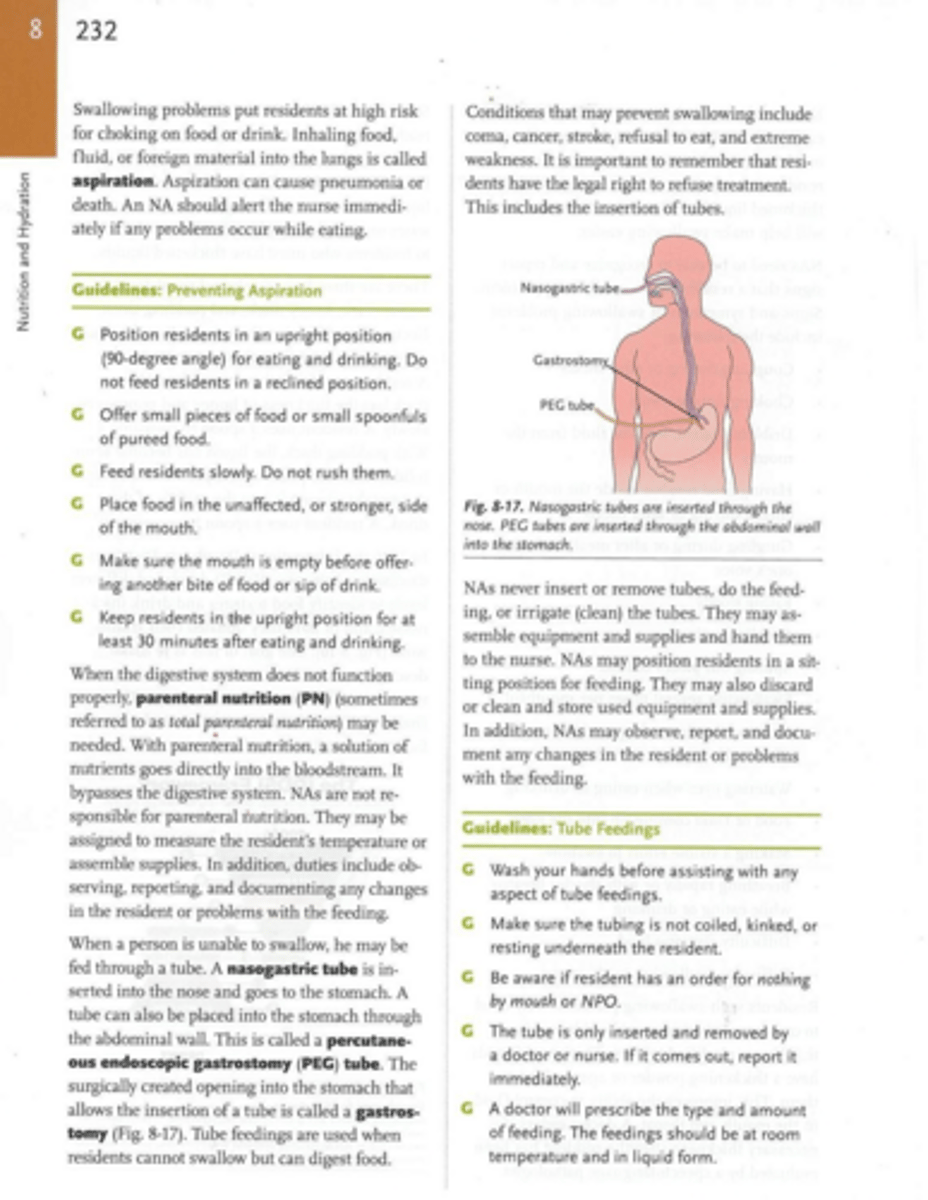
PEG tube
Percutaneous endoscopic gastrostomy tube inserted through the abdominal wall.
Tube feeding position
Head of bed elevated at least 45 degrees during feeding.
Post-feeding position
Keep resident upright for at least 30 minutes after eating.
Hand-over-hand approach
Physical cue where the caregiver places their hand over the resident's.
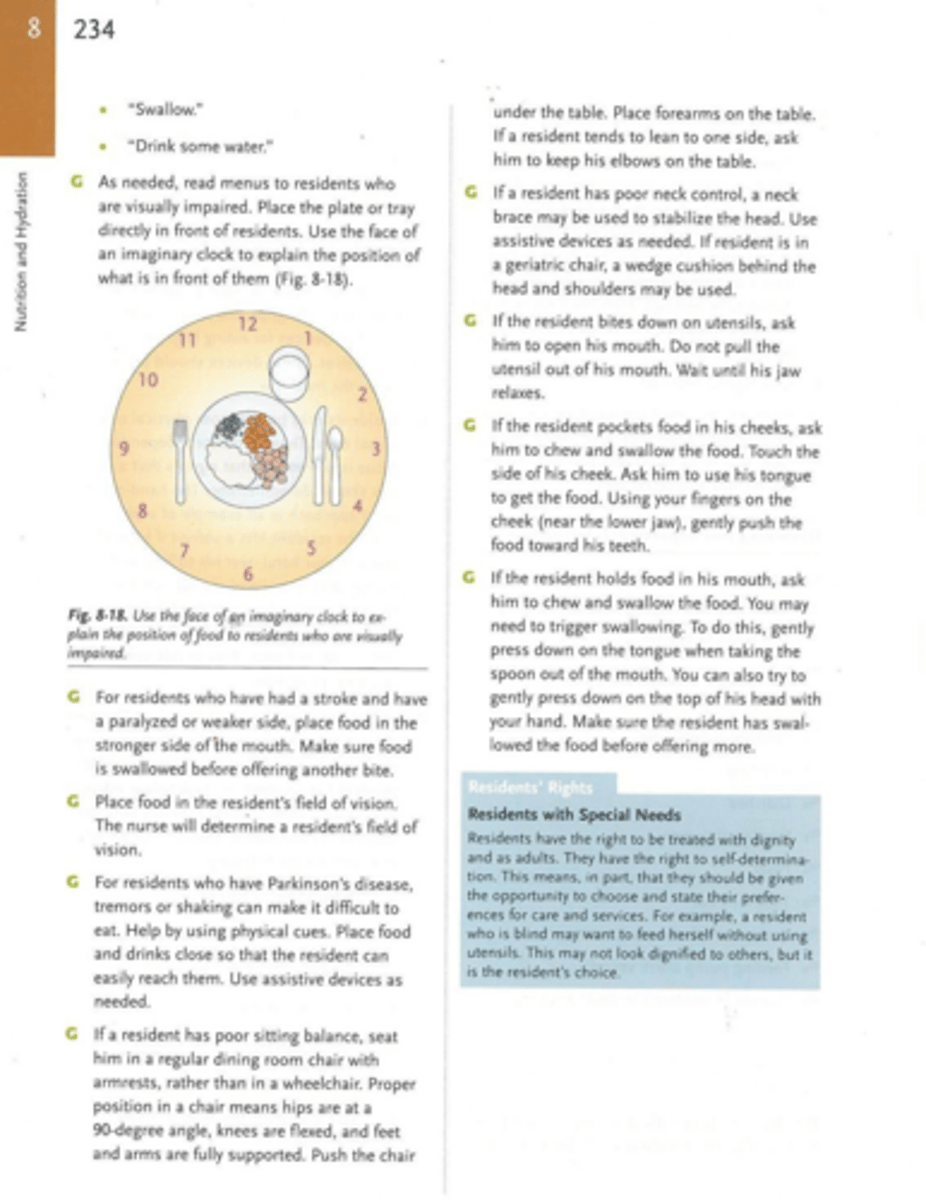
Visually impaired dining tip
Use the face of an imaginary clock to describe food positions.
Stroke dining tip
Place food in the stronger, unaffected side of the mouth.
Parkinson's dining tip
Use physical cues and place food close to the resident.
Dehydration reporting threshold
Report if resident drinks fewer than six 8-ounce glasses daily.