Sleep Disorders
 Call Kai
 Learn
Learn Practice Test
 Spaced Repetition
 Match
Match Flashcards
 Knowt Play
1/31

There's no tags or description
Looks like no tags are added yet.
Name | Mastery | Learn | Test | Matching | Spaced | Call with Kai | Chat |
|---|
No analytics yet
Send a link to your students to track their progress
32 Terms
What are the Benefits of Sleep?

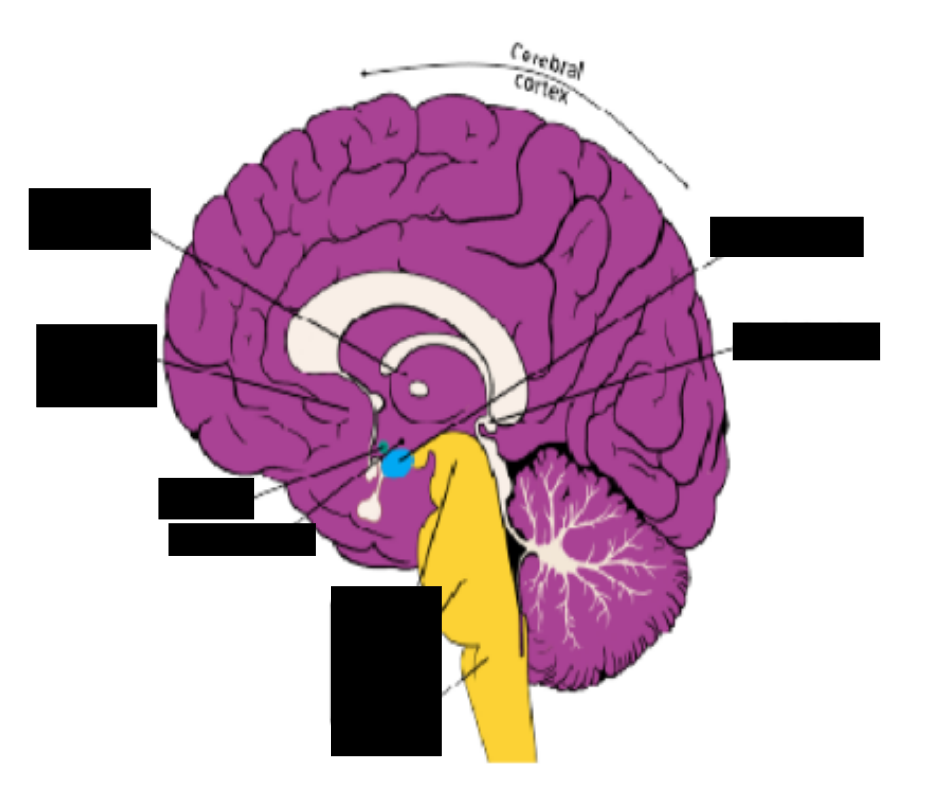

Describe the function of this as it relates to sleep:
Suprachiasmatic nucleus –
Brainstem (pons and medulla)
Thalamus
Pineal gland
Basal forebrain
Amygdala:
Sleep Functions
Suprachiasmatic nucleus –
receives information about light exposure -> Controls sleep rhythms
Brainstem (pons and medulla)
controls transition btw sleep/wakefulness;
Relaxes muscles during REM
Thalamus
relays information from senses -> cortex;
active during REM sleep
(quiet during other phases)
Pineal gland
Produces melatonin
Basal forebrain
releases adenosine,
supports sleep drive
Caffeine blocks this
Amygdala:
Active during dreaming
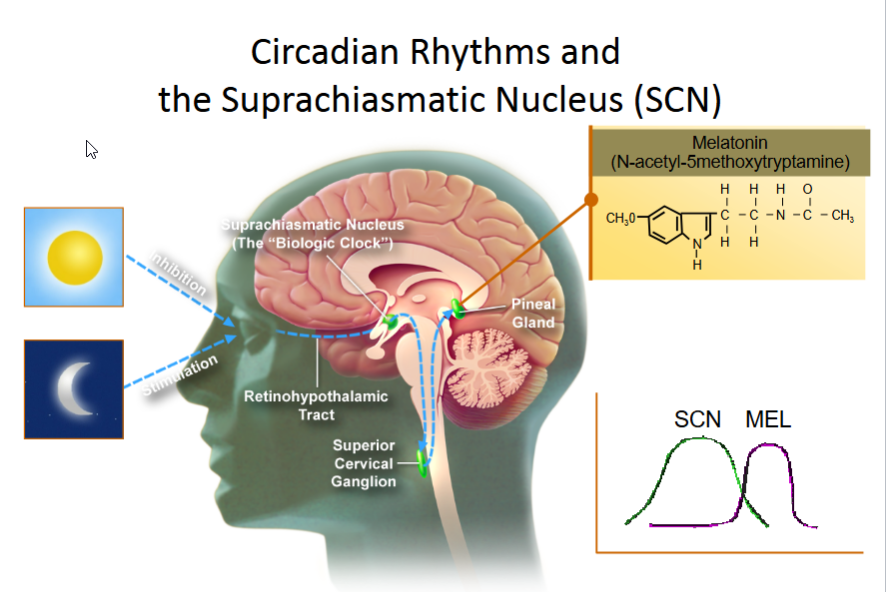

Differentiate between the Role of Adenosine and Orexin in Sleep/Wake Regulation
Role of Adenosine and Orexin in Sleep/Wake Regulation
Adenosin:
Buildups during wakefulness -> sleepiness
Cleared by sleep
Orexin:
In hypothalamus
Promotes wakefulness
Highest activity during wake, lowest during sleep
Loss of signaling =
fragmented sleep/wake
(normal total amount of sleep over 24 hours)
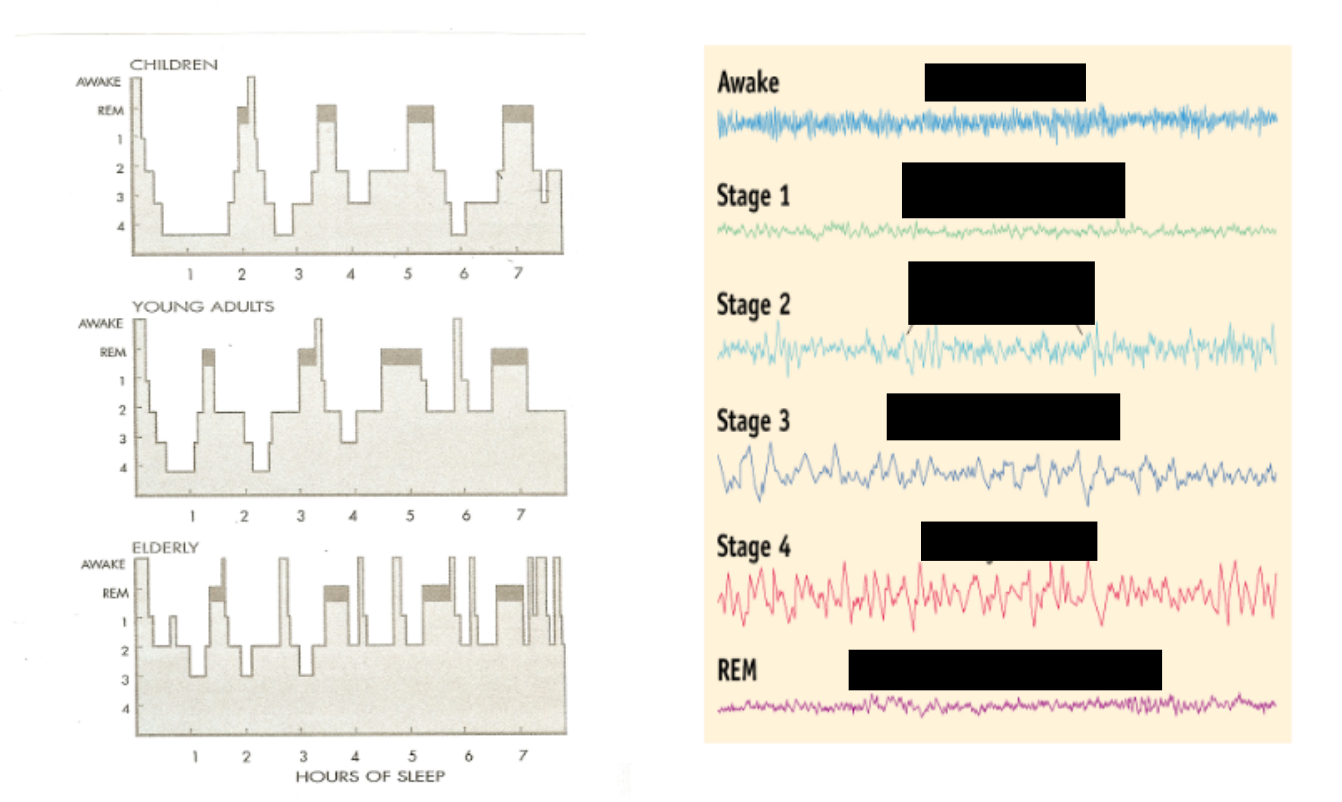
Describe the The Ebb and Flow of Sleep Deprivation

Describe what happens in
NREM (stages 1-4)
REM
NREM (1-4)
Stage 1
Lightly asleep.
Stage 2
Onset of sleep;
detached with environment,
normal breathing + HR
body temperature decreases.
Stage 3 and 4:
Deepest and most restorative sleep
BP + RR Decreases,
release hormones for growth and development
REM (25% of night):
Brain = Active; Dreams
Muscles shut down -> body is immobile + relaxed.
HR + RR = Irregular



Describe Dreams
What are they?
Relationship to memory:
When do they occur?
Brain Areas Associated:
Active during
Nonactive
Dreamwork
Dreams
What are they?
Sleep-dependent thoughts
Vivid images and increased emotions
Visual sense predominates
Relationship to memory:
During: hypermnesia
Increased memory access
Awakening: Decreased memory of dream
When do they occur:
REM; but can also during NREM
Less aggressive; More Social
Brain Areas Associated:
Active:
visuospatial regions,
motor cortex,
hippocampus,
amygdala,
cingulate cortex
Nonactive:
Left and right prefrontal cortex
Dreamwork:
Condensation
two figures combined in one
Displacement
characteristics of one figure are put on another
Symbolization
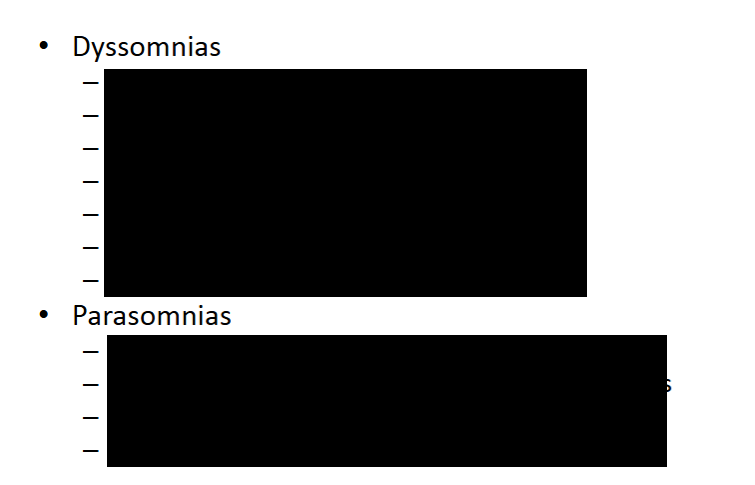
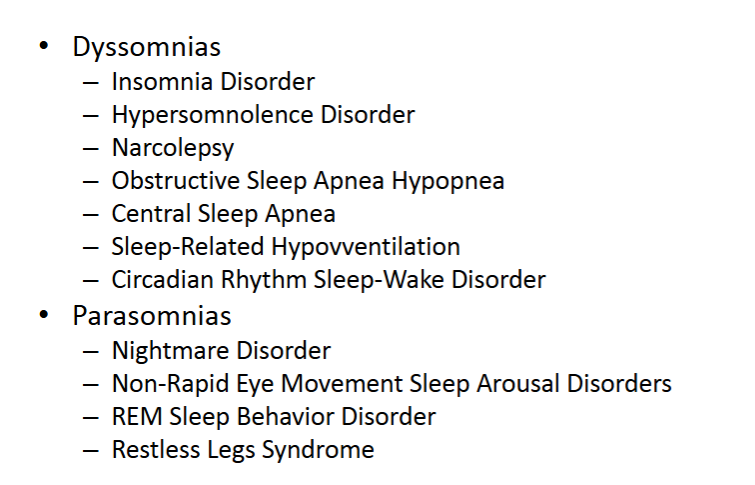
Dyssomnias = affect the amount, quality, or timing of sleep.
Parasomnias= unwanted physical events, movements, or unusual experiences that intrude into the sleep cycle
Describe Adjustment Insomnia (transient or short-term)
Duration:
Resolves:
Describe Chronic insomnia (long-term)
Duration:
Characteristics:
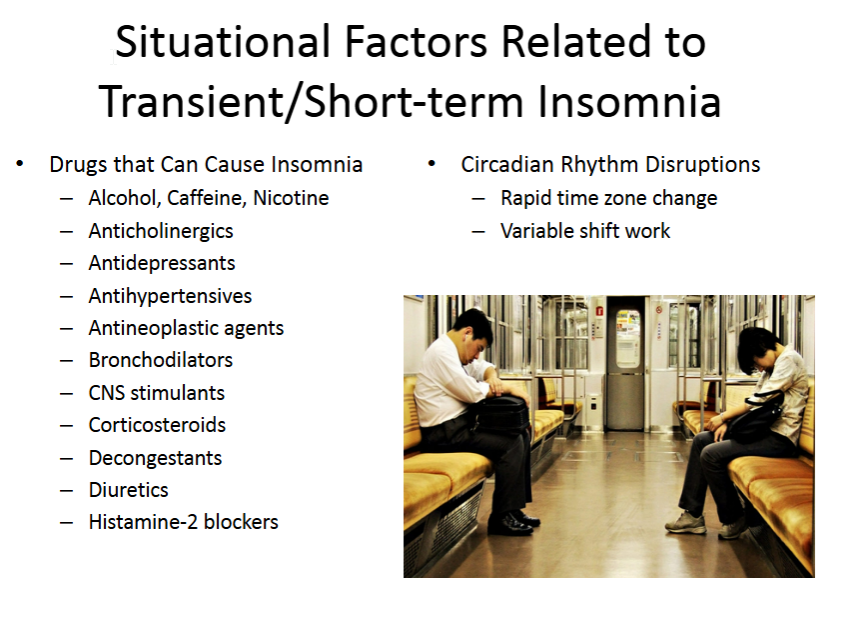
Adjustment Insomnia (transient or short-term)
Duration:
1 night -> few weeks
Resolves:
removal of stressor
or adaptation
Chronic insomnia (long-term)
Duration:
1 month -> years
Characteristics:
waxes and wanes
exist as an isolated disorder (primary) or Comorbid

What is the relationship between Insomnia and obesity
List the Impacts of Insomnia
Describe Insomnia Disorder
Essential Feature:
Consequence:
Does not occur exclusively during
Pharmacologic Agents
Insomnia Disorder
Essential Feature:
difficulty initiating or maintaining sleep or nonrestorative sleep
> 3 nights per week for at least 3 months
NOT DUE to direct physiologic effects of a substance or general medical condition
Consequence:
distress
impairment in
Social, occupational, or other important areas
Does not occur exclusively during
Course of another sleep disorder
Course of another mental disorder
Pharmacologic Agents
Nonprescription
Sedating antihistamines, melatonin, herbal therapies
Low-Dose Sedating Antidepressants
trazadone, amitriptyline, doxepin, mirtazapine
Low-Dose Antipsychotic Medications
quetiapine, olanzapine, risperidone
Benzodiazepines
temazepam, triazolam, flurazepam, quazepam, estazolam, other
Nonbenzodiazepines
Zolpidem, eszopiclone, zaleplon
Melatonin Receptor Agonist
Ramelteon
Orexin Receptor Antagonist
Suvorexant, daridorexant, lemborexant, seltorexant


List the Good Sleep Practices
Good Sleep Practices:
Standardize wake time
Limit amount of time in bed
Limit napping
Avoid exercise immediately before bedtime
Avoid looking at clock after going to bed
Avoid blue light
Reduce or eliminate nicotine, caffeine, and alcohol
Describe the dx criteria for Hypersomnolence Disorder
Hypersomnolence Disorder
Diagnosis Criteria:
>7 hours w/ one of the following:
Recurrent periods of sleep or lapses into sleep w/in same day
prolonged main sleep episode of > 9 hours that is nonrestorative
Difficulty being fully awake after abrupt awakening
>3 times a week for at least 3 months
Describe Primary Hypersomnia
Characteristics
Polysomnographic findings
Tx
Primary Hypersomnia
Characteristics:
Prolonged nocturnal sleep + continued daytime sleepiness
Grogginess on awakening
Lasts several hours
Pts take long naps (>1 hour)
Polysomnographic findings
Diminished delta sleep
Increased number of awakenings
Reduced REM latency
Treatment
Sleep hygiene
Scheduled Naps
Medications
Stimulants (methylphenidate and dextroamphetamine)
Modafanil/Armodafanil
Protryptyline
Describe Narcolepsy
dx criteria
Describe:
Sleep attacks
Sleep Paralysis
Hypnogognic and Hypnopompic Hallucinations
Tx
Dx criteria:
Irresistible need to sleep, lapsing into sleep, or napping
3x a week over at least 3 month\
One of more of following:
Cataplexy
(brief episodes of sudden bilateral loss of muscle tone,
most often in association with intense emotion)
Hypocretin deficiency
measured by CSF
Nocturnal polysomnography Showing
REM latency of less than 15 minutes, Or
MSLT of less than 8 minutes and 2 or more sleep-onset REM periods
Sleep Attacks
Last from seconds to 30 minutes
Can occur in any situation
Cataplexy occurs in 60 – 90%
Collapse may occur without loss of consciousness
Sleep Paralysis
Temporary loss of muscle tone with resulting inability to move
falling asleep or awakening
several seconds -> several minutes
Hypnogognic and Hypnopompic Hallucinations
Occur as falling asleep or on awakening
Vivid hallucinations
Narcoleptics can have several times per week
Generally occur several years after onset of sleep attacks
Treatment
Brief naps
Pharmacologic
Stimulants
Modafanil
TCA’s may help catalepsy or sleep paralysis
Sodium oxybate for cataplexy
Describe Sleep Apnea
What is it?
Types?
Definitions:
Apnea:
Hypopnea:
Apnea hypopnea index:
Clinical History with OSA
Tx
Sleep Apnea
What is it?
episodes of breathing cessation for 10 sec or more
frequency of 15 events per hour
Types:
Central, obstructive or mixed
Definitions:
Apnea:
cessation of airflow for at least 10 seconds
Hypopnea:
reduction of airflow with resultant oxygen desaturation of at least 4%
Apnea hypopnea index:
average frequency of apnea and hypopnea events per hour
Clinical History with OSA
Disruptive snoring
Witnessed apnea or snort arousals
Gasping/choking sensations
Excessive daytime sleepiness
Difficulty concentrating
Excessive nocturia
Difficulty maintaining sleep
Restless or unrefreshing sleep
Morning headaches
Irritability
Daytime fatigue
OSA: Tx
Lifestyle:
Weight loss, exercise, lateral sleep position
Continuous positive airway pressure (CPAP)
Oral appliance
•Uvulopalatopharygoplasty
What is Nightmare Disorder?
Nightmare Disorder
What is it?
Repeated extended, extremely dysphoric, and well-remembered Nightmares
generally occur during second half of sleep episode
Describe Non-Rapid Eye Movement Sleep Arousal Disorders
What is it?
Symptoms?
Non-Rapid Eye Movement Sleep Arousal Disorders
What is it?
Recurrent episodes or incomplete awakening from sleep
occurring in first third of sleep,
Symptoms:
Sleepwalking:
Sleep terrors:
(Relative unresponsiveness to comfort from others)
Dream imagery not recalled.
Amnesia for episodes


Describe REM Eye Movement Sleep Behavior Disorder
What is it?
dx Criteria?
REM Eye Movement Sleep Behavior Disorder
What is it?
Repeated episodes of arousal during sleep associated with vocalization and/or complex motor behaviors
Individual completely awake and alert upon awakening
Dx criteria:
Either of the following:
REM sleep without hypotonia on polysomnography
History of REM sleep behavior disorder + established synucleinopathy diagnosis
(Parkinson’s, multiple system atrophy)
Describe Restless Legs Syndrome
What is it?
Characteristics
Restless Legs Syndrome
What is it?
urge to move legs + Unpleasant sensation in the legs
Characteristics:
Urge worsens during period of inactivity
Urges relieved by movement
Worst at night
Describe Hypnotics
Clinical Usage
Synergy
AE
List the Class and Members
List the Benzodiazepine and Nonbenzodiazepine AE
Nonbenzodiazepines vs BZD’s
Hypnotics
Clinical Usage:
temporary relief for insomnia
Synergy:
In combo w/ sleep hygene
AE:
Habit-forming
Schedule IV
EXCEPT ramelteon and doxepin
Increased mortality and cancer incidence
(Highest cause of mortality is infection)
Class/Members:
Benzodiazepines
Estazolam (Prosom)
Flurazepam (Dalmane)
Quazepam (Doral)
Temazepam (Restoril)
Triazolam (Halcion)
Nonbenzodiazepine
Zolpidem (Ambien, Ambien CR)
Zaleplon (Sonata)
Eszoplicone (Lunesta)
Orexin receptor antagonists
Suvorexant (Belsomra)
Lemborexant (Dayvigo)
Daridorexant (Qyviviq)
Other
Ramelteon (Rozerem)
Doxepin (Silenor)
Benzodiazepine and Nonbenzodiazepine AE
Ataxia
Increased risk of head injury 1.67x
Daytime sedation
Cognitive effects
Anterograde amnesia
Respiratory depression
Rebound insomnia
Nonbenzodiazepines vs BZD’s
Less abuse potential than BZD’s
Little tolerance
Tend not to cause daytime sleepiness
Describe Ramelteon (RozeremTM)
MOA
Overall Safety findings
MOA:
Potent, selective MT1/MT2 receptor agonist
17 times as potent as melatonin
NEGATIVE affinity for:
MT3
GABAA
(dopamine, serotonin, ACh, glutamate, noradrenaline, or opiate receptors
Overall Safety Findings
No clinically meaningful effects with respect to:
Respiratory function: mild-to-moderate COPD or sleep apnea
Not recommended
Next-day residual effects
Rebound or withdrawal effects
Abuse liability
Tolerance
Lab results and QTc interval
Describe Suvorexant, Lemborexant, Daridorexant
MOA
AE
Suvorexant, Lemborexant, Daridorexant
MOA:
Dual orexin receptor (Ox1R and Ox2R) antagonist (DORA)
Decreased sleep latency
Increased sleep efficiency, total sleep time
AE:
Schedule IV
(Little evidence of tolerance, rebound insomnia)
Describe Modafanil and Armodafanil
Clinical usage
MOA
Cog Effects
AE
Modafanil and Armodafanil
Clinical Usage:
Wakefulness-promoting agent
Indications: Narcolepsy, Obstructive Sleep Apnea and Shift Work Sleep Disorder
Other off-label uses:
Depression, Medication- induced sleepiness or cognitive problems (pain, schizophrenia, chemotherapy), Multiple sclerosis, Fibromyalgia, Parkinson’ disease, ADHD
MOA: (speculation)
inhibition of GABA release via a serotonergic mechanism
Inhibition of dopamine transporter
Cog. Effects:
Improves working memory
AE:
Anxiety
Irritability
Sleep disturbances
Potential for Stevens-Johnson Syndrome, Toxic Epidermal Necrolysis
Describe Solriamfetol
Clinical Usage
MOA
AE
Solriamfetol
Clinical USage:
Wakefulness-promoting agent
narcolepsy or obstructive sleep apnea
MOA:
blockade of dopamine and NE transporter
AE:
Increased BP + HR
Anxiety, insomnia and irritability