Sleep P2
 Call Kai
 Learn
Learn Practice Test
 Spaced Repetition
 Match
Match Flashcards
 Knowt Play
1/60

There's no tags or description
Looks like no tags are added yet.
Name | Mastery | Learn | Test | Matching | Spaced | Call with Kai | Chat |
|---|
No analytics yet
Send a link to your students to track their progress
61 Terms
What we need to know for first dot point:
·
·
•Partial Sleep deprivation – inadequate sleep in either quantity or quality
•Effects on affective, behavioural and cognitive functioning
•Affective and cognitive effects of one night of full sleep deprivation compared to blood-alcohol concentration readings of 0.05 and 0.10
•
•
Sleep Deprivation
•Sleep deprivation refers to going without sleep or not getting sufficient amounts of sleep
•Many psychological and physiological effects, including trembling hands, droopy eyelids, increased pain sensitivity, headaches, general discomfort, decrease in cognitive function (memory and concentration), slower reaction times, mood changes, emotional behaviour.
Can have partial or total sleep deprivation:
•Partial sleep deprivation occurs when a person does not get the recommended hours of sleep per night for their age.
•Eg adults needs 8 hours a night
•Full sleep deprivation occurs when a person goes without sleep all together for a certain period of time.
Partial Sleep Deprivation
•Partial sleep deprivation:
•Occurs when a person gets some sleep but not enough to support their normal waking alertness, performance and health.
•
•Can occur because of reduced total sleep time (decreased quantity) OR because of disruptions to the normal progression and sequencing of sleep stages, which leads to fragmented sleep (decreased quality)
•
•It is not necessary to go completely without sleep to feel the effects of sleep loss. Research suggests 1/3 of all adults and MOST teenagers do not get enough sleep each night and research shows a negative impact on mood, cognitive performance and motor function.
Acute Partial Sleep Deprivation
•Acute Partial Sleep Deprivation - a lack of adequate sleep time that is required for optimal daytime functioning, lasting a short period of time.
•Affects judgement, mood, ability to learn and retain information
•Temporary (is resolved with sleep) but still increases risk of serious accident and injury.
•
Chronic Partial Sleep Deprivation
•Chronic Partial Sleep Deprivation - when an individual routinely sleeps less than the time needed for optimal daytime functioning
•May lead to a range of health problems including obesity, diabetes, hypertension, high blood pressure and cardiovascular disease. Early mortality may result.
•
Effects on affective, behavioural and cognitive functioning
Remember - ABC
•Affective functioning - emotional control and responses
•Behavioural - actions and reactions
•Cognitive - higher order executive functions
The effects of partial sleep deprivation on a person’s AFFECTIVE functioning
•Affective functioning = emotional control and responses
•Sleep helps us regulate our emotions so sleep deprivation is detrimental to mood and emotional stability because it amplifies emotional responses
•Prefrontal cortex (area responsible for emotional regulation) is particularly sensitive to sleep deprivation and loss of sleep therefore decreases our ability to regulate our emotions.
•Changes include mood swings, increased irritability, lack of motivation, feelings of sadness and depression.
•Sleep deprivation greatly influences our ability to process emotional information, put it into context and produce controlled, appropriate responses.
•We overreact – amplified emotional response!
affective also
•Also increases the tendency for individuals to experience negative emotions and develop mood disorders such as depression and anxiety.
•Sleep deprived people often report feeling more anxious, irritable, angry, aggressive and unmotivated than usual.
•
•Sleep loss affects our ability to recognise and characterise other people’s emotions, particularly from facial expressions. This reduces the individuals perceived emotional intelligence, making them less empathetic to others.
•
•Lack of adequate sleep lessons our ability to cope with stress so people feel overwhelmed by normal, routine activities.
The effects of partial sleep deprivation on a person’s BEHAVIOURAL functioning
•Behavioural functioning = actions and reactions
•With less sleep, less glucose is metabolised so muscle strength, speed of movement and endurance is reduced
•Ability to perform fine motor functions requiring coordination is impaired, causing increased clumsiness and accidents/injuries.
•If we are awake but sleep deprived the body reacts with brief periods of sleep known as microsleeps.
•= short periods (a few seconds) where the individual appears to be awake and alert but brain activity is similar to first stage of NREM sleep
•Individual may therefore have no recollection of what occurred while they were having a microsleep
physical rreactions- behavioural
•Typical physical reactions to sleep deprivation include lack of energy, tiredness or exhaustion, trembling hands, drooping eyelids, staring and inability to focus the eyes, increased pain sensitivity, headaches and general discomfort
•
•
The effects of partial sleep deprivation on a person’s COGNITIVE functioning
•Cognitive functioning = higher order executive functions
•Sleep is essential for cognitive performance ranging from simple attention and alertness to higher-order executive functions.
•When sleep deprived a person's mental abilities become impaired so their ability to perform cognitive tasks decline, particularly higher order tasks.
•spatial awareness deteriorates, think irrationally, illogical
•ability to plan, coordinate, implement and evaluate deliberate actions is disrupted.
•Difficulty controlling attention and maintaining concentration so ability to perform tasks to a certain standard is reduced.
•Ability to make decisions and problem solve may suffer so they make uncharacteristic errors in judgement as ability to assess risk and revise strategies may be compromised
sleep deprivation also
•Sleep deprivation also impairs memory and learning.
•Difficulty concentrating long enough for info to be processed in STM and transferred to LTM
•More difficult to access and retrieve info from LTM
•Sleep deprivation also results in changes at the cellular level, with altered synaptic efficiency and membrane excitability (critical for memory formation) .
•As neuronal connections are strengthened during sleep this does not occur to its full efficiency and therefore impacts on memory consolidation.
•Sleep deprivation also leads to slower reaction times, especially on motor tasks.
•Ability to complete simple, monotonous or repetitive tasks declines
•Struggle to divide attention, have difficulties reacting quickly to unpredicted rapid change in their circumstances
•
•
Typical Effects of Partial Sleep Deprivation
Category | Effects |
Affective | Mood swings, increased negative emotions, irritability, reduced motivation, easily bored, reduced empathy towards others, inability to cope with stress |
Behavioural | Difficulty completing routine tasks, reduced ability to assess risks, increased risk taking behaviour, reduced ability to perform fine motor tasks, increase in clumsiness. |
Cognitive | Memory lapses, difficulty maintaining attention, difficulty concentrating, difficulty processing information, difficulty thinking logically and problem solving, reduced creativity, distorted perceptions, poor decision making, slowed reaction time, reduced spatial awareness |
Physical | Lack of energy, extreme tiredness/lethargy, trembling hands, drooping eyelids, staring, inability to focus eyes, increased pain sensitivity, headaches, slowed reflexes |
Legal Blood Alcohol Concentrations
•Alcohol impairs consciousness – it is a depressant that slows CNS function
•May enter an Alcohol Induced ASC
•Effects include lack of self-control, disturbed sense of time, distorted perceptions and cognition, emotional instability
•Blood Alcohol Concentration (BAC) is a measure of the amount of alcohol present in the bloodstream
• Must be under 0.05 or 0.00 for P / L Platers
• 0.05 indicates that every 100 millilitres of blood contains 0.05 grams of alcohol
•One in Four people killed on the road between 2008-2012 had a BAC of over 0.05
IMPORTANT:
•Approximately 17 hours of wakefulness leads to equivalent cognitive deficits to that of a BAC of 0.05%.
•
•
•Approximately 24 hours of wakefulness leads to equivalent cognitive deficits to that of a BAC of 0.1%.
•
Affective effects of one night of full sleep deprivation compared to blood-alcohol concentration readings of 0.05 and 0.10
Sleep Deprivation | Legal BAC |
Emotional reactivity is altered so our perception of neutral stimuli is biased towards greater negativity | Emotions and mood may be exaggerated and intensified – overly emotional, display inappropriate emotions or a lack of emotions |
Increase in negative mood (hostile, angry, argumentative) and decrease in positive mood (empathy, excitement, friendliness) | Moods may fluctuate and person has little control over them |
Increased irritability, short tempered and impatient | Changes in mood may alter their ability to make safe decisions on the road, and they may become reckless |
More vulnerable to stress, leading to feelings of anxiousness and depression. Studies show a relationship between sleep deprivation and mood and anxiety disorders) |
Cognitive effects of one night of full sleep deprivation compared to blood-alcohol concentration readings of 0.05 and 0.10
Sleep Deprivation | Legal BAC |
Slows frontal lobe activity, therefore reduces STM and attention (including auditory and visuospatial attention, vigilance, serial addition and subtraction tasks, reaction times) | |
Slows temporal lobe and hippocampus function, therefore reduces ability to process declarative memories | Reduced ability to form memories |
Slows executive functions, such as logical and consistent decision making, problem solving and planning | Slows executive functions, such as logical and consistent decision making, problem solving and planning – may forget when to give way, forget basic road rules or have difficulty judging distance |
Types of Sleep Disorders
•The DSM-5-TR categorises all sleep–wake disorders into 10 disorders or disorder groups, including insomnia disorder, breathing-related sleep disorders, substance/medication-induced sleep disorder, and circadian rhythm sleep–wake disorders.
•In this course, you will only study circadian rhythm sleep disorders.
Circadian Rhythm Sleep Disorders
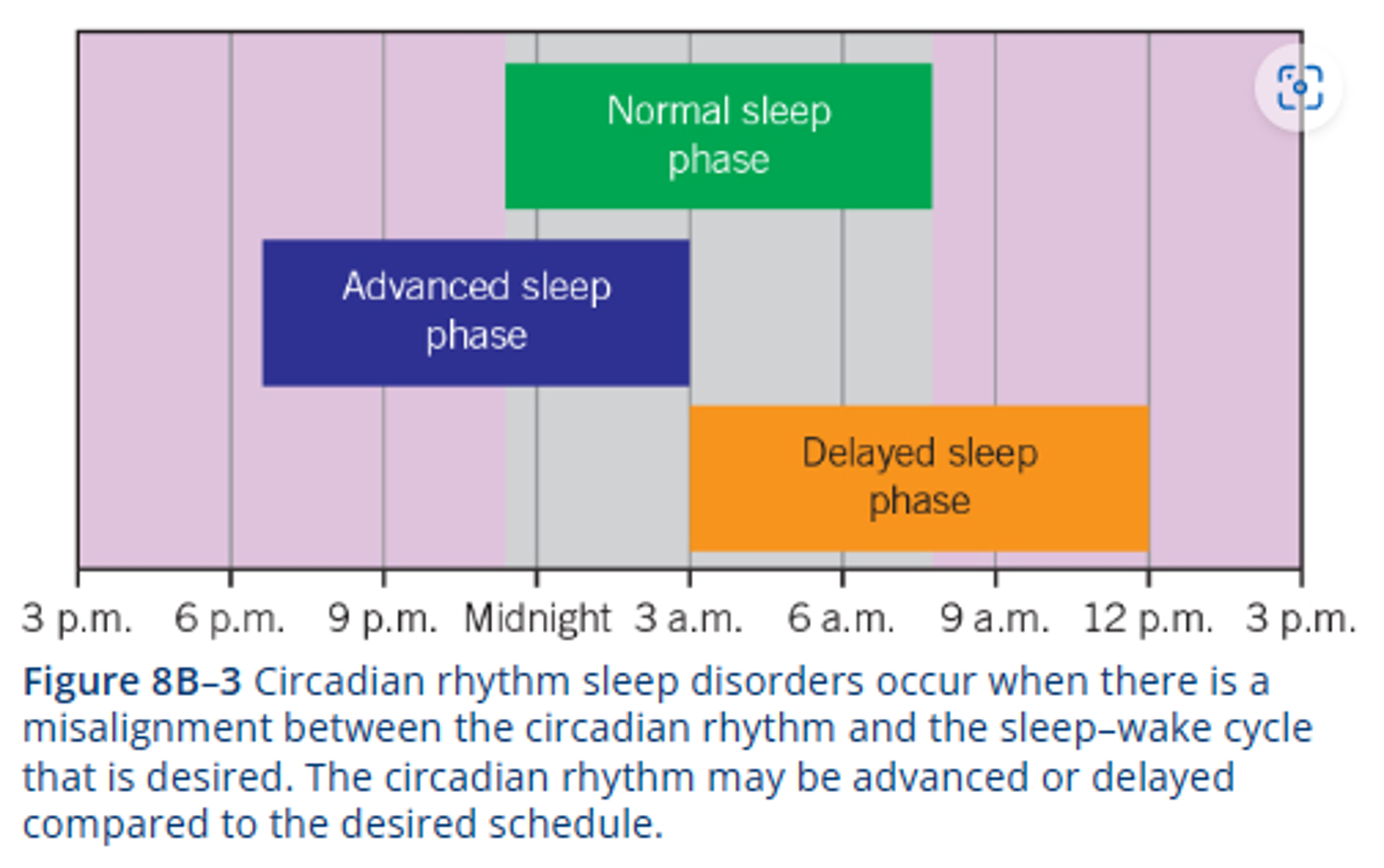
•Circadian rhythm sleep disorders are a category of sleep disorders characterised by a persistent pattern of sleep disruption due to a misalignment between the circadian rhythm and the sleep–wake schedule required by a person.
•
•The misalignment causes excessive sleepiness, insomnia, distress or impairment of a person’s functioning. These disorders may cause a person to be unable to sleep and wake at the appropriate times needed to attend school, go to work or participate in social activities.
•
•Three different circadian rhythm sleep disorders: Delayed Sleep Phase Syndrome, Advanced Sleep Phase Disorder and shift work.
Causes of and susceptibility to Circadian Rhythm Sleep Disorders
•Intrinsic factors: caused by the body itself, including medical conditions and age-related natural shifts in the sleep-wake cycle
•
•Extrinsic factors: caused by the environment or external behavioural factors, such as shift work or jet lag
•
•
•Some people
•Some people are more susceptible than others to circadian phase disorders.
•Stage of life, rapid time zone travel, demands of work or school, social needs and expectations all play a part
Symptoms of Circadian Rhythm Sleep Disorders-day
Key feature is: all Circadian Rhythm Sleep Disorders result in a disruption to the sleep-wake cycle
•
•Daytime symptoms:
•Excessive tiredness and desire to sleep
•Lethargy
•Difficulty following schedules
•Difficulty learning and accessing memory
•Mood swings and decreased emotional control
•Not feeling refreshed or energised upon waking
night symptoms
•Night time Symptoms:
•Difficulty falling asleep at required time
•Difficulty maintaining sleep for the desired time
•Waking frequently
Treatment of Circadian Rhythm Sleep disorders
•Treatment aims at resynchronising a persons’ circadian rhythm to the desired sleep schedule
•
•Properly timed light exposure is crucial.
•The Suprachiasmatic nucleus (SCN) found in the hypothalamus receives information from the eyes about light levels
•Lack of light stimulates the SCN to trigger the pineal gland to release the hormone melatonin
•Melatonin levels increasing causes us to feel sleepy
•
•Bright light therapy
•
•
Bright Light Therapy
•Also called phototherapy
•
•Exposes people to intense but safe amounts of artificial light for a specific and regular length of time to help synchronise their sleep-wake cycle with a normal day-night cycle
•A physiological treatment aimed at reducing the symptoms of circadian rhythm disorders
•Several hours of phototherapy can shift circadian rhythms as much as 2-3 hours per day.
•
•
•
Circadian Rhythm sleep disorders:
1) Delayed Sleep Phase Syndrome
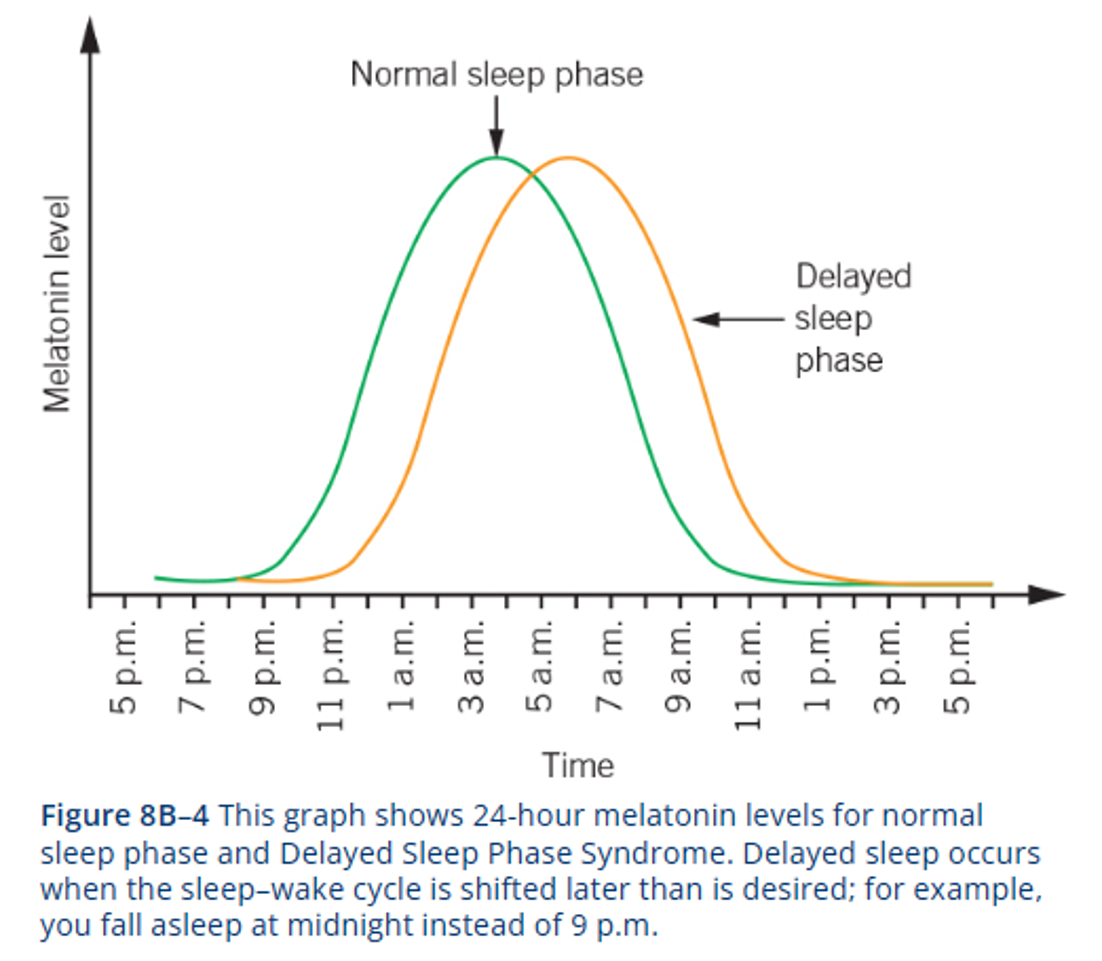
•Delayed Sleep Phase Syndrome (DSPS) is a circadian rhythm sleep disorder characterised by a delay in the timing of sleep onset and awakening, compared with the timing that is desired.
•
•The delay is usually for two or more hours, with a person falling asleep later than what is required or conventionally accepted. This then causes a need to wake up later than required if a person is to achieve an adequate amount of sleep.
•For example, instead of a sleep schedule of 10 p.m. until 6 a.m., a person may sleep from 2 a.m. until 10 a.m.
•
•
•The delay in sleep onset contributes to
•The delay in sleep onset contributes to a sleep disorder when a person is unable to achieve their recommended amount of sleep because they need to wake in the morning for work, school or other commitments.
•For example, a university student who needs to sleep from 11 p.m. until 7 a.m. to achieve the required amount of sleep may not be able to fall asleep until 3 a.m. If they need to wake up at 7 a.m. for university, they are achieving far less sleep than is necessary for proper functioning.
•
•A person with DSPS usually cannot fall asleep at an earlier, more acceptable time due to their shifted circadian rhythm.
•
•In order to be diagnosed with DSPS, a person needs to experience symptoms for more than three months.
melatonin levels
•Other than age, some predisposing risk factors for DSPS include
•Other than age, some predisposing risk factors for DSPS include a longer than average circadian period and an increased sensitivity to light.
•A person who is more sensitive to light present in the evening might have a delayed night-time signal to the suprachiasmatic nucleus, which delays melatonin release by the pineal gland, resulting in fewer signals to the body that it is time to sleep.
•
•Conversely, a person who is less sensitive to morning light upon waking has a lack of light cues to the suprachiasmatic nucleus to signal a reduction in melatonin release by the pineal gland.
•People with Delayed Sleep Phase Syndrome
•People with Delayed Sleep Phase Syndrome who can adjust their lifestyle to suit their particular sleep schedule tend to experience less sleep deprivation and symptoms.
•
•If that is not possible, they can help shift their circadian rhythm to a more appropriate time by using bright light therapy.
•Exposure to light in the early morning
•Exposure to light in the early morning can help reset the sleep–wake cycle by reducing melatonin release earlier in the morning.
•This resets the circadian rhythm, prompting the suprachiasmatic nucleus to trigger melatonin release at a more appropriate earlier time of the evening, and therefore advances sleepiness.
•This therapy also includes limiting night-time light exposure and gradually going to bed earlier each night over several weeks.
Circadian Rhythm sleep disorders:
2) Advanced Sleep Phase Disorder
•Advanced Sleep Phase Disorder (ASPD) is a circadian rhythm sleep disorder characterised by an advance in the timing of sleep onset and awakening compared to the timing that is desired.
example
•A person may fall asleep usually two or more hours earlier than what is needed or acceptable, resulting in them then experiencing an earlier waking time than is desired.
•For example, instead of a sleep schedule of 10 p.m. until 6 a.m., a person may sleep from 8 p.m. to 4 a.m.
•
•When a person with ASPD attempts to adhere to a more reasonable, later bedtime, they will continue to have an early wake time due to the shift in their circadian rhythm.
•A person’s adverse exposure to light can
•A person’s adverse exposure to light can maintain their undesired advanced circadian rhythm.
•By going to bed early and then waking early, a person is not exposed to the regular evening low light and morning bright light signals, which then perpetuates the advanced circadian rhythm cycle, maintaining the disorder.
•
•
•Different people experience different
•Different people experience different symptoms for ASPD but symptoms get more severe when work or social demands require a schedule that does not match the person’s natural sleep–wake cycle.
•For example, a person working in hospitality may need to work late into the evening beyond when their body is ready for sleep, or a person who is awake at 4 a.m. one morning then feels too tired for social events in the evening.
•When a person can adjust
•When a person can adjust their daytime commitments to sleep and wake at their own schedule, they tend to have a stable sleep pattern and reduction in symptoms.
•
•If that is not possible, people with ASPD can help shift their circadian rhythm to a more appropriate time by using bright light therapy.
•Exposure to light in the early evening results in later melatonin release, and therefore delays sleepiness until a more appropriate later time of the evening. This can help reset the sleep–wake cycle to a more conventional timing.
•
Circadian Rhythm sleep disorders:
3) Shift Work
•Shift work can cause a circadian rhythm sleep disorder when a person regularly works outside of normal business hours, particularly at night and the very early morning.
•
•Shift Work Disorder occurs when a person's work hours are scheduled during usual sleep times causing circadian rhythms to be out of sync with their work schedule and with day and night
•This can include
•This can include a consistent night shift or a rotating schedule, in round-the-clock professions such as health care, hospitality, factory work, transport and travel.
•
•Shift work can put a person’s sleep–wake schedule in direct opposition to the regular day–night environmental hours, resulting in distress and dysfunction due to excessive sleepiness at work and impaired sleep at home after their shift.
.
•For example
•For example, a nurse working a night shift needs to sleep during the day, but their sleep may be disrupted due to noise from outside traffic, family members, visitors or bright light shining through curtains. This may result in sleep deprivation and then excessive sleepiness while they are working the following night.
•This disorder affects 5–10% of the population who work during nights
•Diagnosis depends on how severe the symptoms are and the level of distress experienced by the person
effects of shift work and reducing symptoms extra
Effects of Shift Work
Poor work performance, relationship issues, accidents, and mental health problems.
Long-term shift work is linked to digestive disorders, heart disease, diabetes, and cancer.
Reducing Symptoms
Longer periods on the same shift help the body adjust.
Forward-rotating shifts (morning → afternoon → night) are easier to adapt to.
Maintaining a consistent night-time routine can improve sleep.
Symptoms often disappear when returning to regular daytime work.
Bright light therapy can help adjust the circadian rhythm.
Light exposure before night shifts delays melatonin release, increasing alertness during work.
Sleep Hygiene and Zeitgebers
•Sleep hygiene refers to the sleep-related behaviours and environmental conditions that are beneficial for sleep.
We can make many simple changes to our bedtime routine to promote sleep:
•We can make many simple changes to our bedtime routine to promote sleep:
•avoid the use of devices and caffeine before bed
•follow a wind-down bedtime routine
•avoid ‘watching the clock’
•minimise light and noise
•ensure a cool temperature
•have comfortable bedding.
•If you follow recommendations for good sleep hygiene consistently, you may be more likely to fall asleep faster as well as remain asleep, maximising both sleep quantity and quality and overall promoting wellbeing.
•
Many sleep hygiene practices consider important sleep-related zeitgebers.
Zeitgebers
•Zeitgebers are environmental cues, such as light, temperature and eating patterns that can synchronise and regulate the body’s circadian rhythm.
•these cues have different abilities to shift a person’s 24-hour sleep–wake cycle, and so can be purposefully used by a person to improve their sleep–wake cycle and therefore their mental wellbeing.
•
Zeitgebers:
1) Daylight and Blue light
•Daylight includes all direct and indirect sunlight during the daytime and is considered the primary zeitgeber for the human circadian rhythm.
•Light has the greatest influence on the sleep–wake cycle because its detection by the SCN in the brain directly influences the release of melatonin by the pineal gland
•If the amount of light detected increases, melatonin production is suppressed, which promotes wakefulness.
What effect does a decrease in light levels have on melatonin production and sleepiness?
•If the amount of light detected decreases, more melatonin is released, thereby promoting sleepiness.
•The ability of the circadian system to resynchronise daily to keep in sync with the external environment is an evolutionary benefit.
•Since the invention of artificial lighting, our light exposure is no longer just from the Sun during daylight hours.
•The 24-hour access to light means we can undertake activities at night-time that were previously restricted to daylight hours. However, this can be at the expense of our wellbeing.
blue light
•Blue light is a range of the visible light spectrum that is emitted from smartphone screens, computer monitors, televisions, LED and fluorescent light bulbs, as well as the Sun.
influence of blue light
•Blue light has the most influence on the circadian rhythm through its powerful inhibition of melatonin.
•Ultimately, exposure to blue light at the wrong times can reduce the quality and quantity of sleep.
•Therefore, blue light exposure contributes to many types of sleep disorders and poor mental and physical wellbeing.
•Blue light can also be used purposely to improve wellbeing.
•Blue light can keep a person alert while improving performance and mood.
•Increasing the blue portion of artificial light during appropriate times such as daylight hours could improve student learning in schools, the performance of indoor employees or the mood of people in hospitals and nursing homes.
How can exposure to natural daylight improve mental wellbeing?
•People can have a lot of influence over their exposure to light and they can adapt and use this zeitgeber to shift a disrupted sleep–wake cycle and improve their mental wellbeing.
•It is recommended that healthy people with no sleep disorders:
•Have exposure to natural daylight in the morning and throughout the day, and then block out artificial light, particularly blue light, at night before sleep.
•A consistent exposure to light at appropriate times can help reinforce a regular sleep–wake cycle.
What is the most effective way to reduce exposure to blue light before sleep?
•Some ways to avoid blue light from electronic devices in the evenings is to
•use in-built screen filters and ‘night mode’ settings
•reduce screen brightness levels,
•do not use screens before bed at all. MOST EFFECTIVE!!
How can people with circadian rhythm sleep disorders use light strategically to reduce symptoms?
•Dimming LED room lights, using red or orange lamps, or using glasses that block blue light also help to reduce sleep disturbances and their detrimental effects on wellbeing
•People who experience circadian rhythm sleep disorders can use light strategically to help reduce symptoms and even shift the circadian rhythm to the desired time.
•night shift workers can increase the blue portion in artificial light during night-time hours while at work and then minimise daylight exposure while sleeping.
Zeitgebers:
2) Temperature
•People can use the zeitgeber of temperature to improve their sleep–wake cycle by implementing daily behaviours that support the link between temperature and the mechanisms of sleep.
•Body temperature is another biological mechanism that is regulated on a 24-hour circadian rhythm controlled by the SCN, and it is linked to the sleep–wake cycle.
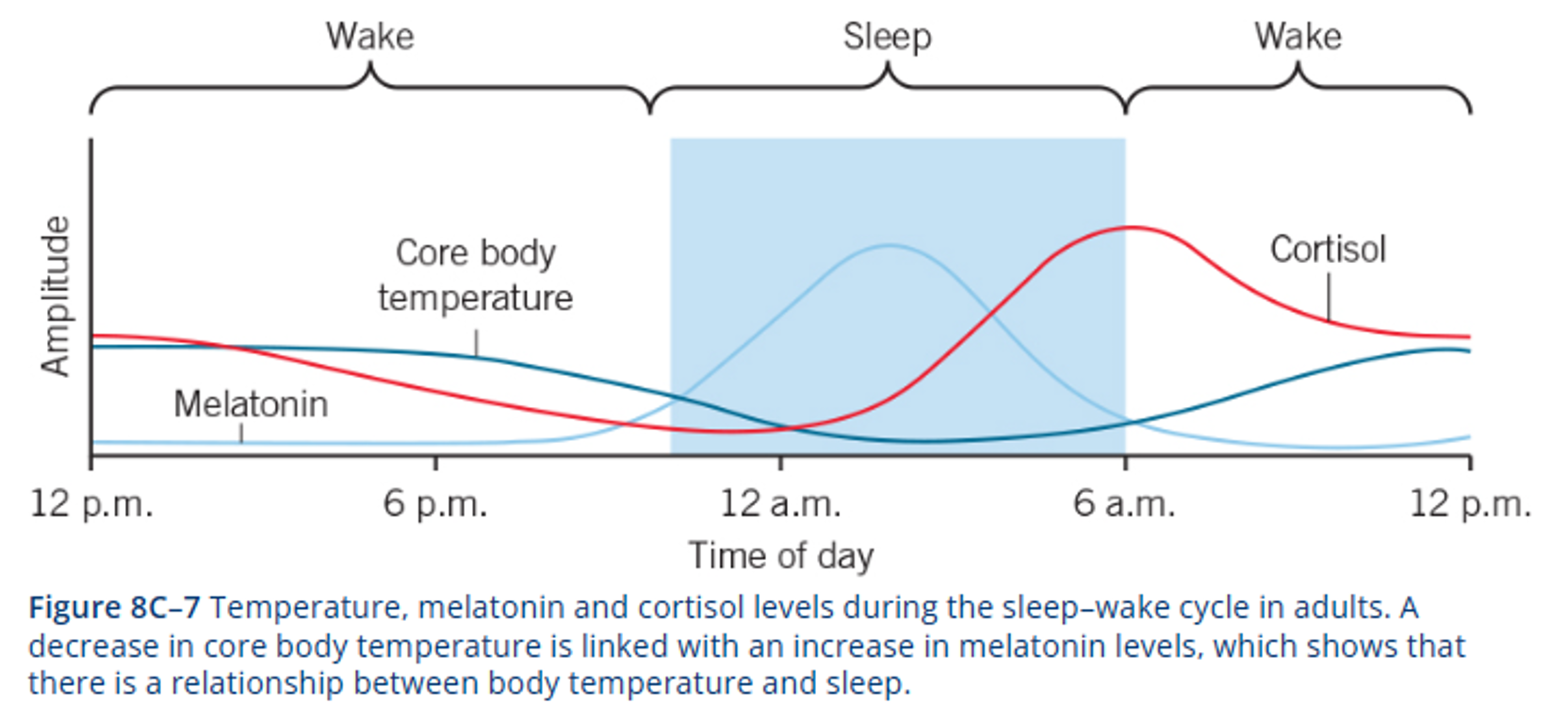
•Body temperature begins to decrease in the early evening, with sleep onset occurring when core body temperature is at its greatest rate of decline.
•An increase in blood flow to the skin results in skin warming and so heat is lost from the body and body temperature drops.
At approximately what time after sleep onset does body temperature reach its lowest point?
•The lowest body temperature occurs at about 2 hours after sleep onset.
•The idea that skin warming helps to initiate sleep is supported by behavioural evidence of using bedding to provide warmth before and during sleep.
•It is also evident in animals curling up for sleep or building and using nests.
•Research has also shown that there is a link between the neural pathways promoting NREM sleep and the neural pathways for body cooling.
increase in melatonin
•An increase in melatonin in the body coincides with the decrease in core body temperature
What is the ideal room temperature range for sleep onset?
•Research has determined that the ideal room temperature for sleep onset is 19–21°C.
•However, the ideal skin and bed microclimate is 31–35°C for people during sleep.
•This means that the combination of a cool room and warm bedding is an easy way that most people can promote sleep, with the simple use of windows, fans, appropriate bedding, sleepwear, curtains, and appropriate mattress and pillow.
•
•
Zeitgebers:
3) Eating and Drinking Patterns
•The SCN is not largely influenced by the timing of meals, provided enough food is ingested.
•However, the SCN is affected by long-term severe food deprivation, calorie restriction and perceived starvation.
•Acting alongside the SCN, other peripheral body clocks exist in almost all other body tissues.
•These secondary clocks receive daily resetting signals from the SCN and are also influenced by other zeitgebers, particularly the timing of meals.
•The SCN maintains the 24-hour cycle, keeping a daily rhythm for food intake and allowing for variation in energy metabolism and insulin sensitivity over the day.
•For optimal energy balance, the peripheral clocks should be synchronised with the SCN
•For most people
•For most people who routinely consume food during the active, daylight phase of the 24-hour cycle, the SCN and peripheral clocks remain synchronised, allowing for a consistent and appropriate sleep–wake cycle.
•But if a person begins to alter the timing, amount and composition of their meals to the inactive, dark phase of the 24-hour cycle, the mealtimes are now in misalignment with the routine light–dark cycle of the day.
•This influences the peripheral clock timing and leads to an uncoupling of the peripheral clocks from the SCN.
•Therefore, the presence of a mealtime zeitgeber outside the usual time, particularly during the inactive phase of the day–night cycle, can disrupt and cause a shift in normal functioning of the body clock.
• In this case, the SCN remains entrained to the daylight cycle, but food is not being consumed when the regular circadian endocrine responses to food intake are being conducted.
example
EXAMPLE:
•If a person starts to regularly stay awake until the early hours of the morning and eats large meals very late at night during their usual inactive phase, the messages being sent to their peripheral clocks will now be at odds with the SCN, which is still trying to maintain a consistent sleep–wake cycle according to light.
•Effectively, the peripheral clocks act as though it is daytime because of food consumption, but the SCN acts as though it is night-time because of the low light exposure.
•This shifts the circadian rhythm out of the day–night cycle.
Why are shift workers at a greater risk of circadian rhythm disruption due to meal timing?
•At particular risk are shift workers who constantly change the timing of their meals based on what time of the day they are awake and at work.
•Other people may be affected by conflicting meal consumption zeitgebers because of influences of a modern lifestyle –
•constant food availability, reduced overall sleep, longer active hours, and socially dictated rhythms of behaviour.
what have researchers found
•Research has found that this desynchronisation of the body clock due to food timing is related to the development of metabolic disorders, including weight gain, obesity and type 2 diabetes.
•In addition to non-ideal timing of meals, several researchers have also shown that eating meals within 3–4 hours of the onset of sleep can
•negatively affect sleep quality,
•increase sleep onset time
•increase awakenings.
How can caffeine consumption affect sleep quality?
•The effects of caffeine on sleep are also well documented; increased caffeine consumption correlates with increased sleep problems, including morning tiredness, increased awakenings, restless sleep and reduced sleep quality.
•One study into the timing of caffeine before sleep indicated that caffeine may still affect sleep if consumed up to 6 hours before sleep.