Unt 2: Matter and Phase Changes
 Call Kai
 Learn
Learn Practice Test
 Spaced Repetition
 Match
Match Flashcards
 Knowt Play
1/44

There's no tags or description
Looks like no tags are added yet.
Name | Mastery | Learn | Test | Matching | Spaced | Call with Kai | Chat |
|---|
No analytics yet
Send a link to your students to track their progress
45 Terms
Physical property
Describes the physical characteristics of the substance
Physical property examples
State of matter, texture, odor, color, appearance, hardness, density, melting, freezing and boiling point, solubility, and viscocity (how it flows)
Chemical property
Describes how the substance reacts with other substances
Chemical property examples
Reactivity, toxicity, ph, conductivity, flammability, corrosiveness, if it rust easily
Physical Change
Matter changes form but not its chemical identity
Physical Changes Examples
phase changes (melting, boiling, freezing), bending/cutting, breaking, dissolving/absorbing, chopping wood, mixing gray and green marbles
Chemical Changes
a chemical reaction occurs and new products are formed
Chemical Changes examples
Burning wood, rotting banana, fireworks, and mixing vinegar and baking soda
Pure substances
Type of matter with a fixed or definite composition that cannot be separated by physical processes
Element
Sample of matter composed of atoms of the same element
Element examples
carbon, Br2, N, H2
Compound
Sample of matter composed of molecules of more than one element
Compound examples
CO2, NaCl, H2O
Molecules
- A molecule is two or more atoms connected by chemical bonds, which form the smallest unit of a substance that retains the composition and properties of that substance.
- A molecule consists of two or more atoms of the same element, or different elements, that are chemically bound together.
The relationship between molecules and compounds
All compounds are molecules but not all molecules are compounds
Mixtures
A type of matter that consists of 2 or more substances that are physically mixed, but are not chemically combined
Homogenous mixture
A mixture of 2 or more substances so that the composition is the same (uniform) throughout
Homogenous mixture examples
Coffee, tomato soup, air
Heterogeneous mixture
Mixture of 2 or more substances so that there is separation and does not contain the same composition throughout
Heterogeneous mixture examples
Salad, trail mix
Filtration
A separation technique carried out by pouring mixture into a funnel with filter paper in it where the filtrate (liquid) is collected into a flask leaving the residue in the filter paper
Paper Chromotography
A separation technique carried out by putting paper in a solvent like water and Etoh (alcohol) and the substance (ink) is being separated, moving up the paper by capillary action. The results is the colors separating because of its different polarities
Distillation
Separation technique carried out by heating the solution until the first substance boils and goes to the gaseous state then gets cooled down through the tube to a another flask while the other mixture stays. This separation works based on their different boiling points
Properties of metal
Lustrous, conductive, malleable, ductile, reactive
Properties of Nonmetal
dull, brittle, poor nonconductive, not reactive, not ductile
Properties of Metalloids'
properties of both metals and nonmetals: semi conductive, lustrious to semi lustrous, brittle; metalloids can react with other elements. The reactivity of metalloids depends on the specific metalloid and the element it is reacting with
Sections of the Periodic Table
18 family or groups (vertical columns)
Group 1 = alkali metals
Group 2 = alkaline earth metals
Groups 3-12 = transition elements
Group 17 = halogens
Group 18 = noble gases or inert elements
Inner transition metals/Rare earth elements/inner earth elements
- Lanthanides = elements 57-71
- Actinides = elements 89-103
Characteristics of liquids
- Definite volume
- no definite shape, so they are fluids
- their particles spread out but there still contained
- medium, slow motion of particles
- repel each other, and weak attractive forces
- little space between the particles, they are near each other
Characteristics of Solids
- definite volume and shape
- the particles are so tightly together that they are vibrating
- strong attractive forces, stick together
- little to no space between particles;
- the arrangement of particles is boxy
Characteristics of gas
- They are fluids
- Particles spread out, fast in all different directions
- No attractive forces, they repel each other
- Far apart, lots of space between the particles
Phase Change: Melting
Solid to liquid; Energy absorbed
Phase Change: Sublimation
Solid to gas; Energy absorbed
Phase Change: Freezing
Liquid to solid; Energy released
Phase Change: Evaporation/Boiling
Liquid to gas; Energy absorbed
Phase Change: Condensation
Gas to liquid; Energy released
Phase Change: Deposition
Gas to solid; Energy released
Kinetic energy (KE)
energy of motion/movement
Relationship between KE and heat
When heat added (adding energy), the particles move faster and the KE increases
Potential Energy (PE)
stored energy
State of matter and PE
Solids have the highest PE and gases have the lowest
Heat Diagram of Water
Used to show how the temperature of a certain amount of water changes as heat is added constantly.
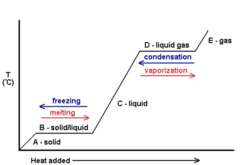
What happens in a Heat Diagram of Water: "A" section
At a solid, temp is increasing
KE is increasing
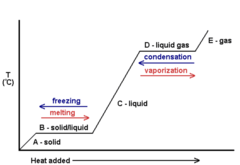
What happens in a Heat Diagram of Water: "B" section
Water changes from solid to liquid
Solid+ liquid temp is staying the same, meaning the melting point
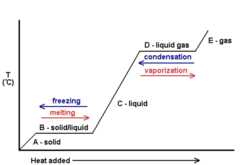
What happens in a Heat Diagram of Water: "C" section
At a liquid, temp is increasing
KE is increasing
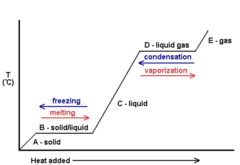
phase diagram
The phase diagram of any solution is a representation of the various pressure and temperature combinations that create each phase. The three phases are solid, liquid and gas. Changing the pressure at a certain temperature can lead to a change in phase.