Introduction to the Course and Review of Geotechnical Properties of Soil
 Call Kai
 Learn
Learn Practice Test
 Spaced Repetition
 Match
Match Flashcards
 Knowt Play
1/32

There's no tags or description
Looks like no tags are added yet.
Name | Mastery | Learn | Test | Matching | Spaced | Call with Kai | Chat |
|---|
No analytics yet
Send a link to your students to track their progress
33 Terms
Foundation Engineering
is the application and practice of the fundamental principles of soil mechanics and rock mechanics (geotechnical engineering) in the design of foundations of various structures.
(a) the load that will be transmitted by the superstructure to the foundation system
(b)the requirements of the local building code
(c)the behavior and stress-related deformability of soils that will support the foundation system
(d)The geological conditions of the soil under consideration
The design of foundations generally requires a knowledge of such factors as:
SOIL
is defined as the uncemented aggregate of mineral grains and decayed organic matter (solid particles) along with the liquid and gas that occupy the empty spaces between the solid particles.
SOIL
Is an assemblage of particles, and thus there are separate volumes of solid and void.
Proper laboratory testing (grain-size distribution, plasticity, compressibility, shear strength, etc..)
Proper field testing (Field density test, o Borehole test, o Plate load test, etc)
The geotechnical properties of a soil can be assessed through:
Field density test, o Borehole test, o Plate load test, etc
What can be assesed under Proper field testing?
grain-size distribution, plasticity, compressibility, shear strength, etc..
What can be assesed under Proper laboratory testing?
Specific gravity
Size and shape of particles
Relative density and consistency of soil
What are the Index Properties of Soils?
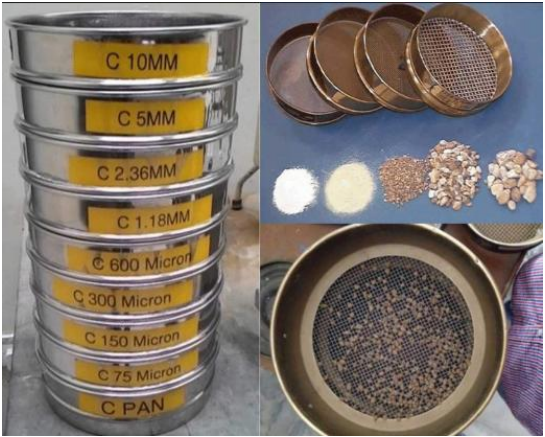
Sieve Analysis
What is this? Under GRAIN- SIZE DISTRIBUTION.
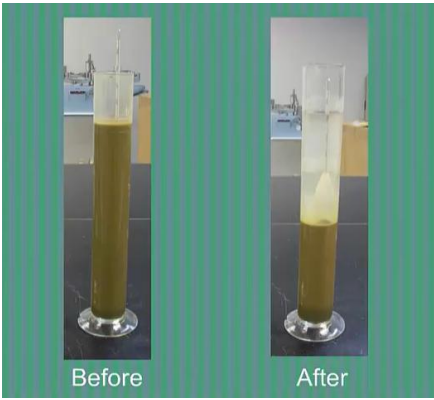
Hydrometer Analysis
What is this? Under GRAIN- SIZE DISTRIBUTION.
solid
semi-solid
plastic
liquid
At a very low moisture content, soil behaves more like a solid. When the moisture content is very high, the soil and water may flow like a liquid. Hence, on an arbitrary basis, depending on the moisture content, the behavior of soil can be divided into four basic states
SHRINKAGE LIMIT
The water content where further loss of moisture will not result in any more volume reduction.
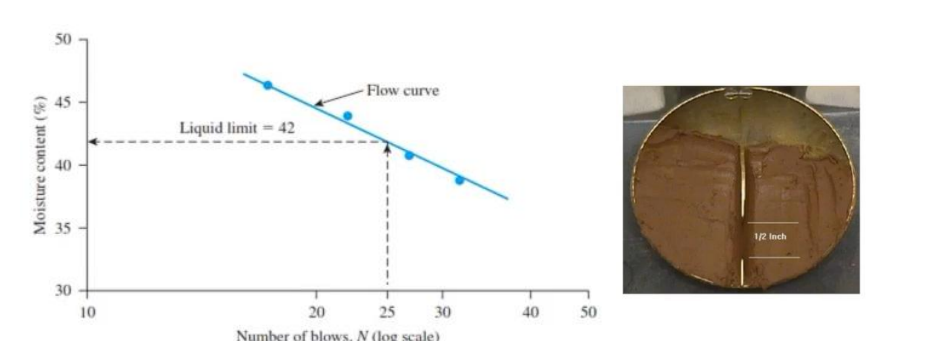
LIQUID LIMIT
The water content that corresponds to 25 blows or 20 mm penetration of cone.
Using Casagrande Cup Method
Using Fall-Cone Method
What are the two methods of LIQUID LIMIT?
Using Casagrande Cup Method
What is this?
Using Fall-Cone Method
In this method, the LL is taken as the moisture content at which a standard 30 degree, 80g cone will penetrate the soil sample at a distance of 20 mm in approximately 5 seconds.
PLASTIC LIMIT
The water content wherein soil sample starts to crumble when rolled into 1/8 in (3.2 mm) diameter thread
PLASTICITY INDEX, PI
It is the range of water content over which the soil remains plastic.
LIQUIDITY INDEX, LI
It is the parameter used to define the consistency of a fine-grained soil with respect to LL and PL.
CONSISTENCY INDEX, CI
Also called as Relative Consistency. It is defined as the ratio of difference between LL and natural water content of the soil with respect to its plasticity index.
Brittle Solid
Plastic
Liquid
In the Soil state based on LI, enumarate what state are the following:
LI < 0
0 < LI < 1
LI > 1
Skempton
defined a quantity called activity, which is the slope of the line correlating PI and % finer than 2 mm.
POROSITY
It is defined as the ratio of the volume of voids to the total volume of the soil mass.
VOID RATIO
It is defined as the ratio of volume of voids to the volume of solids
MOISTURE CONTENT
It is defined as the ratio of the mass of water to the mass of solids.
DEGREE OF SATURATION
It is defined as the ratio of volume of water to the volume of voids.
1
In Fully Saturated soil: S = what?
18th century, 1927
Study of soil behavior in a more methodical manner in geotechnical engineering started in the early part of the _____ and last to _____.
PRE-CLASSICAL PERIOD (1700-1776)
rough classification of soil
CLASSICAL SOIL MECHANICS PHASE II (1856-1910)
started from the publication on the permeability of sand filters by Darcy in 1856.
CLASSICAL SOIL MECHANICS PHASE I (1776-1856)
started from Coulomb’s presentation on determining the sliding surface in soil behind a retaining wall
MODERN SOIL MECHANICS (1910-1927)
Atterberg on consistency of clayey soils, the Atterberg limits; Bell on lateral pressure and resistance of clays; Terzaghi on theory of consolidation for clays
Karl Terzaghi(1883-1963)
he development of Geotechnical Engineering as a branch of Civil Engineering is absolutely impacted by one single professional individual. Who is he?