MCAT Bio/Biochem Section
 Call Kai
 Learn
Learn Practice Test
 Spaced Repetition
 Match
Match Flashcards
 Knowt Play
1/40

There's no tags or description
Looks like no tags are added yet.
Name | Mastery | Learn | Test | Matching | Spaced | Call with Kai | Chat |
|---|
No analytics yet
Send a link to your students to track their progress
41 Terms
Metabolism
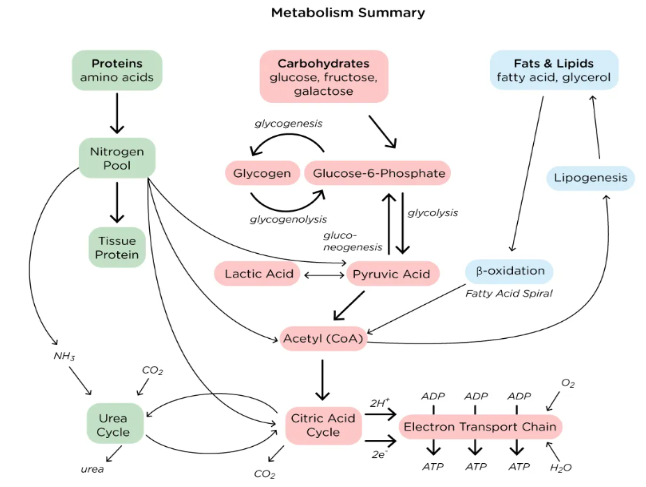
-Key Idea: Carbohydrate, protein, fats & lipids are broken down for ATP production and linked by Acetyl CoA
-Fed state (Insulin): ↑ Energy Store by ↑ Glycolysis, glycogenesis, fatty acid synthesis
-Fasting state (Glucagon): ↑ Energy Release by ↑ Gluconeogenesis, glycogenolysis, β-oxidation
-Glycolysis: Breaks down glucose to make ATP
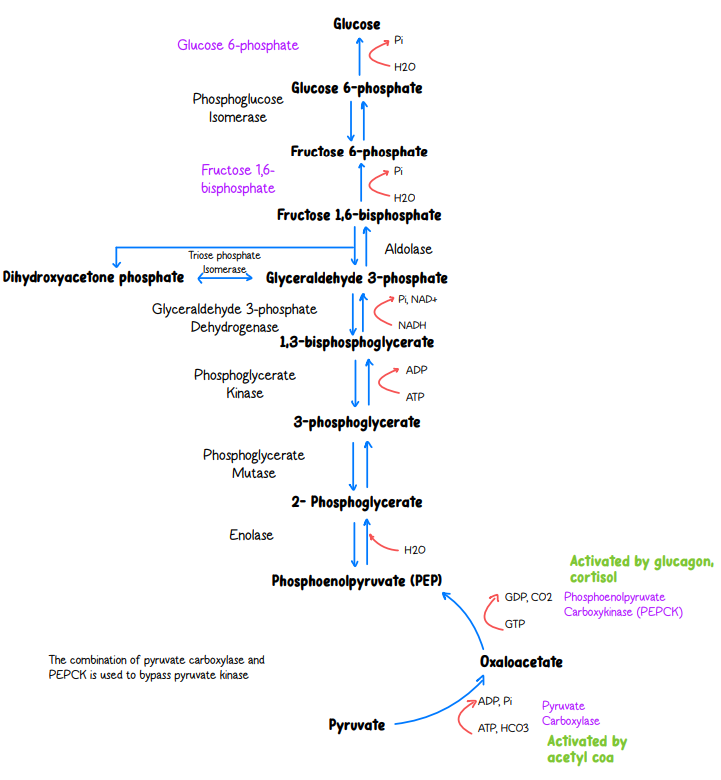
-Gluconeogenesis: Makes glucose during fasting
-Glycogenesis: Stores glucose as glycogen
-Glycogenolysis: Releases glucose from glycogen
-Citric Acid Cycle: Produces NADH/FADH₂ for ETC
-ETC: Produces most ATP
-β-Oxidation: Breaks down fatty acids into acetyl-CoA
-Lipogenesis/ Fatty Acid Synthesis: Stores excess energy as fat
-Urea Cycle: Removes toxic ammonia
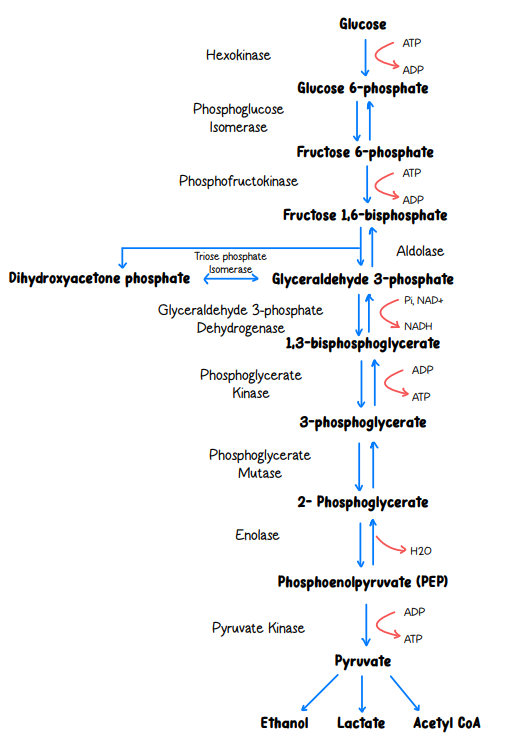
Glycolysis Pathway:
• Net: 1 Glucose + 2 ADP + 2 Pi + 2 NAD⁺ → 2 Pyruvate + 2 ATP + 2 NADH + 2 H⁺ + 2 H₂O
• Occurs in the cytoplasm
Gluconeogenesis Pathway:
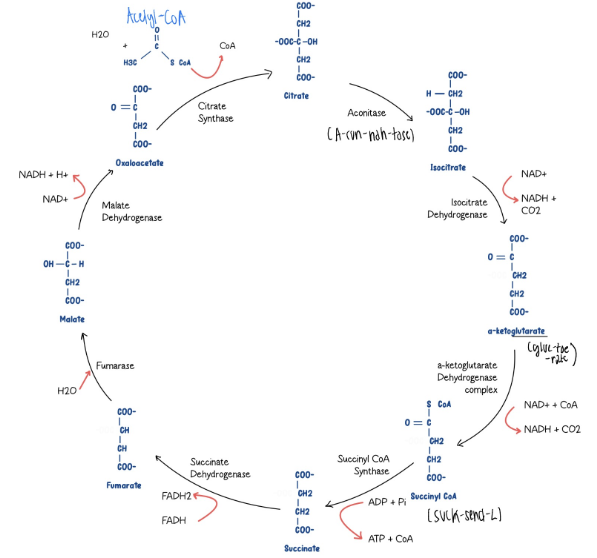
Citric Acid Cycle Pathway:
• Net: 1 Acetyl-CoA + 3 NAD⁺ + FAD + ADP (or GDP) + Pi + 2 H₂O → 2 CO₂ + 3 NADH + FADH₂ + ATP (or GTP) + CoA-SH + 3 H⁺
• Pathway: 1. Oxaloacetate + Acetyl-CoA —(Citrate synthase)→ 2. Citrate ⇌ (Aconitase) ⇌ 3. Isocitrate —(Isocitrate dehydrogenase)→ 4. α-Ketoglutarate —(α-Ketoglutarate dehydrogenase)→ 5. Succinyl-CoA ⇌ (Succinyl-CoA synthetase) ⇌ 6. Succinate ⇌ (Succinate dehydrogenase) ⇌ 7. Fumarate ⇌ (Fumarase) ⇌ 8. Malate ⇌ (Malate dehydrogenase) ⇌ 9. Oxaloacetate
• Citrate synthase: Inhibitors: ATP, NADH, succinyl-CoA, citrate; Activator: ADP
• Isocitrate dehydrogenase: Inhibitors: ATP, NADH; Activator: ADP and NAD+
• α-Ketoglutarate dehydrogenase: Inhibitors: ATP, NADH, succinyl-CoA; Activator: ADP
• Eukaryotes: occurs in mitochondrial matrix; prokaryotes: occurs in cytoplasm
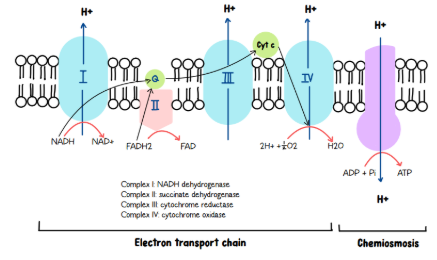
Oxidative Phosphorylation:
-Uses NADH and FADH₂ to produce most ATP.
-Pathway:
Complex I: NADH → NAD⁺ (electrons enter ETC; pumps H⁺)
Complex II: FADH₂ → FAD (electrons enter ETC; does not pump H⁺)
Complex III: Transfers electrons to Cyt c; pumps H⁺
Complex IV: Transfers electrons to O₂ → H₂O; pumps H⁺
Complex V (ATP synthase): H⁺ gradient → ATP
-No O₂: ETC stops → ↓ ATP production → NADH accumulates.
-Complex II inhibition: FADH₂ cannot donate electrons = ↓ ATP production.
-ATP synthase inhibition: H⁺ gradient builds up = ↓ ATP production
-Uncoupling: H⁺ gradient dissipates → ↓ ATP, ↑ heat.
ATP Yield from 1 Glucose:
-Ratio: 1 NADH = 2.5 ATP, 1 FADH2 = 1.5 ATP
-Glycolysis: 2 ATP + 2 NADH = 7 ATP
-Pyruvate Dehydrogenase: 2 NADH = 5 ATP
-Citric Acid Cycle: 2 ATP (GTP) + 6 NADH + 2 FADH₂ = 20 ATP
-Total = 32 ATP/glucose
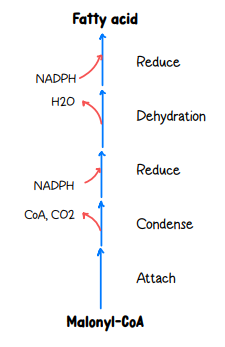
Fatty Acid Synthesis (FAS/Lipogenesis):
-Cytoplasm converts acetyl-CoA into fatty acid using NADPH for energy storage.
-Acetyl-CoA carboxylase (Rate-limiting enzyme): Activated by insulin (fed-state) = ↑ FAS; inhibited by glucagon (fasting) = ↓ FAS
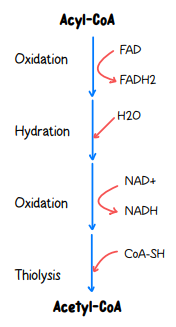
β-Oxidation:
-Breaks down fatty acids into Acetyl-CoA, NADH, and FADH₂ for ATP production in the mitochondrial matrix.
-Activated by Glucagon (fasting); Inhibited by Insulin (fed state) = no β-oxidation = ↓ ATP production
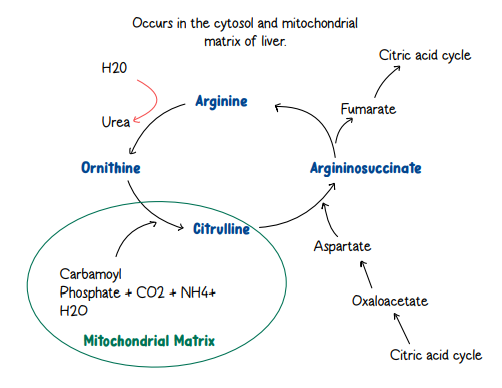
Urea Cycle:
-Converts toxic ammonia (NH₃) from amino acid metabolism into urea for removal
-Occurs in the liver (mitochondria and cytosol).
-Links to the Citric Acid Cycle via fumarate.
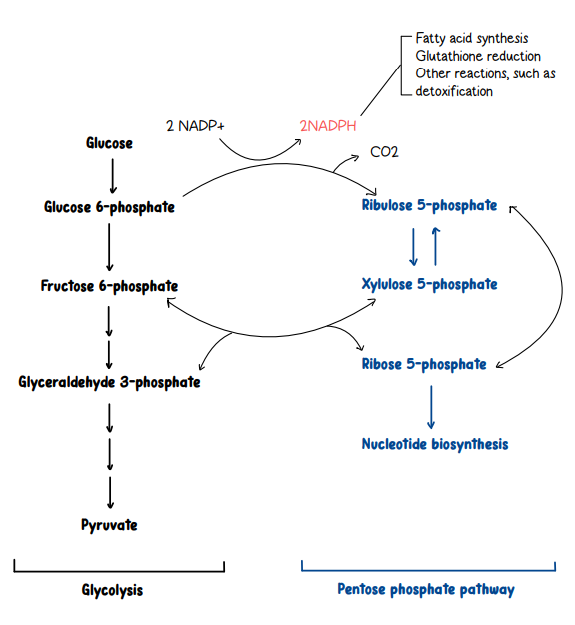
Pentose Phosphate Pathway (do not need to memorize pathways):
-Produces NADPH (fatty acid synthesis & antioxidant defense) and ribose-5-phosphate (DNA/RNA synthesis) in the cytosol.
-Glucose-6-phosphate dehydrogenase (G6PD) deficiency: ↓ NADPH → oxidative stress → hemolytic anemia (destroy red blood cells)
General Hormone Types In Endocrine System:
-Direct hormones: Act directly on target organs.
-Tropic hormones: Stimulate other endocrine glands.
-Peptide hormones: Bind cell surface receptor via second messenger → fast.
-Steroid hormones: Bind intracellular receptor for gene expression → slow.
Anterior Pituitary Hormones:
-Follicle(Fall-la-co) -stimulating (FSH): Follicle development; spermatogenesis (sperm production) (sperm-ma-gen-nah-sis)
-Luteinizing (LH): Stimulates ovulation; testosterone production.
-Adrenocorticotropic (ACTH): Stimulates adrenal cortex to make cortisol
-Thyroid-stimulating (TSH): Produce thyroid hormones.
-Prolactin: Stimulates milk production
-Endorphins: Inhibits perception of pain in the brain.
-Growth hormone: Stimulates bone/muscle growth; lipolysis (breakdown stored fat) (la-paul-la-sis)
-Mmenonic: FLAT PEG
Hypothalamus Hormones:
-Stored in posterior pituitary
-Oxytocin (oxy-toe-sin): Stimulates contractions during labor; milk production
-Antidiuretic(ADH; Anti-die-rat-tick)/vasopressin: Water reabsorption in kidneys.
Thyroid Hormones:
-Thyroid hormones (T₃, T₄): Increase metabolic activity.
-Calcitonin (cal-suh-toe-in): Decreases blood Ca²⁺
-Parathyroid hormone: Increases blood Ca²⁺
Adrenal Cortex Hormones:
-Glucocorticoid (glue-co-corticoid) ↑ blood glucose level and ↓ protein synthesis.
-Mineralocorticoid: ↑ sodium and water reabsorption in kidneys.
Adrenal Medulla Hormones:
-Epinephrine (ep-puh-nah-friend), Norepinephrine (nora-puh-nah-friend): Increases blood glucose level, heart rate, and blood pressure.
Pancreas Hormones:
-Glucagon: Converts glycogen to glucose in the liver; ↑ blood glucose.
-Insulin: ↓ blood glucose; ↑ glycogen stores.
-Somatostatin: Inhibit glucagon and insulin.
Pineal (Pin-knee-o) Hormones:
-Melatonin: Regulates sleep–wake cycles.
Testes Hormones:
-Testosterone: Maintains male secondary s*x characteristics; spermatogenesis (sperm production)
Ovary Hormones:
-Estrogen: Maintains female secondary s*x characteristics.
-Progesterone (Pro-gest-ter-wrong): Maintains endometrium to support pregnancy
Muscular System (Skeletal, Smooth, Cardiac):
Skeletal:
-Support and movement, thermoregulation, blood propulsion (move blood back to heart)
-Voluntary/somatic control
-Multinucleated (1 cell has many nuclei)
Smooth:
-Walls of respiratory, reproductive, cardiovascular, and digestive system
-Involuntary/autonomic control
-Uninucleated (1 cell has 1 nucleus)
Cardiac:
-Heart; pumps blood
-Involuntary/autonomic control
-Uni nucleated (1 cell has 1 nucleus)
-Intercalated discs (gap junctions) allow coordinated contractions.
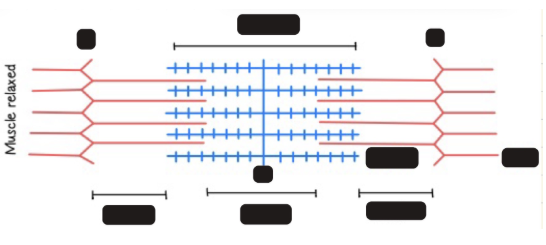
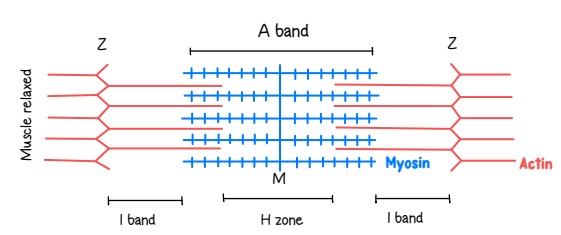
Sarcomere (Functional Unit of Muscle)
-Structure:
Z-line: Boundary/ends
M-line: Middle
-Bands:
I-band: Actin only.
H-zone: Myosin only.
A-band: Entire length of myosin
-Muscle contraction: Actin slides towards Myosin, bringing Z-lines closer to the M-line, shortening sarcomere, I-band and H-zone decrease, and A-band stays the same.
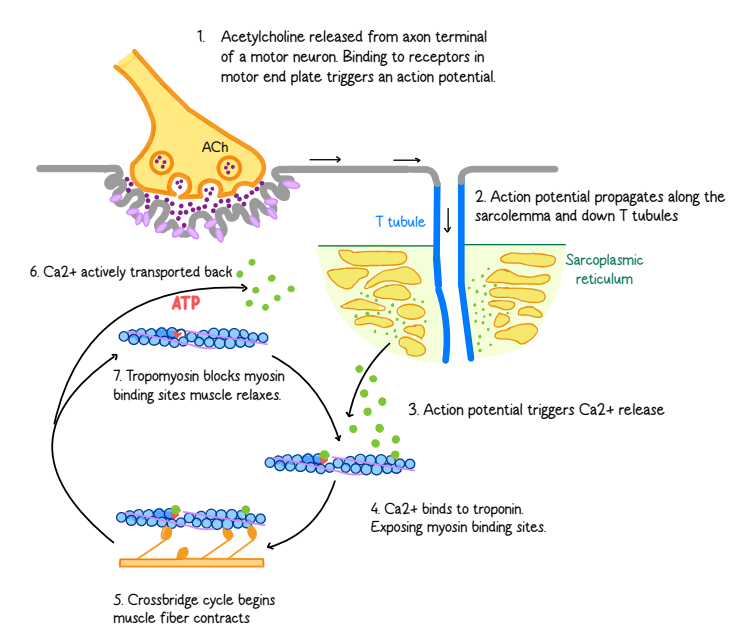
Muscle Contraction Steps:
1. ACh triggers an action potential.
2. Action potential travels along the sarcolemma (sar-co-leh-muh) and T-tubules.
3. Sarcoplasmic reticulum (SR) releases Ca²⁺.
4. Ca²⁺ binds troponin (trop-o-n), moving tropomyosin.
5. Myosin binds actin → muscle contracts.
6. ATP pumps Ca²⁺ back into the sarcoplasmic reticulum (SR).
7. Tropomyosin re-blocks myosin-binding sites.
8. Muscle relaxes.
Digestive System:
1. Oral Cavity/Mouth: Mastication starts digestion
2. Pharynx: Epiglottis (ep-puh-glaa-tis) prevents food from entering larynx (airway).
3. Esophagus: Peristalsis (pair-ra-stall-sis) moves food to the stomach.
4. Stomach: Acidic environment; begins protein digestion with:
Pepsin: Digests proteins.
Mucous cells: Protect stomach lining.
Chief cells: Secrete pepsinogen.
Parietal cells: Acidifies stomach; activates pepsin.
G cells: Secrete gastrin (↑ acid secretion).
5. Small intestine: Major site of digestion & nutrient absorption.
6. Large intestine: Absorbs H₂O and salts; forms feces.
7. Rectum: Stores feces before elimination.
Mnemonic: Old People Eats Salty Snacks Like Rabbits(OPESSL)
Carbohydrate Digestion Enzymes:
Salivary amylase (am-may-lays): Salivary glands → mouth; starch → maltose.
Pancreatic amylase: Pancreas → small intestine; starch → maltose.
Maltase: Intestinal glands → small intestine; maltose → 2 glucose.
Sucrase: Intestinal glands → small intestine; sucrose → glucose + fructose.
Lactase: Intestinal glands → small intestine; lactose → glucose + galactose.
Mnemonic: Silly People Make Sweet Lemonade (SPMSL)
Protein Digestion Enzymes:
-Pepsin: Gastric glands (chief cells) → stomach; hydrolyzes specific peptide bonds
-Trypsin: Pancreas → small intestine; hydrolyzes specific peptide bonds & chymotrypsinogen → chymotrypsin
-Chymotrypsin: Pancreas → small intestine; hydrolyzes specific peptide bonds
-Carboxypeptidase: Pancreas → small intestine; hydrolyzes terminal peptide bond at C-terminus
-Aminopeptidase: Intestinal glands → small intestine; hydrolyzes terminal peptide bond at N-terminus
-Dipeptidase: Intestinal glands → small intestine; Hydrolyzes part of amino acids
-Enteropeptidase: Intestinal glands → small intestine; trypsinogen → trypsin
Mmenomic: Please Take Chocolate Cakes After Dinner Everyday. (TCCADE)
Excretory System
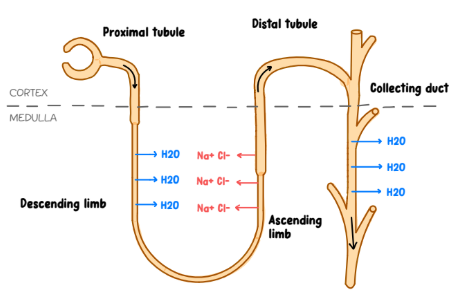
-Kidneys filters blood, removes wastes, and produces urine
1. Bowman's capsule: Filters blood to start urine formation.
2. Proximal convoluted tubule (PCT): Bulk reabsorption of glucose, amino acids, salts & H₂O; secretes H⁺, NH₃ & drugs.
3. Descending loop of Henle: Permeable to H₂O only.
4. Ascending loop of Henle: Permeable to salts only.
5. Distal convoluted tubule (DCT): Fine-tunes ions; responds to aldosterone.
6. Collecting duct: Responds to ADH & aldosterone; Reabsorbs H₂O.
7. Renal pelvis: Collects urine.
8. Ureter (yur-uh-tur): Carries urine to the bladder.
9. Bladder: Stores urine.
10. Urethra (yur-re-tah): Releases urine.
Mmenomic: Big Pandas Do Awesome Dances Carrying Red Umbrellas Back Up.
Kidney Hormones
-Aldosterone: ↑ Na⁺ reabsorption; ↑ K⁺ & H⁺ secretion = ↑ H₂O reabsorption, blood volume & blood pressure.
-Antidiuretic(ADH; Anti-die-rat-tick)/vasopressin: ↑ H₂O reabsorption in collection duct by ↑ its permeability to water.
Circulation (Blood Flow):
-Deoxygenated: Body → Vena cava → Right atrium → Right ventricle → Pulmonary artery → Lungs.
(a) Mnemonic: Big Vikings Ride Red Ponies Loudly (BVRRPL)
-Oxygenated: Lungs → Pulmonary vein → Left atrium → Left ventricle → Aorta → Body.
(a) Mnemonic: Little Ponies Love Leaping Around Barns (LPLLAB)
Electrical Conduction
-Pathway: SA node → AV node → Bundle of His → Purkinje fibers
-SA node: Starts heartbeat (pacemaker).
-AV node: Delays signal before ventricles.
-Bundle of His: Carries signal to ventricles.
-Purkinje fibers: Spread signal through ventricles.
Types of Blood Vessels:
Blood flow: Artery → Arteriole (R-tear-re-o) → Capillary → Venule → Vein (Mnemonic: All Apples Can Visit Vegas)
-Arteries: Thick, elastic wall; carry blood away from the heart.
-Arterioles: Regulate blood flow.
-Capillaries: One-cell thick wall; site of gas, nutrient & waste exchange.
-Venules: Small veins.
-Veins: Thin walls + valves; carry blood to the heart.
Blood
-Plasma (~55%): Liquid portion; transports nutrients, hormones, wastes & proteins.
-Erythrocytes (uh-reth-o-sight) (Red Blood Cells = RBCs, ~45%): Carry O₂ via hemoglobin; no nucleus or mitochondria.
-Leukocytes (loo-ko-sight) (White Big Cells = WBCs, <1%): Immune defense (fight infection)
-Platelets (plate-liss) (<1%): Blood clotting (thromboplastin → thrombin → fibrin → clot).
Blood Types
-Type A: Antigen A; anti-B antibodies; donates to A, AB; receives A, O.
-Type B: Antigen B; anti-A antibodies; donates to B, AB; receives B, O.
-Type AB: Antigens A & B; no antibodies; donates to AB; receives A, B, AB, O (universal recipient).
-Type O: No antigens; anti-A & anti-B antibodies; donates to A, B, AB, O (universal donor); receives O only.
Rh Factor
Rh⁺: Has Rh antigen; no anti-Rh antibodies.
Rh⁻: No Rh antigen; can produce anti-Rh antibodies after Rh⁺ exposure.
Respiratory System
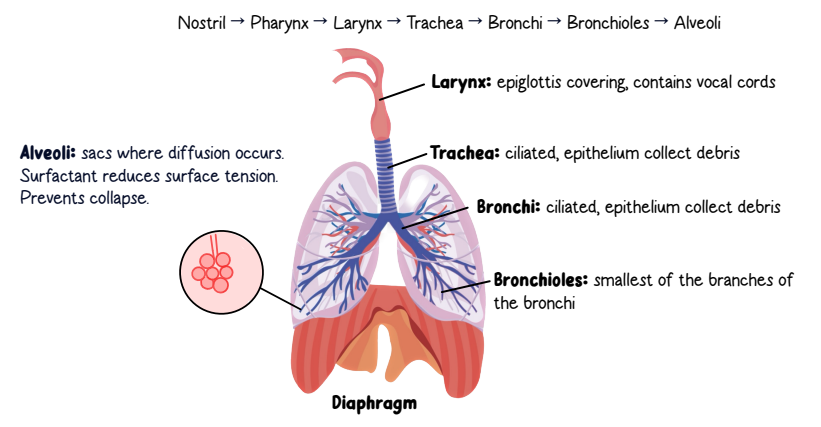
-Airway Pathway: Nostrils → Pharynx → Larynx → Trachea → Bronchi → Bronchioles (brang-key-owlz) → Alveoli (Mmenomic: Nice People Love To Breathe Big Air)
-Larynx: Vocal cords; epiglottis prevents food from entering the airway.
-Trachea & Bronchi: Cilia removes debris.
-Bronchioles: Smallest airways
-Alveoli: Site of O₂/CO₂ exchange ; surfactant prevents collapse.
-Diaphragm: Main muscle of breathing
Pulmonary Circulation
-Pulmonary artery: Carries deoxygenated blood to the lungs.
-Pulmonary vein: Carries oxygenated blood to the heart.
Breathing
-Inhalation: Diaphragm & external intercostal contract → ↑ lung volume → ↓ lung pressure → air enters.
-Exhalation: Muscles relax → ↓ lung volume → ↑ lung pressure → air exits
Lung Volumes
-Tidal volume (TV): Normal breathing
-Inspiratory reserve volume (IRV): Extra inhale.
-Expiratory reserve volume (ERV): Extra exhale
-Residual volume (RV): Air left after max exhale; Prevents alveolar collapse.
-Vital capacity (VC): Maximum air exhale after maximal inhale (TV + IRV + ERV).
Bicarbonate buffer. Given: CO₂(g) + H₂O(l) ⇌ H₂CO₃(aq) ⇌ H⁺(aq) + HCO₃⁻(aq)
• Regulates pH by changing CO₂ levels.
• ↑ CO₂ (hypoventilation) → ↑ H⁺ → ↓ pH (acidic)
• ↓ CO₂ (hyperventilation) → ↓ H⁺ → ↑ pH (basic)
Humoral Immunity (B cells)
-B cells: Mature in bone marrow; produce antibodies.
-Plasma cells: Secrete antibodies.
-Memory B cells: Provide faster response upon re-exposure.
-Opsonization: Antibodies tag pathogens for phagocytosis.
-Agglutination: Antibodies clump pathogens together.
Cell-Mediated Immunity (T cells)
-T cells: Mature in the thymus; attack infected cells.
-Cytotoxic T cells (CD8⁺): Kill infected cells directly.
-Helper T cells (CD4⁺): Activate B cells, T cells & macrophages via cytokines.
-Regulatory (Suppressor) T cells: Suppress immune response.
-Memory T cells: Provide faster response upon re-exposure.