HANDOUT KINETICS
 Call Kai
 Learn
Learn Practice Test
 Spaced Repetition
 Match
Match Flashcards
 Knowt Play
1/24

There's no tags or description
Looks like no tags are added yet.
Name | Mastery | Learn | Test | Matching | Spaced | Call with Kai | Chat |
|---|
No analytics yet
Send a link to your students to track their progress
25 Terms
The reaction in which rate equation corresponds to a
stoichiometric equation is called
a. elementary reaction c. non-elementary reaction
b. parallel reaction d. autocatalytic reaction
a. elementary reaction
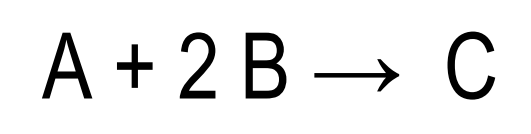
The overall order of the reaction for the elementary reaction
a. 0 c. 2
b. 1 d. 3
d. 3
If “n” is the order of reaction, then unit of rate constant is
a. 1 / (time) (concentration)n-1
b. (time)-1(concentration)n-1
c. (time)n-1 (concentration)
d. none of these
a. 1 / (time) (concentration)n-1
A certain reaction has a specific rate constant of 10 L/mol-min. The order of the reaction is
a. ½ c. 1
b. 0 d. 2
d. 2
Inversion of cane sugar is an example of
a. unimolecular reaction with first order.
b. bimolecular reaction with second order.
c. bimolecular reaction with first order.
d. unimolecular reaction with second order
c. bimolecular reaction with first order.
If the rate of reaction independent of the concentration of the reactants, the reaction is said to be?
a. first order c. second order
b. third order d. zero order
a. first order
For a __________ order reaction, the units of rate constant
and rate of reaction are the same.
a. zero c. first
b. second d. fractional
a. zero
The reaction A → B is conducted in an isothermal batch
reactor. If the conversion of A increases linearly with holding
time, then the order of the reaction is
a. 0 c. 1.5
b. 1 d. 2
a. 0
With increase in initial concentration, the fractional conversion of a first order reaction in each given time
a. increases c. decreases
b. remains constant d. unpredictable
a. increases
The concentration of A in a first order reaction, A → B, decreases
a. linearly with time.
b. exponentially with time.
c. very abruptly towards the end of the reaction.
d. logarithmically with time.
b. exponentially with time.
In a first order reaction the time required to reduce the
concentration of reactant from 1 mol/L to 0.5 mol/L will be _
that required to reduce it from 10 mol/L to 5 mol/L in the same volume.
a. more than c. same as
b. less than d. data insufficient
c. same as
If the reaction, 2 A → C is second order, which of the following plots will give a straight line?
a. log CA vs time c. log CA vs reciprocal time
b. CA vs time d.1/CA vs time
d.1/CA vs time
Half-life period of a chemical reaction is
a. the time required to reduce the concentration of the reacting substance to half its initial value
b. half of the space time of the reaction
c. half of the residence time of the reaction
d. none of these
a. the time required to reduce the concentration of the reacting substance to half its initial value
For which reaction order, the half-life of the reactant is half full of the full lifetime (time for 100% conversion) of the reactant?
a. zero order c. first order
b. half order d. second order
a. zero order
If the time required to change the concentration of reactant to half its original value is independent of the initial concentration, the order of reaction is
a. zero c. one
b. two d. three
c. one
The half-life of a material undergoing second order decay is
a. proportional to the square of initial concentration
b. independent of initial concentration
c. proportional to initial concentration
d. inversely proportional to initial concentration
d. inversely proportional to initial concentration
. For the liquid phase reaction A → P, in a series of experiments in a batch reactor, the half-life was found to be inversely proportional to the square root of the initial concentration of A. The order of the reaction is
a. 3/2 c.1
b. 1/2 d. 2
a. 3/2
With increases in temperature, the rate constant obeying Arrhenius equation
a. increases
b. decreases
c. decreases exponentially with temperature
d. can either increase or decrease, depends on the frequency factor
a. increases
Which of the statements is wrong?
a. From Arrhenius Law, the value of the frequency factor, ko
does affect the temperature sensitivity.
b. Reactions with high E are very T- sensitive, with low E are relatively T – insensitive
c. Any given reaction is much more T- sensitive at a low T
than at a high T.
d. From Arrhenius law, a plot of ln k vs 1/T gives a straight
line, with large slope for large E and small slope for small E
a. From Arrhenius Law, the value of the frequency factor, ko
does affect the temperature sensitivity.
The equilibrium constant of a chemical reaction
a. increases in the presence of catalyst
b. decreases in the presence of catalyst
c. remains unaffected in the presence of a catalyst
d. can either increase or decrease; depends on the type of
catalyst
c. remains unaffected in the presence of a catalyst
Fractional conversion __________ for an exothermic
reversible chemical reaction, when the temperature is
maximum.
a. increases c. remains unchanged
b. decreases d. unpredictable from the data
b. decreases
A batch reactor is characterized by
a. constant residence time
b. the variation in extent of reaction and properties of the
reaction mixture with time
c. variation in reactor volume
d. very low conversion
b. the variation in extent of reaction and properties of the
reaction mixture with time
A plug-flow reactor is characterized by
a. high capacity
b. presence of axial mixing
c. presence of lateral mixing
d. constant composition and temperature of reaction mixture
c. presence of lateral mixing
A space-time of 3 hours for a flow reactor means that
a. the time required to process one reactor volume of feed
(measured at specified conditions) is 3 hour
b. three reactor volumes of feed can be processed every hour
c. it takes three hours to dump the entire volume of the reaction
with feed
d. conversion is per cent after three hour
a. the time required to process one reactor volume of feed
(measured at specified conditions) is 3 hour
A space velocity of 5/hour means that
a. five reactor volumes of feed (at specified conditions) are
being fed into the reactor per hour
b. after five hours, reactor is being filled with the feed
c. percent conversion can be achieved in at least 5 hours
d. a fixed conversion of a given batch of feed takes 5 hours
a. five reactor volumes of feed (at specified conditions) are
being fed into the reactor per hour