AP Calculus AB - Chapters 4 & 5
 Multiple Choice & FRQ
 Call Kai
1/16

Earn XP
Name | Mastery | Learn | Test | Matching | Spaced | Call with Kai | Chat |
|---|
No analytics yet
Send a link to your students to track their progress
17 Terms
Antiderivatives
A function F is an antiderivative of f on an interval I if F’(x) = f(x) for all x in I.
The antiderivative MUST have
+C, the constant of integration.
Antidifferentiation/indefinite integral (antiderivative)
y = Sf(x)dx = F(x) + C
Basic Integration Rules
S0dx = c
Skdx = k Sdx = kx + c
Skf(x)dx = k Sf(x)dx = kF(x) + c
S[f(x)±g(x)]dx = F(x) ± G(x) + c
Sx^ndx = Power Rule = xn+1/(n+1) + c
*Find derivative to check work
How to determine if the sum is a Riemann sum
Start with a continuous function on a closed interval [a,b].
Partition the interval into n subintervals. The kth subinterval has width deltaxk. They can be different.
In each subinterval, pick any number and call the number picked from the kth subinterval ck (LRAM picked the left endpoint… RRAM picked the right endpoint… MRAM picked the midpoint)
For each interval, using the width deltaxk of the interval as the base, create a rectangle that extends from the x-axis to the function value, f(ck), of the number you picked in each interval. (Note: some of these rectangles could lie below the x-axis.)
On each interval, form the product f(ck) * deltaxk
Find the sum of each of these products
Every Riemann sum depends on the partition you choose (i.e the number of subintervals) and your choice of the number within each interval, ck.
Limit of the Riemann sum:
lim(n→∞) Σ[f(xi)Δxi]
Definite Integral as a Limit of a Riemann Sum
A definite integral is defined as a limit of a Riemann Sum.
Option #1: We didn’t care if our subintervals were the same width. If we use the notation ||P|| to denote the longest subinterval length we can force the longest subinterval length to 0 using a limit of the Riemann Sum as follows:
lim ||P|| → 0 Σ f(xi)Δxi
Option #2: If we make sure the subintervals are all the same width, we can increase the number of rectangles to infinity using a limit of the Riemann Sum as follows:
lim(n→∞) Σ[i=1 to n] f(xi) Δx
Notation for Definite Integrals
∫[a,b] f(x) dx
The notation is read as “the integral of f of x from a to b.”
Definition of Definite Integral
If f is defined on the closed interval [a,b] and the limit of Riemann sums over partitions
[ \lim_{n \to \infty} \sum_{i=1}^{n} f(x_i) \Delta x ]
exists (as described above), then f is said to be integrable on [a,b] and the limit is denoted by
∫[a,b] f(x) dx.
The limit is called the definite integral of f from a to b. The number a is the lower limit of integration, and the number b is the upper limit of integration.
The Definite Integral as the Area of a Region
If f is continous and nonnegative on the closed interval [a,b], then the area of the region bounded by the graph of f, the x-axis, and the vertical lines x=a and x=b is given by
Area =∫[a to b] f(x) dx
1st Fundamental Theorem of Calculus
If f is continuous on [a.b] and F(x) is an antiderivative of f, then
∫(a to b) f(x) dx = F(b) - F(a)
This integral gives us the NET change.
The Mean Value Theorem (for Integrals)
If f is continuous on the closed interval [a,b], then there exists a number x=c in the CLOSED interval [a,b] such that
∫[a,b] f(x) dx = f(c) * (b - a)
Where f© is called the average value of the function f on the interval [a,b]. The above equation can be explicitly solved for f©.
The Average Value of a Function
If f is integrable on [a,b], its average value on [a,b] is given by
[ \frac{1}{b-a} \int_{a}^{b} f(x) , dx ]
How to find average value
Use average value expression to find f©.
Solve for x by taking f© and making it equal to the given equation.
Determine if x-value(s) are inside given interval.
How to evaluate definite integrals
Take antiderivative
Do F(b)-F(a) by plugging lower and upper limits into antiderivative
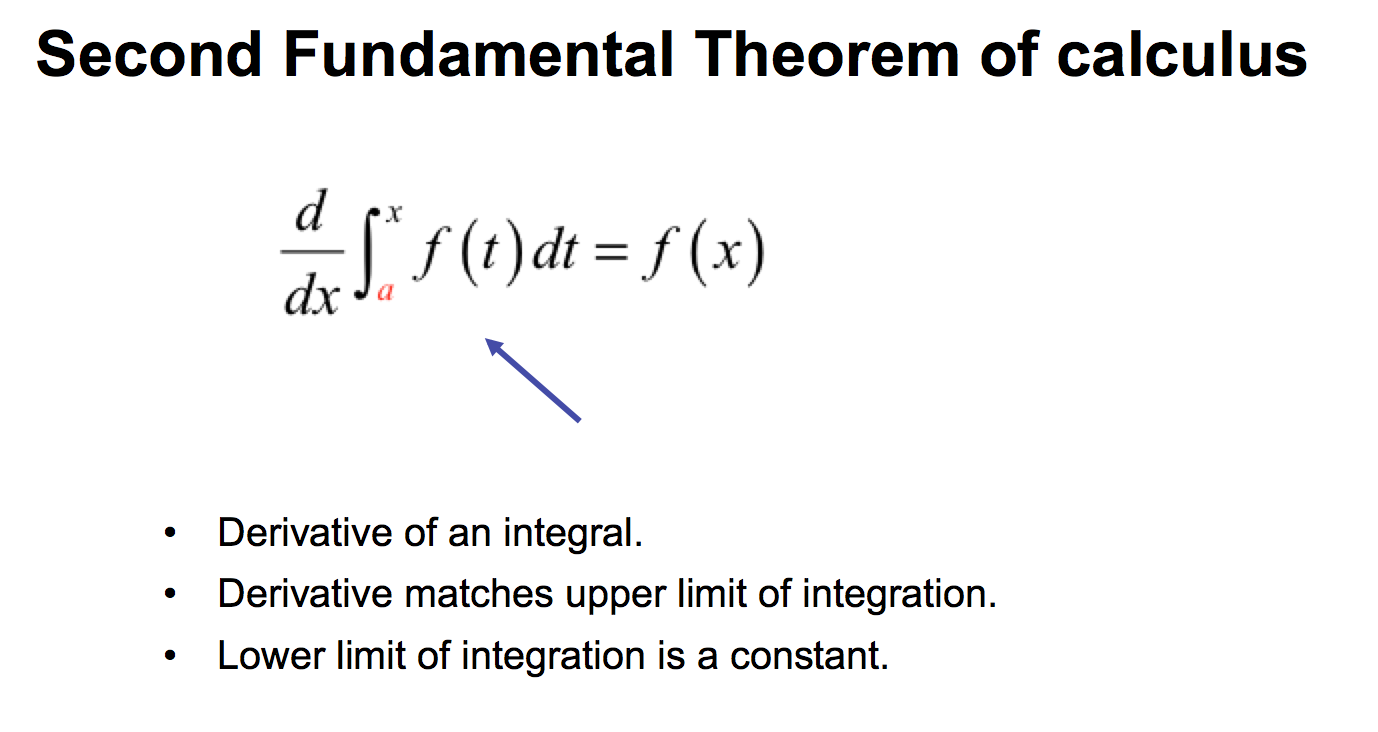
The Second Fundamental Theorem of Calculus
If f is continuous on open interval containing a, then, for every x in the interval,
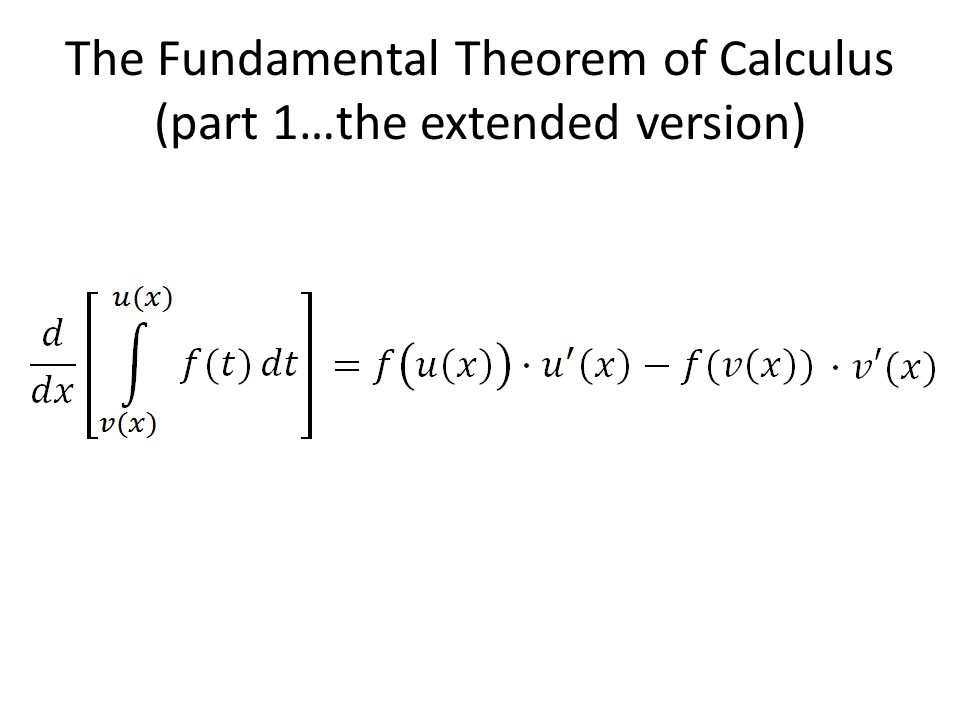
The Second Fundamental Theorem of Calculus Extended
If f is continuous on open interval containing a, then, for every x in the interval,
Solving related rate problems
Steps to solving then:
Draw a picture. Label all sides and quantities that change throughout the life of the problem as convenient variables of your choice. If something in the problem is not changing throughout the problem, label it with its constant value.
State what you are given in terms of a rate.
State what you are trying to find.
Find an equation whcih ties your variables together. If it is an area equation, you need an area equation. If it is a right triangle, the Pythagorean Theorem formula may work or general trigonometry formulas may apply, etc.
If your equation is a function of two variables, write a secondary equation and solve for one of the variables to get your related rates equation in terms of a single variable.
Use implicit differentiation to take the derivative of both sides with respect to t (time).
Substitute in known information and solve for the value you are trying to find.