BDOC Atlantic- NSS Flashcards
 Call Kai
 Learn
Learn Practice Test
 Spaced Repetition
 Match
Match Flashcards
 Knowt Play
1/73

There's no tags or description
Looks like no tags are added yet.
Name | Mastery | Learn | Test | Matching | Spaced | Call with Kai |
|---|
No analytics yet
Send a link to your students to track their progress
74 Terms
What are the 2 types of propeller forces?
Longitudinal: Front to Back
Transverse Thrust: Side to Side
What are Propeller Side Forces?
The propeller causes a sideways motion that causes the stern to walk from side to side.
How do ships counteract the Propeller Side Forces?
When a ship has multiple screws, the propellers rotate in opposite directions, creating opposing side forces, cancelling each other out
How do rudders work? What are the similar too?
They function similar to airfoils/wings.
When pivoting, they will create areas of high and low pressure on opposing sides of the rudder and will push the rudder in the desired direction.
What is Bare Steerageway? What is its range?
The minimum speed at which a rudder is still effective to maneuver a ship.
Typically 2-3 Kts
What is important to remember when avoiding danger in regarding to rudders?
You can stop OR you can turn. But it is nearly impossible to do both unless a twist is applied
What is Slewing?
A series of rudder orders and course changes to starboard and port using a hard rudder
Allows a ship to reduce headway while maintaining a course
How does the Pivot Point of a ship move through a ship at different speeds?
At Rest: Pivot Point is at the Geometric Center
With an Ahead Bell: Pivot point is from the bow, back 1/3 ship length
All Ahead Bell: Pivot Point further forward
Astern Bell: Closer to the rudders
Speed INCREASES push the pivot point forward
What are the Controllable Ship Handling Forces?
Lines
Anchors
Tugs
Engines
Rudders
Bow/Stern Thrusters
What are the Semi-Controllable Ship Handling Forces?
Shallow Water Effects
Bank Cushion/Suction
Passing Ship Effects
What are the Uncontrollable Ship Handling Forces?
Wind
Current
What is the Shallow Water Effects?
As a ship increases speed, the stern will sink into the water and the bow will rise
What is Bank Cushion and Suction?
Bank Cushion: Wedge of water between ship and bank builds up, forcing bow out sharply
Bank Suction: Decrease of water level near quarter due to rotation of screw to bank = draws stern closer
What are the 3 types of MOB Discoveries?
Immediate Response: Noticed by Bridge Watch standers and recovery action is immediately executed
Delayed Action: Reported to the bridge by an eye witness, such as topside watch standers, and recovery action is initiated
Person Missing: Individual is reported to the bridge as “missing” and recovery action is initiated
What are the Immediate actions in a MOB situation taken by the Bridge Watchstanders?
Executed Rudder and engine orders
1MC Announcement
Hoist Flag OSCAR
Pulsating Red Light
6 Short Blasts
Located and Point at MOB
Throw a life ring
Throw Smoke Float
Locate True Winds and best course to create a Lee
Notify ships in vicinity via VHF
What is a Pan-Pan Call?
Pronounced “Pahn-Pahn”
Signal indicates the calling station has an urgent message to transmit
What are 3 pieces of equipment used in a MOB situation?
Man Overboard Indicator (MOBI)
Provides relative bearing to the MOB. Closer to the transmitter, the stronger the signal gets
Search and Rescue Transponder (SART)
Component of Global Maritime distress and safety system (GMDSS)
Provides radar lines and increases the size of the lines as you get closer
Emergency Position Indicating Radiobeacon (EPIRB)
Components of GMDSS
Used when abandoning ship
Detectable by satellites anywhere
What are 3 MOB Recovery Methods?
Small Boat: Typically RHIBS lowered into the water to go and get MOB
Forecastle Recovery/J-Bar Davit Recovery: J-Bar deploys a SAR Swimmer (Must be less than 1 Kts over ground)
Helicopters: Fastest Rescue but only if already airborne with a SAR Swimmer onboard
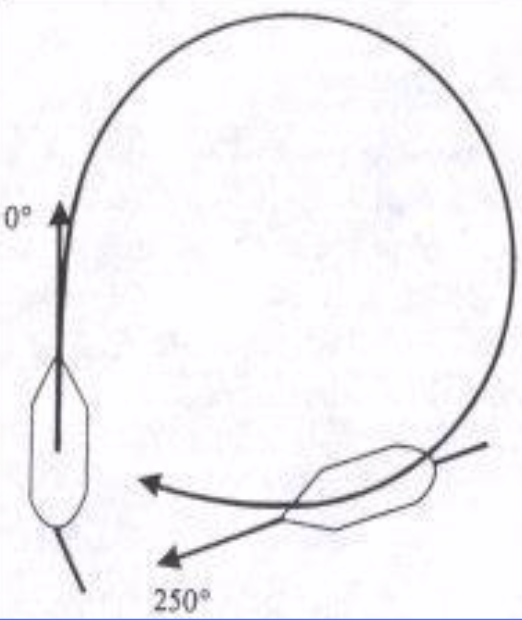
What is the Anderson Turn and what are the pros and cons?
Advantages
Quick Recovery
Simple
Never looses sight of MOB
Disadvantages
Immediate Notification is needed. (Need to know where the MOB is)
Visibility and weather
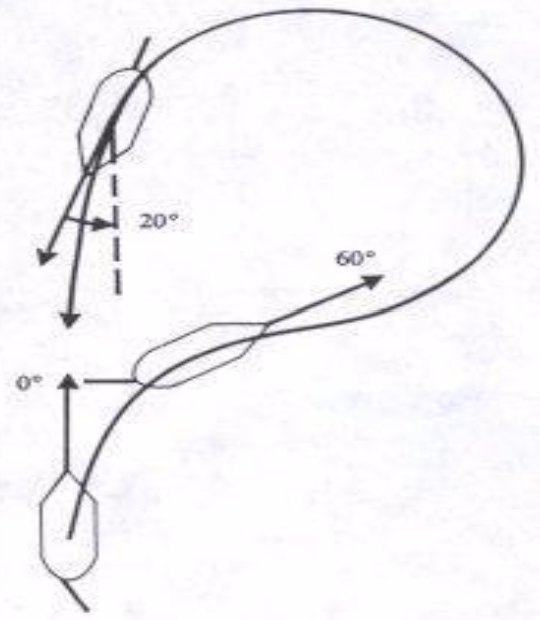
What is the Williamson Turn and what are the pros and cons?
Advantages
The Location or time of MOB may not be known
Any condition or visibility
Places the ship on a reciprocal course
Disadvantage
Distance between victim and ship
Victim is lost from view
Slower Maneuver
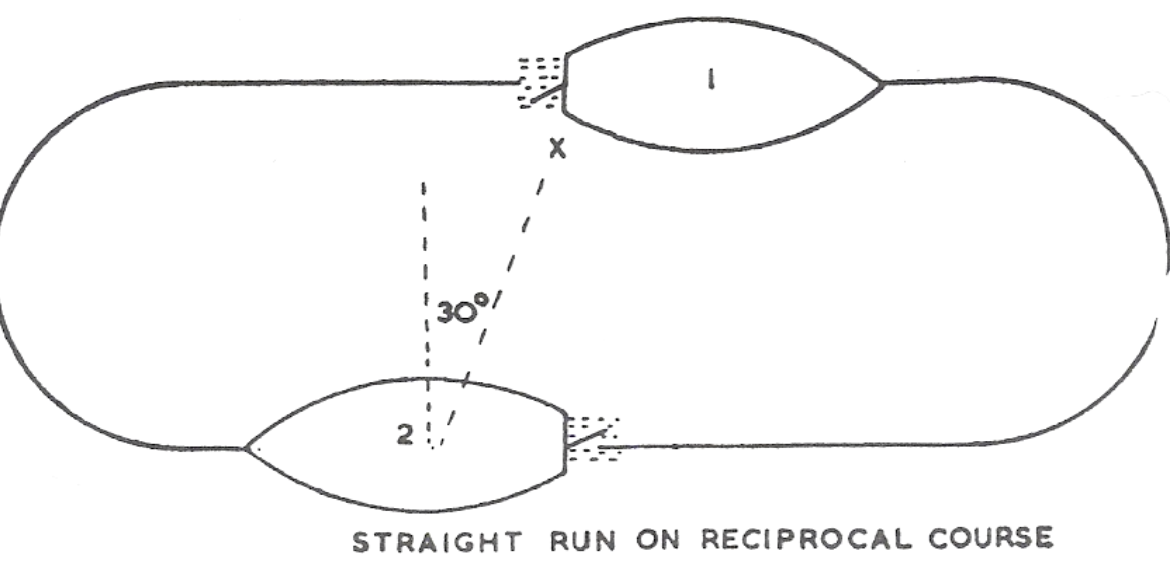
What is the Race Track Turn and what are the pros and cons?
Used by Big Deck Ships
Advantages
Simple to do
Disadvantages:
Slow
Long Runway
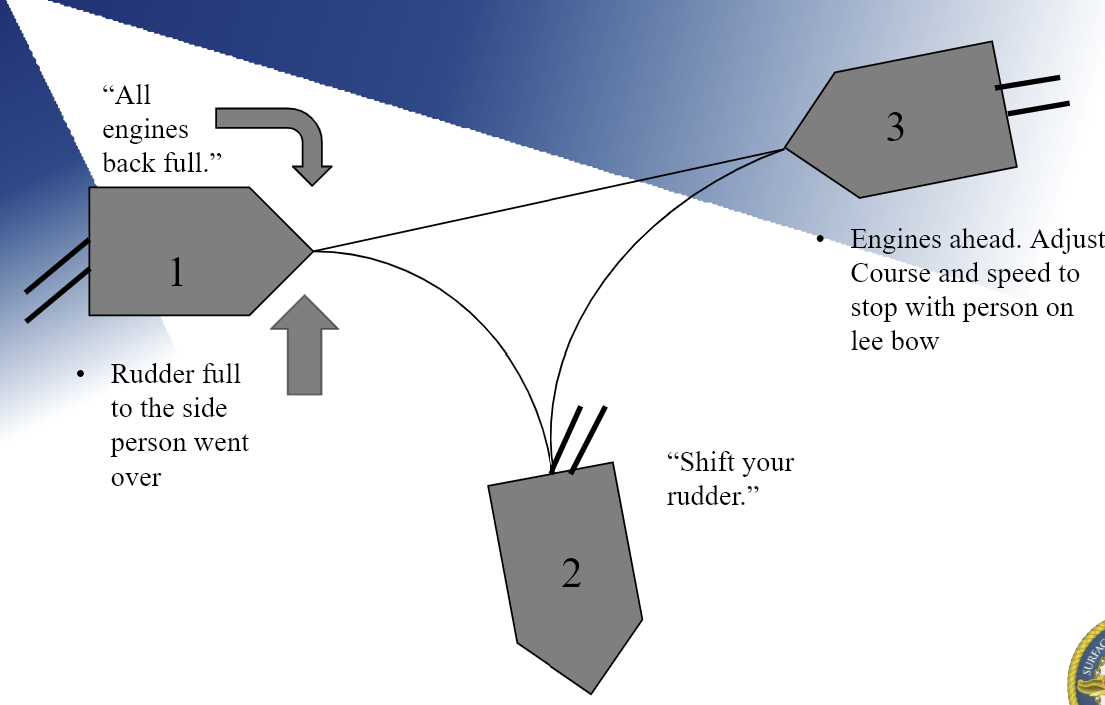
What is the Y Backing Turn and what are the pros and cons?
Advantages
Keeps the MOB in Sight and nearby
Disadvantages
Very Slow
Currents and winds will affect the ship when slow
What are the responsibilities of the CO in regards to Navigation?
Responsible for the safe navigation of the ship
Establish underway policies for tactical decision making
Final Qualifier for OOD Underway
Still Responsible even when Pilot is present
What are the responsibilities of the XO in regards to Navigation?
Assist the Navigator and Navigation Team during all restricted water transits (Unless CO says otherwise)
Review planning in Nav Briefs, Charts, and routes
Finalize Ships daily routine
What are the responsibilities of the Navigator?
Responsible to the CO for the safe navigation of the ship
Advises the CO/XO/TAO/OOD on Ship movements
Maintain accurate fix and notify team when going into danger
supervise navigation during restricted water transits and at battle stations
Prepare CO Night Orders
Maintain Ships Navigation Bill
Ensure proper preparation, Accuracy and entries and timely submission of the ships deck log
What are the responsibilities of the Officer of the Deck?
CO’s direct representative on the bridge
Remain informed of the ships position and use all situational awareness tools to detect and avoid navigational hazards and dangers
Prepare for and formally relieving the watch
Leadership and supervision of the bridge watch team
Execute the daily routine
Maintain formality, standards, and good appearance of the bridge and watch standers
Making reports and notifications to the CO, XO, and Navigator
Understand contact picture, traffic density, nav boundaries
What are the documents that provide guidance to the OOD?
NAVDORM
Navigation Bill
Captains Standing Orders
Captains Night Orders
Captains Battle Orders
Plan of the Day
What are the responsibilities of the JOOD/JOOW?
Assist in training the Conning Officer and other bridge watch standers
Assist in managing the surface contact picture and making reports to the CO and XO
Assist in Managing special evolution checklists
What are the responsibilities of the Conning Officer?
Directly controls the engine and rudder angle orders of the ship
Supervise the Helmsman and Lee Helmsman
Authorize and supervise the Helmsman and Lee Helmsman
What are the Duties of the Boatswains Mate of the Watch (BMOW)?
Supervises and trains the enlisted members of the bridge watch team
Pass words over the ships 1MC
Assist the OOD, JOOD, and JOOW
What are the responsibilities of the Quartermaster of the watch (QMOW)?
Serves as the navigators direct representative to assist the OOD, JOOD, and JOOW in navigational matters per NAVDORM and Navigation Bill
Provide a continuous navigation watch
Maintain ships position, voyage information, and nav logs
Notify Nav and OOD of Nav Details, Hazards, Dangers, and issues
What are the responsibilities of the Helm Safety Officer?
Manned during CO Directed RMD
Supervises and ensures the Helmsman and Lee Helmsman acknowledge and comply with all orders
What are the responsibilities of the Tactical Action Officer (TAO)?
Fights the ship and executes tactical decisions
Senior OOD qualified Watch stander who understands enemy threats and ship capability
Authority to assume control of the ship from OOD in tactical situations
Has weapons release authority per CO Battle Orders
What are the responsibilities of the Combat Information Center Watch Officer (CICWO)?
Supervises watch standers in the CIC
Maintains an accurate summary of geographic plots, status boards, and watch information
Monitors and ensures all communications circuits are working properly
Informs the OOD of CIC recommendations for maintaining station, avoiding navigational hazards and collisions, and general safety
Controls RADAR, SONAR, and Electronic Warfare Support Measures
What are the responsibilities of the Combat Systems Officer of the Watch (CSOOW)?
Supervises the operation of the ships combat systems
Provides Status updates and casualty reports to the TAO, OOD and CICWO
Takes immediate and controlling action per the SOP during Equipment Casualties
What are the responsibilities of the Engineering Officer of the Watch?
Responsible for the safe and proper performance of the engineering and departmental watch standers
Reports directly to the OOD to routinely report plant status, casualties, and planned maintenance during the watch
What are CO Standing Orders?
CO Expectations and standard operating procedures for your ship while underway, at anchor, or in port
Addresses the day-to-day management of the ships routines that form the foundation of safe shipboard operations
Defines the authorities and responsibilities for all major watch and control stations
Defines what needs special permissions and reports
What are some common Standing Orders?
Responsibilities
The Watch
Conning and Maneuvering
Required Reports
CO Approval Items
Navigation
Restricted Visibility
Man Overboard (MOB)
Anchoring
RMD
Max Reliability
Flight Deck Operations
What Examples of Required Reports to the CO, XO and NAV?
CO
Declining the take the watch
12 O’Clock Reports
Position Reports
Contact Report
Loss/Degradation of Major Equipment
Medical Emergencies
XO
Administrative ITems
Changes to POD
Major Schedule Changes
NAV
Changes in Weathers/Seas
Issues with NAV Equipment
Changes/Issues with PIM
What are examples of CO Approval Items?
Relief of the Deck when CO is on the Bridge
Initial Green Deck During Flight Ops
Initial Green Well during Well Deck Operations
Sending Sailors Aloft or over the side
Small boat operations
Deploying SAR Swimmer and recovering Man Overboard
Setting and Securing from RMD
Tagging out major pieces of equipment
What are the CO’s Night Orders?
Supplement the CO Standing Orders for nighttime procedures
Tactical and stationing information
Engineering Data
Major Equipment Casualties
Nav Information
Expected Weather
Night Orders take precedence over the Standing Orders
What information should be passed on during a Watch Turnover?
Navigation Info
Estimated or True Position compared to intended Track
Course and Speed
Aids/Hazards
Tactical Info
Expected changes in formations or screens
Status of all contacts
Emergency instructions from the OTC/CO
Readiness Info
Current Readiness and Material Conditions
Status of Engineering plant and damage control
Location of the CO or Embarked flag or unit commander
What is a nautical chart?
A graphical Representation, of the spherical earth, on a plane two dimensional surface
What is are Great Circles and Small Circles?
Great Circle: The intersection of a sphere and a plane through its center
Longitude lines (Meridians)
The Equator
Small Circle: The Intersection of a sphere and a place which does not pass through its center
Latitude Lines (Parallels)
What is the difference between Speed of Advance, Speed Over Ground, and Speed Made Good?
Speed of Advance: Planned or DR Speed
Speed over Ground: Actual Speed of the Vessel
Speed Made Good: Calculated Speed based on measured distance between fixes
What is a Rhumb Line?
A Line that makes the same angle with all meridians
What are the advantages and disadvantages of the Mercator Projection?
Advantages:
Rhumb Lines plot as straight lines
Provides for easy measuring of distance, direction, and position
Latitude and Longitude draw as straight lines
Disadvantages:
Great circles plot as curves
Minor distortions of features at extreme latitudes
How are Rhumb Lines and Great Circles shown on Gnomonic and Mercator Projection Charts?
Mercator Projection
Rhumb Lines are Straight
Great Circles are Curved
Opposite for Gnomonic Charts
What are the Advantages and Disadvantages of Gnomonic Projections?
Advantages:
Great circles plot as straight lines which are ideal for long voyages
Distortion on a gnomonic chart is tolerable
Disadvantages:
Rhumb lines plot as curved lines on a gnomic projection and do not plot directions or measure distances easily on charts
True Shapes of earth are not represented
What is Chart No. 1?
Provides descriptions and depictions of basic elements and symbols on nautical charts
Published by NOAA
What are the Navigation Rules & Regulations (COLREGS)?
International and Inland regulations for preventing collisions at sea
All Mariners must have a complete understanding of these regulations
What is US Fleet Guide?
Series of booklets containing port information for US Naval Bases
Includes:
Navigational POI
Listing of important Phone Numbers
Maps of the port
Radio Frequencies
Safety Requirements
What is NOAA Coast Pilots?
Published to supplement nautical charts for inland US waters
Contains information that can’t be fit on a chart
Harbor and port information
Pilot information and requirements
Berthing facilities
Repair Facilities
Repair Facilities
Tidal and Current information
Radio Frequencies and draw bridge schedules
Weather Patterns
What is the USCG Light List?
USCG provided detailed information about navigation lights in Inland US Waters.
What is the NGA List of Lights?
NGA provides information on Lighted aids to navigation and sound signals in Foreign Waters
Contains information on storm signals, signal stations, racons, radio beacons, radio direction finder calibration stations and DGPS
What is the NGA Radio Navigational Aids?
Contains a detailed list of selected worldwide radio stations that provide services to navigators
Radar Stations
Radio Time Signals
Radio Navigation Warnings
Distress and Safety Information
Long-Range Navigation Aids
What is the NGA/USCG Notice to Mariners?
Weekly publication that is used to correct multiple navigation references and charts
Summary of corrections contain accumulated corrections since the print date
What is the USCG Local Notice to Mariners?
Covers regions in the US and its territories. Way for the coast guard to disseminate navigation information
What is Distance between U.S. Ports (Pub 151)?
Contains the distances between different ports. Used for voyage planning
What is in Sailing Directions?
Contains 37 Enroutes and 5 planning guides that have detailed coast and port information. Divided by Geographic Regions
What is in Sailing Directions (Planning Guides)?
Describe general features of ocean basins. Covers relatively permanent information to assist the navigators in planning extensive oceanic voyages
What is in Sailing Directions (Enroute)?
Contains numbered sections along a coast or through a strait.
Contains:
Winds, tides and currents
Offshore dangers
Coastal Features
Anchorages
Major Ports
What is the World Port Index (Pub 150)?
Contains the location and physical characteristics of, and the facilities and services offered, by major ports and terminals world wide
What is in the International Code of Signals (Pub 102)?
Lists the international communication signals to be employed by vessels at sea
Signals can be transmitted via:
Morse code
Lights
Sounds
Flags
Radio Telegraph
Semaphore
What is in the Nautical Almanac?
Periodical publication of astronomical data that is designed for marine navigation
What is typically included in a Voyage Plan?
Charts and Publications
Courses and Track Data
Forecasted Weather and Tides
Sailing Directions & Coast Pilot Information
Projections of various future events
Classified Documents and messages
Fleet OPORDS
Equipment Status
How are great circles and rhumb lines used together to plan voyages?
A Great Circle is plotted and multiple waypoints are selected. Rhumb lines are then used to connect those waypoints, making multiple straight segments that approximate to a great circle curve, increasing efficiency while staying relatively simple
What is a PIM?
Plan of intended Movement
What are the 4 types of Movement Reports?
Departure
Arrival
Position
Cancellation