2 - Simple Meters
 Call Kai
 Learn
Learn Practice Test
 Spaced Repetition
 Match
Match Flashcards
 Knowt Play
1/49

Earn XP
Description and Tags
The Musician's Guide to Theory and Analysis - Part I: Elements of Music
Name | Mastery | Learn | Test | Matching | Spaced | Call with Kai | Chat |
|---|
No analytics yet
Send a link to your students to track their progress
50 Terms
clave
A syncopated Afro-Cuban rhythm that has been incorporated into many popular styles. The 3-2 ___ has three rhythmic attacks in the first bar and two in the second. In simple meter, it is notated as [see image]. If the second measure is played first, that is referred to as 2-3 ___.
![<p>A syncopated Afro-Cuban rhythm that has been incorporated into many popular styles. The 3-2 ___ has three rhythmic attacks in the first bar and two in the second. In simple meter, it is notated as [see image]. If the second measure is played first, that is referred to as 2-3 ___.</p>](https://assets.knowt.com/user-attachments/0a559fac-7fa1-45b7-84aa-41e39661594e.png)
anacrusis (upbeat)
A note or group of notes that begin a melody just before the first downbeat; also called an upbeat or pickup.
bar
A measure.
bar line
A vertical line that indicates the end of a measure.
beat
The primary pulse in musical meter.
beat unit
In a meter, the note value that gets one beat.
beat division
The secondary pulse in musical meter; the first level of faster-moving pulses within the primary beat.
beat subdivision
Further division of the beat smaller than the beat division; the second level of faster-moving pulses within the primary beat.
downbeat
Beat 1 of a metrical pattern.
offbeat
A weak beat or weak portion of a beat.
beats per minute (bpm)
The numbers of beats in a minute; used to measure tempo for popular music. May also appear as a metronome marking in printed scores of other musical genres.
bell patterns
Cyclically repeated rhythmic patterns originating in sub-Saharan Africa, originally performed using a metal bell (like a cowbell) struck by a metal rod. These patterns form the referential timeline for a performance.
duration
The length of sounds or silences; represented in music by notes and rests.
entrainment
The process of perceiving a beat and tapping, dancing, or moving to it.
gong cycle
A recurring sequence of gong strokes that provides the rhythmic and structural foundation for a musical piece, most commonly in Southeast Asian traditions like Indonesian gamelan.
hemiola
A temporary duple rhythmic grouping in the context of an underlying triple meter (e.g., two measures of 3/4 meter heard as three measures of 2/4);or a temporary two-part division of the beat in the context of an underlying three-part division (e.g., a measure of 6/4 heard as a measure of 3/2).
hypermeter
A high-level metric grouping that interprets groups of measures as though they were groups of beats within a single measure.
iqa’, iqa’at
A cyclically repeated rhythmic pattern in Middle Eastern Arabic music, employing the two basic sounds of Arabic drums (dum and tek) to accompany a sung or instrumental melody.
legato
Played or sung smoothly (or instruction to play or sing smoothly), sometimes indicated by a slur.
measure
A unit of music grouped by beats; generally, a measure begins and ends with notated bar lines.
meter
A hierarchical arrangement of beats and their divisions that repeat from measure to measure and are perceived as relatively strong and weak. The first beat of each measure is perceived as strongest.
simple duple
Any meter with two beats in a measure, with each beat divided into two.
simple triple
Any meter with three beats in a measure, with each beat divided into two.
simple quadruple
Any meter with four beats in a measure, with each beat divided into two.
compound
Meter in which the beat divides into threes. The top number is 6, 9, or 12.
alla breve
Also called “cut time.” Counted in two half-note beats.
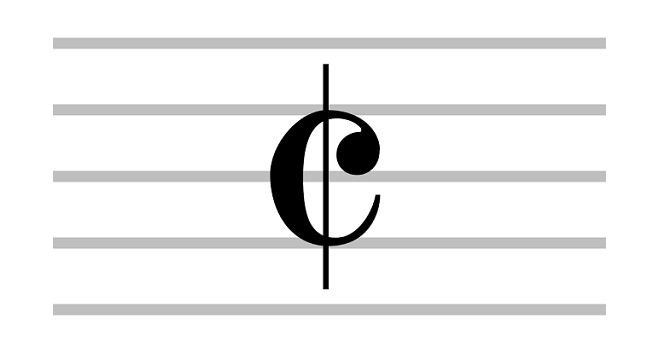
meter signature
A sign that appears at the beginning of a piece, after the clef and key signature; its two numbers convey the number of beats per measure and the type of note that represents one beat; also called a time signature.
time signature
Another term for meter signature.
metric accent
A perceived emphasis on a beat because of its placement in the meter; for example, notes on the first and third beats of quadruple meter have a metric accent.
note value
Notation that reflects how long a note is to sound in a specific meter.
whole note
A stemless open note head; equal in duration to two half notes.
half note
A stemmed white note head; its duration is equivalent to two quarter notes.
quarter note
A stemmed black note head, equivalent in duration to two eighth notes.
eighth note
A stemmed black note head with one flag.
sixteenth note
A stemmed black note head with two flags.
thirty-second note
A stemmed black note head with three flags; equal in duration to two sixty-fourth notes.
sixty-fourth note
A stemmed black note head with four flags; half the duration of a thirty-second note.
breve
A note value that is twice as long as a whole note; sometimes written as a double whole note.
flag
A wavy line attached to a stem of a single note to shorten its duration. The more ___, the shorter the duration.
beam
A horizontal line connecting two or more notes that is used to shorten their duration instead of a flag; the more ___, the shorter the duration.
tie
A small arc connecting the note heads of two or more identical pitches, adding the durations of the notes together,
dot
Rhythmic notation that adds to a note half its own value (e.g., a dotted-half equals a half note plus a quarter note).
double dot
Rhythmic notation that adds to a note a half and a quarter of its own value (e.g., a double-dotted-half equals a half note plus a quarter note plus an eighth note).
rest
A duration of silence.
rhythm
The patterns made by ther durations of pitch and silence (notes and rests) in a piece.
rhythm clef
Two short, heavy vertical lines preceding the meter signature, notated on a single line instead of a staff, indicating rhythm only, not pitches.
slur
An articulation mark consisting of an arc that connects two or more different pitches, indicating that they are to be played or sung in a smooth and connected way. Unlike ties, they affect articulation but not duration.
syncopation
Off-beat rhythmic accents created by dots, ties, rests, dynamic markings, or accent marks.
tempo
How fast or slow music is played. Examples include adagio (slow), andante (medium), and allegro (fast).
tresillo
A syncopated Latin-American rhythm that appears in traditional and recent popular music. In simple meter, it is notated as [see image].
![<p>A syncopated Latin-American rhythm that appears in traditional and recent popular music. In simple meter, it is notated as [see image].</p>](https://assets.knowt.com/user-attachments/d40bb491-38c4-436d-9f8e-32ca98e9b4c3.png)