C2 Monsoons, Cyclones and ENSO
 Call Kai
 Learn
Learn Practice Test
 Spaced Repetition
 Match
Match Flashcards
 Knowt Play
1/6

There's no tags or description
Looks like no tags are added yet.
Name | Mastery | Learn | Test | Matching | Spaced | Call with Kai | Chat |
|---|
No analytics yet
Send a link to your students to track their progress
7 Terms
January monsoon
Difference in surface atmospheric pressure
Asia is experiencing winter and intense cooling, it develops an area of high pressure
Australia is experiencing summer and heated air rises, developing an area of low pressure
Due to pressure gradient force, air moves from Central Asia to Australia
Deflection of winds
Due to differing specific heat capacities of land and sea, Pacific Ocean forms a region of lower pressure
Winds moving towards Pacific Ocean are deflected to the right in NH due to Coriolis force, forming northeast monsoon winds away from Central Asia
When winds cross the equator, it moves into the SH and deflects to the left, forming northwest monsoon winds towards Australia
Weather patterns
Central Asia experiences a dry and cool winter monsoon season as dry air blows off the continent
Singapore and Malaysia experience heavy rainfall as northeast monsoon winds blow over the South China Sea and pick up moisture
Northwest Australia experiences heavy rainfall as north west monsoon winds pick up moisture from Indian Ocean
July monsoon
Difference in surface atmospheric pressure
Australia is experiencing winter and intense cooling, it develops an area of high pressure
Central Asia is experiencing summer and heated air rises, developing an area of low pressure
Due to pressure gradient force, air moves from Australia to Central Asia
Deflection of winds
Due to differing specific heat capacities of land and sea, Central Asia forms a region of lower pressure compared to Pacific Ocean
Winds moving towards Central Asia are deflected to the left in SH due to Coriolis force, forming southeast monsoon winds away from Australia
When winds cross the equator, it moves into the NH and deflects to the right, forming southwest monsoon winds towards Central Asia
Weather patterns
Australia experiences a dry and cool winter monsoon season as dry air blows off the continent
Most of Asia experiences heavy rainfall as southwest monsoon winds pick up moisture from Indian Ocean
ITCZ dominates over the Asian continent in July, creates an even lower pressure zone
Tropical cyclone conditions
Surface Conditions for Development of Cyclones
Huge body of warm water
Creates an area of low pressure
Ensures there is sufficient energy for storm to maintain its intensity
Sea temperatures beyond 26ºC and waters deeper than 60m
Sufficient Coriolis force
Results in spinning of winds around the area of low pressure (the eye)
Atmospheric Conditions for Development of Cyclones
Low (or absence of) vertical wind shear
Little change in velocity of wind across altitudes
Allows for upward spiralling winds to form thick vertical wall of clouds
High vertical wind shear will disrupt flow of heat and moisture
Divergence of air aloft
Rising air currents will be pumped out and low pressure is maintained at the centre
Impact of cyclones
Torrential rainfall
Walker’s circulation
Surface ocean currents
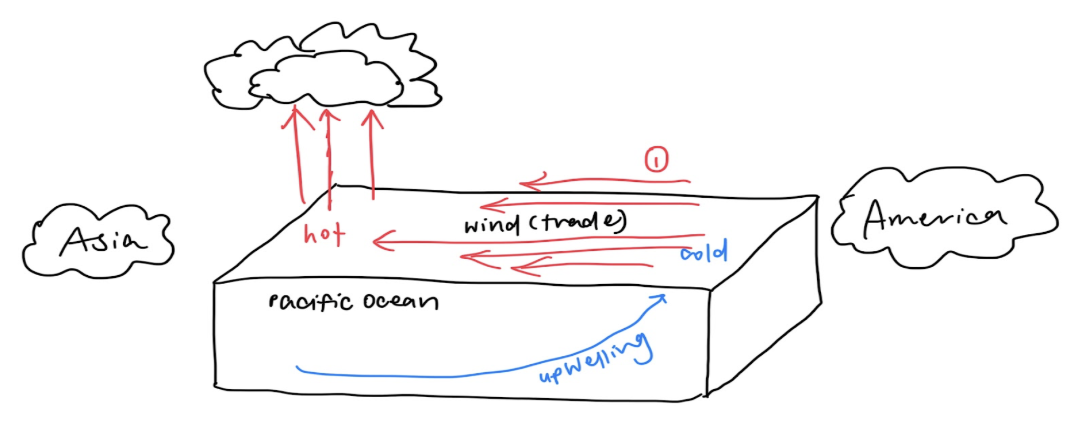
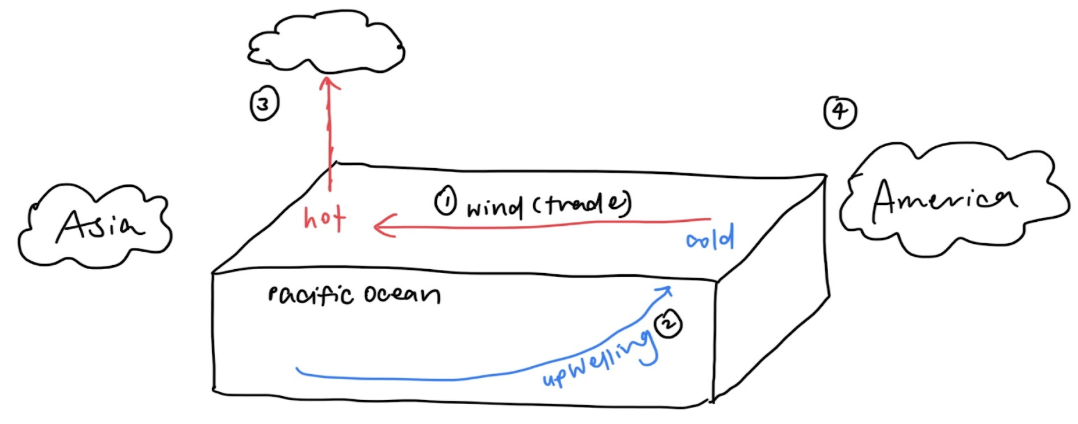
Easterly trade winds blow from the high pressure area off the western coast of South America to the low pressure area off East Asia. Generates surface ocean currents travelling in the same direction as the easterly trade winds
Upwelling
Surface waters off Peruvian coast is pushed westward, hence deeper colder water rises up from below to fill the gap
Walker Circulation (atmospheric)
Rising air in western Pacific and sinking air in eastern Pacific connect to form a continuous loop
Weather patterns
Warmer water in western Pacific results in higher air temperatures and more convective precipitation (eg Indonesia)
Colder water in eastern Pacific leads to lower air temperatures and dry weather conditions in South America
El Niño Phase
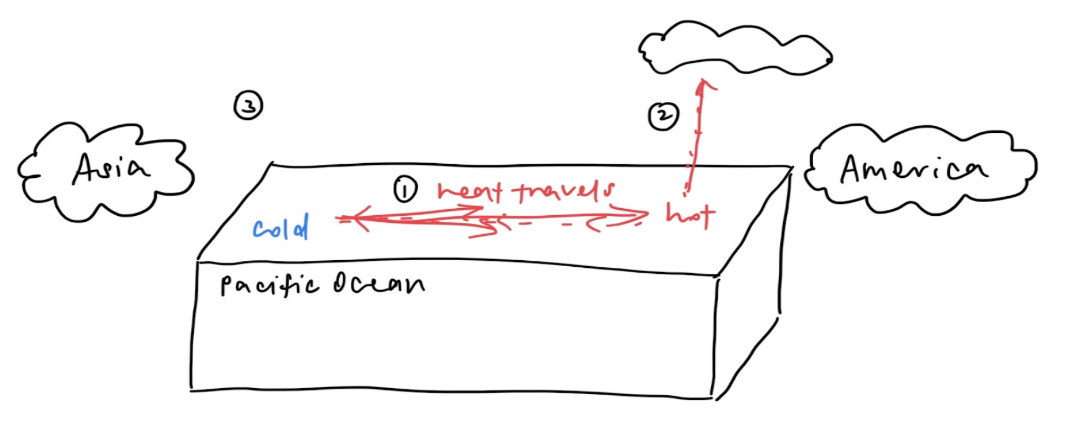
Reversal of trade winds
Every 3-7 years periodically, easterly trade winds weaken and even reverse and flow eastwards
Warm water piled up in the west sloshes back towards the east
Weather pattern in eastern Pacific
Sea surface temperatures in the east increases by 2-3ºC
Experiences warmer and wetter weather conditions
Weather pattern in western Pacific
Experiences drier than usual conditions
Upwelling is repressed
La Niña phase
Intensification of Walker’s Circulation
If waters cool to below normal temperatures, La Nina occurs
Walker Circulation intensifies with greater convection over western Pacific due to stronger trade winds, causing surface of eastern Pacific to cool
Weather patterns
Droughts in South America
Heavy rainfall and floods in eastern Australia