chapter 13 manufacturing
 Studied by 0 people
 Call Kai
 Learn
Learn Practice Test
 Spaced Repetition
 Match
Match Flashcards
 Knowt Play
1/41

There's no tags or description
Looks like no tags are added yet.
Name | Mastery | Learn | Test | Matching | Spaced |
|---|
No study sessions yet.
42 Terms
BLOCKCHAINS AND SMART CONTRACTS
Blockchain technology, which is the digital record-keeping system used for tracking cryptocurrency, is being applied by some companies to help supply chain partners solve difficult information security challenges. Blockchains are used to securely store digital transaction data
The blockchain is a visible, tamperproof history of digital transactions. In the context of supply chains, it enables the secure tracking of inventory flows, and the accompanying financial flows between a buyer and a supplier. When implemented properly,the technology can make products traceable, enable fast and cost-efficient product delivery, and simplify financing the process that links buyers, suppliers, and banks.
Many of the transactions can be automated
through smart contracts, where lines of computer code use data from the blockchain to verify when contractual obligations are met, and payments can be issued. Additional automation can take actions such as recording ledger entries in a conventional accounting system, and flagging problems that need manual attention.
Strategie sourcing
the development and management of supplier relationships to acquire goods and services in a way that aids in achieving the immediate needs of the business. In the past, the term sourcing was just another term for purchasing, a corporate function that financially was important but strategically was not the center of attention. Today, as a result of globalization and inexpensive communications technology, the basis for competition is changing. A firm is no longer constrained by the capabilities it owns; what matters is its ability to make the most of available capabilities, whether they are owned by the firm or not.
Outsourcing is so sophisticated that even core functions such as engineering, research and development, manufacturing, information technology, and marketing can be moved outside the firm.
Sourcing
activities can vary greatly and depend on the item being purchased. L) Exhibit 13.1 maps different processes for sourcing or purchasing an item./ The term sourcing implies a more complex process suitable for products that are strategically important. Purchasing processes that span from a simple "spot" or onetime purchase to a long-term strategic alliance are depicted on the diagram. The diagram positions a purchasing process according to the specificity of the item, contract duration, and intensity of transaction costs.)
Specificity
refers to how common the item is and, in a relative sense, how many substitutes might be available. For example, blank USB flash drives are commonly available from many different vendors and would have low specificity. A custom-made envelope that is padded and specially shaped to contain a specific item that is to be shipped would be an example of a high-specificity item.
Commonly available products
can be purchased using a relatively simple process. For low-volume and inexpensive items purchased during the regular routine of work, a firm may order from an online catalog. Often, these online catalogs are customized for a customer. Special user identifications can be set up to authorize a customer's employees to purchase certain groups of items, with limits on how much they can spend. Other items require a more complex process.
request for proposal (RFP)
is commonly used for purchasing items that are more complex or expensive and where there may be a number of potential vendors. A detailed information packet describing what is to be purchased is prepared and distributed to potential vendors. The vendor then responds with a detailed proposal of how the company intends to meet the terms of the RFP. A request for bid or reverse auction is similar in terms of the information packet needed. A major difference is how the bid price is negotiated. In the RFP, the bid is included in the proposal, whereas in a request for bid or reverse auction, vendors actually bid on the item in real time and often using Internet software.
Vendor managed inventory
when a customer actually allows the supplier to manage the inventory policy of an item or group of items for them. In this
Page 434
case, the supplier is given the freedom to replenish the item as they see fit. Typically, there are some constraints related to the maximum that the customer is willing to carry, required service levels, and other billing transaction processes. Selecting the proper process depends on minimizing the balance between the supplier's delivered costs of the item over a period of time, say a year, and the customer's costs of managing the inventory. This is discussed later in the chapter in the context of the "total cost of ownership" for a purchased item.
forward buying.
Retailers respond to the price cut by stocking up, in some cases buying a year's supply-a practice the industry calls. Nobody wins in the deal. Retailers have to pay to carry the year's supply, and the shipment bulge adds cost throughout the supplier's system. For example, the supplier plants must go on overtime starting in October to meet the bulge. Even the vendors that supply the manufacturing plants are affected because they must quickly react to the large surge in raw material requirements.
bullwhip effect.
The impact of these types of practices has been studied at companies such as Procter & Gamble.
Exhibit 13.2 shows typical order patterns faced by each node
in a supply chain that consists of a manufacturer, a distributor, a wholesaler, and a retailer. In this case, the demand is for disposable baby diapers. The retailer's orders to the wholesaler display greater variability than the end-consumer sales; the wholesaler's orders to the manufacturer show even more oscillations; and, finally, the manufacturer's orders to its suppliers are the most volatile. This phenomenon of variability magnification as we move from the customer to the producer in the supply chain is often referred to as the bullwhip effect. The effect indicates a lack of synchronization among supply chain members. Even a slight change in consumer sales ripples backward in the form-of magnified oscillations upstream, resembling the result of a flick of a bullwhip handle. Because the supply patterns do not match the demand pafterns, inventory accumulates at various stages, and shortages and delavs occur at others..
continuous replenishment
Campbell Soup pioneered a program called continuous replenishment that typifies what many manufacturers are doing to smooth the flow of materials through their supply chain. Here is how the program works. Campbell establishes electronic data interchange (EDI) links with retailers and offers an "everyday low price that eliminates discounts. Every morning, retailers electronically inform the company of their demand for all Campbell products and of the level of inventories in their distribution centers. Campbell uses that information to forecast future demand and to determine which products require replenishment based on upper and lower inventory limits previously established with each supplier. Trucks leave the Campbell shipping plant that afternoon and arrive at the retailers' distribution centers with the required replenishments the same day. Using this system, Campbell can cut the retailers' inventories, which under the old system averaged four weeks of supply, to about two weeks of supply.
This solves some problems for Campbell Soup, but what are the advantages for the retailer? Most retailers figure that the cost to carry the inventory of a
Page 435
given product for a year equals at least 25 percent of what they paid for the product. A two-week inventory reduction represents a cost savings equal to nearly 1 percent of sales. The average retailer's profits equal about 2 percent of sales, so this saving is enough to increase profits by 50 percent.
Functional products
include the staples that people buy in a wide range of retail outlets, such as grocery stores and gas stations. Because such products
Page 436
satisfy basic needs, which do not change much over time, they have stable, predictable demand and long life cycles. But their stability invites competition, which often leads to low profit margins. Specific criteria for identifying functional products include the following: product life cycle of more than two years, contribution margin of 5 to 20 percent, only 10 to 20 product variations, an average forecast error at time of production of only 10 percent, and a lead time for make-to-order products from six months to one year.
avoid low margins,
many companies introduce innovations in fashion or technology to give customers an additional reason to buy their products. Fashionable clothes and personal computers are good examples. Although innovation can enable a company to achieve higher profit margins, the very newness of the innovative products makes demand for them unpredictable. These innovative products typically have a life cycle of just a few months. Imitators quickly erode the competitive advantage that innovative products enjoy, and companies are forced to introduce a steady stream of newer innovations. The short life cycles and the great variety typical of these products further increase unpredictability.
stable supply process
is where the manufacturing process and the underlying technology are mature and the supply base is well established. In
Page 437
contrast,
evolving supply process
where the manufacturing process and the underlying technology are still under early development and are rapidly changing. As a result, the supply base may be limited in both size and experience. In a stable supply process, manufacturing complexity tends to be low or manageable. Stable manufacturing processes tend to be highly automated, and long-term supply contracts are prevalent. In an evolving supply process, the manufacturing process requires a lot of fine-tuning and is often subject to breakdowns and uncertain yields. The supply base may not be reliable, as the suppliers themselves are going through process innovations. L Exhibit 13.3 summarizes some of the differences between stable and evolving supply processes.
Logistics
is a term that refers to the management functions that support the complete cycle of material flow: from the purchase and internal control of production materials; to the planning and control of work-in-process; to the purchasing, shipping, and distribution of the finished product. The emphasis on lean inventory means there is less room for error in deliveries.
An activity can be evaluated using the following characteristics:
required coordination, strategic control, and intellectual property. Required
Page 440
coordination refers to how difficult it is to ensure that the activity will integrate well with the overall process. Uncertain activities that require much back-and-forth exchange of information should not be outsourced, whereas activities that are well understood and highly standardized can easily move to business partners who specialize in the activity. Strategic control refers to the degree of loss that would be incurred if the relationship with the partner were severed. There could be many types of losses that would be important to consider, including specialized facilities, knowledge of major customer relationships, and investment in research and development. A final consideration is the potential loss of intellectual property through the partnership.
Good advice is to keep control of-or
acquire-activities that are true competitive differentiators or have the potential to yield a competitive advantage, and to outsource the rest. It is important to make a distinction between "core" and "strategic" activities. Core activities are key to the business, but do not confer a competitive advantage, such as a bank's information technology operations. Strategic activities are a key source of competitive advantage. Because the competitive environment can change rapidly, companies need to monitor the situation constantly, and adjust accordingly. As an example, Coca-Cola, which decided to stay out of the bottling business in the early 1900s, partnered instead with independent bottlers and quickly built market share. The company reversed itself in the 1980s when bottling became a key competitive element in the industry.
Green Sourcing
Being environmentally responsible has become a business imperative, and many firms are looking to their supply chains to deliver "green" results. A significant area of focus relates to how a firm works with suppliers where the opportunity to save money and benefit the environment might not be a strict trade-off proposition. Financial results can often be improved through cost reductions and by boosting revenues.
Green sourcing is not just about finding new environmentally friendly technologies or increasing the use of recyclable materials. It can also help drive cost reductions in a variety of ways, including product content substitution, waste reduction, and lower usage.
Outsourcing
the act of moving some of a firm's internal activities and decision responsibility to outside providers. The terms of the agreement are established in a contract. Outsourcing goes beyond the more common purchasing and consulting contracts because not only are the activities transferred, but also resources that make the activities occur, including people, facilities, equipment, technology, and other assets. The responsibilities for making decisions over certain elements of the activities are transferred as well. Taking complete responsibility for this is a specialty of contract manufacturers such as Flex Ltd.
The reasons why a company decides to outsource can vary greatly. ° Exhibit 13.4 lists examples of reasons to outsource and the accompanying benefits.
Outsourcing allows a firm to focus on activities that represent its core competencies.
The following is an outline of a six-step process (see " Exhibit 13.6) designed to transform a traditional process to a green-sourcing process:
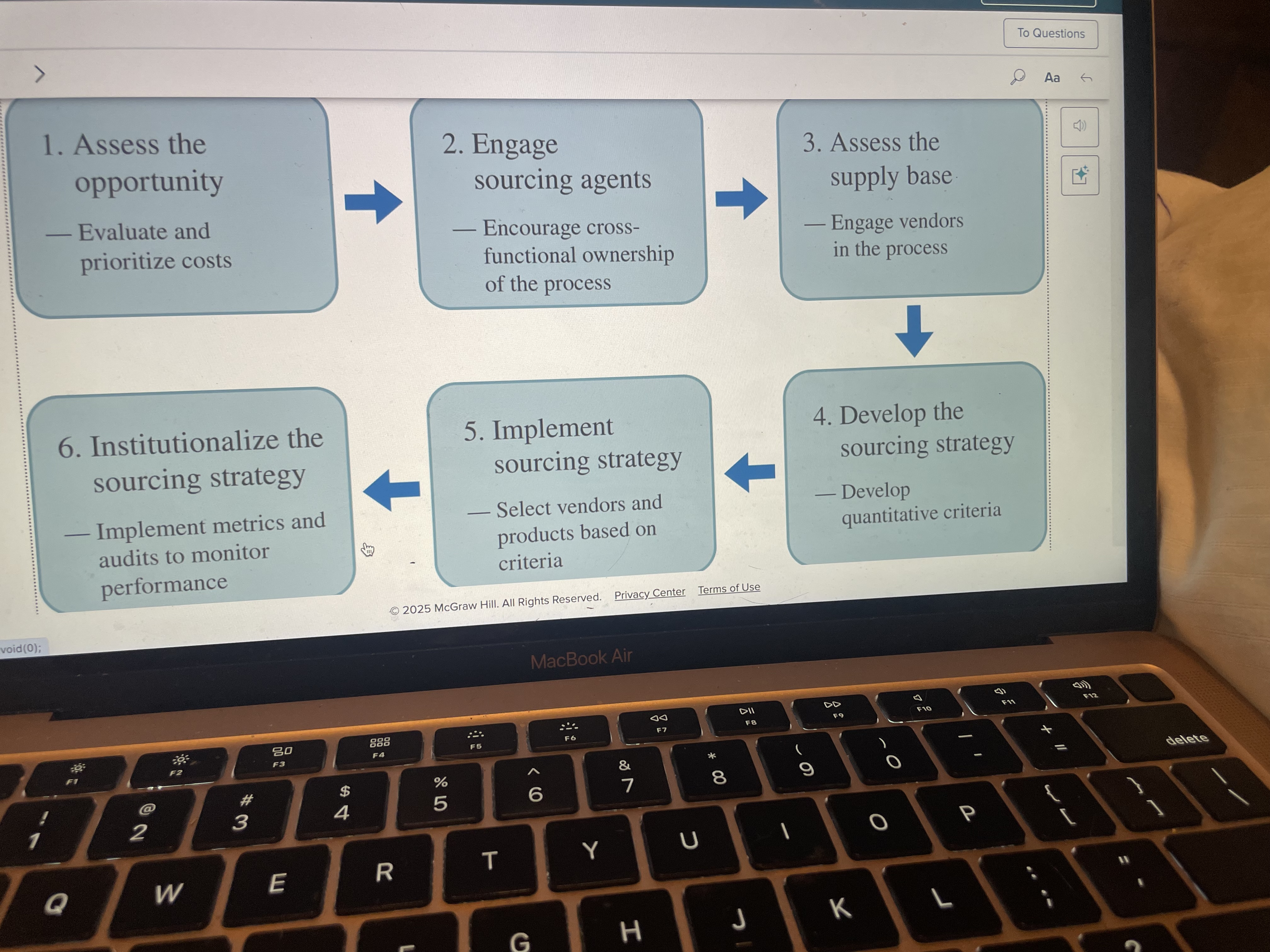
Assess the opportunity.
For a given category of expense, all relevant costs need to be taken into account. The five most common areas include electricity and other energy costs; disposal and recycling; packaging; commodity substitution (alternative materials to replace materials such as steel or plastic); and water (or other related resources). These costs are identified and incorporated into an analysis of total cost (sometimes referred to as "spend" cost analysis) at this step. From this analysis, it is possible to prioritize the different costs based on the highest potential savings and criticality to the organization. This is important in directing effort to where it will likcly have the most impact on the firm's financial position and cost-reduction goals.
Engage internal supply chain sourcing agents.
Internal sourcing agents are those within the firm that purchase items and have direct knowledge of business requirements, product specifications, and other internal perspectives inherent in the supply chain. These individuals and groups need to be "on-board" and be partners in the improvement process to help set realistic green goals. The goal of generating no waste, for example, becomes a cross-functional supply chain effort that relies heavily on finding and developing the right suppliers. These internal managers need to identify the most significant opportunities.
They can develop a robust baseline model of what should be possible for reducing current and ongoing costs. In the case of procuring new equipment, for example, the baseline model would include not just the initial price of the equipment as in traditional sourcing, but also energy, disposal, recycling, and maintenance costs.
Using the supply and demand characteristics discussed so far, four types of supply chain strategies, as shown in L Exhibit 13.3, are possible. Information technologies play an important role in shaping such strategies.
Efficient supply chains. These are supply chains that utilize strategies aimed at creating the highest levels of cost efficiency. For such efficiencies to be achieved, non-value-added activities should be eliminated, scale economies should be pursued, optimization techniques should be deployed to get the best capacity utilization in production and distribution, and information linkages should be established to ensure the most efficient, accurate, and cost-effective transmission of information across the supply chain.
Risk-hedging supply chains. These are supply chains that utilize strategies aimed at pooling and sharing resources in a supply chain so that the risks in supply disruption can be shared. A single entity in a supply chain can be vulnerable to supply disruptions, but if there is more than one supply source or if alternative supply resources are available, then the risk of disruption is reduced. A company may, for example, increase the safety stock of its key component to hedge against the risk of supply disruption, and by sharing the safety stock with other locations that also need this key component, the cost of maintaining this safety stock can be shared. This type of strategy is common in retailing, where different retail stores or dealerships share inventory. Information technology is important for the success of these strategies since real-time information on inventory and demand allows the most cost-effective management and transshipment of goods between partners sharing the inventory.
Responsive supply chains. These are supply chains that utilize strategies aimed at being responsive and flexible to the changing and diverse needs of the customers. To be responsive, companies use build-to-order and mass customization processes as a means to meet the specific requirements of customers.
Agile supply chains. These are supply chains that utilize strategies aimed at being responsive and flexible to customer needs, while the risks of supply shortages or disruptions are hedged by pooling inventory and other capacity resources. These supply chains essentially have strategies in place that combine the strengths of "hedged" and "responsive" supply chains. They are agile because they have the ability to be responsive to the changing, diverse, and unpredictable demands of customers on the front end, while minimizing the back-end risks of supply disruptions.
Efficient supply chains.
These are supply chains that utilize strategies aimed at creating the highest levels of cost efficiency. For such efficiencies to be achieved, non-value-added activities should be eliminated, scale economies should be pursued, optimization techniques should be deployed to get the best capacity utilization in production and distribution, and information linkages should be established to ensure the most efficient, accurate, and cost-effective transmission of information across the supply chain.
Risk-hedging supply chains.
These are supply chains that utilize strategies aimed at pooling and sharing resources in a supply chain so that the risks in supply disruption can be shared. A single entity in a supply chain can be vulnerable to supply disruptions, but if there is more than one supply source or if alternative supply resources are available, then the risk of disruption is reduced. A company may, for example, increase the safety stock of its key component to hedge against the risk of supply disruption, and by sharing the safety stock with other locations that also need this key component, the cost of maintaining this safety stock can be shared. This type of strategy is common in retailing, where different retail stores or dealerships share inventory. Information technology is important for the success of these strategies since real-time information on inventory and demand allows the most cost-effective management and transshipment of goods between partners sharing the inventory.
Responsive supply chains.
These are supply chains that utilize strategies aimed at being responsive and flexible to the changing and diverse needs of the customers. To be responsive, companies use build-to-order and mass customization processes as a means to meet the specific requirements of customers.
Agile supply chains.
These are supply chains that utilize strategies aimed at being responsive and flexible to customer needs, while the risks of supply shortages or disruptions are hedged by pooling inventory and other capacity resources. These supply chains essentially have strategies in place that combine the strengths of "hedged" and "responsive" supply chains. They are agile because they have the ability to be responsive to the changing, diverse, and unpredictable demands of customers on the front end, while minimizing the back-end risks of supply disruptions.
The total cost of ownership (TCO)
an estimate of the cost of an item that includes all the costs related to the procurement and use of an item, including any related costs in disposing of the item after it is no longer useful. The concept can be applied to a company's internal costs or it can be viewed more broadly to consider costs throughout the supply chain. To fully appreciate the cost of purchasing an item from a particular vendor, an approach that captures the costs of the activities associated with purchasing and actually using the item should be considered. Depending on the complexity of the purchasing process, activities such as pre-bid conferences, visits by potential suppliers, and even visits to potential suppliers can significantly impact the total cost of the item.
A TCO analysis is highly dependent on the actual situation; in general, though, the costs outlined in ° Exhibit 13.7 should be considered. The costs can be categorized into three broad areas: acquisition costs, ownership costs, and post-ownership costs. Acquisition costs are the initial costs associated with the purchase of materials, products, and services. They are not long-term costs of ownership but represent an immediate cash outflow. Acquisition costs include the prepurchase costs associated with preparing documents to distribute to potential suppliers, identifying suppliers and evaluating suppliers, and other costs associated with actually procuring the item. The actual purchase prices, including taxes, tariffs, and transportation costs, are also included.
Ownership costs are incurred
after the initial purchase and are associated with the ongoing use of the product or material. Examples of costs that are quantifiable include energy usage, scheduled maintenance, repair, and financing (leasing situation). There can also be qualitative costs, such as aesthetic factors (eg, the item is pleasing to the eye), and ergonomic factors (e.g., productivity improvement or reducing fatigue). These ownership costs can often exceed the initial purchase price and have an impact on cash flow, profitability, and even employee morale and productivity.
Major costs associated with post-ownership
include salvage value and disposal costs. For many purchases, there are established markets that provide data to help estimate reasonable future values, such as the Kelley Blue Book for used automobiles. Other areas that can be included are the long-term environmental impact (particularly when the firm has sustainability goals), warranty and product liabilities, and the negative marketing impact of low customer satisfaction with the item.
cost of goods Sold
the annual cost for a company to produce the goods or services provided to customers; it is sometimes referred to as the cost of revenue.
This does not include the selling and administrative expenses of the company.
average aggregate inventory value
is the average total value of all items held in inventory for the firm valued at cost. It includes the raw material, work-in-process, finished goods, and distribution inventory considered owned by the company.
weeks of supply
In many situations, particularly when distribution inventory is dominant, weeks of supply is the preferred measure. This is a measure of how many weeks' worth of inventory is in the system at a particular point in time. The calculation is as follows:
13
Weeks of supply = Average aggregate inventory value/ Cost of goods sold X 52 weeks
Assess the supply base.
A sustainable sourcing process requires engaging new and existing vendors. As in traditional sourcing, the firm needs to understand vendor capabilities, constraints, and product offerings. The green process needs to be augmented with formal requirements that relate to green opportunities, including possible commodity substitutions and new manufacturing processes. These requirements need to be incorporated in vendor bid documents or the request for proposals (RFPs).
A good example is concrete that uses fly ash, a by-product from coal-fired power plants. Fly ash can be substituted for Portland cement in ready-mix concrete or in concrete blocks to produce a stronger and lighter product with reduced water consumption. Fly ash substitution helps a company reduce its exposure to volatile and rapidly increasing prices for cement. At the same time, the reduced weight of the block lowers transportation costs to the company's new facilities. A company is also able to establish a specification incorporating fly ash for all new construction sites to follow. Finally, the substitution also helps power plants by providing a new market for fly ash, which previously had to be discarded.
Develop the sourcing strategy.
The main goal with this step is to develop quantitative and qualitative criteria that will be used to evaluate the sourcing process.
These are needed to properly analyze associated costs and benefits. These criteria need to be clearly articulated in bid documents and RFPs when working with potential suppliers so that their proposals will address relevant goals related to sustainability.
Implement the sourcing strategy.
The evaluation criteria developed in step 4 should help in the selection of vendors and products for each business requirement. The evaluation process should consider initial cost and the total cost of ownership for the items in the bid. So, for example, energy-efficient equipment that is proposed with a higher initial cost may, over its productive life, actually result in a lower total cost due to energy savings and a related lower carbon footprint. Relevant green opportunities such as energy efficiency and waste reduction need to be modeled and then incorporated into the sourcing analysis to make it as comprehensive as possible and to facilitate an effective vendor selection process that supports the firm's needs.
Institutionalize the sourcing strategy.
Onche vendor is selected and contracts finalized, the procurement process begins. Here, the sourcing and procurement department needs to define a set of metrics against which the supplier will be measured for the contract's duration. These metrics should be hased on nerformance deliverv comnliance with nricino onidelines and similar factors It is vital that metrics that relate to the comman's sustainahilit
Develop the sourcing strategy.
The main goal with this step is to develop quantitative and qualitative criteria that will be used to evaluate the sourcing process.
These are needed to properly analyze associated costs and benefits. These criteria need to be clearly articulated in bid documents and RFPs when working with potential suppliers so that their proposals will address relevant goals related to sustainability.
Implement the sourcing strategy.
The evaluation criteria developed in step 4 should help in the selection of vendors and products for each business requirement. The evaluation process should consider initial cost and the total cost of ownership for the items in the bid. So, for example, energy-efficient equipment that is proposed with a higher initial cost may, over its productive life, actually result in a lower total cost due to energy savings and a related lower carbon footprint. Relevant green opportunities such as energy efficiency and waste reduction need to be modeled and then incorporated into the sourcing analysis to make it as comprehensive as possible and to facilitate an effective vendor selection process that supports the firm's needs.
Institutionalize the sourcing strategy.
Once the vendor is selected and contracts finalized, the procurement process begins. Here, the sourcing and procurement department needs to define a set of metrics against which the supplier will be measured for the contract's duration. These metrics should be based on performance, delivery, compliance with pricing guidelines, and similar factors. It is vital that metrics that relate to the company's sustainability goals are considered as well. Periodic audits may also need to be incorporated in the process to directly observe practices that relate to these metrics to ensure honest reporting of data.
A key aspect of green sourcing, compared to a traditional process, is the expanded view of the sourcing decision. This expanded view requires the incorporation of new criteria for evaluating alternatives. Further, it requires a wider range of internal integration such as designers, engineers, and marketers.
Finally, visualizing and capturing the green-sourcing savings often involves greater complexity and longer payback periods compared to a traditional process.