508 Lecture 2: Pharmacology of Sex Hormones
 Call Kai
 Learn
Learn Practice Test
 Spaced Repetition
 Match
Match Flashcards
 Knowt Play
1/43

There's no tags or description
Looks like no tags are added yet.
Name | Mastery | Learn | Test | Matching | Spaced | Call with Kai | Chat |
|---|
No analytics yet
Send a link to your students to track their progress
44 Terms
What drug classes are related to sex hormones?
Direct replacement hormones
Estrogens
Progestagens
Androgens
Oral contraceptives, hormone replacement therapy for women and men
Upstream regulatory agents
Gonadotropins
GnRH agonists and antagonists
Downstream modifiers
Aromatase inhibitors
Selective estrogen receptor modulators
Antiandrogens
What are the hormonal methods for contraception?
Daily combined estrogen + progesterone oral contraceptive pills
Daily progestin-only oral contraceptive pills (POPs)
Transdermal weekly patches
Long-term hormonal intrauterine devices (IUDs)
What is the mechanism of action of oral contraceptives?
Three-pronged approach:
1) suppression of ovulation
2) change turbidity of cervical mucus, and
3) altering the endometrium
Highly effective (9% failure rate)
What are indications for oral contraceptives?
Contraception/birth control
Menstrual pain
Irregular menstruation
Fibroids
Endometriosis-related pain
Menstrual-related migraines
Acne, hirsutism
The estrogen component of oral contraceptives can be…?
Estradiol, Ethinylestradiol, or Estetrol
What is the importance of the C-17 position of ethinylestradiol?
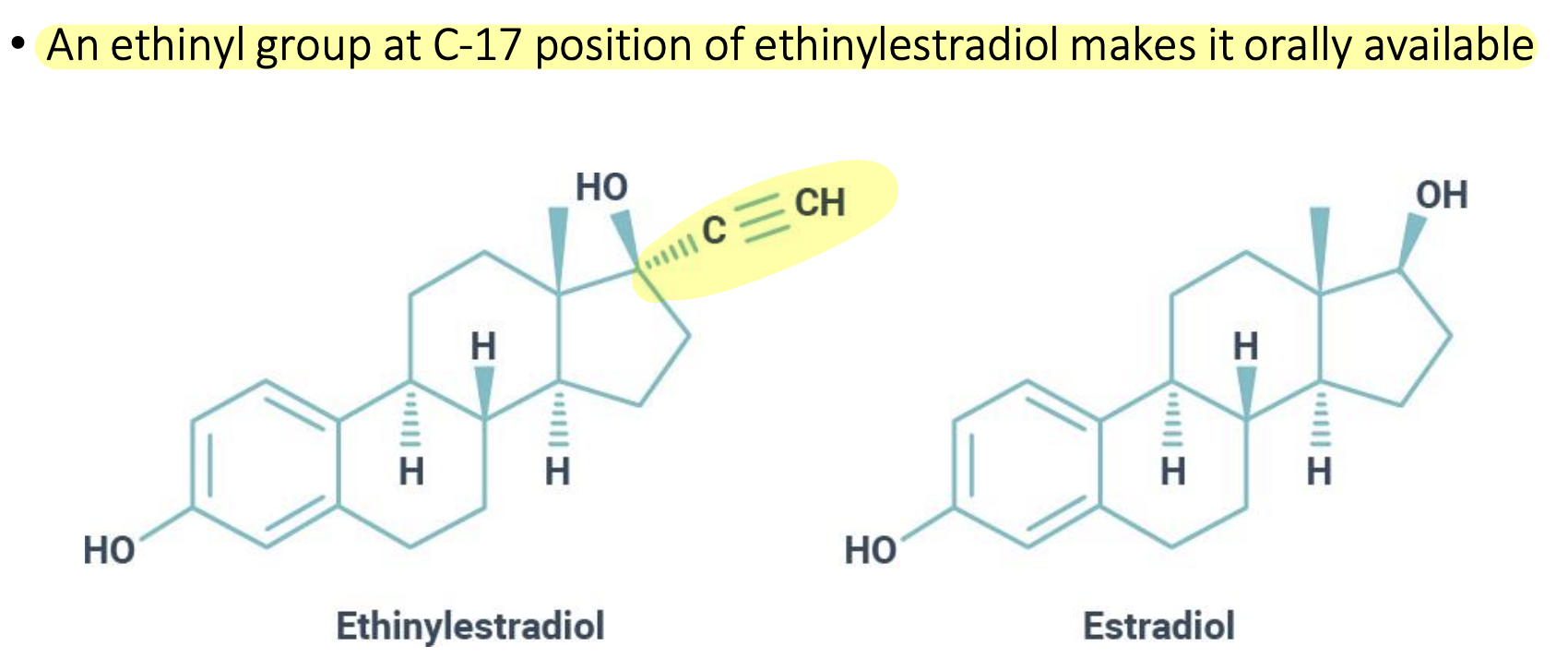
The C-17 position makes ethinylestradiol orally available
Is the progestin component of oral contraceptives natural or synthetic?
They contain synthetic forms only in order to provide stable 24hr hormone levels
Natural forms are not stable, natural progesterone breaks down too quickly
What are the 1st generation progestins?
Norethindrone
Ethinyl diacetate
Norgestrel
Norethindrone acetate
Which generation progestins have both estrogenic and androgenic activity? What is the downside of this?
1st Generation progestins has both effects
This means that it has a larger array of adverse effects

What is the mechanism of action of combination oral contraceptives?
Suppress LH and FSH
Absence of mid-cycle LH surge
Prevent ovulation
The combination acts synergistically and consistently
What is the role of estrogens in MOA of oral contraceptives?
Primary function → stabilize endometrial lining and provide menstrual cycle control
Estrogens suppress FSH release from the pituitary; hence a follicle cannot begin development
This may contribute to blocking LH surge and preventing ovulation
What is the role of progestins in MOA of oral contraceptives?
Progestins provide the main contraceptive effect
Progestins bind to PR receptors in the cells of the cervix leading to production of thick mucus, which prevents sperm penetration, slowing transport through the fallopian tube
Progestins bind to PR receptors in the uterine lining and counteract proliferative signals of E2, leading to thinning and atrophy of endometrium
Progesterone diminishes the frequency of GnRH pulses in the hypothalamus in the brain using negative feedback loop, thus blocking LH surge and preventing ovulation
In oral contraceptives, which component (estrogen or progestin) provides the main contraceptive effect?
Progestins
Progestins bind to PR receptors in which two locations?
1) Bind to PR receptors in the cervix → leads to production of thick mucus → prevents sperm penetration → slows transport through fallopian tube
2) Bind to PR receptors in the uterine lining and counteracts proliferative signals of E2 → leads to thinning and atrophy of endometrium
What is the most common type of birth control pill?
Combined monophasic
One concentration of estrogenic component
One concentration of progestin component
Ex: Yasmin (Berlex) - 30mcg ethinylestradiol + 3mg drospirenone
What are absolute/relative contraindications to oral contraceptives?
ABSOLUTE CONTRAINDICATIONS
✓ Heart attack, stroke, history of coronary artery disease or history of blood clots
✓ Tumors of the liver or impaired liver function
✓ Known or suspected cancer of the breast or reproductive system
✓ Known or suspected pregnancy
✓ Migraines
✓ Smokers
✓ Unmanaged hypertension
Relative
Diabetes or strong family history of diabetes
Gallbladder disease including having your gallbladder removed
Acute mononucleosis
Sickle cell disease
Undiagnosed abnormal vaginal bleeding
True or False: It is recommended that IUDs and contraceptive implant be offered as first-line methods of contraception to all women, inlcuding adolescents
True
What are the two different types of long-acting reversible contraception (LARCs)?
Hormonal and non-hormonal intrauterine devices (IUDs) and subdermal implants
What are examples of nonhormonal and hormonal LARC?
Nonhormonal
IUD Paragard– spermicidal non-hormonal copper-containing device; 10 years of use; may increase bleeding
Hormonal
IUDs and subdermal - prevent pregnancy by thickening cervical mucus, thinning the uterine wall, and partially stopping ovulation
IUDs Milena and Liletta– contain 52 mg of progestin levonorgestrel; 5 years of use; inhibits ovulation, thickens cervical mucus;
reduces heavy bleeding
IUD Kyleena– contains 19.5 mg of levonorgestrel; 5 years of use
IUD Skyla– contains 13.5 mg of levonorgestrel; 3 years of use
Subdermal implant Nexplanon - slowly releases the progestin etonogestrel, it contains barium to facilitate the radiologic detection of implants that cannot be palpated; 3 years of use; inhibits ovulation, thickens cervical mucus
What is perimenopause and symptoms of menopausal transition?
Perimenopause: a period preceding to menopause (2-8 years)
Sharp decline in ovarian mass and fertility after age 35 and on
Irregular hormone secretion
Menopausal transition can cause hot flashes, night sweats, irregular bleeding, and vaginal dryness, sleep disturbances, mood swings, depression, impaired memory, incontinence, sexual dysfunction
What is hormone replacement therapy (HRT) for women?
Taking medications containing female hormones to replace the ones the body no longer makes after menopause
Estrogen based HRT is primarily used for?
Used for tx of vasomotor and urogenital symptoms of menopause + prevention of osteoporosis
When should progestin be added to HRT?
Progestin should be added for protection of uterine endometrium, as it reduces risk of endometrial hyperplasia and carcinoma
*Those who have undergone hysterectomy take only estrogen
What are benefits of HRT?
Symptom relief: reduces hot flashes/night sweats, improves vaginal health, stabilizes mood, improves sleep quality
Bone health
Potentially has cardiovascular benefits
Potentially improves bladder function, prevents memory loss, helps maintaining muscle mass
What are risks of HRT?
Endometrial (uterine) cancer
Venous thromboembolism
Breast cancer *
Gallbladder disease
What is testosterone replacement therapy (TRT) for men used for?
Hypogonadism - gradual decrease of free testosterone with age
Results in sexual dysfunction, obesity, fatigue, loss of muscle mass, loss of body hair, depression
What is primary vs secondary hypogonadism?
Primary hypogonadism: the testicular steroidogenesis is insufficient to synthesize adequate levels of testosterone
Secondary hypogonadism: signaling to the testis is unable to stimulate sufficient testosterone production by Leydig cells
What are goal testosterone levels in elderly men vs young men?
Elderly: 500-800 ng/mL
Young men: 600-900 ng/mL
What are dosage forms of TRT?
oral, buccal, and transdermal gels, patches, solutions, subcutaneous pellets, pills, intramuscular injections, intranasal gels
What are contraindications of TRT?
History of breast cancer, prostate cancer
Uncontrolled heart failure
Untreated obstructive sleep apnea,
A pre-treatment hematocrit over 48%
Palpable undiagnosed prostate nodules
An elevated prostate specific antigen (PSA)
Having a first-degree relative with prostate cancer
What are our upstream regulatory agents?
Gondaotropins and GnRH agonist/antagonists
What are gonadotropins used for? What types are there?
Treatment of infertility
Ovulation induction in IVF
Testosterone production and sperm development
Human menopausal gonadotropin (hMG)
From urine of postmenopausal women
A mixture of FSH and LH
Human chorionic gonadotropin (hCG)
From urine of pregnant women
Mostly LH, little FSH (good for stimulation of T in Leydig cells)
FSH products
Follitropins, synthetic recombinant FSH
What is the main use of GnRH agonists?
Metastatic prostate cancer
What are GnRH (LHRH) agonists mechanism of action?
First phase: activation
Initially GnRH agonists promote LH and FSH →
Second phase: After longer exposure to the drugs (10 days) the receptors undergo desensitization and internalization
This leads to decrease in FSH and LH, which is the therapeutic goal of this treatment
What is Goserelin (Zoladex)?
Injectable gonadotropin releasing hormone agonist
Used to suppress production of the sex hormones (testosterone and estrogen) in the treatment of breast and prostate cancer as well as endometriosis
Side effects: tumor flare effect, bone pain, hot flushes, headache, stomach upset, depression, difficulty urinating, weight gain, swelling and tenderness of breasts, decreased erections and reduced sexual desire
What are the main uses of GnRH antagonists?
IVF (in vitro fertilization) procedure
Used against advanced prostate cancer
Fibroids/endometriosis
What is the MOA of GnRH antagonists?
Competitively and reversibly bind to GnRH receptor
Block LH and FSH release from the pituitary
Robustly suppress T in men
Suppress E2 and P4 in women
GnRH antagonists block release of what from where?
Block LH and FSH release from the pituitary
What are our downstream modifiers?
Aromatase inhibitors
Selective estrogen receptor modulators
Antiandrogens
What is the role of aromatase?
Aromatase is an enzyme that converts androgens (testosterone) to estrogens

Therefore, aromatase inhibitors block the conversion of testosterone to estrogen
Are aromatase inhibitors reversible or irreversible?
Both!
Irreversible → Form permanent bond with the enzyme (example: Exemestane (Aromasin)
Reversible → Inhibit estrogen synthesis by completion with aromatase
What are SERMs? What are the used for?
Selective estrogen receptor modulators
SERMs as treatment
SERMs as treatment → Generally, used to prevent and/or treat estrogen-related diseases/disorders
Breast cancer (tamoxifen)
Gynecomastia (tamoxifen)
Postmenopausal osteoporosis (raloxifene
What do antiandrogens do?
Antiandrogens inhibit circulating androgens (testosterone) by:
1) blocking androgen receptors and
2) suppressing androgen (testosterone) synthesis, or acting in both those ways
What are antiandrogens commonly used for?
Hirsutism and prostate cancer