PSY 347 exam 1
 Call Kai
 Learn
Learn Practice Test
 Spaced Repetition
 Match
Match Flashcards
 Knowt Play
1/109

There's no tags or description
Looks like no tags are added yet.
Name | Mastery | Learn | Test | Matching | Spaced | Call with Kai | Chat |
|---|
No analytics yet
Send a link to your students to track their progress
110 Terms
Defintions of learning
process by which behavioral changes arise from organism’s experience interacting with the world
process whereby organism comes to anticipate a future event based on info/stimuli that it received from environment
to gain knowledge/comprehension/mastery through experience/study
Processes involved in learning
perception
memory
categorization
Conditioning
procedures that can modify behavior (aka process of learning)
Classical conditioning
certain inborn involuntary behaviors come sot be produced in new situations
underlies many emotional responses & contributes to development of dislikes
Operant/instrumental conditioning
strengthning/weakening of behavior as result of consequences
Aristotle (nature vs nurture)
argued knowledge not inborn but acquired through experience
early example of empiricist
Empiricism
assumes that a person’s characteristics are mostly learned
Aristotle’s laws of association
law of similarity
law of contrast
law of contiguity
law of frequency
Law of similarity
similar events are readily associated
Law of contrast
opposite events are readily associated
Law of contiguity
events in close proximity in time/space are readily associated
Law of frequency
the more frequently 2 items occur together, the stronger the association
Descartes (nature vs nurture)
disputed notion that human behavior was governed entirely by free will
dualistic model of human nature: body behaviors are involuntary, mind behaviors are voluntary
only humans posses self-directing mind
suggested reflexive behaviors were mechanistic & could be studied
British Empiricists/Associationists
almost all knowledge is function of experience
conscious mind composed of finite set of basic elements
gathered from experience, combined through prinicples of association into complex sensations & thought patterns
Factors for formation of associations
intensity
similarity
recency
frequency
Structuralism
determine structure of mind by identifying basic elements of which it is composed
method of introspection: subject attempts to describe conscious thoughts, emotions, & sensory experiences
Functionalism
mind evolved to help us adapt to world around us
partially derived from Darwin
what we learn from animals may be relevant for humans
strong proponent of associationism
Stimulus
sensory event that provides info about outside world
any event that can potentially influence behavior
Learning curve
graph showing learning performance (DV) as function of training time (IV)
Response
behavioral consequence of perception of stimulus
a particular instance of a behavior
Extinction
process of reducing a learned response to stimulus by ceasing to pair that stimulus with reward/punishment
Law of effect
probability of particular behavioral response inceased/decreased depending on consequences that followed
Behaviorism
natural science approach to psychology that emphasizes study of environmental influences on observable behavior
learning involves simple associations between stimuli/between responses & stimuli
complex behavior can be understood as combo of simple elements
learning is largely determined by external, environmental influences
principles of learning transcend species & situational boundaries
Behaviorism
natural science approach to psychology that emphasizes study of environmental influences on observable behavior
learning involves simple associations between stimuli/between responses & stimuli
complex behavior can be understood as combo of simple elements
learning is largely determined by external, environmental influences
principles of learning transcend species & situational boundaries
Morgan’s Canon
whenever possible, interpret an animal’s behavior in terms of lower, more primitive processes rather than higher, more mentalistic processes
Watson’s methodological behaviorism
only study behaviors that can be directly observed
all behavior is reflexive
learning involves development of simple connection between stimulus & response
complex behavior is long set os stimulus-response chains
Neobehaviorism
brand of behaviorism that utilizes intervening variables (hypothesized physiological processes) to help explain behavior
still rejected mentalism & subjective experiences
assumes that learning consists of establishment of connections between specific stimuli & specific responses
Tolman’s cognitive behaviorism
felt that behavior should be analysed on a broader level
similar to Gestalt approach to perception
intervening variables more mentalistic
cognitive processes explain behavior
Cognitive map
mental representation of spatial surroundings
Latent learning
learning occurs despite absence of any observable demonstration of learning & only becomes apparent under a differing set of conditions
Bandura’s social learning theory
cognitive-behavioral approach strongly emphasizing importance of observational learning & cognitive varaibles in explaining human behavior
internal events/expectations have primary role in learning process
doesn’t dismiss value of introspectively observed subjective experience in explaining behavior
Skinner’s radical behaviorism
emphasized influence of environment on overt behavior
rejects use of internal events to explain behavior
views thoughts & feelings as behaviors that need to be explained
once we understand how it affects us, can change environment so it exerts more beneficial influence on our behavior
Reciprocal determinism
internal events don’t just mediate between environment & behavior
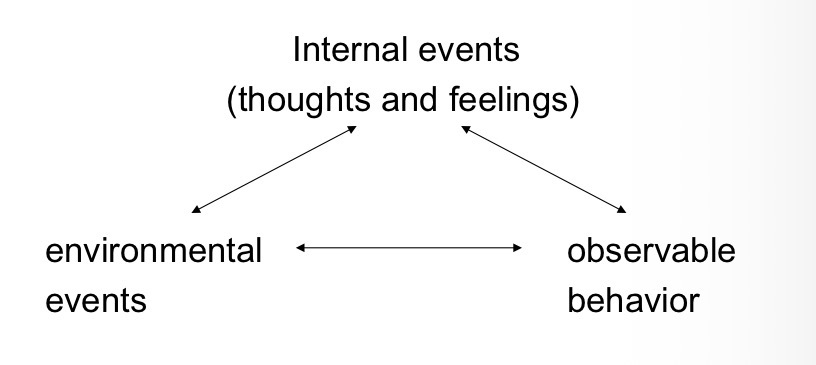
Countercontrol
deliberate manipulation of environmental events to alter their impact on behavior
Skinner on internal events
didn’t want to consider them as explanations for behavior
no direct access, must rely on verbal reports
also difficult to determine relationship of thoughts & feelings to behavior
Skinner on genetics
didn’t want to place too much emphasis on genetics
genetic factors are unmodifiable
would assume that behaviors with genetic bases would be unmodifiable
Natural selection
members of species that inherit certain adaptive characteristics are more likely to survive & propagate & pass characteristics to offspring
Criteria for evolution
species evolve when possess a trait that meets 3 conditions
inheritable
variable
relevant to survival
Formal Models & Universal Laws
philosophers & psychologists have borrowed methods & metaphors from other scientific fiedls to enhance their understanding
Variables
characteristics of person/place/thing that can change over time/vary from situation to another
IV
aspects of experiments that systematically vary across conditions
DV
aspects of experiment that are allowed to vary freely to see if they’re affected by changes in IV
Functional relationships
between changes in IV & changes in DV
Overt behaviors
publicly observed
Covert behaviors
behaviors that can be perceived only by person performing the behavior
private behaviors/events
dreaming, thinking, visualising, feeling
can usually be made overt
Appetitive stimuli
events that organisms seek out
Aversive stimuli
events that organisms avoid
Establishing operation
procedure affecting appetitiveness/aversiveness of stimulus
Deprivation
establishing operation that increases appetitiveness of event
prolonged absence of event
Satiation
establishing operation that decreases appetitveness of event
prolonged exposure to event
Contiguity
closeness/nearness
in time or space
both important for learning
Contingency
predictive relationship between 2 events
occurence of one predicts the porbable occurence of the other
Measuring behavior
behavior being observed must be
defined/unambiguous
consistent across time & settings
objective/observable
Rate of response
frequency with which response occurs in certain period of time
when responses are brief & have well-defined onset & offset
very sensitive measure of behavior
Cumulative recorder
measures total responses over time
graphic depiction of rate of behavior
steeper line = higher rate of response
Intensity of behavior
force/magnitude of behavior
Duration of behavior
length of time that animal repeatedly/continuously performs a behavior
Speed of behavior
amount of time required to perform a complete episode of behavior from start to finish
Latency
length of time to begin a behavior
Interval recording
measuring whether behavior occurs within series of continuous intervals
good for behaviors with ambiguous starts/stops
Time sample recording
measure whether behavior occurs within series of discontinuous intervals
e.g. record 1st 10 min of every hour & analyzing behaviors within those intervals
time efficient
Topography
exact physical form of behavior
Number of errors
for any behavior that can be classified as right or wrong
Descriptive research
describe behavior & situation where it occurred, no manipulation of variables
naturalistic observation
case studies
Naturalistic observation
systematic observation & recording of behavior in its natural environment
definition of variables unambiguously & objectively
consistent & uniform observations
commonly used in ethology
natural environment is important as behavior may not occur when removed
Ehtology
branch of zoology focusing on study of inherited behavior patterns in animals
Ethogram
catalogue of bhevaiors observed in animal
Pros of naturalistic observation
excellent approach to gain detailed info about behavior + circumstances in which it typically occurs
Cons of naturalistic observation
cannot determine which variables are important for behavior
often insufficient for gaining full understanding of behavior
Case Studies
extensive examination of one or a few individuals
in natural settings/more structured settings
common in medical research
examining lives of gifted individuals
Limitations of case studies
must be based on systematic observation
must reduce observer bias
often can’t generalise to other people, places & times
difficult to determine which variables are responsible for which behavior
Experimental research
discovering cause & effect relationships between environmental events & behaviors
1 or more IVs are varied to see how they influence DV
differences in behavior are presumed to be caused by changes in IV
Pros of experimental research
causal statements can be made about effects of IVs on DVs
control over environment enables isolation of IVs while controlling other influences
easy replication
Cons of experimental research
artificial environments lead to limited applicability
World vs Lab
events that influence behavior don’t occur in isolation
to understand a situation, strip away unessential details & analyze it
lab allows study of non-human organisms in controlled environments
start with simple events to develop technqiues for studying complex ones
Control genetic makeup & learning history (why animal research)
help eliminate/assess effects of inherited differences on learning & behavior
animals bred for research have had identical experiences during upbringing
impossible to control for learning histories in humans (except twins)
Strictly control experimental environment (why animal research)
important when manipulating environment to determine its effects on learning & behavior
humans discuss experiments with friends
animals more consistent from day to day
animals more insulated from outside influences so behavior is more likely to reflect the true influence of IV
Might be unethical for humans (why animal research)
life-saving research conducted on animals
experimental manipulations that can be aversive/harmful can be used
experiments too long
Criticisms
findings have limited applications & relevance to humans
some find it morally wrong
General Process Theory of Learning
facts about learning & behavior will generalize across many (if not all) groups of species
depends somewhat on species involved & characteristics studied
Neuroscience
study of brain & rest of nervous system
believe brain is seat of learning & memory
Nervous system
organ system devoted to distribution & processing of signals that affect biological functions throughout body
Central nervous system
brain & spinal cord
Peripheral nervous system
transmits signals from sensory receptors to CNS & carries commands from CNS to muscles
Neuron
special type of cell, one of main components of nervous system
most neuroscientists focus efforts on understanding neurons
how they control behavior
how they change during learning (plasticity)
Cerebral cortex
brain tissue covering top & sides of brain in most vertebrates
involved in storage & processing of sensory inputs & motor outputs
Frontal lobe
part of cerebral cortex at front of human brain
enables person to plan & perform actions
Parietal lobe
part of cerebral cortex at top
important for processing somatosensory (touch) inputs
Temporal lobe
part of cerebral cortex at sides
language & auditory processing
learning new facts
forming new memories of events
Occipital lobe
part of cerebral cortex at rear
important for visual processing
Cerebellum
brain region lying below cerebral cortex in back of heaf
regulation & coordination of complex voluntary muscular movement
Brainstem
group of structures that
connects rest of brain to spinal cord
plays key roles in regulating automatic functions e.g. breathing & body temperature
Brain regions contributing to memory
basal ganglia
thalamus
hippocampus
amygdala
Phrenology
skull measurements to predict individual’s personality & abilities
developed by Franz Jospeh Gall
Structural neuroimaging
modern techniques for creating pictures of anatomical structures within brain
Magnetic resonance imaging (MRI)
method of structural neuroimaging based on recording changes in magnetic fields
Diffusion tensor imaging (DTI)
type of MRI measuring connections between brain regions
Components of neurons
dendrites
cell body/soma
axons
Dendrites
input areas that receive signals from other neurons
Cell body/soma
integrates signals from dedrites