2.6 chem
 Call Kai
 Learn
Learn Practice Test
 Spaced Repetition
 Match
Match Flashcards
 Knowt Play
1/30

There's no tags or description
Looks like no tags are added yet.
Name | Mastery | Learn | Test | Matching | Spaced | Call with Kai | Chat |
|---|
No analytics yet
Send a link to your students to track their progress
31 Terms
catalyst diagram

analysing reactions
The line is steep, indicating a fast rate of reaction. This is because at the start of a reaction, the concentration of reactant particles (example + example) are relatively high, resulting in an increased rate of effective collisions.
As the reaction continues, the amount of reactants decrease because some products are forming, so the concentration of reactant particles decreases. This results in a decreased rate of effective collisions, slowing down the rate of reaction and the line becomes less steep.
Eventually, the concentration of reactants would fall to zero as all reactants would be converted into the product. The line is flat, indicating the reaction is complete and the rate of reaction stops.
mass decreasing stuff maybe??
state that the gas has been released
the logic is that concentration decreases, mass decreases
Temperature affecting the rate of reaction
As the temperature increases, the kinetic energy of reactant particles also increases. This means that reactant particles move with greater speed, resulting in more frequent collisions between reactant particles, increasing the rate of successful collisions with sufficient energy to overcome the activation energy per unit time. Therefore, the rate of reaction will increase.
Concentration affecting rate of reaction
As the concentration of reactants increase, there will be a greater number of reactant particles per unit volume. This means that there are more frequent collisions between reactant particles, which increases the rate of successful collisions with sufficient energy to overcome the activation energy per unit time. Therefore, there will be a higher rate of reaction.
Surface area affecting the rate of reaction
An increase in surface area of the reactant will increase the rate of reaction. This is because more reactant particles are exposed and available to collide with particles in the other reactant per unit volume. This means that there are more frequent collisions between reactant particles, which increases the rate of successful collisions with sufficient energy to overcome the activation energy per unit time. Therefore, there will be a higher rate of reaction.
catalyst affecting rate of reaction
Catalysts speed up the rate of reaction by lowering the activation energy required by reactant particles for a chemical reaction to take place. This means that there will be more frequent collisions between reactant particles, which increases the number of successful collisions with sufficient energy to overcome the activation energy per unit time. Therefore, there will be a higher rate of reaction.
Pressure (gases)
More particles in the same volume = higher pressure = more collisions
When comparing the rate of reaction of two different compounds
you must state what happens to the other type (even if you’ve mentioned it partially while explaining the first type)
If asked about the total mass loss and they have the same concentration of reactants used:
Both reactions will eventually produce the same reduction in mass as the same mass of CO2 is formed, because the same amounts of each reactant are used.
Kc value
Kc > 1 = products are favoured at equilibrium (forwards direction)
Kc < 1 = reactants are favoured at equilibrium (reverse direction)
Kc = 1 neither is favoured
given Kc value, but have to calculate and explain why not at equilibrium
[calculations]
The Kc value is not at equilibrium as the value is higher/lower than it should be at equilibrium
As Kc is the ratio of products / reactants, to decrease/increase the Kc value, the concentration of reactants/products need to increase. To increase/decrease reactants/products, the reverse/forwards reaction would need to be favoured until the concentration of reactant/product falls/increases, and the system achieves equilibrium.
Concentration affecting equilibrium
As the concentration of reactants increases, the system will try to minimise this change and shift in the forwards direction. This means that at equilibrium, there will be products than reactants. This means that there will be a higher ratio of products / reactants, resulting in an increased Kc value.
Temperature rules for system
Increase in temp = endo. decrease in temp = exo
Increase in kc = products favoured, decrease in kc = reactants favoured
Forward reaction rules:
kc increase + temp increase = forwards reaction is endo
Kc increase + temp decrease = forwards reaction is exo
Reverse reaction rules:
kc decrease + temp decrease = reverse reaction is exo
kc decrease + temp increase = reverse reaction is endo
Positive △H = endo. Negative -△H = exo
Temperature affecting system (and you know Kc value increases)
When the temperature increases, the system will shift in the endothermic direction to minimise this change. Since the Kc value increases, the forward reaction is favoured, therefore there will be more products than reactants at equilibrium. As the kc value increases while the temp increases, the forward reaction is endothermic.
Temperature affecting system (and you know bond enthalpy)
Because the bond enthalpy for this reaction is __ mol-1, the forward reaction is exothermic/endothermic and the reverse reaction is endothermic/endothermic. When the temperature increases/decreases, the system will shift in the endothermic/exothermic direction to absorb the added heat/release heat. This means that there will be more reactants than products (vice versa) at equilibrium. Because the ratio of products : reactants decreases/increases, the value of Kc decreases/increases as the temperature increases/decreases.
Catalyst affecting equilibrium
Adding a catalyst does not shift the reaction. Since there is no overall change to the relative amount of product or reactant present, there is no change in the equilibrium position and no change in Kc value. Catalysts speed up the rate of forward and reverse reactions equally.
Pressure affecting the rate of reaction
There are __ moles on the reactant side of the equation, and __ moles on the product side of the equation, therefore the __ side of the equation has more pressure. When the pressure is increased, the system will shift in the forwards/reverse direction to minimise this change. This means that at equilibrium, there are more products/reactants than products/reactants. This results in a higher/lower ratio of products/reactants, leading to an increased/decreased Kc value. The colour associated with the product/reactant will be more intense and the colour associated with the reactant/product will fade.
If same moles:
say everything up to when the pressure part
Since there is no difference in moles of gas particles on either side of the equation, increasing/decreasing the pressure would not affect equilibrium system and will remain unchanged.
Removing something as it forms
Removing the __ as it forms will result in the system responding to minimise the effect of this change. This means that it will favour the forwards/reverse direction, resulting in an increase in the amount of __ produced.
Strong acids
completely dissociates in water
Examples: HCl, HNO3, H2SO4, HBr, HI
Forward sign, h2o reactant
Conductivity of strong acids
Conductivity depends on the concentration of free-moving charged particles present in a solution. Strong acids completely dissociate, therefore there will be a higher concentration of free-moving charged particles, meaning strong acids are good conductors.
Weak acids
partially dissociates in water
Examples: HCN, HF, CH3COOH (basically all COOH), NH4+, H2SO3, H3PO4, HNO2
reversible sign
Weak acid conductivity
say conductivity part
Weak acids partially dissociate, therefore there will be a lower concentration of free-moving charged particles, meaning weak acids are poor conductors.
Strong bases
completely dissociate
Examples: NaOH, LiOH, Mg(OH)2, Sr(OH)2, Cs(OH)2, Rb(OH)2, KOH, Ba(OH)2
forward sign (h2o above)
Strong base conductivity
same as strong acid
Weak base
partially dissociate in water
Examples: NH3,CH3NH2, NH4OH
reversible sign
Weak base conductivity
same as weak acid
Conjugate base/acid pairs
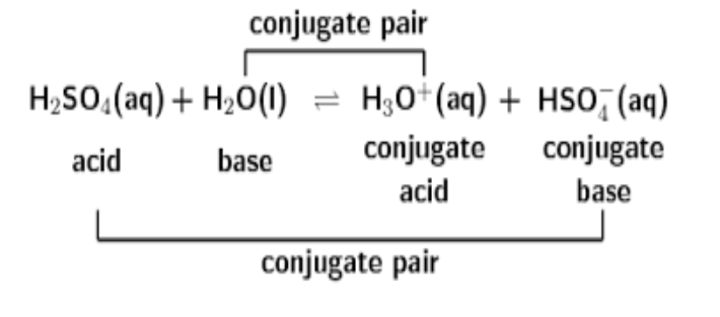
polyprotic
Example for polyprotic:
H2SO4 + H2O → HSO4- + H3O+ (reacts once, take the species to react again)
HSO4 + H2O ⇌ SO42- + H3O+ (reacts twice)
Overall: H2SO4 + 2H2O → SO4- + 2H3O+
Basically just keep going until you get rid of H
comparing strong and weak acid/base
you must state the dissociation and give equation
identifying nature of salts
dissociate salt in water (just split it up)
check active species
Spectator species = group 1 and 2 cations, group 17 anions
react active species with water
check if it releases OH or H3O+
Reasoning:
[active species] when reacted with water releases OH or H3O+, therefore [salt] is acidic/basic in nature. talk about conjugate acid base pairs with active species if you want
kc value over 1
The value of K is significantly over 1, so there are far more products than reactants, which means the equilibrium favours the products.