Water Cycle, Cloud Formation, and Precipitation Types in Meteorology Study Guide | Quizlet
 Call Kai
 Learn
Learn Practice Test
 Spaced Repetition
 Match
Match Flashcards
 Knowt Play
1/23

There's no tags or description
Looks like no tags are added yet.
Name | Mastery | Learn | Test | Matching | Spaced | Call with Kai | Chat |
|---|
No analytics yet
Send a link to your students to track their progress
24 Terms
What is heat energy?
The kinetic energy of random molecular motion, measured in calories.
What is latent heat?
Stored or hidden heat important in atmospheric processes.
What process converts liquid to gas and requires 600 calories?
Evaporation
what process converts gas to liquid and releases 600 calories?
Condensation
How many calories are needed for melting a solid into a liquid?
80 calories.
What is the process called when a solid changes directly to a gas?
Sublimation
What is transpiration?
The process by which moisture gets into the atmosphere from plants.
What is the combination of evaporation and transpiration called?
Evapotranspiration.
What is absolute humidity?
Mass of water vapor divided by the volume of air, expressed in grams per cubic meter.
What is relative humidity?
The ratio of the air's actual water vapor content compared to the amount required for saturation, expressed as a percent.
What is the dew point temperature?
The temperature to which a parcel of air must be cooled to reach saturation.
What happens during adiabatic cooling?
Air expands and cools as it rises due to decreasing air pressure.
What is the dry adiabatic rate?
Unsaturated air cools at 1°C per 100 meters as it rises.
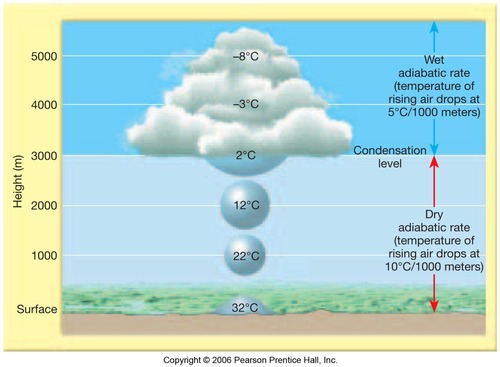
What is the wet adiabatic rate?
The rate at which saturated air cools, varying from 0.5°C to 0.9°C per 100 meters.
What are condensation nuclei?
Tiny bits of particulate matter that provide surfaces for water vapor to condense on.
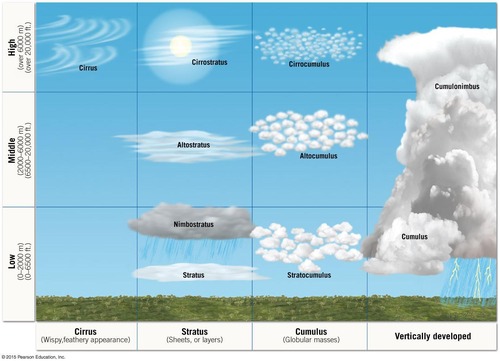
What type of cloud is characterized by high, white, thin formations?
Cirrus clouds.
What is advection fog?
Fog formed when warm, moist air moves over a cool surface.
What is the difference between rain and drizzle?
Rain droplets are at least 0.5 mm, while drizzle droplets are less than 0.5 mm.
What causes convectional precipitation?
Heating of air near the surface, causing it to rise and condense.
What is cyclonic precipitation?
Precipitation that occurs when air converges in a low-pressure system and is forced to rise.
What is frontal precipitation?
Precipitation that occurs at zones of contact between warm and cold air masses.
What is orographic precipitation?
Precipitation caused by air being forced to rise over land barriers like mountains.

What is a rain shadow?
An area on the leeward side of a mountain that receives less precipitation.
What factors influence patterns of precipitation related to latitude?
Variations in temperature and atmospheric pressure.
