Pollution: Mid 1
 Call Kai
 Learn
Learn Practice Test
 Spaced Repetition
 Match
Match Flashcards
 Knowt Play
1/74

Earn XP
Name | Mastery | Learn | Test | Matching | Spaced | Call with Kai | Chat |
|---|
No analytics yet
Send a link to your students to track their progress
75 Terms
Water is not a cyclic resource
False, it has a water cycle
Water pollution
Pollution of water bodies usually caused by human activities. A change in the physical, chemical, or biological properties of water that have harmful consequences.
Water pollution causes
Domestic effluents and sewage
Industrial effluents
Radioactive waste
Thermal pollution
Oil pollution
Domestic waste and sewage
Household purposes that go through drain pipes and into rivers, reservoir, or lakes. this depletes oxygen
Ex. cooking, cleaning, cooling bathing
Domestic waste and sewage contain many organisms in the form of bacteria and viruses
True
What is the cause of high infant mortality rate in developing contries?
The untreated wastewater that carry viruses and bacteria coupled with poor household sanitation.
Sewage supports the growth of other forms of life that consume oxygen, measured in in Biochemical Oxygen Demand (BOD)
True
Biochemical Oxygen Demand (BOD)
Amount of oxygen that is demanded by microorganisms in order to break down excess levels of nutrients and organic materials
Industrial effluents
Industrial activities generate a wide variety of waste products, normally categorized as heavy or synthetic organic compounds.
Normally discharged into water courses through direct discharge or leaching waste dumps.
How are industrial discharge controlled?
Developing countries largely uncontrolled
Developed countries: strictly controlled
How does the paper industry affect nature?
Effluents produce sludge that blanket fish spawning grounds, destroying certain types of aquatic life
Effluent contain: Chlorine, Sulfur dioxide, Methyl mercaptan, etc.
How does the textile industry affect nature?
Alkaline in nature and demand more oxygen
How does the food industry affect nature?
Waste products include fats, proteins, and organic wastes
How does the chemical industry affect nature?
Effluents contain corrosive acids
How does the fertilizers industry affect nature?
Effluents contain phosphorus, fluorine, silica, and large amount of suspended solids
How does the metal industry affect nature?
Effluents contain copper, led, chromium, zinc, acids, greases, and cleaning agents
How does the petroleum industry affect nature?
effluents contain hydrocarbons, phenolic compounds, other inorganic sulfur compounds
How does the mining industry affect nature?
Effluents include metals leaching into acidic, mercury from gold mines.
How does the plastic industry affect nature?
Effluents contain mercury
How does the agricultural affect nature?
Pollutes water by fertilizers, insecticides, pesticides, and farm animal wastes.
The chemicals seep into ground water(leaching) and surface water(run-off)
How are insecticides and pesticides harmful to nature (water)?
Have long lasting residues
How are farm animals harmful to nature?
Wastes contain pathogenic organisms
Sediments of soil and mineral particles wash out from fields into stream channels and reservoirs.
How does radioactive waste affect nature?
Posses highly unstable atomic nuclei, resulting in radiation emission.
During nuclear tests, radioactive dust often comes down to earth as rain
What is Thermal pollution?
Discharge of heated effluents from industrial processes that can affect life processes of aquatic organisms
What is oil pollution?
The spread of oil into the sea
Transported tankers of oil are transported across the ocean
Oil spills are ether caused by some accident or leakage.
Ecology
The study of the interactions among the organism/group of organisms with their environment
Environment components? Give examples for each
Biotic components: living parts
Plants
Animals
Microorganisms (decomposers)
Abiotic components: non-living parts
Water
Oxygen
Sunlight
Rocks
etc.
Types of abiotic components
Physical
Energy, climate, raw materials, living space
Chemical
Source for essential nutrints
Types of ecosystems
Terrestrial ecosystem: relayed to land
Aquatic ecosystem: related to water
Fresh water: running , standing
Marine
Man-made/Artificial ecosystem: operated/maintained by humans
Producers (autotrophs)
Make their own food by photosynthesis
All green plants and trees
Consumers (heterotrophs)
Primary: Herbivores, consume plants
Insects, Rats, Goats
Secondary: Primary carnivores, consume meat
Frogs, Cats, Foxes
Tertiary: Secondary carnivores, consume the primary carnivores
Tigers, Lions
Decomposer: Detritivores, consume the remains of animals
Fungi
Ecosystem function
To allow energy flow and recycle nutrients
Explain Energy Flow

Types of cycles
Water cycle
Carbon cycle
Nitrogen cycle
Types of pollution
Noise pollution
Soil pollution
Radioactive pollution
Air pollution
Water pollution
Air
A mixture of diff gases and particles
Why is air important?
It’s essential for respiration
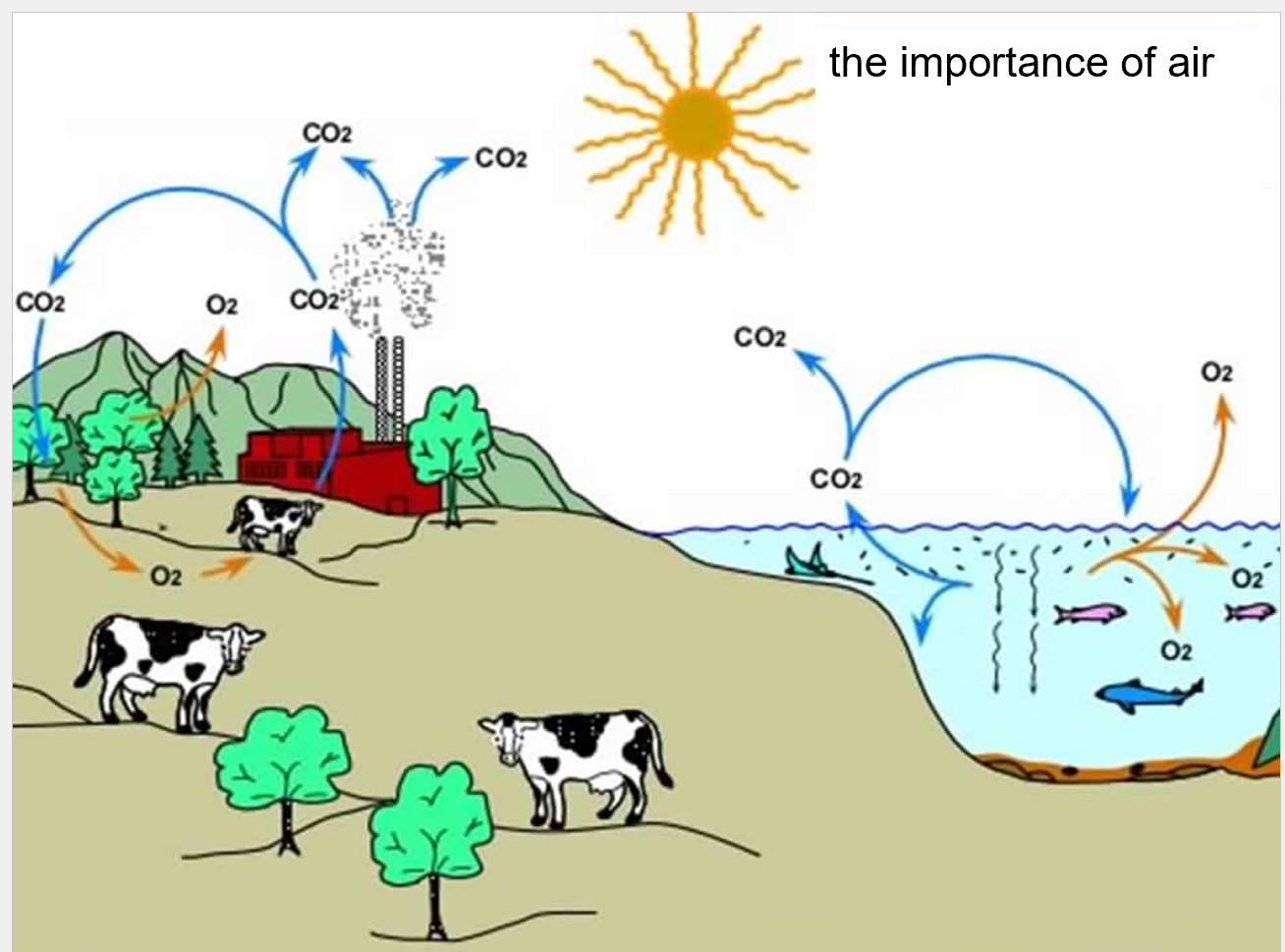
Photosynthesis formula
CO2 + H2O + Sunlight => C6H12O6 + O2
Respiration formula
O2 + C6H12O6 => CO2 + H2O
When is air polluted?
It’s polluted when there is a build up of harmful gases, dust, smoke, or chemicals in the air
what are the compositions of air
(N) Nitrogen
(O) Oxygen
(Ar) Argon
(CO2) Carbon dioxide
Others.
Weather
The state of the atmosphere at any given time or place
Meteorology
The study of the weather and the atmosphere
Atmosphere
Gaseous portion of a planet
The layer of air around the earth, 300miles thick
75% of all air
Atmosphere layers according to temp and chemistry from top to bottom
Exosphere
Thermosphere (w/ Ionosphere)
Mesosphere
Stratosphere (w/ Ozone layer)
Troposphere
All weather happens here
Troposphere air and temp levels with height?
Gases decrease, air becomes thinner
Temperature decrease, becomes colder
Almost all weather, clouds, and storms happen here
99% of water vapor is in this layer
Tropopause
The transition boundary between the troposphere and the layer above it (Stratosphere)
Stratosphere air and temp levels with height?
Holds 19% of atmosphere’s gases
No air mixing
LITTLE WATER VAPOR
Temperature increases
Oxygen molecules absorb radiation (Ultraviolet)
Calm layer ideal for commercial airplanes to fly
Ozone layer
Mesosphere air and temp levels with height?
Gases continue to become thinner
Causes most meteors to burn due to friction
Warming by ultraviolet effect becomes less
Temperature decreases
Coldest layer
Weather balloons are released in this layer
Burning meteors
Middle atmosphere
Stratosphere
Stratopause
Mesosphere
Mesopause
Thermosphere air and temp levels with height?
Upper atmosphere
Gases extremely thin
Only the higher energy UV and X-ray radiation from the sun are absorbed
Ionosphere
High temperature
Aurora
Northern and Southern Lights
International Space Station is in this layer.
Where do satellites orbit the earth?
Exosphere and Thermosphere
Exosphere air and temp levels with height?
Final layer
Sparce hydrogen and helium molecules
Air is constantly and gradually leaking out of the earths atmosphere
No clear cut upper boundary
Most weather satellites orbit.
The atmospheres chemical layer
Ionosphere
Ozone layer
Ozone layer
In the Stratosphere
Blocks the harmful UV rays
Ionosphere
In the thermosphere and Exosphere
Blocks harmful rays
Made up of ions
Charged atoms and free plasma

How does the Ham Radio work?
The Radio waves bounce off the ionosphere, allowing to send broadcasts around the worlds
Radiosonde
Tool used for studying the upper atmosphere
How are the Radiosondes carried up?
By using weather balloons
What causes Air pollution?
Transport
Agriculture
Household
Industrial burning
Waste
HF is produced by
Uranium and steel making
Brick manufacture
Glass and ceramic manufacture
Fertilizer industry by-product
Contact with moisture turns HF into Hydrofluoric acid, HIGHLY corrosive and toxic
Greenhouse gasses
CO2
Water vapor
Methane
Acid rain
Results when SO2 and NOX are emitted into the atmosphere and reacts with water, oxygen, and other chemicals to form sulfuric acid and nitric acid.
both acids mix with water and the rain becomes Acid rain.
Nitrogen oxides (NOX)
From fossil fuel combustion
for urban areas
Soil activity, agricultural practices
for rural areas
Exposer may causer respiratory tract inflammation
Particulate matter (PM)
Solid particles and liquid droplets found in atmospheric air
Can be natural or industrial and transportation related
Ammonia (NH3)
A burnt gas
Flammable
Toxic
Important emission focus in agricultural activity
Resulting from the use of fertilizers
NH3 reacts quickly with body moisture and cause damage
Sulfuric dioxide (SO2)
Invisible gas
Strong odor
From fuel combustion
Exposure leads to respiratory problems
reacting with water causes Acid rain
Carbon monoxide (CO)
Odorless gas
Emitted by incomplete combustion of fuel
mainly from gasoline or diesel
Very toxic with increased risk of heart disease
Climate
Trend of temperature and weather over a long period of time
Global warming
Earth’s temperature is getting hotter, a 1C increase over the last 100 years
What is the Green House effect?
Green houses let sunlight and heat in, but most of the heat can’t escape, making it a good environment. But when they get too hot doors and windows can be opened to let the heat out.
The earth is the same, it lets heat and sunlight in.
Greenhouse gases that get released into the atmosphere allow heat to escape the earth
False, they PREVENT heat release.
Short waves
Radiant energy
Warm up the atmosphere and surface
Turn into long waves
Escapes earth over time
Earth’s heat budget
30% Reflect back to space
70% Absorbed by earth
19% Absorbed into water vapor and clouds
51% Absorbed by the earth’s surface
Causes for global warming
Fossil fuel pollution
CO2 emission
Farming
Methane from the burping and trumping of cows
Deforestation