3.1.1 Atomic structure
 Call Kai
 Learn
Learn Practice Test
 Spaced Repetition
 Match
Match Flashcards
 Knowt Play
1/16

There's no tags or description
Looks like no tags are added yet.
Name | Mastery | Learn | Test | Matching | Spaced | Call with Kai | Chat |
|---|
No analytics yet
Send a link to your students to track their progress
17 Terms
Isotopes
Same number of protons but a different number of neutrons
Behave similarly because they have the same number of protons and electrons, and so they have almost identical chemical properties that react in the same way
Neurons give isotopes different masses
TOF Mass spec:
Separates ions based on their m/Z ratio by measuring how long it takes an ion to travel a fixed distance
Done under a vacuum otherwise air particles would ionise and would also register in the detector
Four stages:
Ionisation
Acceleration
Ion drift
Detection
Stage one mass spec: Ionisation
Electron impact:
-Vaporised sample is injected at low pressure
-High energy electrons fired using an electron gun
-This knocks out an outer electron
-Forms an ion with a plus one charge
-Used for compounds with a low formula mass
X (g) —> X+ (g) + e-
Electrospray ionisation:
Sample is dissolved in polar, volatile solvent
Volatile so can evaporate
Polar to supply H plus ions
Injected through a needle at high voltage
For substances with a higher molecular mass
M (g) —> MH+ (g)
Stage two: Acceleration
Samples are ionised to be accelerated by attraction to electric field, to hit detector to gain an electron to generate a current
Positive ions are accelerated by attraction towards a negatively charged plate
To a constant kinetic energy
Light ions have a faster velocity, heavier ions have a slower velocity
Stage three: ion drift
Ions hit the detector and each ion gains an electron which generates a current
Abundance is proportional to the size of the current produced
This is fed into a computer for analysis
X (g) + e- —> X (g)
Determining molecular mass
Electron impact:
Fragmentation due to being an energetic ionisation technique
Fragmentations are smaller parts of the original molecule
Relative Mr is the greatest m/Z value
Smaller peaks due to the presence of isotopes
Electrospray:
Only one peak
Ion does not fragment or break up
Subtract one from the Mr of the molecule for the hydrogen bonded to it
Mass spectrum graph for chlorine and bromine

Calculating relative atomic mass
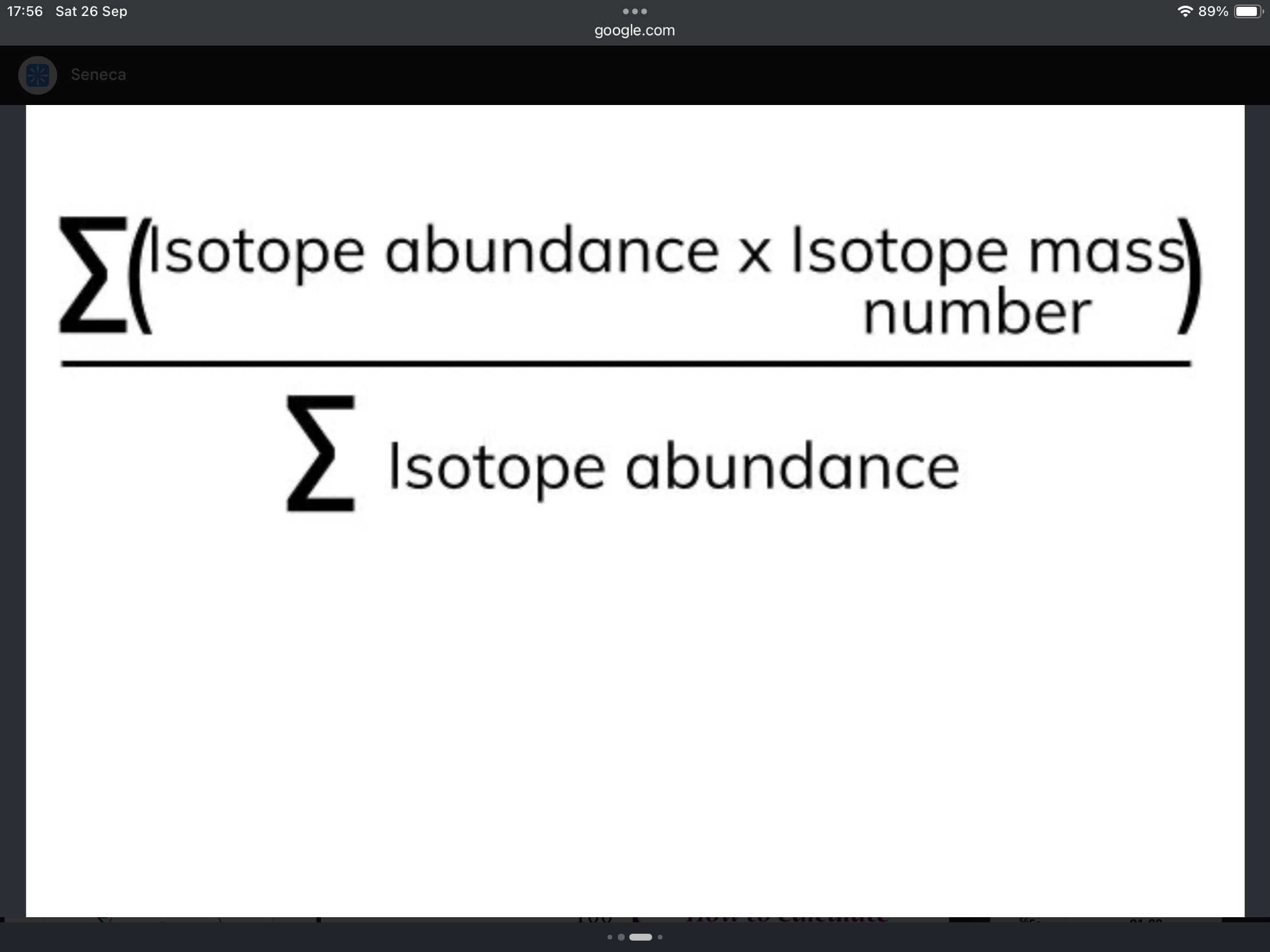
TOF mass spec calculations formulas

Electronic configuration
Sub shells have orbitals, (s,p,d,f)- use atomic number
S holds up to so electrons, p holds up to six electrons, d holds up to ten electrons
The block the element is in is the sub shell of the last electron it is in
Special cases in electron configuration
Crypton an copper only have one electron in their 4s sub shell and an extra electron in 3d, as 3d is not stable
Transition metals- 4s orbital is always before the 3d orbital as it has less energy
When forming ions, transition electrons lose electrons in their 4s subshell before 3d subshell
Examples for electron configuration

Ionisation energy
The first ionisation energy: the energy needed to remove one mole of electron from one mole of gaseous atom to form one mole of gaseous ion with a plus one charge
Second ionisation energy: energy needed to remove one mole of electron from one mole of gaseous ion with a plus one charge to form one mole of gaseous ion with a plus two charge
X (g) —> X + (g) + e-
X+ (g) —> X 2+ (g) + e-
An endothermic process as energy is needed to overcome the attraction between the negative electron and the positive nucleus
On a table this is shown as a large jump in energy, showing that the electron has been removed from a different shell which is closer to the nucleus, as the attraction is stronger
Factors affecting ionisation energy
Nuclear charge/ proton number: greater for of attraction between outer electrons and nucleus which requires more energy to remove an electron
Distance between the nucleus and outer electron: weaker attraction as distance increases to less energy needed
Shielding: more electron shells means more repulsion experienced by the outer shell by the inner shells, so less energy required to remove an electron
Electron pairing: paired electrons in an orbital repel each other, making it easier to remove
Ionisation energy trends
Down a group: IE decreases
Shells increase so more shielding
More electron repulsion by inner shells
Nuclear radius increases so distance increases
Less energy required remove outer shell electrons
Even though the proton number does increase, the effect of shielding and the increase in radius is greater
A cross a period: IE increases
More protons so stronger nuclear charge
No effect of sheilding as all have the same number of electron shells
Stronger attraction between nucleus and outer shell electron
Ionisation energy patterns that defy the general trend
Elements group two and five have higher ionisation energy than in three and six in the same period
Group two greater than group three:
In group two outer electron is in the s orbital
In group three the outer electron is in the p orbital
The p orbital is further from the nucleus than the s orbital
So the distance is greater, and so the attraction between the outer electron and the positive nucleus is weaker
Group five is greater than group six:
Group five has an odd number of electrons in its outer electron shell
Group six has an even number of electron pair in its outer subshell
The electron pairs repel each other, asking it easier for an electron to be lost
Why is the second ionisation energy higher than the first.
After the first ionisation energy, there are more protons than electrons as an electron has been removed
So the electron in the outer shell is held more strongly by the positive nucleus because it is closer to the nucleus
This requires more energy to overcome