People Places & Toured Landscape
0.0(0)
Studied by 3 people Call Kai
 Learn
Learn Practice Test
 Spaced Repetition
 Match
Match Flashcards
 Knowt Play
Card Sorting
1/65

Earn XP
Description and Tags
Last updated 8:36 PM on 2/14/23
Name | Mastery | Learn | Test | Matching | Spaced | Call with Kai |
|---|
No analytics yet
Send a link to your students to track their progress
66 Terms
1
New cards
Geography of Place
**Geography** is “the study of places and the relationships between people and their environments.”
• A **Geographer** is a “physical scientist, social scientist or humanistwhose area of study is geography, the study of Earth's natural environment and human society, including how society and nature interact.”
• **Tourism Geography** is “the study of travel and tourism, as an industry and as a social and cultural activity.”
• Some geographers refer to people having a personal and emotional attachment to a specific place, as having a **Sense of Place**
• A **Geographer** is a “physical scientist, social scientist or humanistwhose area of study is geography, the study of Earth's natural environment and human society, including how society and nature interact.”
• **Tourism Geography** is “the study of travel and tourism, as an industry and as a social and cultural activity.”
• Some geographers refer to people having a personal and emotional attachment to a specific place, as having a **Sense of Place**
2
New cards
What is a place?
• **Place** can be defined as space which has been ascribed meaning: Space + Meaning = **Place**.
• **Topophilia** is a strong sense of place, which often becomes mixed with the sense of cultural identity among certain people and a love of certain aspects of a place.
• **Topophilia** is a strong sense of place, which often becomes mixed with the sense of cultural identity among certain people and a love of certain aspects of a place.
3
New cards
Sense of Place
In the reading by Jarratt (2019), he defines
**-**
**Sense of**
**Place**
**as the shifting and many**
**sided way in which we**
**know important or memorable places through sensing,**
**experiencing, and remembering a geographical**
**location and its features.**
• Through this, he explains that it is a combination of the way we interact (use) the physical environment and what “meaning” we give to it.
• This “meaning” can be personal or based on societal or cultural practices and beliefs.
**-**
**Sense of**
**Place**
**as the shifting and many**
**sided way in which we**
**know important or memorable places through sensing,**
**experiencing, and remembering a geographical**
**location and its features.**
• Through this, he explains that it is a combination of the way we interact (use) the physical environment and what “meaning” we give to it.
• This “meaning” can be personal or based on societal or cultural practices and beliefs.
4
New cards
How do we Identify with place?
* **How do we identify ourselves with a Place?** \n • Place identity is created through the connection of
personal identity and topographical (physical) place. • Our home countries, cities, and neighbourhoods.
* When a places’ identity becomes strong enough to be felt or experienced, then we often refer to the term Sense of Place (Jorgensen and Stedman, 2001)
* Geographers refer to Sense of Place as the subjective and emotional attachment people have to a place (Cresswell, 2015)
personal identity and topographical (physical) place. • Our home countries, cities, and neighbourhoods.
* When a places’ identity becomes strong enough to be felt or experienced, then we often refer to the term Sense of Place (Jorgensen and Stedman, 2001)
* Geographers refer to Sense of Place as the subjective and emotional attachment people have to a place (Cresswell, 2015)
5
New cards
• **Does Sense of Place have a role to play in tourism?**
• Marketing places? \n • Building connections between places and tourists? • Taking advantage of a Sense of Place? \n • Benefits of tourism for society as a whole?
6
New cards
EXPLORER QUOTIENT - TRAVELER TYPES
• EQ market segmentation is a marketing analysis technique that groups customers into “segments” or traveler types.
• These are based on common criteria such as *demographics*, *geography*, *interests*, and *travel behaviour*.
• This allows marketers to identify and understand the segments that are most likely to align with the product or experience they are selling.
• This market segmentation is based on psychographics.
• *The study and classification of people according to their attitudes, aspirations, and other psychological criteria, especially in market research.*
• This looks deeper at people’s values and views of the world, rather than simply age, income, or place of origin.
• These are based on common criteria such as *demographics*, *geography*, *interests*, and *travel behaviour*.
• This allows marketers to identify and understand the segments that are most likely to align with the product or experience they are selling.
• This market segmentation is based on psychographics.
• *The study and classification of people according to their attitudes, aspirations, and other psychological criteria, especially in market research.*
• This looks deeper at people’s values and views of the world, rather than simply age, income, or place of origin.
7
New cards
**Free Spirits**
“Free Spirits are highly social and open- minded. Their enthusiasm for life extends to their outlook on travel. Experimental and adventurous, they indulge in high-end experiences that are shared with others.”
8
New cards
Cultural Explorers
“Cultural Explorers are defined by their love of constant travel and continuous opportunities to embrace, discover and immerse themselves in the culture, people and settings of the places they visit.”
9
New cards
Authentic Experiencer
• “Authentic Experiencers are typically understated travelers looking for authentic, tangible engagement with destinations they seek, with a particular interest in understanding the history of the places they visit.”
10
New cards
Cultural History Buff
• “Cultural History Buffs are defined by their focused interest in the history, culture and natural surroundings of the places they visit. They are driven to learn everything about a culture, in the company of other like-minded people.”
11
New cards
Gentle Explorers
“Gentle Explorers are primarily defined by their reluctance to venture far beyond the comfort of home and travel ‘on condition,’ demanding the very best and most comfortable environments for themselves when they must do so.
12
New cards
No Hassle Traveler
“No-Hassle Travelers are cautious, dutiful and reserved people who seek secure group travel that allows them to escape from the duties and obligations of everyday life.”
13
New cards
Personal History Travellers
“As travelers, Personal History Explorers are primarily defined by their desire to connect to their own cultural roots – and do so by travelling in comfort, style and security.”
14
New cards
Rejuvinators
“Rejuvenators are family-oriented people who travel with others to escape the stresses of everyday life to get pampered and indulgethemselves.”
15
New cards
Virtual Travellers
“Virtual travelers tend not to travel very often; they prefer the comforts of home to the uncertainties of new places and cultural differences. Often very active locally, they usually find enough to satisfy their sense of exploration within their community. Rather than being restricted to the confines of pre-packaged tours, they prefer the flexibility of being able to decide what they want or don’t want to do on their own. Their trips tend to be shorter, closer to home and centred on family events.”
16
New cards
**Where and why did tourism begin?**
* The word “tour” comes from Greek (“tornos”) and Latin (“tornare”)words for circle and turn, and “tourism” and “tourist” represent the activities of circling away from home and thenreturning (Theobald, 1998).
* Our modern concept of tourism dates back to the 1600s in Europe when wealthy nobles would travel around Europe on what was called the Grand Tour.
* The word “Tourist” did not appear in print (in English) until 1772.
• Many nations and empires throughout history have travelled for military and conquest purposes, but that ultimately led to greater access to new areas, and travel for simple curiosity.
* Our modern concept of tourism dates back to the 1600s in Europe when wealthy nobles would travel around Europe on what was called the Grand Tour.
* The word “Tourist” did not appear in print (in English) until 1772.
• Many nations and empires throughout history have travelled for military and conquest purposes, but that ultimately led to greater access to new areas, and travel for simple curiosity.
17
New cards
Long Distance Travel
• As long-distance travel became more regular, people travelled for more reasons;
• This can include commercial, educational, official government, “discovery”, and religious purposes, among many others.
* Traveling long distances required many things, such as roads, maps, food and water, lodgings, money, and relative safety.
* In one famous example, Rome built a 563km long road in 312 B.C. – The Appian Way – to move Roman troops, and eventually many other travellers, including early “tourists”.
• During this time, known as the Empire Era, there were widely accepted currencies, Inns built along roads every 30 miles or so, a wealthy population that wanted to travel, and a well-built travel route.
• This can include commercial, educational, official government, “discovery”, and religious purposes, among many others.
* Traveling long distances required many things, such as roads, maps, food and water, lodgings, money, and relative safety.
* In one famous example, Rome built a 563km long road in 312 B.C. – The Appian Way – to move Roman troops, and eventually many other travellers, including early “tourists”.
• During this time, known as the Empire Era, there were widely accepted currencies, Inns built along roads every 30 miles or so, a wealthy population that wanted to travel, and a well-built travel route.
18
New cards
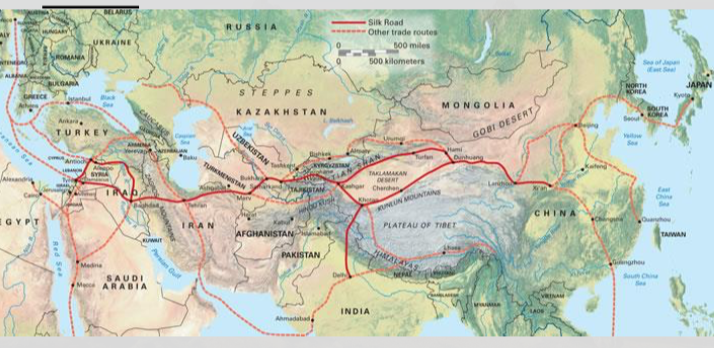
The Silk Road
* While travel routes like the Appian Way connected cities and empires, and allowed the movement of troops, another “road” was established that created one of the largest corridors for sharing ideas and trade goods among many diverse cultures.
* The Silk Road began in China when the Han Dynasty opened trade with the West in 130 B.C.
* This began 1500 years of trade, travel, and culture and idea sharing between China, the Middle East, Europe and beyond.
* The Silk Road began in China when the Han Dynasty opened trade with the West in 130 B.C.
* This began 1500 years of trade, travel, and culture and idea sharing between China, the Middle East, Europe and beyond.
19
New cards
Who established the Silk Road?
* The Silk Road was established by the Han Dynasty in China, who officially opened trade with the West in 130 B.C.E. (2,141 years ago).
* The Silk Road was a network of trade routes that connected China and the Far East with the Middle East and Europe.
* The Silk Road trade routes remained active until 1453 C.E., when the Ottoman Empire boycotted trade with China and closed the routes.
* The Silk Road was a network of trade routes that connected China and the Far East with the Middle East and Europe.
* The Silk Road trade routes remained active until 1453 C.E., when the Ottoman Empire boycotted trade with China and closed the routes.
20
New cards
What is the Silk Road?
* Although the Silk Road is a common name, Historians prefer to use “*silk routes*” to describe the network of roads that supported trade.
* Both terms were coined by German geographer and traveler, Ferdinand von Richthofen, in 1877 C.E, who designated them \`Seidenstrasse’ (silk road) or \`Seidenstrassen’ (silk routes).
* The history of the Silk Road pre-dates the Han Dynasty in practice.
* However, the route was formally established during the Han Dynasty of China, which linked the regions of the ancient world in commerce and trade.
* Both terms were coined by German geographer and traveler, Ferdinand von Richthofen, in 1877 C.E, who designated them \`Seidenstrasse’ (silk road) or \`Seidenstrassen’ (silk routes).
* The history of the Silk Road pre-dates the Han Dynasty in practice.
* However, the route was formally established during the Han Dynasty of China, which linked the regions of the ancient world in commerce and trade.
21
New cards
The royal road
* While this route was formally established during the Han Dynasty of China, the transportation of goods and services along these routes has a longer history.
* The Royal Road was established approximately 300 years earlier by Persian ruler Darius I during the Achaemenid Empire.
* The Royal Road connected present-day Iran with present-day Turkey, approximately 2,500km apart.
* Alexander the Great of Macedonia expanded his rule into Persia via the Royal Road.
* The Royal Road was established approximately 300 years earlier by Persian ruler Darius I during the Achaemenid Empire.
* The Royal Road connected present-day Iran with present-day Turkey, approximately 2,500km apart.
* Alexander the Great of Macedonia expanded his rule into Persia via the Royal Road.
22
New cards
Ancient Routes
* The map on the next slide represents historical routes linking ancient China to ancient Rome and Western Asia.
* The region separating China from Europe and Western Asia is a very harsh environment.
* Much of the area is taken up by the Taklimakan desert, one of the most hostile environments on our planet.
* There is very little vegetation, and almost no rainfall; sandstorms are very common, and have claimed the lives of countless people.
* The region separating China from Europe and Western Asia is a very harsh environment.
* Much of the area is taken up by the Taklimakan desert, one of the most hostile environments on our planet.
* There is very little vegetation, and almost no rainfall; sandstorms are very common, and have claimed the lives of countless people.
23
New cards
Trade along the Silk Road
* The Silk Road stretched approximately 6,437 kilometers (that is the distance from the west coast to the east coast of Canada).
* The Silk Road routes included a large network of strategically located trading posts, markets and thoroughfares.
* This made the transport, exchange, distribution and storage of goods much simpler.
* The Silk Road routes included a large network of strategically located trading posts, markets and thoroughfares.
* This made the transport, exchange, distribution and storage of goods much simpler.
24
New cards
What was traded on the Silk Road?
* Silk
* Precious Stones/Gems
* Porcelain
* Tea
* Spices
* Glassware
* Manufactured Goods
* Technology
* Precious Stones/Gems
* Porcelain
* Tea
* Spices
* Glassware
* Manufactured Goods
* Technology
25
New cards
THE IMPORTANCE OF THE SILK ROAD
* The greatest value of the Silk Road was the exchange of culture, technology, art, religion, language, science, architecture and many other elements of human civilization (*including disease*).
* This exchange was supported by commerce, trade, and the commercial goods the merchants carried from country to country.
* Some research suggests that the Black Death, which devastated Europe between 1347-1351 C.E., (killing between 75-200 million people) likely spread from Asia along the Silk Road.
* This exchange was supported by commerce, trade, and the commercial goods the merchants carried from country to country.
* Some research suggests that the Black Death, which devastated Europe between 1347-1351 C.E., (killing between 75-200 million people) likely spread from Asia along the Silk Road.
26
New cards
Origin of Pasta
* Pasta’s history can be traced back approximately 3,500 years in some form through Asia to Africa to the Middle East.
* Pasta’s earliest origin likely began in China, during the Shang Dynasty (1700-1100 B.C.E), where some form of pasta was made with either wheat or rice flour.
• "China has had a longer tradition of bread than noodles, and the ripping of dough — either boiled or cooked — into a wok of boiling water was how noodles first originated in China," says author Jen Lin-Liu.
According to Historians, dried pasta probably originated in Iran.
• The first pasta dish is recorded in a 10th- century Arab cookery book.
• It was likely the Arab people who introduced noodles, and the hard durum wheat necessary for making them, to Italy in the 9th century via Sicily (noodles) and Genoa (ravioli).
• Author Jen Lin-Liu says "Some people theorized that Ghengis Khan was responsible for carrying these filled pasta dishes all the way from China through Eastern Europe \[along the Silk Road\], where of course you have pierogies and other similar dishes“.
* Pasta’s earliest origin likely began in China, during the Shang Dynasty (1700-1100 B.C.E), where some form of pasta was made with either wheat or rice flour.
• "China has had a longer tradition of bread than noodles, and the ripping of dough — either boiled or cooked — into a wok of boiling water was how noodles first originated in China," says author Jen Lin-Liu.
According to Historians, dried pasta probably originated in Iran.
• The first pasta dish is recorded in a 10th- century Arab cookery book.
• It was likely the Arab people who introduced noodles, and the hard durum wheat necessary for making them, to Italy in the 9th century via Sicily (noodles) and Genoa (ravioli).
• Author Jen Lin-Liu says "Some people theorized that Ghengis Khan was responsible for carrying these filled pasta dishes all the way from China through Eastern Europe \[along the Silk Road\], where of course you have pierogies and other similar dishes“.
27
New cards
Origin of pasta 2
* Before the Han dynasty (206 B.C.E. -220 C.E.), China lacked the mills for large-scale flour grinding.
* However, as China expanded to the west via the newly explored Silk Road the mill was introduced, and Han cooks adapted or invented a vast array of "noodle foods"
* Evolved into strings of pasta, dumplings, steamed buns, and little wheat cakes.
* Although it is suggested that these dishes originated in Central Asia no one knows for sure – but their names are all related.
* The interesting piece is that there appears to be a culinary bond suggesting early communication among distant cultures that were often hostile to each other.
* Central Asia – manti = “small steamed pasta that may contain meat, cheese, or vegetables and is served with yogurt or vinegar”.
* However, as China expanded to the west via the newly explored Silk Road the mill was introduced, and Han cooks adapted or invented a vast array of "noodle foods"
* Evolved into strings of pasta, dumplings, steamed buns, and little wheat cakes.
* Although it is suggested that these dishes originated in Central Asia no one knows for sure – but their names are all related.
* The interesting piece is that there appears to be a culinary bond suggesting early communication among distant cultures that were often hostile to each other.
* Central Asia – manti = “small steamed pasta that may contain meat, cheese, or vegetables and is served with yogurt or vinegar”.
28
New cards
The story of rice
**China and India Iran**
• Rice is a grain that was cultivated in China and India for at least 5,000 years.
• Became a mainstay – anchoring the meal in China.
**Iran**
• Rice didn’t reach Iran until the 4th century B.C.E. (this was the period where Alexander the great was expanding his empire).
• Rice wasn’t considered important until 8th century C.E.
• Since then rice is considered special and is used in festivals and elaborate occasions – called polow.
• Rice is a grain that was cultivated in China and India for at least 5,000 years.
• Became a mainstay – anchoring the meal in China.
**Iran**
• Rice didn’t reach Iran until the 4th century B.C.E. (this was the period where Alexander the great was expanding his empire).
• Rice wasn’t considered important until 8th century C.E.
• Since then rice is considered special and is used in festivals and elaborate occasions – called polow.
29
New cards
The story of Tea
* History of tea making began in China over 4,000 years ago when an Emperor was boiling water in his garden and a leaf from an overhanging tree fell into the water.
* As tea become popular in China during the Tang dynasty (618-907 AD) the government imposed a tea tax.
* It was during this time that tea became China’s national drink.
* As tea become popular in China during the Tang dynasty (618-907 AD) the government imposed a tea tax.
* It was during this time that tea became China’s national drink.
30
New cards
Journey of Tea to other countries
* A Japanese Buddhist monk, studying in China in the early 9th century is credited with introducing tea to Japan.
* Around the same period Arab trade documents refer to the boiling of bitter leaves.
* Marco Polo, in the 14th century C.E. had been introduced to tea in China and Japan and documented his discovery in his travel writings about China.
“In 1610, the first shipments of Japanese and Chinese tea arrived in Europe via ships charted by the Dutch East India Company”.
Camel trains, travelling the silk road, carried cakes of tea to Russia.
The popularity of tea grew among the aristocrats and royals in Paris, Amsterdam and London.
* the high price prohibited the average person from purchasing tea.
* In the 1660’a tea was valued between 16-50 shillings per pound (16 shillings was at least two weeks’ salary for a labourer)
* Around the same period Arab trade documents refer to the boiling of bitter leaves.
* Marco Polo, in the 14th century C.E. had been introduced to tea in China and Japan and documented his discovery in his travel writings about China.
“In 1610, the first shipments of Japanese and Chinese tea arrived in Europe via ships charted by the Dutch East India Company”.
Camel trains, travelling the silk road, carried cakes of tea to Russia.
The popularity of tea grew among the aristocrats and royals in Paris, Amsterdam and London.
* the high price prohibited the average person from purchasing tea.
* In the 1660’a tea was valued between 16-50 shillings per pound (16 shillings was at least two weeks’ salary for a labourer)
31
New cards
Tea in Britain
* Tea time in Britain is a traditional past-time .
* The first shop selling tea opened in England in 1657.
* The practise of tea time was introduced to the royal court of England by a Portuguese Princess who married Charles II, and she adored tea.
* Boston Tea Party
* American Revolution was kicked off by throwing tea off
ships in Boston, USA
* The British government considered this an act of treason.
* The first shop selling tea opened in England in 1657.
* The practise of tea time was introduced to the royal court of England by a Portuguese Princess who married Charles II, and she adored tea.
* Boston Tea Party
* American Revolution was kicked off by throwing tea off
ships in Boston, USA
* The British government considered this an act of treason.
32
New cards
Technological advances in the Silk Road
The Silk Road was used by traders, religious, artists, fugitives and bandits.
It was also heavily used by refugees and populations of emigrants or displaced persons.
* These groups of migrant populations brought knowledge, tools, culture, physical products, and crops with them when they moved.
* This “cultural and technological globalization” would change the world.
It was also heavily used by refugees and populations of emigrants or displaced persons.
* These groups of migrant populations brought knowledge, tools, culture, physical products, and crops with them when they moved.
* This “cultural and technological globalization” would change the world.
33
New cards
Paper manufacturing
* Around 104 C.E. the manufacturing of paper was invented in China
* An Chinese court official of the Eastern Han Dynasty, named Cai Lun, invented paper manufacturing based on the processing, pressing, and drying of a mixture of vegetable fibres and water.
* Beginning in the 7th century, paper manufacturing technology began its expansion along the Silk Road, reaching Europe in the 12th century.
* An Chinese court official of the Eastern Han Dynasty, named Cai Lun, invented paper manufacturing based on the processing, pressing, and drying of a mixture of vegetable fibres and water.
* Beginning in the 7th century, paper manufacturing technology began its expansion along the Silk Road, reaching Europe in the 12th century.
34
New cards
Mechanical Printing
* Mechanical Printing was invented in China around the 6th century.
* Text was engraved onto wooden plates, allowing fast reproduction of the text onto fabrics and paper.
* Mobile versions of mechanical printers were invented in China in the 11th century.
* This technology made its way to Europe during the 12th and 13th centuries.
* Text was engraved onto wooden plates, allowing fast reproduction of the text onto fabrics and paper.
* Mobile versions of mechanical printers were invented in China in the 11th century.
* This technology made its way to Europe during the 12th and 13th centuries.
35
New cards
What is the significance of mechanical printing?
* The invention of technology that allowed for the fast reproduction of written texts drove huge developments in “education, commerce, communications and cartography”.
* This accelerated the transition from the Dark Ages to the Renaissance and the Modern Age.
* This accelerated the transition from the Dark Ages to the Renaissance and the Modern Age.
36
New cards
Gun Powder
• Invented in China in the 9th century, it has been • suggested that gunpowder was invented
Gunpowder it reached Europe through the Silk Road in the 13th century.
accidentally by Chinese alchemists (someone who tried to transform base metals such as lead or copper into silver or gold) or monks.
• It was invented by “heating sulphur, realgar (arsenic sulphide) and saltpetre (potassium nitrate) together with honey, producing smoke and flames that burned everything”, and putting it into a container, which led to a violent explosion.
• Europeans immediately began using it for military purposes.
Gunpowder it reached Europe through the Silk Road in the 13th century.
accidentally by Chinese alchemists (someone who tried to transform base metals such as lead or copper into silver or gold) or monks.
• It was invented by “heating sulphur, realgar (arsenic sulphide) and saltpetre (potassium nitrate) together with honey, producing smoke and flames that burned everything”, and putting it into a container, which led to a violent explosion.
• Europeans immediately began using it for military purposes.
37
New cards
Magnetic Compass
* The magnetic compass or needle was invented in China, likely around the 2nd century C.E.,
* It was used as an instrument for geomancy (the art of placing or arranging buildings).
* The first compass consisted of small magnet stones or magnetized needles suspended in the air or in water.
* In this form, it first reached Europe around the 12th century C.E.
In the 14th century C.E., in the Italian region of Amalfi, they reached their current look, with the needle turning in a casing.
* The compass allowed for extensive maritime trade and travel, beginning the “Age of Discoveries”, marking the beginning of the “Modern Age”.
* It was used as an instrument for geomancy (the art of placing or arranging buildings).
* The first compass consisted of small magnet stones or magnetized needles suspended in the air or in water.
* In this form, it first reached Europe around the 12th century C.E.
In the 14th century C.E., in the Italian region of Amalfi, they reached their current look, with the needle turning in a casing.
* The compass allowed for extensive maritime trade and travel, beginning the “Age of Discoveries”, marking the beginning of the “Modern Age”.
38
New cards
The new Silk Road
* In 2013, China’s president, Xi Jinping, announced the creation of a new trade corridor to connect China with Central Asia, the Middle East and Europe.
* This is known as China’s Belt and Road Initiative (BRI), sometimes called the **New Silk Road**.
* This initiative encompasses land routes (the “Belt”) and maritime/sea routes (the “Road”).
• "Belt" refers to the "Silk Road Economic Belt"
• This is the proposed overland routes for road and rail transportation through landlocked Central Asia along the historical trade routes of the Western Regions.
• “Road" refers to the "21st Century Maritime Silk Road" \n • This is the Indo-Pacific sea routes through Southeast Asia to South Asia, the Middle East and Africa.
* This is known as China’s Belt and Road Initiative (BRI), sometimes called the **New Silk Road**.
* This initiative encompasses land routes (the “Belt”) and maritime/sea routes (the “Road”).
• "Belt" refers to the "Silk Road Economic Belt"
• This is the proposed overland routes for road and rail transportation through landlocked Central Asia along the historical trade routes of the Western Regions.
• “Road" refers to the "21st Century Maritime Silk Road" \n • This is the Indo-Pacific sea routes through Southeast Asia to South Asia, the Middle East and Africa.
39
New cards
What impacts could the new Silk Road have on tourism?
* How are these trade routes and goods connected to the tourism industry?
* Are these physical and trade connections between countries positive or negative for tourism?
* Large-scale tourism?
* Small-scale tourism?
* Cultural Impacts
* Are these physical and trade connections between countries positive or negative for tourism?
* Large-scale tourism?
* Small-scale tourism?
* Cultural Impacts
40
New cards
Modern day travel along the Silk Road
* While tourism along the New Silk Road has potential, there are numerous challenges as many of the destinations are located in what are described as developing countries.
* Some of the challenges include transportation, accommodations, border crossings and visas.
* How can those challenges be addressed?
* Some of the challenges include transportation, accommodations, border crossings and visas.
* How can those challenges be addressed?
41
New cards
FIRST FREIGHT TRAIN FROM CHINA TO LONDON
* In 2017, the first freight train arrived from China to London and crossed seven countries in 18 days.
* The train left the city of Yiwu, on China's east coast, travelling 12,000km (twice the width of Canada) to London.
* It delivered 34 containers of clothes and High Street goods.
* The train left the city of Yiwu, on China's east coast, travelling 12,000km (twice the width of Canada) to London.
* It delivered 34 containers of clothes and High Street goods.
42
New cards
POTENTIAL PROBLEMS WITH THE NEW SILK ROAD
• Environmental
• Social \n • Economic \n • Cultural
• Linguistical • Others?
Impacts on tourism? Good or bad?
• Social \n • Economic \n • Cultural
• Linguistical • Others?
Impacts on tourism? Good or bad?
43
New cards
CHALLENGES OF THE BELT AND ROAD INITIATIVE
• **Huge Debts** \n • This can lead to economic collapses, corruption, and foreign control across participating
countries.
• **Environmental Degradation**
* A 2017 report published by the World Wildlife Fund (WWF) noted that there would be
considerable overlap between BRI projects and sensitive environments.
* As many as 1,739 Important Bird Areas and Key Biodiversity Areas are at risk of harm, and over 265 threatened species could be adversely affected (including endangered tiger species and the critically endangered saiga antelope).
* **Exporting Energy**
* China may move high-emission manufacturing industries to developing BRI host countries.
* China could move high-polluting industries and appease large, urban constituencies most affected by poor air quality.
* As of late 2016, Chinese banks and companies were involved in 240 coal projects in developing BRI host countries.
* **Cultural Loss through Globalization** \n • A potential side effect of a globalized economy dominated by China, the United States and
Europe is the possible decline of cultural diversity in some Silk Road member countries. \n • Large-scale projects, such as this, often overlook the impacts on cultures in impacted areas.
countries.
• **Environmental Degradation**
* A 2017 report published by the World Wildlife Fund (WWF) noted that there would be
considerable overlap between BRI projects and sensitive environments.
* As many as 1,739 Important Bird Areas and Key Biodiversity Areas are at risk of harm, and over 265 threatened species could be adversely affected (including endangered tiger species and the critically endangered saiga antelope).
* **Exporting Energy**
* China may move high-emission manufacturing industries to developing BRI host countries.
* China could move high-polluting industries and appease large, urban constituencies most affected by poor air quality.
* As of late 2016, Chinese banks and companies were involved in 240 coal projects in developing BRI host countries.
* **Cultural Loss through Globalization** \n • A potential side effect of a globalized economy dominated by China, the United States and
Europe is the possible decline of cultural diversity in some Silk Road member countries. \n • Large-scale projects, such as this, often overlook the impacts on cultures in impacted areas.
44
New cards
THE NEW SILK ROAD’S SUSTAINABILITY
• In 2022, The University of Cambridge’s – Cambridge Institute for Sustainability Leadership looked into the sustainability the Belt and Road Initiative (BRI) to determine its sustainability.
• The looked to understand the links between the BRI, urban transformation and global development.
• There finds of the BRI include;
1. Major changes in land uses, the expansion of large-scale infrastructure, and the intensification of social and
environmental processes that transform the entire urban fabric.
2. Mixed implications for local communities, including the displacement and relocation of urban and rural populations.
3. Significant changes in labour relations, standards and conditions of employment.
4. Inadequate inclusion of local communities in the decision-making processes through which BRI projects have been negotiated and agreed.
• The looked to understand the links between the BRI, urban transformation and global development.
• There finds of the BRI include;
1. Major changes in land uses, the expansion of large-scale infrastructure, and the intensification of social and
environmental processes that transform the entire urban fabric.
2. Mixed implications for local communities, including the displacement and relocation of urban and rural populations.
3. Significant changes in labour relations, standards and conditions of employment.
4. Inadequate inclusion of local communities in the decision-making processes through which BRI projects have been negotiated and agreed.
45
New cards
UNWTO
* The UNWTO is very engaged in the development of the New Silk Road.
* The UNWTO is: “a global forum for tourism policy issues....and plays a central role in promoting the development of responsible sustainable and universally accessible tourism”.
* Since the early 1990’s, the United Nations World Tourism Organization (UNWTO) has been promoting the revival of the Silk Road as an interconnected trade route that has historically had a transformative impact on human development.
* By linking the East with the West through land corridors and maritime ports, the UNWTO is working to establish the Silk Road as an internationally renowned and seamless travel experience.
* The UNWTO is: “a global forum for tourism policy issues....and plays a central role in promoting the development of responsible sustainable and universally accessible tourism”.
* Since the early 1990’s, the United Nations World Tourism Organization (UNWTO) has been promoting the revival of the Silk Road as an interconnected trade route that has historically had a transformative impact on human development.
* By linking the East with the West through land corridors and maritime ports, the UNWTO is working to establish the Silk Road as an internationally renowned and seamless travel experience.
46
New cards
UNWTO AND THE NEW SILK ROAD
• The UNWTO decided to revive the ancient Silk Road routes as a tourism concept, connecting three continents in a project encompassing over 12,000 km
• Their desire to undertake this project was due to renewed interest in the Silk Road for cultural exchange, trade and tourism.
• Their desire to undertake this project was due to renewed interest in the Silk Road for cultural exchange, trade and tourism.
47
New cards
UNWTO & SILK ROAD TOURISM
The concept of a Silk Road tourism project was first raised at UNWTO's General Assembly in Indonesia in 1993.
* According to the UNWTO, “By collaborating in areas of mutual interest, Silk Road Member States and private sector tourism stakeholders are in a unique position to create new opportunities and tourism initiatives capable of favouring sustained and healthy growth.”
* As of 2018 there are 34 Silk Road Member States from Europe, Africa, Central Asia and Asia & the Pacific who “work together to promote the Silk Road routes as a transnational tourism adventure.”
* According to the UNWTO, “By collaborating in areas of mutual interest, Silk Road Member States and private sector tourism stakeholders are in a unique position to create new opportunities and tourism initiatives capable of favouring sustained and healthy growth.”
* As of 2018 there are 34 Silk Road Member States from Europe, Africa, Central Asia and Asia & the Pacific who “work together to promote the Silk Road routes as a transnational tourism adventure.”
48
New cards
WHAT IS THE UNWTO’S INVOLVEMENT?
* UNWTO understands how important the Silk Road is as a tourism concept that is geographically defined by participating countries in Asia and Europe, as well as countries located along the Mediterranean basin, the Caspian Sea and the Black Sea.
* All participating countries share one defining criterion: **they were in contact with, influenced, and were influenced by the historic Silk Road routes.**
* All participating countries share one defining criterion: **they were in contact with, influenced, and were influenced by the historic Silk Road routes.**
49
New cards
BRI AND TOURISM
* The BRI will play a key role in developing maritime infrastructure that will support tourism – products and experiences such as Cruise Tourism.
* “Over time, the proposed infrastructural projects will have a significant impact in terms of the geography of travel and tourism, the scale of the industry and its tourism product offering”.
* “Improved transport links from ports to land routes and airports will make previously unknown destinations more accessible to international tourists. The opening up of new tourism gateways will provide an excellent opportunity for tourism growth in many regions. Cruise tourism, in particular, will be facilitated”
* “Over time, the proposed infrastructural projects will have a significant impact in terms of the geography of travel and tourism, the scale of the industry and its tourism product offering”.
* “Improved transport links from ports to land routes and airports will make previously unknown destinations more accessible to international tourists. The opening up of new tourism gateways will provide an excellent opportunity for tourism growth in many regions. Cruise tourism, in particular, will be facilitated”
50
New cards
21ST CENTURY MARITIME SILK ROAD
* As the original Silk Road routes began to be used more by traders, travelers, and armies, disruptions to the route due to wars and other impacts, a new route had to be expanded.
* The Maritime Silk Road expanded to include maritime/sea routes, trading goods and cultural ideas and knowledge from one port to the next.
* The 21st Century Maritime Silk Road is continuing that legacy.
• With the goal of connecting China to Europe, via Southeast Asia, India, Africa, and the Eastern
Mediterranean.
• The Silk Road and Maritime Silk Road are deeply connected and will support and stimulate one another.
* The Maritime Silk Road expanded to include maritime/sea routes, trading goods and cultural ideas and knowledge from one port to the next.
* The 21st Century Maritime Silk Road is continuing that legacy.
• With the goal of connecting China to Europe, via Southeast Asia, India, Africa, and the Eastern
Mediterranean.
• The Silk Road and Maritime Silk Road are deeply connected and will support and stimulate one another.
51
New cards
21ST CENTURY MARITIME SILK ROAD
* This Maritime Silk Road not only allows for the transportation of goods but also increases tourist capacity in certain areas.
* Tourism is increasing across these regions of Asia.
• The top 5 tourist-receiving destinations are mainland **China, Hong Kong, Thailand, Malaysia, and Japan**.
* Increases in the number and capacity of ports in this region will benefit industry, trade, and tourism.
* For example, there are many UNESCO (United Nations Educational, Scientific and Cultural Organization) World Heritage Sites that are easily accessible from ports.
• Additionally, coastal tourism as a whole can benefit from increased accessibility of the 21st Century Maritime Silk Road
* Tourism is increasing across these regions of Asia.
• The top 5 tourist-receiving destinations are mainland **China, Hong Kong, Thailand, Malaysia, and Japan**.
* Increases in the number and capacity of ports in this region will benefit industry, trade, and tourism.
* For example, there are many UNESCO (United Nations Educational, Scientific and Cultural Organization) World Heritage Sites that are easily accessible from ports.
• Additionally, coastal tourism as a whole can benefit from increased accessibility of the 21st Century Maritime Silk Road
52
New cards
INDIA
The Indian government recognizes the potential of cruise tourism;
* Upgrading infrastructure to bring India’s ports on par with international standards, actions also include the simplification of port procedures, the facilitation of immigration arrangements, and marketing and promotional initiatives.( Pg 36)
* “While a number of the most significant cultural heritage sites, such as the Agra Fort, the Taj Mahal and the Golden Fort at Amritsar are in the land-locked north, some of the country’s 36 UNESCO World Heritage Sites, in addition to a further 44 sites on the Government’s list to be put forward for nomination, are accessible from port destinations.” (pg 74)
* Upgrading infrastructure to bring India’s ports on par with international standards, actions also include the simplification of port procedures, the facilitation of immigration arrangements, and marketing and promotional initiatives.( Pg 36)
* “While a number of the most significant cultural heritage sites, such as the Agra Fort, the Taj Mahal and the Golden Fort at Amritsar are in the land-locked north, some of the country’s 36 UNESCO World Heritage Sites, in addition to a further 44 sites on the Government’s list to be put forward for nomination, are accessible from port destinations.” (pg 74)
53
New cards
CHINA
CHINA \n “China has a total of nine main ports listed online as regularly receiving cruises”
• Primary attractions accessible from China’s ports are those of the Silk Road Sea routes, heritage sites and varied landscapes.
• “China has 36 cultural sites, 12 natural sites and 4 mixed sites, inscribed on the UNESCO World Heritage list. A further 60 sites are on the Government’s tentative list to be put forward for nomination. Although many are not accessible for day trip excursions, many are located within three hours from the nearest port”. (pg 67)
* Cruise tourism set to increase along Silk Road Maritime Routes
• Primary attractions accessible from China’s ports are those of the Silk Road Sea routes, heritage sites and varied landscapes.
• “China has 36 cultural sites, 12 natural sites and 4 mixed sites, inscribed on the UNESCO World Heritage list. A further 60 sites are on the Government’s tentative list to be put forward for nomination. Although many are not accessible for day trip excursions, many are located within three hours from the nearest port”. (pg 67)
* Cruise tourism set to increase along Silk Road Maritime Routes
54
New cards
55
New cards
56
New cards
57
New cards
58
New cards
PHILIPPINES
The Philippine archipelago comprises over 7,600 islands (with c. 2,000 inhabited) spread over 43 million hectares.
* Most towns and cities are spread out on islands, leading to a strong local maritime tradition and a reliance on ferry services.
* However, limited facilities for cruise ships mean that not all heritage and natural attractions are accessible from cruise liners.
The Philippines has six properties inscribed on the UNESCO World Heritage list (three classified as cultural and three as natural sites), and a further 19 sites on the tentative list which the Philippine Government intends to put forward for nomination.
* Manila is the main Philippine port receiving cruises.
* With the exception of one, all cruise ships were scheduled to pass through Manila in 2018. (pg 100)
* Most towns and cities are spread out on islands, leading to a strong local maritime tradition and a reliance on ferry services.
* However, limited facilities for cruise ships mean that not all heritage and natural attractions are accessible from cruise liners.
The Philippines has six properties inscribed on the UNESCO World Heritage list (three classified as cultural and three as natural sites), and a further 19 sites on the tentative list which the Philippine Government intends to put forward for nomination.
* Manila is the main Philippine port receiving cruises.
* With the exception of one, all cruise ships were scheduled to pass through Manila in 2018. (pg 100)
59
New cards
SRI LANKA
* Sri Lanka’s culture is a blend of native, European (Portuguese, Dutch and British) and Indian influences.
* Outstanding variety of food and cultural performances, natural scenery and beaches, provides the port visitor with a whole range of activities, including access to some UNESCO World Heritage sites.
* Due to its large harbour and its strategic location along the east–west trading routes, Colombo was already known to ancient traders 2,000 years ago.
* Outstanding variety of food and cultural performances, natural scenery and beaches, provides the port visitor with a whole range of activities, including access to some UNESCO World Heritage sites.
* Due to its large harbour and its strategic location along the east–west trading routes, Colombo was already known to ancient traders 2,000 years ago.
60
New cards
SINGAPORE
* Singapore is a major hub for several cruise ships.
* Over three-quarters of visitors are from other Asian countries, with the five leading source markets.
* Singapore’s cruise program comprises a mixture of:
* World Cruises: around-the-world voyages starting in Europe or Australia
and calling at Singapore,
* Mini-cruises of a week or less to Thailand, Hong Kong (China), Viet Nam, Malaysia and Indonesia; and
* Longer cruises, of up to 14 days, between Singapore and Hong Kong (China), or other Chinese ports.
* Each individual ethnic group in Singapore has kept its artistic heritage alive.
* This cultural inheritance frequently blended with more contemporary
* Over three-quarters of visitors are from other Asian countries, with the five leading source markets.
* Singapore’s cruise program comprises a mixture of:
* World Cruises: around-the-world voyages starting in Europe or Australia
and calling at Singapore,
* Mini-cruises of a week or less to Thailand, Hong Kong (China), Viet Nam, Malaysia and Indonesia; and
* Longer cruises, of up to 14 days, between Singapore and Hong Kong (China), or other Chinese ports.
* Each individual ethnic group in Singapore has kept its artistic heritage alive.
* This cultural inheritance frequently blended with more contemporary
61
New cards
International Tourism
* Between 2010 and 2017, every Asian destination registered an increase in international tourist arrivals.
* China, Japan, the Republic of Korea and other countries are engaged in shipbuilding and will benefit from the opportunities presented by the 21st Century Maritime Silk Road.
* Cruise ships are already being adapted and retrofitted to cater to the changing market demand, as China and South- East Asia emerge as major market drivers.
* An example is the Glory of the Seas, which was retrofitted in 2015.
* China, Japan, the Republic of Korea and other countries are engaged in shipbuilding and will benefit from the opportunities presented by the 21st Century Maritime Silk Road.
* Cruise ships are already being adapted and retrofitted to cater to the changing market demand, as China and South- East Asia emerge as major market drivers.
* An example is the Glory of the Seas, which was retrofitted in 2015.
62
New cards
WHO BUILDS CRUISE SHIPS?
**Asia**
* Majority of commercial shipbuilding take place in Asia.
* China, Japan and South Korea are the worlds largest shipbuilding countries.
**Europe**
* Majority of passenger shipbuilding takes place in Europe.
* Shipyards for cruise ships located in Italy, Germany, France and Finland.
* Fincantieri largest cruiseship builder in the world. (statista.com)
* Majority of commercial shipbuilding take place in Asia.
* China, Japan and South Korea are the worlds largest shipbuilding countries.
**Europe**
* Majority of passenger shipbuilding takes place in Europe.
* Shipyards for cruise ships located in Italy, Germany, France and Finland.
* Fincantieri largest cruiseship builder in the world. (statista.com)
63
New cards
Opportunities and Benefits 21ST CENTURY MARITIME SILK ROAD
* Accommodation and Resort Development
* Restaurant and Food Tourism
* Retail and Product Industry
* Upgrades to Ports
* Urban areas in port cities
* Cruise ship terminals
* Destination Attraction/Experience Development
* Nature and Culture Conservation
* Restaurant and Food Tourism
* Retail and Product Industry
* Upgrades to Ports
* Urban areas in port cities
* Cruise ship terminals
* Destination Attraction/Experience Development
* Nature and Culture Conservation
64
New cards
**Challenges and Impacts** 21ST CENTURY MARITIME SILK ROAD
* Economic Impacts
* Cruise tourism is a growing sector.
* Increased cruises and visitors = increased spending and revenue
* Increased investment in tourism products in and near port cities
* Social and Cultural Impacts
* Increased investment in UNESCO and other heritage site management for tourists
* New business opportunities and new residents
* Displacement of locals through overdevelopment and rising property costs
* Potential for negative interactions with locals and newcomers/tourists
* Cultural changes, assimilation, and social structure breakdown
* Environmental Impacts
* New environmental regulations and new technologies
* Overuse of resources, overtourism, pollution, megaprojects.
* Cruise tourism is a growing sector.
* Increased cruises and visitors = increased spending and revenue
* Increased investment in tourism products in and near port cities
* Social and Cultural Impacts
* Increased investment in UNESCO and other heritage site management for tourists
* New business opportunities and new residents
* Displacement of locals through overdevelopment and rising property costs
* Potential for negative interactions with locals and newcomers/tourists
* Cultural changes, assimilation, and social structure breakdown
* Environmental Impacts
* New environmental regulations and new technologies
* Overuse of resources, overtourism, pollution, megaprojects.
65
New cards
BELT AND ROAD INTERNATIONAL GREEN DEVELOPMENT COALITION
* According to the UN Environment Programme “...if Belt and Road investments lock countries into unsustainable infrastructure, technology, and resource extraction, this will create long-lastingnegative environmental consequences.”
* Environmental sustainability of the Belt and Road Initiative is being overseen by the Belt and Road Initiative International Green Development Coalition (BRIGC).
* The BRIGC was launched in 2019 and involves 134 partners, including 26 Environmental Ministries of UN Member States.
* The BRIGC mission is to integrate sustainable development, environmental sustainability, international standards and best practices, across the Belt and Road Initiative: policy coordination, infrastructure, trade, financial integration, and cultural exchanges.
* Environmental sustainability of the Belt and Road Initiative is being overseen by the Belt and Road Initiative International Green Development Coalition (BRIGC).
* The BRIGC was launched in 2019 and involves 134 partners, including 26 Environmental Ministries of UN Member States.
* The BRIGC mission is to integrate sustainable development, environmental sustainability, international standards and best practices, across the Belt and Road Initiative: policy coordination, infrastructure, trade, financial integration, and cultural exchanges.
66
New cards
OTHER TRADE ROUTES
* The Silk Road is one of many trade routes that shaped our world and have been incorporated into the tourism industry.
* As we move forward in this course, we will dive into cultural tourism around the world.
* We will examine how Canada and Canadian national parks and protected areas balance tourism and how the Indigenous people, who were forcibly removed or cheated out of their traditional lands, which became these parks, want to utilize those places for cultural, ceremonial, community, and sustenance practices.
* As we move forward in this course, we will dive into cultural tourism around the world.
* We will examine how Canada and Canadian national parks and protected areas balance tourism and how the Indigenous people, who were forcibly removed or cheated out of their traditional lands, which became these parks, want to utilize those places for cultural, ceremonial, community, and sustenance practices.