MIDTERM Gen Microbiology Dr. R SummerCourse 2026
 Call Kai
 Learn
Learn Practice Test
 Spaced Repetition
 Match
Match Flashcards
 Knowt Play
1/99

There's no tags or description
Looks like no tags are added yet.
Name | Mastery | Learn | Test | Matching | Spaced | Call with Kai | Chat |
|---|
No analytics yet
Send a link to your students to track their progress
100 Terms
Microbe
microscopic agent that interacts with its environment
(alive or not)
- includes viruses
microorganisms
a microscopic organism
- ALIVE
- ubiquitous
- cellular: bacteria, archaea
Acellular
no cellular structure
- viruses
- viroids
- prions
Prokaryotes
- Prokaryotic cells are smaller than eukaryotic cells
- lacking membrane bound organelles
- include bacteria and archaea.
- Smaller ribosomes 30S, 50s
Eukaryotes
- organisms made up of one or more cells that have a nucleus and membrane-bound organelles
- small part of domain classification
- ex: Protists, Yeast
3 Domains
Bacteria, Archaea, Eukarya
Bacteria
- 16 S rRNA
- in cell wall, PEPTIDOGLYCAN
- single celled
- most dont have membrane bound nucelons
- prokaryote
Archaea
- 235 rRNA
- Prokaryote
- single cell
- no peptidoglycan; Have PSEUDOMUREIN cell walls
- extremophile
- unique membrane lipids
extremophile
organism that grows under extreme or harsh conditions
(specially archaea)
Protists
single-celled or simple multicellular eukaryotic organisms that generally do not fit in any other kingdom
Acellular microorganisms
Viruses
Viriods
Satellites
Prions
Viruses
Acellular
- not alive b/c require host cell to replicate
- lack ribosomal RNA
- ex: bacteriophages
Viroids
Acellular
infectious agents composed of RNA
Satellites
Acellular
coinfect with viruses
Prions
Acellular
infectious proteins -> denatured
ViruS veruss Virion
VIRUS - intracellular form (already in cell)
ViRION - extracellular form
- not live long
Structure Gram + bacteria
in CELL WALL:
- 10% techoic acids (imbeded in cell wall)
- 90% peptidoglycan
CYTOPLASMIC MEMBRANE (w/thin it = proteins)
No outer membrane
thick peptidoglycan layer in cell wall retains crystal violet stain. in Gram staining -> purple

Gram + and Gram - value in medical diagnostic and treatment
many antibiotics target bacterial cell wall
(animal and human not have cell wall)
target gram-negative = Polymyxins
- disrupt lipid membranes in outer membrane
- many infectious caused by this bacteria more diffucult to treat
target gram-positive = PENICILLINS
- interfeer with contruction of cell wall. Prevent peptidoglycan from being assembled and repaired
Gram -
CELL WALL:
- outer membrane
(w/thin - phospholipids, LPS (lipopoly-saccharide layer) + lipid A
- periplasmic space
(w/thin- thin PEPTIDOGLYCAN layer)
CYTOPLASMIC MEMBRANE
Gram staining, appear pink
3 structures ALL CELLS have in common
- DNA
- Ribosomes
- Cell membrane
Archaeal CELL WALL
PSEUDOMUREIN - NAG but NO NAM
- maybe S-layers on top
NO peptidoglycan
process ALL cells do (Requirements for LIFE)
- METABOLISM:
build and breakdown compounds to take anergy and trasform into waste
- GROW:
increase the # cells
- EVOLVE:
genetic change
Differentiation
process some cells do
modification of cellular components to form new structures
helps with enduring extreme environmental changes
result of it in Bacteria = ENDOSPORES
What are Endospores? What is their purpose?
differentiation reults in endospore
nongrowing, heat-resistant and light-refractive dormant structure formed inside of some bacteria that can withstand adverse conditions
only produced by gram-positive bacteria and its production is usally triggered when a nutrient becomes limiting

Structure of endospores
multilayered
(some have) EXOSPORIUM
outer protenaceous layer
ENDOSPORE COAT
layer of spore specific proteins
OUTER SPORE MEMBRANE
CORTEX
composed of peptidoglycan
INNER MEMBRANE
developes from cytoplasmic membrane od vegetative cell
CORE
contain DNA and ribosomes
develops from the cytoplasm of the vegetative cell
dehydrated

Mycobacteria
acid-fast bacteria
has murein (peptidoglycan) & cytoplastic membrane (like GRAM - BACTERIA)
mycoplasma
group of pahtogenic bacteria related to gram + bacteria. they lack cell wall
Thermoplasma
Archaea with NO cell wall
grows at pH
Sporulation Cycle
1. asymmetric cell division
2. engulfment of forespore by mother cell -> outer membrane surrounds developing endospore
3. late sporulation: cortex and spore coat are formed
4. dehydration of spore -> using Ca2+ uptake, dipicolonic acid and SASPs (small acid-soluble spore proteins)
5. germination spore develope into a vegetative cell

Cell membrane (ALL CELLS)
semipermeable barrier
separates the inside of cell (cytoplasm) from external enviro
role - transport substances inand out cell

cell membrane structure Archaeal
can be bilayer or monolayer
glycerophosphate head + hydrophobic tails of repeating ISOPRENE LIPDS
- isoprene = 5-carbon hydrocarbon; NOT FATTY ACIDS
have an ETHER linkage that connects hydrophobic tails and glycerophasphate head groups.
ether link stronger than ester linkage, make some archaeal extremophiles
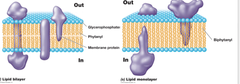
Cell membrane structure Bacteria
bilayer
primarily composed of phospholipid bilayer
Phosphoipid - glycerophosphate head + FATTY ACIDS tails connected by ESTER linkage
amphipathic
A molecule that has both a hydrophilic region and a hydrophobic region.
ex: phospholipids in Bacteria and Eukaryotic cell membranes
hydrophilic - glycerophosphate head
hydrophobic - fatty acids
Plamid
extrachromosomal DNA
Nucleoid
region inside the cell that has one closed circular chromosome
NOT nucleous
A non-membrane-enclosed region in a PROKARYOTIC cell where its chromosome is located.
Ribosomes
BACTERIA & ARCHAEA - 70S encoded by 16S RNA
50S
30S
EUKARYOTES 80S encoded by 23S
60S
40S
the ribosome of bacteria are encoded by what gene?
16S rRNA
the ribosome of Eukaryotes is encoded by what gene?
23 S
Storage inclusions
storage of nutrients, metabolic end products, energy, building blocks

Capsules
protective layers surrounding some bacterial cells
composed of polysaccharides
Organized, impermeable
enhance bacterial virulece by protecting agains phagocytosis and aiding in ADHERANCE to surfaces
protect from defication/ drying out
Slime layer
less organized than capsules
facilitates motility
precvents the cell from drying out
phagocytosis
A type of endocytosis in which a cell engulfs large particles or whole cells

polysacchorides
long chains of carbohydrates
monosaccharides - ex: glucose
capsules are made of these,
Peptidoglycan
Made of a sugar polymer and polypeptide- NAG and NAM
Cell wall of prokaryotes, but NOT ARCHAEA.
polypeptide
A polymer (chain) of many amino acids linked together by peptide bonds.
polymer
A long molecule consisting of many similar or identical monomers linked together.
flagella
A long, whip-like filament that helps in cell motility.
pattern of motility = flagellation
Many bacteria are flagellated, and sperm are flagellated.

Types of Flagella
Monotrichous - 1 flagellum
Lophorichous - cluster of flagella in 1 or both ENDS
Peritrichouse - spread over entiere surface
fimbria
A short, hairlike protein appendage of a prokaryotic cell that helps it adhere to the substrate or to other cells.
sweeps DNA
FOR attachment
often a virulence factor
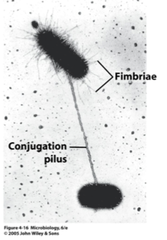
pili
long
multiprotein Appendages that allow bacteria to attach to each other and to transfer DNA
play role in twitching, gliding, motility, biofilm formation and pathogenesis

cell structure bacteria
cell wall (SOMe bacteria have it some not) - peptidoglycan (murein) layer
cell membrane
cytoplasm
Glycocalyx
The external surface of a plasma membrane that is important for cell-to-cell communication
Metabolism
teh sum of all biochemical reactions an organisms needs for life
Catabolism
Metabolic pathways that break down molecules, releasing energy.
anabolism
Metabolic pathways that construct molecules, requiring energy.
ATP
(Adenosine Triphosphate) main energy source that cells use for most of their work
Reducing Power
ability to donate electrons using electron transfer reactions - i.e. redox reactions
What is the classification of humans and why?
We are Chemo-organo-hetero-trophs
because
chemo- energy source from molecules
organo - electron donors are organic cpds
hetero - carbon source is organic compounds
Classification of organisms that use sunlight as their energy source
photo-trophs
classification of organisms whose electron donors are inorganic compounds
litho-trophs
classification of organisms that use carbon dioxide as their carbon source
auto-trophs
classification of organisms that use ORGANIC COMPOUNDS as their carbon source
hetero-trophs
classification of organisms that use organic compounds as their electron donor
organo-trophs
classification of organisms that use preformed molecules as their energy source
chemo-trophs
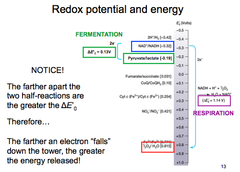
electron tower
represents a range of reduction potentials for redox couples from the most negative at the top to the most positive at the bottom
greater the difference between the E' of the donor and the E' of the acceptor --> greater reduction potential, the more ATP that is generated
reduction potential
the tendency of a substance to gain electrons
according to the electron tower what are the best pair of molecules for greatest ATP generated
best electron donnor = glucose
best electron acceptor = oxygen
Fermentation
process that follows glycolysis
its purpoe is to recycle NADH into NAD+
metabolic process converts carbohydrates into acid or alcohol
No NET GAIN of ATP
ALWAYS ANAEROBIC process
it is a substrate-level phosphoralation
Under what conditiosn does fermentation happen and why?
Occurs in ANAEROBIC environment because in presence of oxygen cell prioritizes pathways that yield the most amount of energy- Aerobic respitartion
Lactic Acid Fermentation
break down glucose into 2 pyrubate and lactic acid (in this process NADH -> NAD+
then pyrubate is metabolized by enzyme lactate into lactate
Ethanol Fermentation
glucose -> pyrubate -> acetaldehyde (toxic) and CO2 (turn NADH -> NAD+) -> ethanol
Glycolisys
Occurs in the cytoplasm
glucose, 2 ATP, NAD+ -> pyruvate
results in formation 4ATP and NADH
primery pathway for cellular respiration AND fermentation
Can microbes only do glycolysis? Why?
NO b/c has limiting factor of NAD+ - the electron carrier
Aerobic respiration
occur in plasma membrane
Glycolysis -> pyrubate -> Krebs cycle -> respiration (electron trnasport chain)
electron transfer from reduced electron donnor to external electron acceptor (OXYGEN) .
> turns NADH -> NAD+ and produces A LOT OF ATP
Oxidative phosphoralation
Anaerobic respiration
ONLY in PROKARYOTES
electron transfer from reduced electron donnor to external electron acceptor (NOT Oxygen).
> turns NADH -> NAD+ and produces A LOT OF ATP
All EUKARYOTES respire OXYGEN because...
have a mitochondria and it does not allow to use any other electron acceptor other than oxygen
also b/c multicellular organisms need more energy, The reduction potential between oxygen and glucose is really big, which gives for the best production of ATP. This is why aerobic respiration produces more ATP than anerobic respiration.
oxidative phosphorylation
steps:
1. uses energy from redox reactions in Electron transport chain to phosphorylate ADP
builds H+ concentration gradient -used to-> create a lot ATP
2. Chemiosmosis - diffusion of ions across a membrane down their concentration gradient

where does oxidative phosphorilation happen?
in plasma membrane & Electron Transport Chain
where does susbtrate-level phosphorylation occur?
in cytoplasm
substrate-level phosphorylation
uses enzyme and susbtrate to DIRECTly catalizing the transfer of a phsophate group into APT -> ATP
creates small amount of ATP during Glycolysis and Krebs Cycle

Types of Phosphorylation
Substrate-level Phosphorylation
Oxidative Phosphorilation
Main differences between fermentation and Anerobic respiration
Fermentation is a substrate-level phosphorylation meaning it directly phosphoralates ADP into ATP by breaking the chemical bonds of organic compounds
the compound is oxydized and the redox reaction with NADH -> NAD+ and a fermentation product for excretion
there is NO NET GAIN of ATP
ANAEROBIC RESPIRATION = oxidative phosphoralation -> the phosphoralation of ADP into ATP is by electron transport chain. it is not a direct process.
you also have an electron transfer from a reduced electron donor to an electron acceptor to produce a LOTof ATP
Krebs Cylce (citric acid cycle)
process during cellular respiration that breaks down a carbon molecule to produce molecules that are used in the electron transport chain
process acetyl-CoA to produce energy trhough oxydation of organic compounds -> CO2, ATP, and electron carriers (NADH and FADH2)
Minimum temperature
temperature bellow which growth is not possible
optimum temperature
temp at which growth is MOST RAPID

maximum temp
temp above which growth is not possible

Psychrophiles
microbes with low temperature optima
(cold-loving)
optimun temp 4C (fridge temp)
NOT pathogens
Psychotrophs
Organisms that grow between 0-30 degrees celsius and are responsible for most food spoilage while in the refrigerator
temperature range in which can function = in body temperature -> fridge temp
Chaperones
proteins that assist other proteins in folding/ refolding
help proteins achive corect 3D shapes
Mesophile
midrange temp optima
HUMAN PATHOGENS
can function btw 10 -45C
Thermophile
high temp optima
NO human pathogen
optimal temp 45-65C
Hyperthermophile
VERY high temp optima
65- 140C
What do Microbes need to survive? Growth factors NEED to keep in mind when cultivating colonies
- Temperature
- pH
- Water activity (salt concentration)
- micro and macronutrients
- Oxygen or lack of it
Neutrophile
grow optimally at CIRCUMNEUTRAL pH range (-> pH 5.5 - 7.9)
Acidophile
grows optimally at a enviro with pH below 5.5
acid-tolerant AND need high concentrations of protons for cytoplasmic membrane stability
** cytoplasmic pH values ALWAYS need to be near neutrality
Alkaliphile
pH optima of 8 or higher in environment
** intracellular pH ALWAYS remain near neutral pH
in media, buffers are needed to
keep the enzyme solution at optimal pH
ensures enzyme remain catalitically active and unaffected by protons or hydroxyl ions generated in enzymatic reaction
water activity
measure of water availability
depends on concentration of solutes
more solutes -> bind to water -> less water available
aw - ration of vapor pressure of air in equilibrium with a substance or solution to the vapor pressure of pure water
0 - no free water
1 - pure water
positive water balance
(normal state of cell)
cytoplasm of cell has higher solute concentration than the enviro -> tendency water to diffuse into the cell
Halophiles
require at least some NaCl to grow