BMB II test 1
 Call Kai
 Learn
Learn Practice Test
 Spaced Repetition
 Match
Match Flashcards
 Knowt Play
1/1759

There's no tags or description
Looks like no tags are added yet.
Name | Mastery | Learn | Test | Matching | Spaced | Call with Kai | Chat |
|---|
No analytics yet
Send a link to your students to track their progress
1760 Terms

What does this image reflect?
The major pathways of carbohydrate metabolism are connected, especially through glucose, glucose-6-phospate, and pyruvate
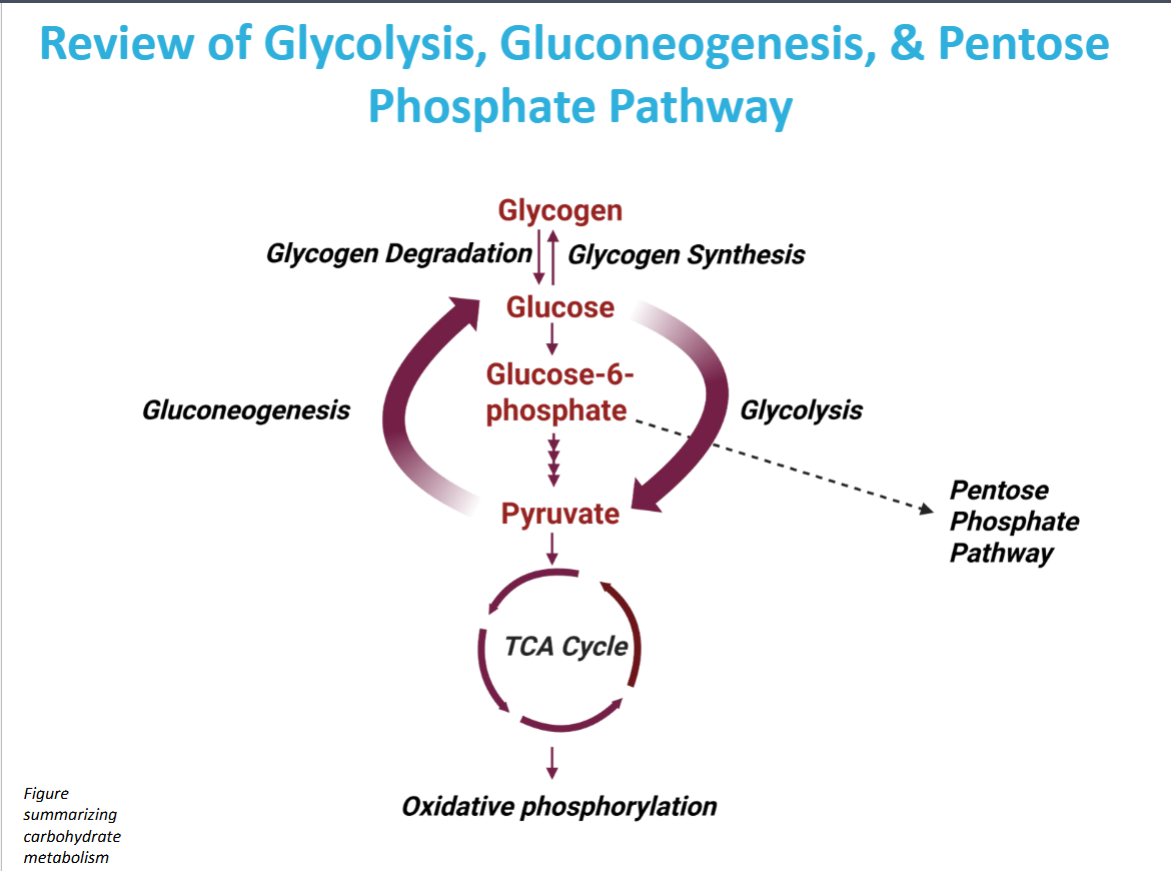
Based on the diagram, what molecule acts as the starting point connecting glycolysis, glycogen metabolism, and the pentose phosphate pathway?
Glucose-6-phospate (G6P)

Based on the diagram, what happens to glucose before it goes through glycolysis?
Glucose is converted into glucose-6-phosphate
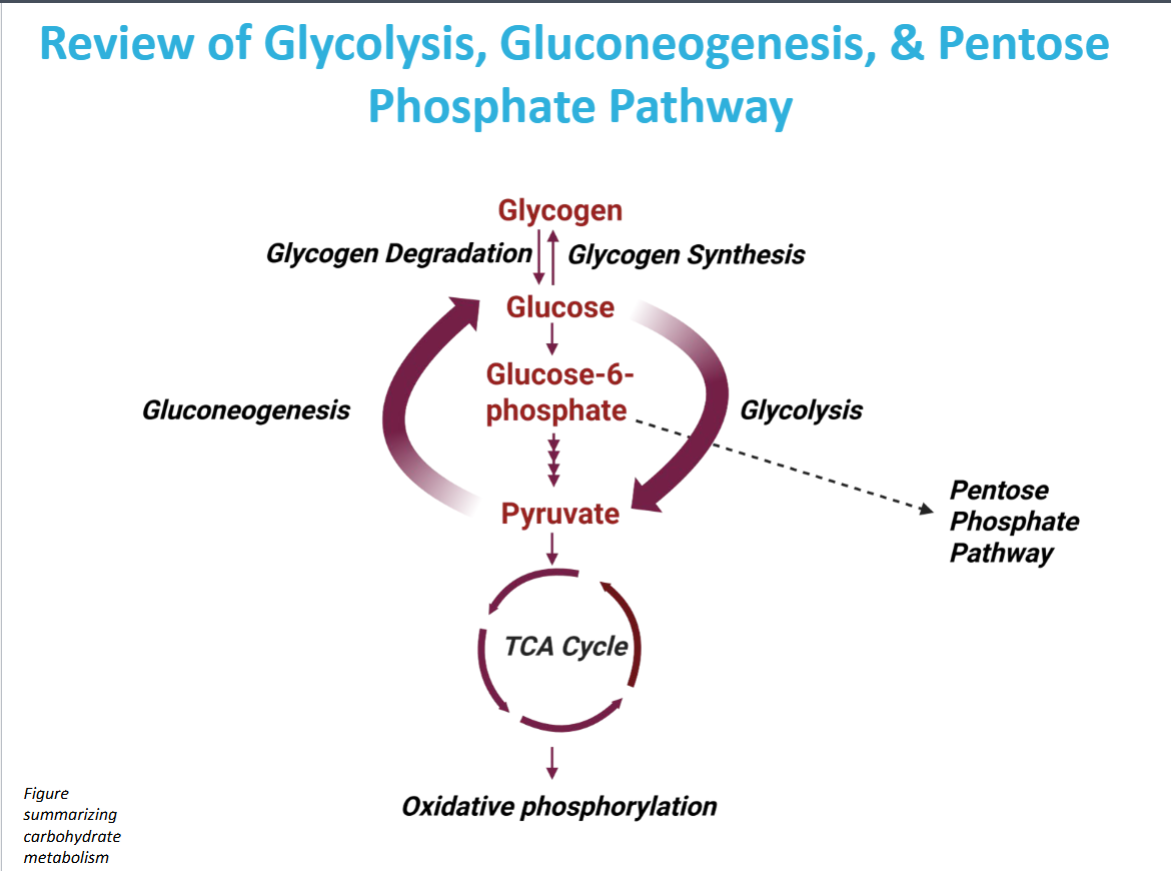
What pathway is represented by the downward movement from glucose → glucose-6-phosphate → pyruvate?
Glycolysis
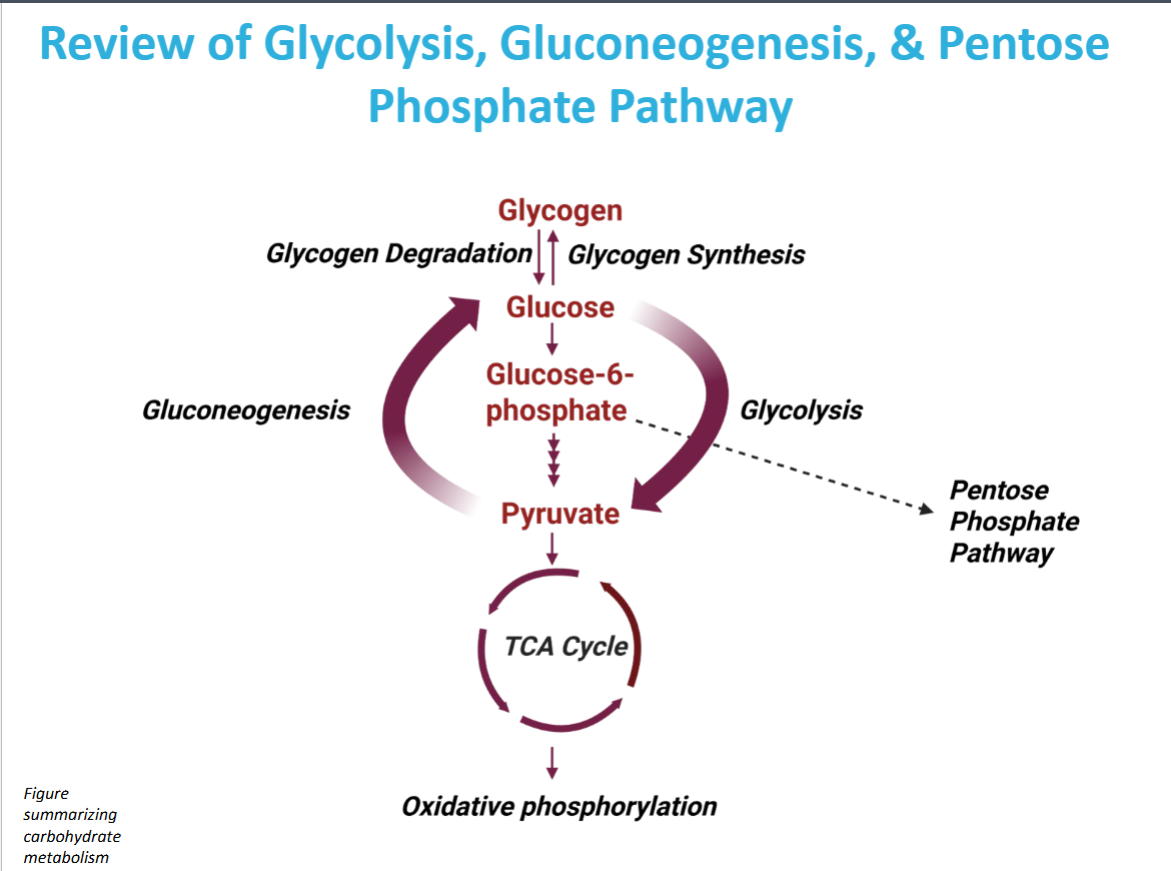
What pathway is represented by the movement from pyruvate back to glucose?
gluconeogenesis
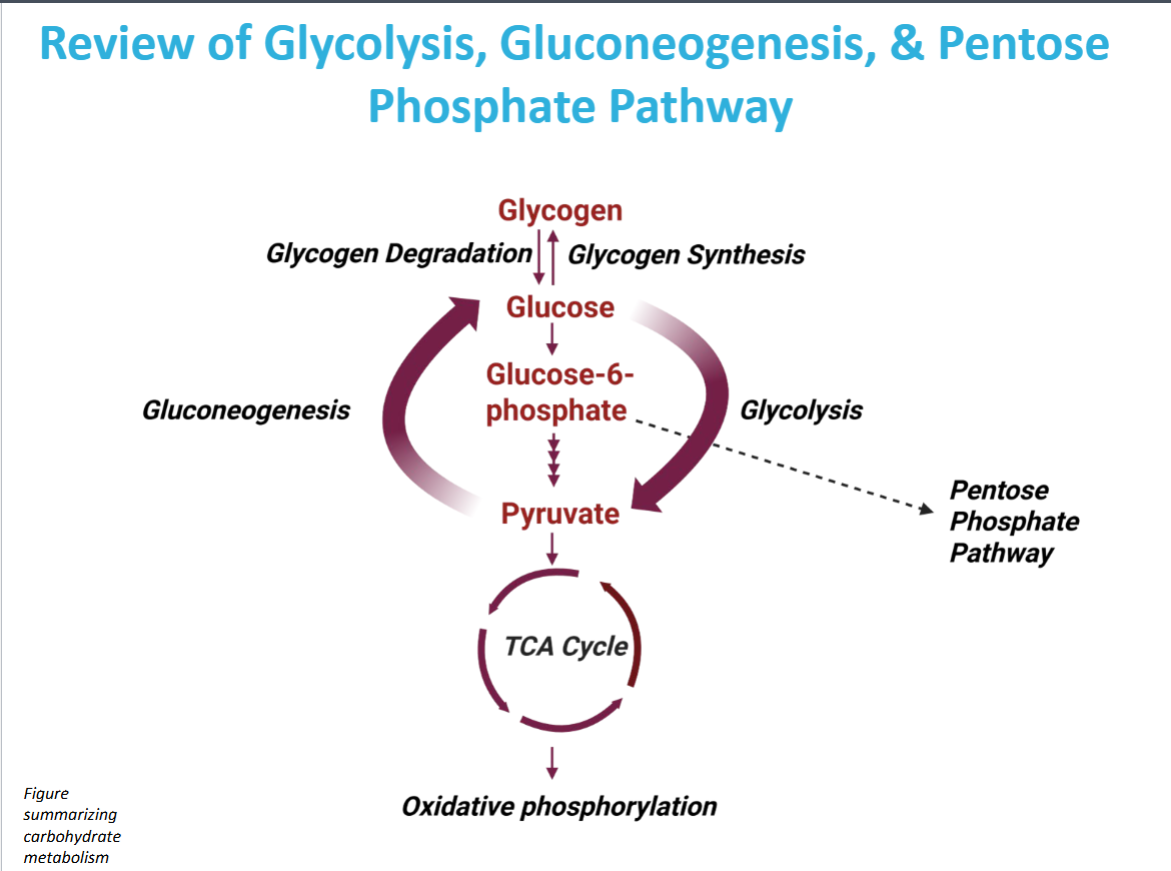
What does the dashed arrow extending from glucose-6-phospate represent?
It shows how glucose-6-phosphate can be siphoned into the pentose phospate pathway (PPP)

What storage molecule is shown at the top of the diagram?
glycogen
What process converts glucose into glycogen?
Glycogen synthesis or glycogenesis
what process converts stored glycogen back toward usable glucose
glycogen degradation or glycogenolysis

According to the diagram, what major metabolic process can pyruvate eventually feed into?
The Citric Acid Cycle (TCA) after pyruvate is converted into acetyl-CoA

What energy producing process is shown downstream of the TCA cycle?
Oxidative phosphorylation
What is the general order of the following processes:
glucose, glycolysis, oxidative phosphorylation, TCA cycle, pyruvate
Glucose→glycolysis→pyruvate→acetyl-CoA→TCA cycle→oxidative phosphorylation
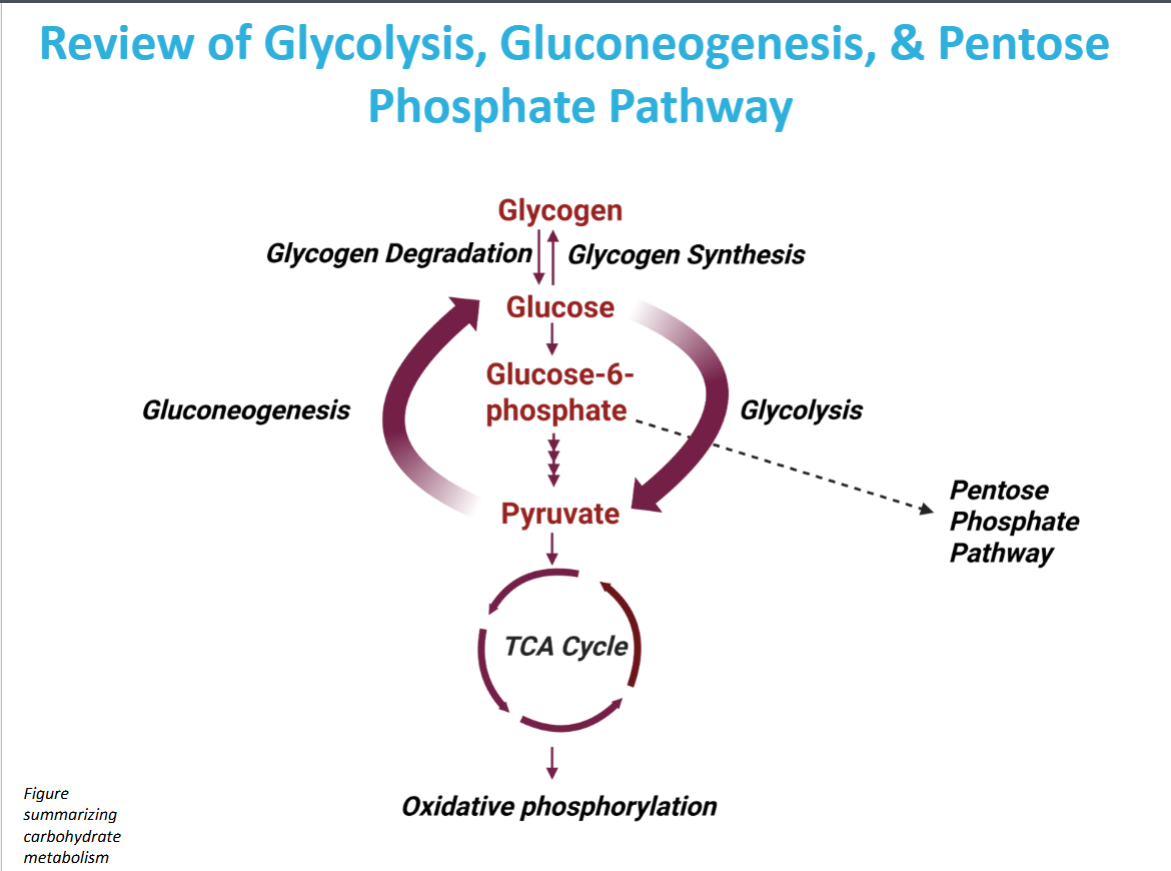
What does the two way relationship between glycogen and glucose represent?
glucose can be stored as glycogen and glycogen can be broken down to provide glucose
What is glycolysis?
The conversion of glucose to pyruvate
what molecule does glycolysis begin with?
glucose
What molecule does glycolysis end with
Pyruvate
Does glycolysis require oxygen
No. Glycolysis can occur in the presence or absence of O2
Why can glycolysis occur in both aerobic and anaerobic conditions?
The glycolytic pathway itself does not require oxygen
What is one major advantage of glycolysis as an energy producing pathway
It provides a rapid way to produce energy
How many total steps does glycolysis have?
10 steps
Which steps of glycolysis are irreversible?
Steps 1, 3, and 10
How many irreversible reactions are present in glycolysis
Three
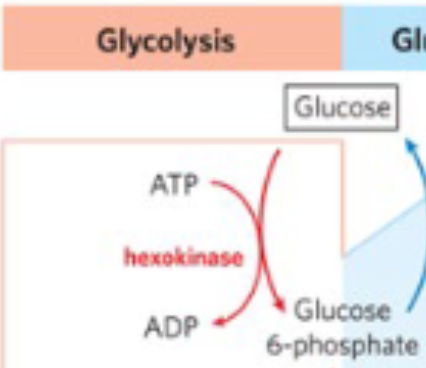
Which enzyme catalyzes irreversible step 1 of glycolysis?
Hexokinase
What reaction occurs during step 1 of glycolysis?
Glucose → glucose-6-phospate

What energy molecule is consumed during step 1 of glycolysis?
ATP which is converted to ADP

Which enzyme catalyzes irreversible step 3 of glycolysis?
Phosphofructokinase-1 (PFK-1)
What reaction occurs during step 3 of glycolysis?
Fructose-6-phospate → fructose-1,6-bisphosphate
What energy molecule is consumed during step 3?
ATP which is converted to ADP


Which enzyme catalyzes irreversible step 10 of glycolysis?
Pyruvate Kinase
What reaction occurs during Step 10 of glycolysis?
Phosphoenolpyruvate (PEP) → pyruvate
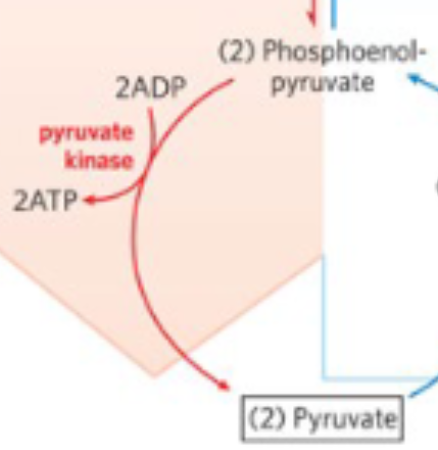
What energy molecule is produced during the pyruvate kinase reaction
ATP

What enzyme catalyzes the rate limiting step of glycolysis?
Phosphofructokinase 1 (PFK/PFK-1)
What enzyme catalyzes the committed step of glycolysis?
PFK 1
Which step of glycolysis is the rate limited and committed step?
Step 3
What does it mean for PFK to catalyze the “rate limiting step” of glycolysis
This step plays a major role in determining the overall rate of glycolysis
What does “committed step” mean in glycolysis?
Once the molecule passes this step it is committed to proceeding through glycolysis
Why is step 3 of glycolysis important compared with many other glycolytic reactions
It’s irreversible, rate-limiting, and the committed step of glycolysis
Is the first irreversible reaction neccesarrily the committed step of glycolysis?
No, step 1 is irreversible but step 3 catalyzed by PFK is the committed step

Based on the diagram what are the three enzymes highlighted at irreversible glycolytic reactions?
Hexokinase, phosphofructokinase-1, and pyruvate kinase

Why does gluconeogenesis use different enzymes around the irreversibel glycolytic steps?
because steps 1, 3, and 10 of glycolysis are irreversible so gluconeogenesis must use different reactions to move in the oppsoite direction
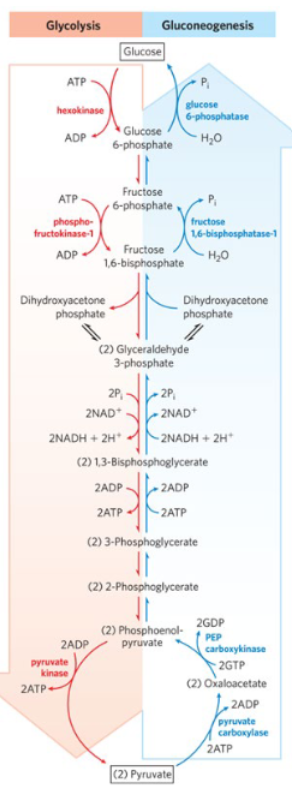
what glycolytic intermediate is produced immediately after glucose?
Glucose-6-phosphate
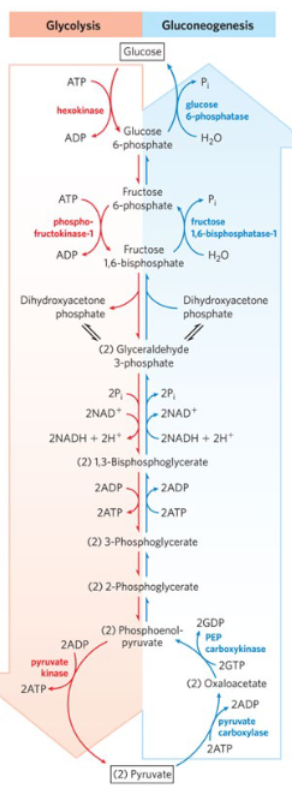
What molecule is converted into fructose-1,6-bisphosphate?
Fructose-6-phosphate

What 6 carbon molecule is split into smaller molecules during glycolysis?
Fructose-1,6-bisphosphate
If PFK activity changes why could this affect glycolysis
Because PFK catalyzes the rate-limiting and committed step of the pathway
What is gluconeogenesis
The resynthesis of glucose from non-sugar sources (amino acids, lactate, glycerol)
what is the overall purpose of gluconeogenesis
to produce glcuose from molecules that are not sugars
what are three non sugar sources of glucose used in gluconeogenesis
amino acids, lactate, glycerol
How does the overall direction of gluconeogenesis compare with glycolysis
They generally proceed in opposite directions
What is the primary organ responsible for gluconeogenesis
the liver
approximately what percentage of gluconeogenesis occurs in the liver
75%
aside from the liver what other organs can perform gluconeogenesis
the kidneys and intestines
Does gluconeogenesis require energy
yes it requires a lot of energy
why can gluconeogenesis be thought of as an energy consuming pathway rather than an energy producing pathway
beacuse the pathway requires substantial energy to resynthesize glucose
How is gluconeogenesis pathway related to glycolysis
it is largely the reverse of glcyolysis
is gluconeogenesis the exact reverse of glycolysis
no it needs to bypass glycolysis’ irreversible steps
What must gluconeogenesis do at the irreversible glyvolytic steps
it must bypass them using alternative reactions

What two enzymes are shown helping gluconeogenesis bypass the pyruvate kinase reaction
pyruvate carboxylase and PEP carboxykinase

What enzyme bypasses the phosphofructokinase-1 reaction during gluconeogenesis
Fructose-1,6-bisphosphatase

What enzyme bypasses the hexokinase reaction during gluconeogenesis
glucose-6-phosphatase
If glycerol is being used to resynthesize glucose, what pathway is occuring
gluconeogenesis
What molecule enters the pentose phosphate pathway (PPP)?
Glucose-6-phosphate

What are the two phases of the pentose phosphate pathway
oxidative and nonoxidative phases

which phase of the pentose phosphate pathway is irreversible
the oxidative phase

which phase of the pentose phosphate pathway is reversible
nonoxidative phase

what are two major purposes/products of the pentose phosphate pathway
Production of NADPH and ribose-5-phosphate

What is the starting molecule of the oxidative phase of the pentose phosphate pathway
Glucose-6-phosphate

what intermediate is formed from glucose-6-phosphate during the oxidative phase
6-phosphogluconate
what molecule is produced from 6-phosphogluconate
ribulose-5-phosphate

what important reducing molecule is produce during the oxidative phase
NADPH

What molecule is converted to NADPH during the oxidative phase?
NADP+

How many NADPH-producing reactions are shown in the oxidative phase
TWo
what molecule is released during the conversion of 6-phosphogluconate to ribulose-5-phosphate
CO2
Is the oxidative phase of the PPP reversible
No it is irreversible

What are the two major uses of NADPH
glutathione reduction and reductive biosynthesis

What enzyme uses NADPH in the glutathione system
glutathione reductase
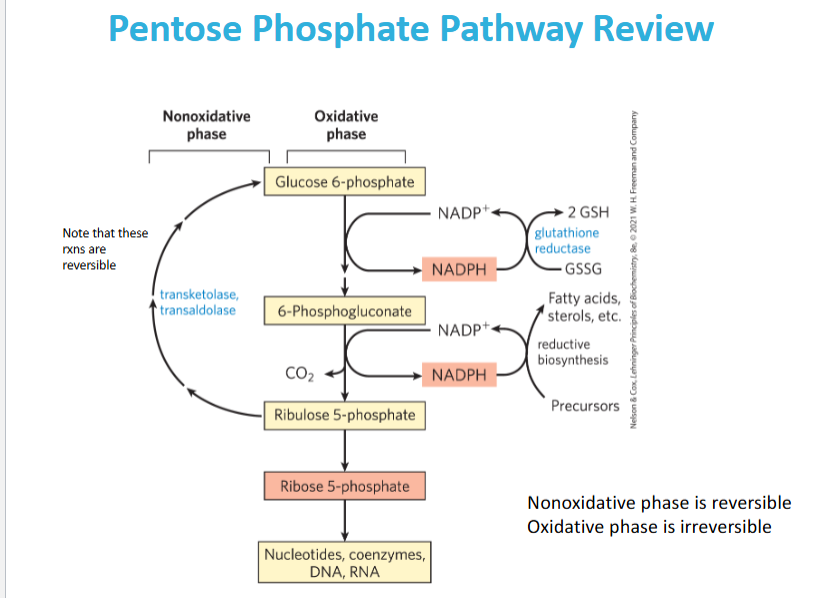
What does glutathione reductase convert using NADPH
GSSG → 2 GSH
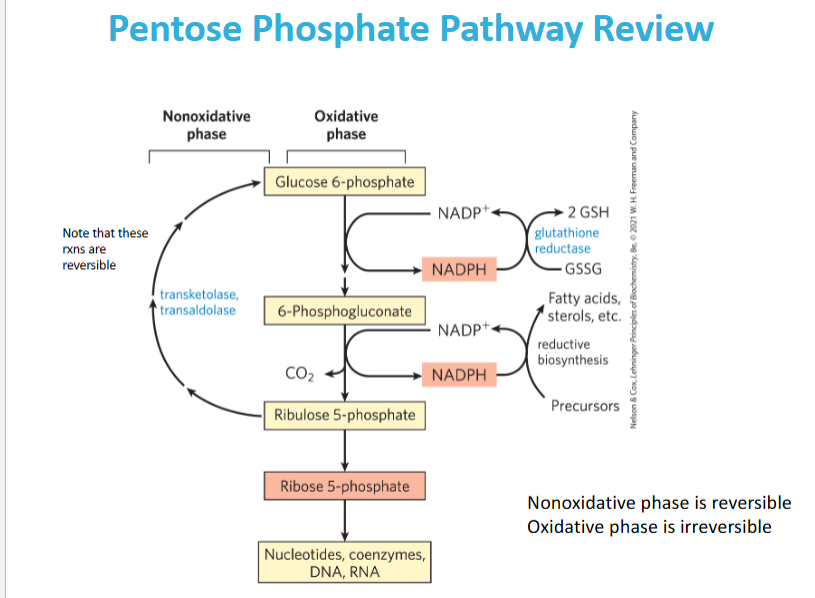
What types of molecules are listed as products of NADPH-dependent reductive biosynthesis
Fatty acids and sterols
If a cell needs reducing power for fatty acid or sterol synthesis what PPP product is important
NADPH
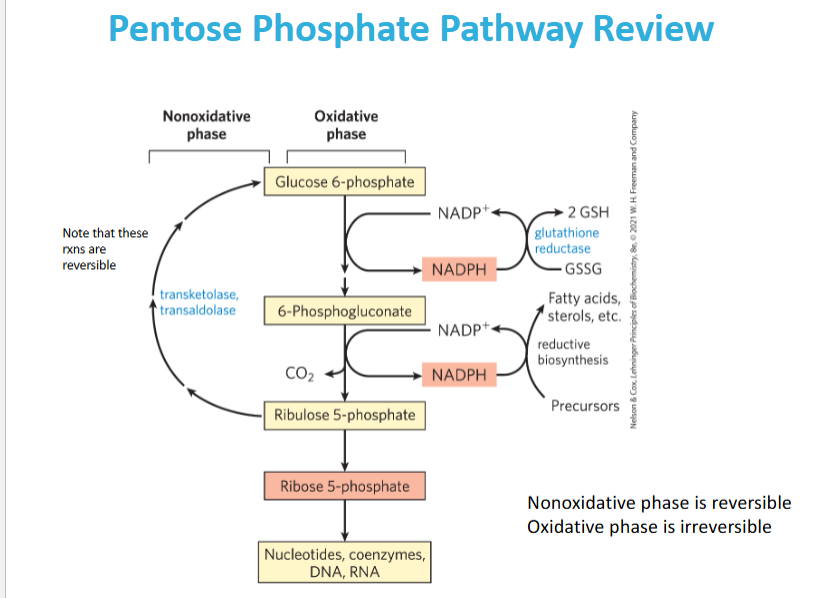
What is ribulose-5-phosphate converted into in the Pentose Phosphate Pathway
Ribose-5-Phosphate

What is ribose-5-phosphate used to produce
nucleotides, coenzymes, DNA, and RNA

What Pentose Phosphate Pathway product is especially important for nucleotide and nucleic acid production
Ribose-5-phosphate
If a cell needs to make DNA or RNA, which product of the PPP would be useful
Ribose-5-phosphate

Is the nonoxidative phase of the Pentose Phosphate Pathway reversible or irreversible
Reversible
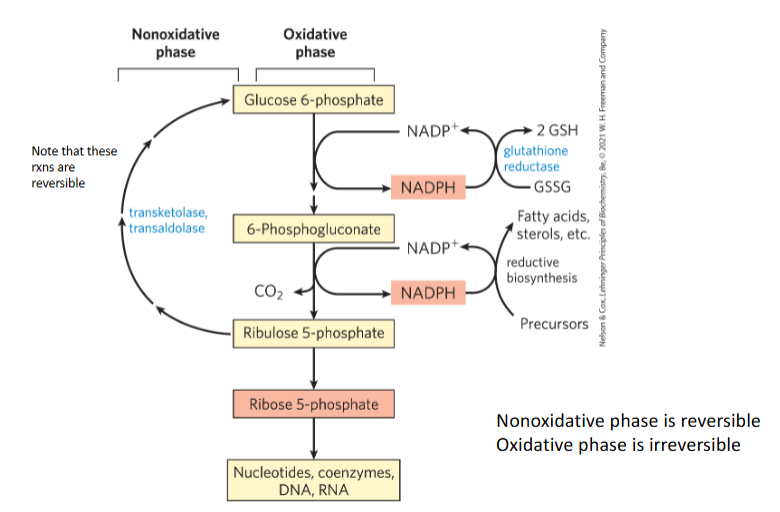
What two enzymes are highlighted in the nonoxidative phase?
Transketolase and transaldolase
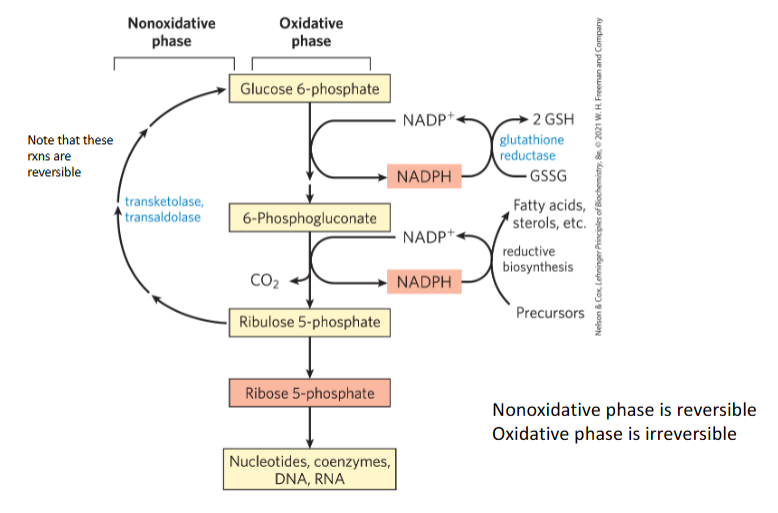
What important feature of the transketolase/transaldolase reactions are emphasized in the diagram
the reactions are reversible
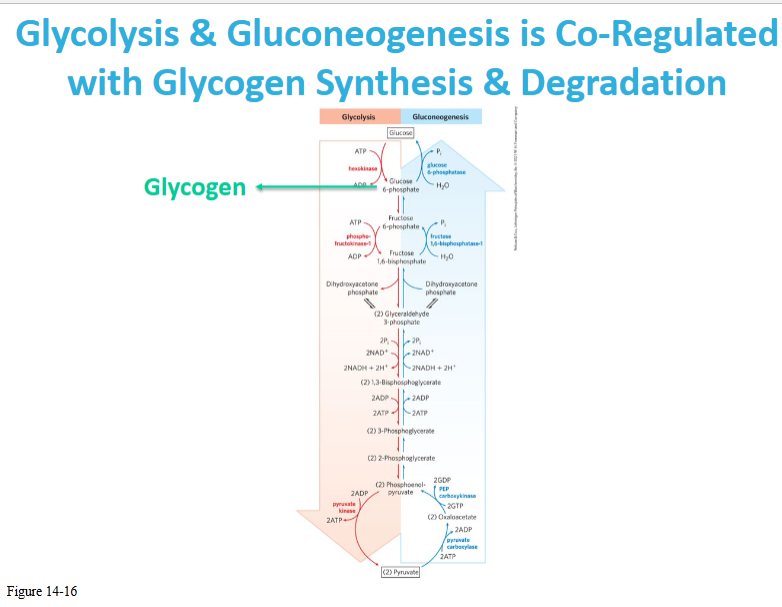
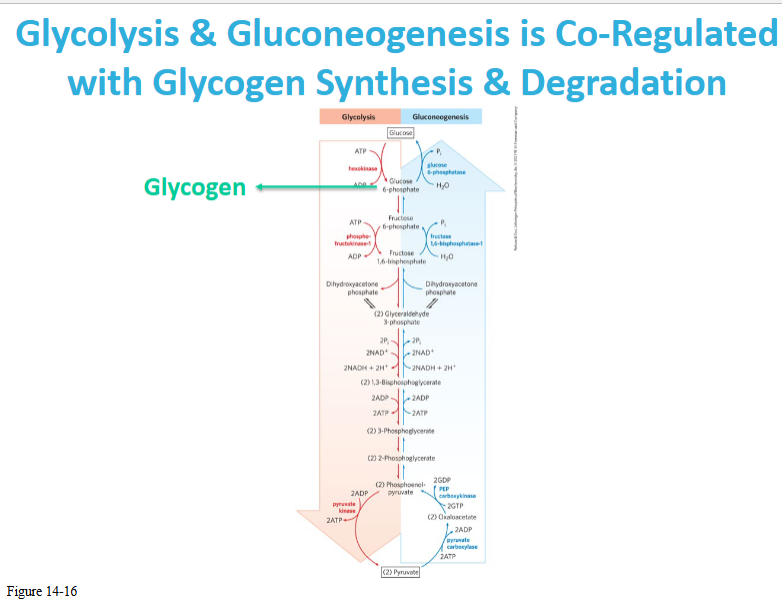
What metabolic pathways does this slide show as being coregulated
Glycolysis, gluconeogenesis, glycogen synthesis, and glycogen
What does it mean when pathways are coregulated
their activities are coordinated with one another so glucose can be appropriately used, produced, and stored
Why would glycolysis and glycogen metabolism need to be coordinated
because glucose can either be used for energy through glycolysis or stored as glycogen
why would gluconeogenesis and glycogen metabolism need to be coordinated
both are involved in controlling the availability of glucose
What is glycogen
storage form of glucose
what is glycogen synthesis
process of storing glucose as glycogen
what is glycogen degradation
process of breaking down glycogen to make stored glucose available
what important glucose intermediate is located near the glycogen branch shown in the figure
glucose-6-phosphate
why wouldn’t it make metabolic sense to strongly promote glucose breakdown and glucose production at the same time?
they have opposing metabolic purposes which is why their activity needs to be coordinated
structurally, what is glycogen?
a branched polymer of glucose
what does it mean that glycogen is a polymer of glucose
glycogen consists of many glucose molecules that are linked together
What is the overall purpose of glycogen storage
to store glucose for later use
What are the two main sites of glycogen storage
liver and muscle
what is the primary role of glycogen stored in the liver
it helps maintain blood glucose levels
what is the primary role of glycogen stored in muscle
it provides a source of glucose for the muscles