NRSE210 Exam #2 part 1
 Call Kai
 Learn
Learn Practice Test
 Spaced Repetition
 Match
Match Flashcards
 Knowt Play
1/122

There's no tags or description
Looks like no tags are added yet.
Name | Mastery | Learn | Test | Matching | Spaced | Call with Kai | Chat |
|---|
No analytics yet
Send a link to your students to track their progress
123 Terms
Epidermis locations and regrowth general information
outer layer, avascular, thin and tough
replaced every 4 weeks
mostly thin except in places with high friction (palms and soles of feet)
Dermis general information
inner supportive layer, consists mostly of connective tissue and collagen
tough and elastic, allows for stretching, resist tearing
Dermis makeup
nerves, sensory receptors, blood vessels, lymphatics, hair follicles, sabacous glands, sweat glands
Subcutaneous layer makeup
Fat (adipose tissue)
Subcutaneous layer function
energy storage, insulation, cushioning, aids mobility of skin over underlying structures
Hair information
comes out of follicles
growth cycle is active and resting phase
2 types: vellus and terminal hair
Vellus hair
fine, faint, covers most of the body
arms, face, legs
Terminal hair
Darker, thicker
on scalp, evebrows, axillae, pubic area, face and chest of men
Sabaceous glands (produces and secretion site)
sebum
hair follicle
sebum functions
lubricates skin and hair, prevents water loss, antibacterial properties
Distribution of sebaceous glands
everywhere but palms and soles of feel
abundant on scalp, forehead, face, chin
two sweat gland types
eccrine and apocrine
Eccrine sweat gland (description, function)
coiled tubules that open directly to the surface
produce sweat (water and salt) and important for temperature regulation
Apocrine sweat gland (description, function, body odor cause)
open into hair follicles
located in axillae, nipples, anogenital area. produce thick oily secretion (becomes active at puberty
cause by bacterial action on secretion
Nails (parts and description)
lunula and cuticle
hard plates of keratin
Lunula
white, crescent- shaped area at nail base where new keratin cells form
Cuticle
protects nail matrix by covering and sealing space between nail plate and skin
Function of skin (8)
protection, perception, temperature regulation, identification, communication, wound repair, absorption/ secretion, production of vitamin D
Subjective data: previous history of the skin
allergies, hives, psoriasis, eczema
changes in mole
dryness or moisture
pruritus or excessive bruising, rash/lesion
medications
hair loss, change in nails, self care
enviorment/ job hazards
pruritus
sensation of itching on the skin
Equipment for skin objective data collection
good lighting, small centimeter ruler, penlight, gloves
vitiligo
absence of melanin; autoimmune destruction of pigment (patches with no melanin, genetic)
skin danger signs ABCDE
Asymmetry (both sides look similar)
Border irregularity (fuzzy, blending edges)
Color variation (uniform vs dark)
Diameter (< 6mm is likely benign)
Elevation/ evolution changes
Pallor
color pigmentation changes
paleness, stress, anxiety, fear
blood vessels constrict
seen with anemia
Erythema
color pigmentation changes
redness
dilated superficial capillaries
local inflammation
blushing, warmth
cyanosis
bluish color; decreased perfusion and oxygenation
jaundice
yellow color due to increased bilirubin; visible in sclera and mucous membrane
checking mobility and turgor
pinch skin to check elasticity; should return to normal quickly
tending = dehydration
Lesions: observe for 6 factors
color
elevation
patter/ shape
measurement (size)
location
distribution
Hair (inspection and palpate details)
distribution, texture, excess hair growth
separate hair into sections to examination scalp
Nail shape
normal 160 degrees
clubbing 180 degrees
curved nail 160 degrees or less (no concern)
capillary refill
depress nail edge, color should return in 2 seconds or less
Skin lesions: annular
circular, begins at center and spreads to the periphery (ex. ringworm)
Skin lesions: confluent
lesions that run together (ex. hives)
Skin lesions: discrete
distinct, individual lesions that remain separate (ex. acne, skin tags)
Skin lesions: grouped
clusters of lesions (ex. vesicles of contact dermatitis)
Skin lesions: gyrate
twisted, coiled, spiral, or snake line (ex. ringworm)
Skin lesions: target (or Iris)
resembles the Iris of an eye, concentric rings of color in the lesion (ex. erythema multiforme)
Skin lesions: linear
scratch, streak, line
Skin lesions: polycyclic
annular lesions that grow together, run in groups (ex. psoriasis)
Skin lesions: zosteriform
linear arrangement along a unilateral nerve route (ex. shingles, herpes)
Skin lesions: macule
primary skin lesion
flat, circumscribed, < 1 cm (ex. freckles)
Skin lesions: papule
primary skin lesion
elevated, firm <1 cm (ex. wart)
solid, no fluid
Skin lesions: patch
primary skin lesion
flat, > 1cm (ex. vitiligo)
macule > 1 cm
Skin lesions: plaque
primary skin lesion
papules grouped to form a surface elevation >1 cm
Skin lesions: nodule
primary skin lesion
solid, elevated > 1 cm (ex. psoriasis)
Skin lesions: wheal
primary skin lesion
superficial, raised, transient, irregular shape, red (ex. mosquito bite)
Skin lesions: tumor
primary skin lesion
1g, solid grwoth, > 102 cm
benign/ malignant
Skin lesions: Urticaria (hives)
grouped wheals
primary skin lesion
very pruritic (itchy)
Skin lesions: vesicle
primary skin lesion
elevated cavity containing clear fluid < 1 cm (ex. blister)
Skin lesions: bulla
primary skin lesion
>1cm, elevated, easily ruptured (ex. thin blister)
Skin lesions: cyst
primary skin lesion
encapsulated, fluid filled, elevating the skin
Skin lesions: pustule
primary skin lesion
pus- filled cavity (ex. acne)
Skin lesions: crust
secondary skin lesion
thickened, dried up
ex. scab
Skin lesions: scale
secondary skin lesion
compact, desiccated flakes of skin
ex. psoriasis
Skin lesions: fissure
secondary skin lesion
linear crack with abrupt edges
ex. athletes foot
Skin lesions: erosion
secondary skin lesion
scooped out, shallow depression
moist, no bleeding, heals without scar
Skin lesions: ulcer
secondary skin lesion
deep depression into dermis, irregular shape, may bleed
leaves scar
Skin lesions: exoriation
secondary skin lesion
self inflicted abrasion, superficial, sometimes crusted
ex. scratching
Skin lesions: scar
secondary skin lesion
normal tissue replaced with connective tissue after surgery
Skin lesions: lichenification
secondary skin lesion
thickened skin from prolonged scratching
Skin lesions: keloid
secondary skin lesion
hypertrophic scar, excess scar tissue beyond wound edges
primary skin lesion definition
happen on their own and can evolve into secondary
secondary skin lesion definition
result of underlying primary lesions or external factors
how do pressure ulcers happen, where do they happen, and who's at risk for them?
caused by localized ischemia from unrelieved pressure, tissue compression (causing decrease blood flow)
often occur on bony prominences
immobile or bed bound patients, elderly, malnourished
stages of pressure ulcers
stage 1: non blanchable erythema of intact skin (epidermis)
stage 2: partial thickness skin loss, shallow ulcer with pink wound or blister (dermis)
stage 3: full thickness loss of skin, into subcutaneous fat (hypodermis)
stage 4: full thickness skin loss, exposed bone, tendon, or muscle
cranial bones
frontal, parietal, occipital, temporal
Facial bones
14 total, articulate at surface
mandible
only movable facial bone
mastoid process
boney prominence behind the ear, part of the temporal bone
cervical vertebrae (job)
support the head (C1- C7)
C7
vertebra prominence, palpable landmark on base of the neck
Cranial nerve VII
control facial muscles
salivary glands: parotid
in the cheeks, in front of the ear
salivary glands: submandibular
beneath mandible at angle of jaw
salivary glands: sublingual
floor of the mouth under the tongue, smallest, no palpable
Temporal artery
side of the forehead
palpable, smaller than other arteries
Major muscles in the neck
sternomastoid, trapezius
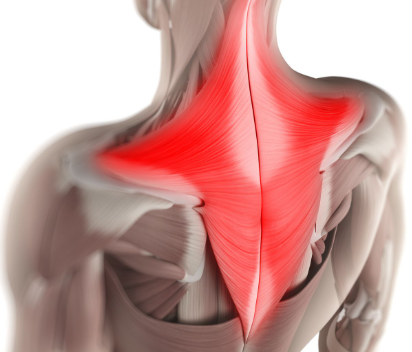
Trapezius (location and function)
back of the head to shoulders, occipital bone to scapular and clavicles
Function: turning head, moving shoulders, extending head
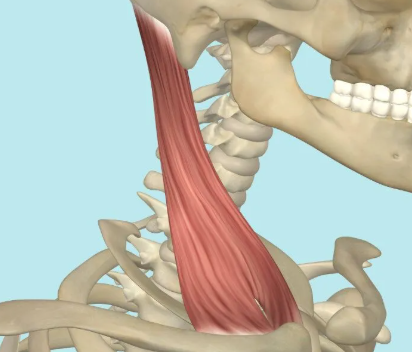
Sternomastoid (location and function)
sternum to mastoid (behind ear)
head rotation and flexion
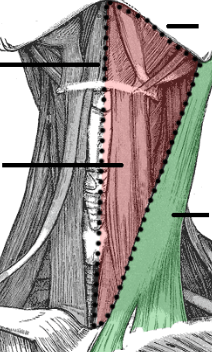
neck triangle: antierior triangle (location)
in front of sternomastoid (RED)
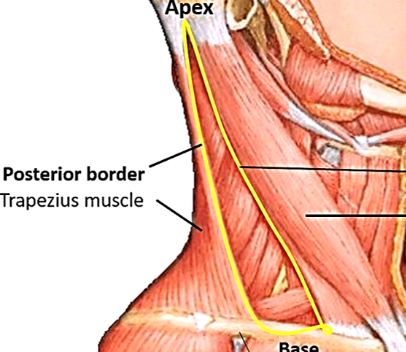
neck triangle: posterior triangle (location)
behind sternomastoid, bordered by trapezius and clavicle
thyroid gland (makeup, location, function)
endocrine gland with two lobes connected by thin isthmus
straddles trachea
stimulates rate of cellular metabolism; affects weight
cricoid cartilage (location)
1 cm above isthmus; upper trachea ring
thyroid cartilage (location)
above cricoid
Forms Adams apple in men
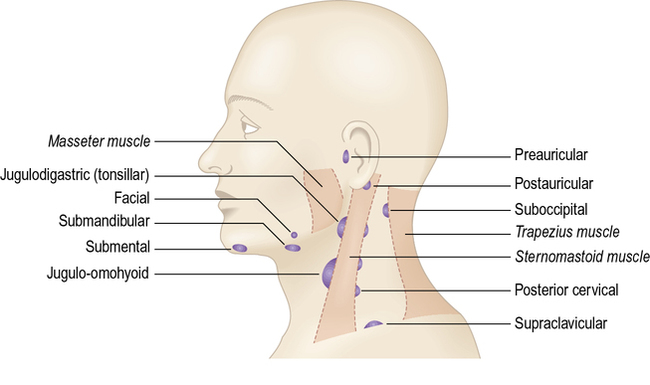
lymph nodes order (1-5)
1) preauricular
2) post auricular
3) occipital
4) submental
5) submandibular
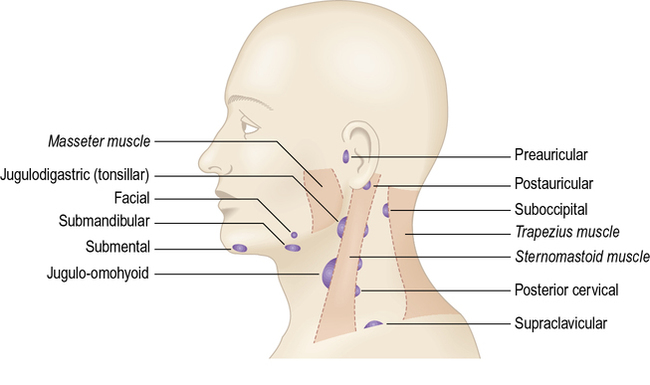
lymph nodes (6-10)
6) jugulodigastric
7) superficial cervical
8) deep cervical
9) posterior cervical
10) supraclavicular
subjective data for head/ neck
headaches
past injury to head or surgery
dizziness
neck pain
lumps/swelling
Objective data: head and neck
skull- inspect and palpate (normal cephalic, smooth symmetrical)
Temporal artery: palpate
TMJ: palpate both sides of jaw and ask patient to open and close
Face: symmetrical, facial expressions
CN VII test
smile, puff up cheeks, raise eyebrows
CN XI test
shoulder shrug and head turn against resistance
Tension headache (origin, pain, triggers, Tx)
musculoskeletal origin
gradual onset, bilateral, mild- moderate pain
Triggers: stress, fatigue, dehydration
Tx: rest, massage, tylenol
Migraine (origin, pain, triggers, Tx)
vascular/ nerve origin, genetic, more common in women
moderate- sever, throbbing, unilateral/bilateral
Trigger: hormones, food, sleep, weather, N/V
Tx: rest in a dark, quiet room, meds, NSAIDs
NSAID
Non-Steroidal Anti-Inflammatory Drugs.
reduce pain, inflammation, and fever -
Examples of NSAIDs include ibuprofen, naproxen, and aspirin.
Tx
treatment
Cluster headache (origin, pain, triggers, Tx)
around/ behind the eye, temporal
unilateral, severe, more common in men
Triggers: strong smells, alcohol
Tx: oxygen therapy, calcium channel blockers
simple diffuse goiter
thyroid enlargement, iodine deficiency
pilar cyst (wen)
benign scalp, cyst, shiny, smooth
parotid gland enlargement
mumps, duct inflection/ blockage, unilateral swelling
grave’s disease (definition, effects)
hyperthyroidism
increase metabolic rate, goiter, bulging eyes, weight loss, tachycardia, anxiety