ANSC 107
 Call Kai
 Learn
Learn Practice Test
 Spaced Repetition
 Match
Match Flashcards
 Knowt Play
1/128

There's no tags or description
Looks like no tags are added yet.
Name | Mastery | Learn | Test | Matching | Spaced | Call with Kai | Chat |
|---|
No analytics yet
Send a link to your students to track their progress
129 Terms
Ad Libitum
Allowing animals to eat all they want at any time.
Compensatory Growth
Increased growth rate in response to previous undernourishment.
Calorie
The amount of heat required to raise the temperature of 1 gram of water from 14.5 degrees Celsius to 15.5 degrees celcius.
Kilocalorie
Equivalent to 1000 calories
Concentrate
A feed that is high in energy, low in fiber, and highly digestible.
T.D.N (Total Digestible Nutrients)
Includes the total amount of digestible protein, nitrogen-free extract, fiber, and fat (x2.25) all added together, approximates energy content.
Roughage
Feed that is high in fiber, low in digestible nutrients, and low in energy. Feeds such as hay, silage, straw, and pasture are examples.
Feeder
Animals which need further feeding prior to slaughter.
Fill
The contents of the digestive tract.
Carcass Merit
The value of a carcass for consumption.
Dark Cutter
Color of the lean in the carcass, has a dark appearance usually caused by stress to the animal prior to slaughter.
Contemporary Group
Set of animals of the same age, gender and breed that have been raised under similar environmental and management conditions.
Breed
Animals having a common origin and characteristics that distinguish them from other groups within the same species.
Scurs
Small horn-like tissue attached to the skin of polled or de-horned animals.
Cull
To eliminate from the breeding population.
Identification Systems (5 items)
Branding (hot and freeze)
Ear tagging
tattoo
Microchip
Retinal scanning
Fertility
The capacity to initiate, sustain, and support reproduction.
Open
Refers to a non-pregnant female.
Haploid
Half the normal number of chromosomes. Found in sperm and ova.
A.I.
Artificial Insemination
Clone
An individual grown from a single somatic cell of its parent and generally identical to it.
Estrus or Heat
The period of mating activity in the female
Estrous
An adjective meaning “heat” that modifies such words as “cycle.” Estrous cycle is the heat cycle, or time from one heat period to the next.
equine- 21 days
Bovine-21 days
Porcine-21 days
Ovine-17 days
Caprine-21 days
Estrus Synchronization
Controlling the estrous cycle so that high percentage of the females in the herd express estrus at the same time.
Gestation
Term of pregnancy
Equine-340
Bovine-283
Porcine-113
Ovine-147
Caprine-147
Dystocia
Difficult birth
Anestrous Period
The time when a female is not cycling. She is not experiencing estrus and thereby will not breed. `
Castration
Removing the testicles
Spaying
The removal of the ovaries from the female reproductive tract (most often done in cats and dogs).
Colostrum
The first milk given by the female following delivery of her young. Contains high levels of antibodies which are absorbed by the young for quick immunity.
Lactation Period
Period that female produces milk.
Dry
Refers to a non-lactating female (mare, cow, ewe, sow).
Weaning
Separating an offspring animal from its dam (mothering).
Male of breeding age (Bovine)
Bull
Mature Female (Bovine)
Cow
Immature female (Bovine)
Heifer
Newborn (Bovine)
Calf
Unsexed Male (Bovine)
Steer
Groups (Bovine)
Herd
Genus (Bovine)
Bos
Act of Parturition (Bovine)
Calving
Male of breeding age (Equine)
Stallion
Mature Female (Equine)
Mare
Young Male (Equine)
Colt
Young Female (Equine)
Filly
Newborn (Equine)
Foal
Unsexed male (Equine)
Gelding
Groups (Equine)
Herd
Genus (Equine)
Equus
Act of Parturition (Equine)
Foaling
Male of breeding age (Porcine)
Boar
Mature Female (Porcine)
Sow
Young Female (Porcine)
Gilt
Newborn (Porcine)
Pig
Unsexed Male (Porcine)
Barrow
Groups (Porcine)
Drove
Genus (Porcine)
Sus
Act of Parturition (Porcine)
Farrowing
Male of breeding age (Caprine)
Billy
Mature Female (Caprine)
Doe
Young male (Caprine)
Billy kid
Young Female (Caprine)
Doe kid
Newborn (Caprine)
Kid
Unsexed male (Caprine)
Wether
Groups (Caprine)
Band
Genus (Caprine)
Capra
Act of Parturition (Caprine)
Kidding
Male of breeding age (Ovine)
Ram
Mature Female (Ovine)
Ewe
Young Male (Ovine)
Ram Lamb
Young Female (Ovine)
Ewe Lamb
Under 1 year old (Ovine)
Lamb
Unsexed Male (Ovine)
Wether
Groups (Ovine)
Flock
Genus (Ovine)
Ovis
Act of Parturition (Ovine)
Lambing
Sire breed
Fast growing, muscular, late maturing, and low milking.
Maternal Breeds
Early maturing sexually, inherently fertile, moderate to heavy milking, and small to moderate size.
Composite/ Cross breed
Display desirable traits from multiple breeds, fast growing, hardy, and productive.

Black, naturally polled, moderate size.
Excellent marbling, early compositional maturity.
Excellent maternal breed, easy fleshing, good milk production.
Early maturing sexually.
Largest number of annual registration in United States.
Angus (Scotland- Bos Taurus (British))

Red with white face, also white on underline, switch etc.
Moderate size, adaptable to many environments, good disposition.
Poorest marbling of the British breeds.
——— are horned; polled ———- are polled.
Hereford/Polled Hereford (England- Bos Taurus (British))

3 major colors- red, white and roan.
Moderate size, good disposition, and excellent milk production.
Can be considered dual purpose via milking ———- lines.
Has appendix registry program which allows outside genetics to be introduced and offspring to still be registered.
Shorthorn (England- Bos Taurus (British))

White, off-white to cream coloration, some pigmentation of skin possible.
Extremely fast growing, muscular breed that is fast maturing.
Large framed with relatively heavy birth weights and large, mature size.
Produced lean, muscular carcasses, marbling can be a problem.
Below average maternally
Charolais (France- Bos Taurus (European))

One of the world’s oldest breeds.
Originally had short, straight off-white hair coat with black skin pigmentation
Prominent color today is black hair coat and black skin pigmentation.
Extremely large framed, late maturing breed that is fast growing.
Has had a tremendous impact on the “show steer” industry in US.
Produce lean, muscular carcasses, marbling is typically problematic.
Below average maternal characteristics.
Chianina (Italy-Bos Taurus (European))

Originally reddish gold in color with pink nose pigmentation and horns. (Today they are mostly black)
-Black polled with black pigmentation and polled are acceptable within breed standards today.
Moderate sized that will finish at <1200 pounds.
Produce extremely lean, muscular carcasses but difficult to grade choice.
Below average maternally, somewhat lacking in milk production.
Limousin (France- Bos Taurus (European))

The American ——- is a cross of 3 Indian breeds.
Both red and gray strains of ——— exist, both have black pigmentation, horned.
Noted for heat tolerance, disease and insect resistance and crossing ability.
Poor marbling ability, and slow sexually maturity is offset by their ability to thrive in hot, humid, environments in the Southern US.
——— composites (Brangus, Santa Gertudis, Beefmaster, Bradford, Simbrah, etc).
Brahman (Indian- Bos Indicus)

5/8 Angus and 3/8 Brahman, black and naturally polled.
Excellent mothering ability, moderate size, early sexually maturing, heat tolerance and forage ability result from the 2 parent cross.
Intermediate in carcass merit between the 2 parent breeds.
Most “widespread” composite breed in the U.S.
Brangus (United States- Bos Indicus)

5/8 Shorthorn and 3/8 Brahman, dark red, both polled and horned.
Developed on the King Ranch in Kingsville, TX by founder Robert J. Kleberg
Breed traces back to single sire.
Noted for maternal ability productivity under hot, adverse conditions, and overall hardiness.
Composite breed.
Santa Cruz composite developed at King Ranch (50% Santa Gert., 25% Red Angus).
Santa Gertrudis (United States- Bos Indicus)

Developed by Tom Lasater in the 1930’s in Falfurrias, Texas.
About 50% Brahman, 25% Shorthorn, and 25% Hereford, composite breed
No set color pattern
Developed based on the “6 essential” as described by Lasater- weight, conformation, fertility, hardiness, disposition, and milking ability.
Noted for longevity, hardiness, rapid growth, and maternal ability.
Beefmaster (United States- Bos Indicus)

Long distinctive horns, many colors include speckled or spotted.
Lived as feral cattle for approximately 300 years 1550-1850
Used in 1800’s cattle drives (pop culture reference: Lonesome Dove)
In 1800’s began to improve Longhorns with British Bulls (primarily shorthorns and Herefords), by the early 1900’s the Longhorn was diluted nearly to extinction.
Restored as a specialty breed prized for horns and hide.
Texas Longhorn (Spain origin)

Name refers to all Japanese beef cattle.
Origin of Asian strains crossed with British and European.
Horned with black and red coat hair.
Prized for marbling and tenderness.
Meat has elevated levels of omega-3 and omega-5 fatty acids as well as conjugated linoleic acid.
Early maturing, highly fertile, calving ease.
In 1975 first 4 bulls were imported into US.
Increased imports in the 1990s.
Wagyu (Japan)

Large docile breed from the Swiss Alps known for its strength and vigor.
Hair is brown of various shades, from light brow with gray of silvery tones to very dark brown.
The border of muzzle is very light and often a light-colored dorsal stripe is seen.
Average lactation (305 days) of 16,135 lbs. of milk.
Brown Swiss (Switzerland)

Dominant breed of dairy cattle (over 90% of all commercial dairy cattle).
Black and white color pattern (red and white do exist), large framed, easy-going nature.
#1 dairy cow in the world.
Unparalleled milk producing ability (20,121 lbs. of milk average in 305 days.
Lowest percentage of butterfat 3.6% and total solids thus milk is not as valuable for cheese, butter, and non-fat dry milk production as is that from colored cows, however the preferred breed for fluid milk production.
Holstein-Friesian (Netherlands)
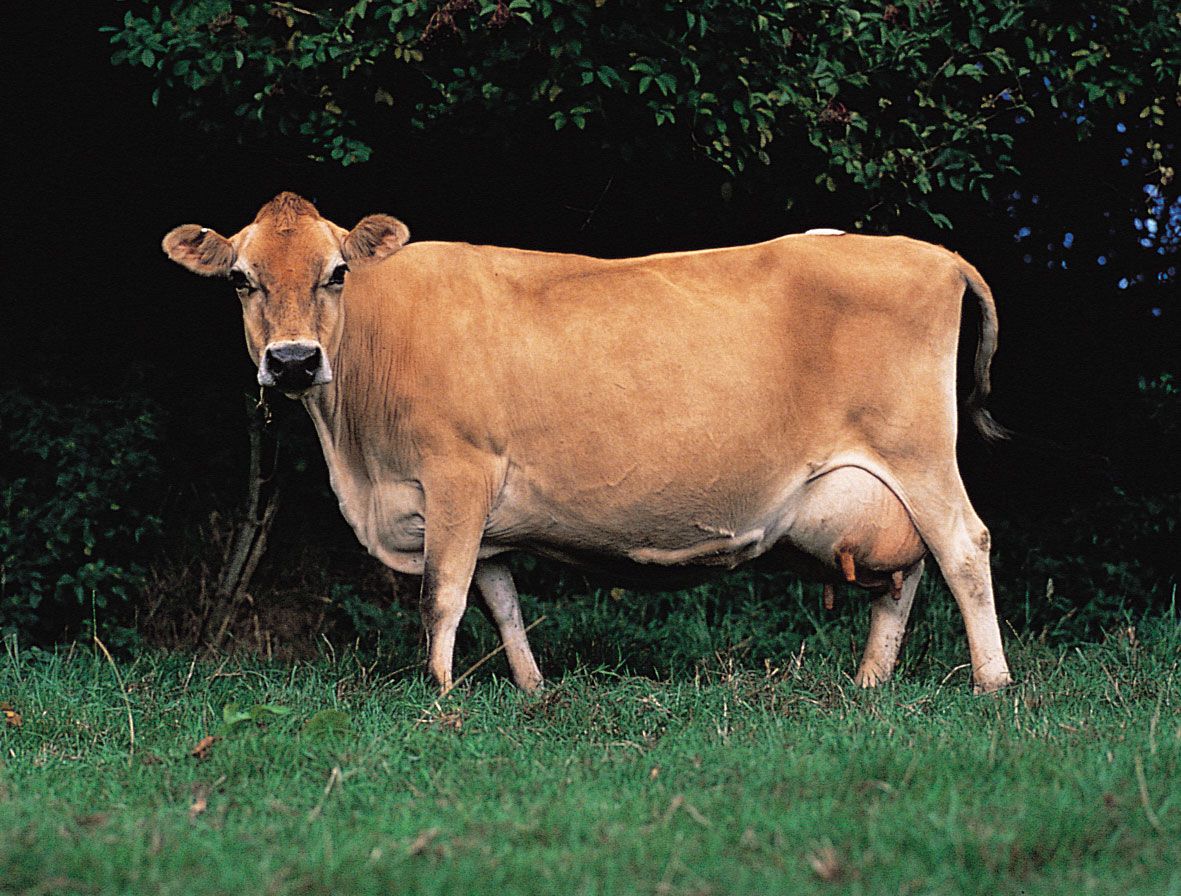
A small, refined animal with feminine appearance (big brown eyes).
Vary from light tan to dark fawn with darker shadings around the head and lower legs. Some white patches may be present.
Early maturing, high fertility.
Highest percentage of butterfat (average of 4.7%) and significantly more solids than other breeds, thus milk is sought for manufacturing (e.g. cheese products).
Average milk yield of 13,358 lbs.
Heat and humid tolerant- many herds in Texas.
Jersey (Isle of Jersey)

White in color with huge drooping ears
The most prolific swine breed that is longer bodies than other breeds because of an extra vertebrae
Most confinement adaptable than many other breeds.
Good mothers.
Landrace (Denmark)
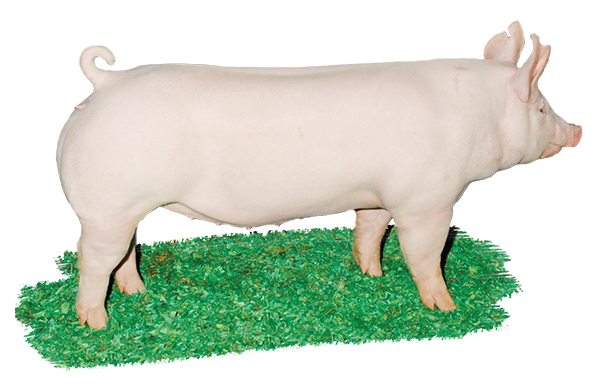
It is called the “mother breed”, white with erect ears.
In UK referred to as Large White.
Frequently part of crossbreeding programs.
Noted for large litters, relatively lean carcasses and good feed conversion.
Yorkshire (England)

Reddish brown (range from light red to dark red with dropping ears.
Excellent growth rate and feed efficiency generally considered a sire breed.
Average carcass merit, tend to be fatter than Hampshire sired pigs.
Now known for good marbling ability.
Duroc (United States)

One of the oldest breeds in the US.
Likely origin is UK, but brought to US and expanded.
Black with a white belt around shoulders, erect ears.
Known for lean, muscular carcasses, used primarily as a sire breed.
Hampshire (United States)

Black and white spotted with erect ears.
Terminal sire breed
Frequently used as a sire in a crossbreeding operation in which all progenies are sold for carcass.
Extreme muscularity and leanness.
Early maturing
Can carry gene that makes it susceptible to Porcine Stress Syndrome (can cause death).
Utilized heavily in the show pig industry.
Pietrain (Belgium)
Genetic condition
Recessive gene- frequently linked to muscularity.
Carriers should be culled.
Carcass can be PSE (pale, soft, exudative/ wet and exuding excess fluid).
Carcass defect.
Triggered by stress (excitement, transportation, anesthesia, temperature, etc.).
Can cause death (respiratory distress, muscle tremors/rigidity, blotchy dermal hyperemia (bright red skin blotches), acute heart failure).
Porcine Stress Syndrome