4.6 - Transfer of materials between circulatory system & cells
 Call Kai
 Learn
Learn Practice Test
 Spaced Repetition
 Match
Match Flashcards
 Knowt Play
1/16

There's no tags or description
Looks like no tags are added yet.
Name | Mastery | Learn | Test | Matching | Spaced | Call with Kai | Chat |
|---|
No analytics yet
Send a link to your students to track their progress
17 Terms
What happens at the capillaries?
Metabolic materials (e.g. oxygen, carbon dioxide & glucose) are exchanged between the blood & body cells
Capillaries can’t serve every cell directly → the final journey is through tissue fluid
What is tissue fluid?
The fluid that surrounds all cells of the body & is made from blood plasma:
contains water, glucose, amino acids, fatty acids, ions & oxygen → supplies these to the cells, whilst also removing waste materials
What is the difference in proteins between plasma & tissue fluid?
Plasma: proteins are more & larger
Tissue fluid: proteins are fewer & smaller
Why are urea & carbon dioxide levels higher in tissue fluid than plasma?
They are produced by cells, enter the tissue fluid first, & then gradually diffuse into the plasma
Why are oxygen, glucose & amino/fatty acids levels lower in tissue fluid than plasma?
They are delivered in plasma, diffuse out of capillaries into tissue fluid & are used up by cells for energy/growth
Less of these substances are left in the tissue fluid compared to plasma
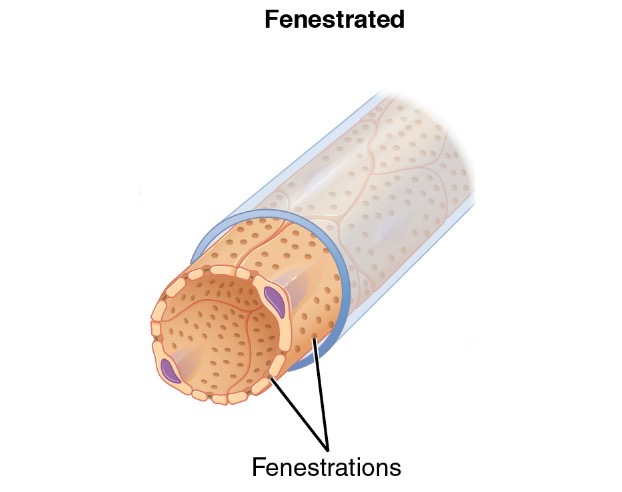
What are fenestrations in capillaries?
Small gaps in the endothelial cell lining layer → fluid is forced through these gaps at the arterial end
Erythrocytes & large plasma proteins are too big to leave the plasma & enter the tissue fluid
What is hydrostatic pressure?
The residual pressure from the heartbeat that is still present at the arterial end of the capillary bed → tends to force fluid out through the leaky capillary walls
What is osmotic (oncotic) pressure?
The tendency for water to move back into the capillaries by osmosis
How is tissue fluid formed?
Capillaries have small gaps in their walls (fenestrations), so that liquid & small molecules can be forced out
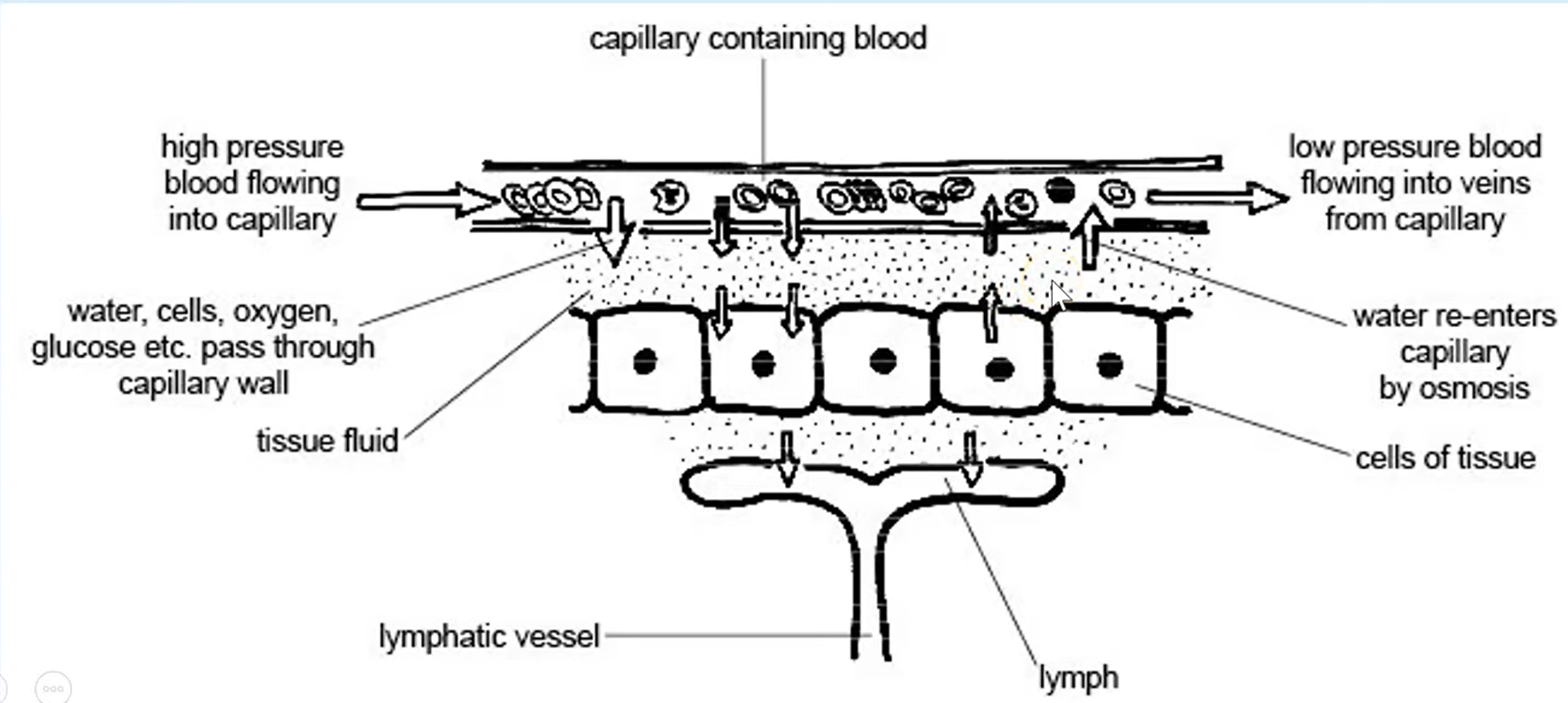
As blood enters the capillaries from arterioles (arteriole end), the smaller diameter results in a high hydrostatic pressure, so water, glucose, amino acids, fatty acids, ions & oxygen are forced out → ultrafiltration
What is forced out & what remains in the capillary during ultrafiltration?
What is forced out:
Water molecules
Dissolved minerals/salts
Glucose & oxygen
Fatty acids
Small proteins & amino acids
What remains in the capillary:
Red blood cells & platelets
Large proteins
How is tissue fluid reabsorbed?
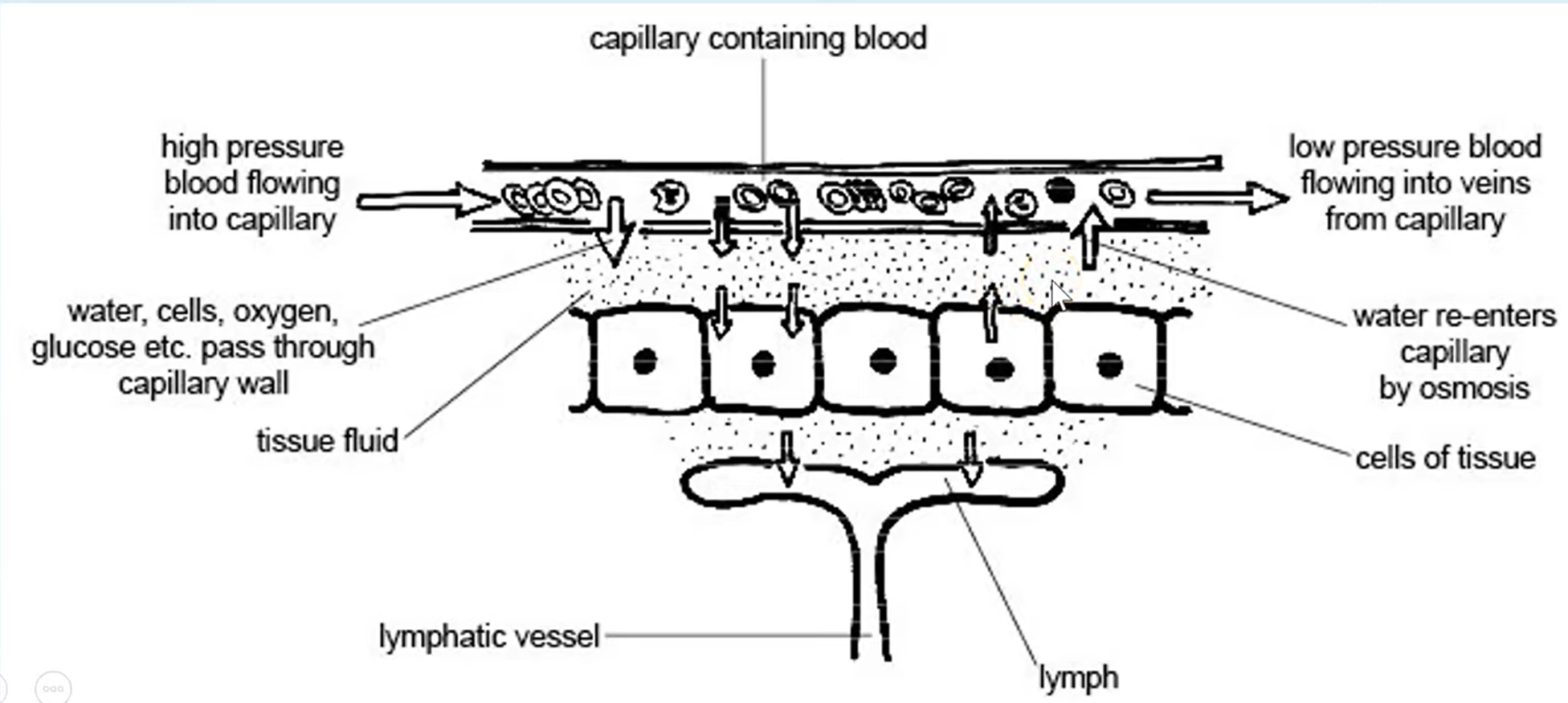
Large molecules (e.g. proteins & red blood cells) remain in the capillaries, as they are too big to pass through & therefore, lower the water potential
Towards the venule end of the capillaries, the hydrostatic pressure is lowered due to the loss of liquid & the water potential is very low
Water re-enters the capillaries by osmosis, as osmotic pressure is greater than hydrostatic pressure
What happens to excess tissue fluid?
It drains into lymph vessels into the lymphatic system & the lymph returns to the blood near the heart
What is the lymphatic system?
Consists of a network of lymph vessels flowing alongside the veins:
the vessels lead towards the heart, where the lymph drains back into the blood system near the vena cava
What are the three different functions of the lymphatic system?
Drains excess tissue fluid
Absorbs fats from the small intestine, via the lacteals inside each villus
Part of the immune system → networks of lymph vessels (lymph nodes) where white blood cells develop
What is plasma?
The liquid part of blood → contains dissolved glucose, amino acids, salts/vitamins & suspended proteins & fats
What is serum?
Purified blood plasma, with blood clotting proteins removed → used in hospitals for blood transfusions
What is lymph?
The solution inside lymph vessels:
its composition is similar to tissue fluid, but with more fats from the digestive system