Exam 1 Study Guide`
 Call Kai
 Learn
Learn Practice Test
 Spaced Repetition
 Match
Match Flashcards
 Knowt Play
1/16

There's no tags or description
Looks like no tags are added yet.
Name | Mastery | Learn | Test | Matching | Spaced | Call with Kai | Chat |
|---|
No analytics yet
Send a link to your students to track their progress
17 Terms
Question 1
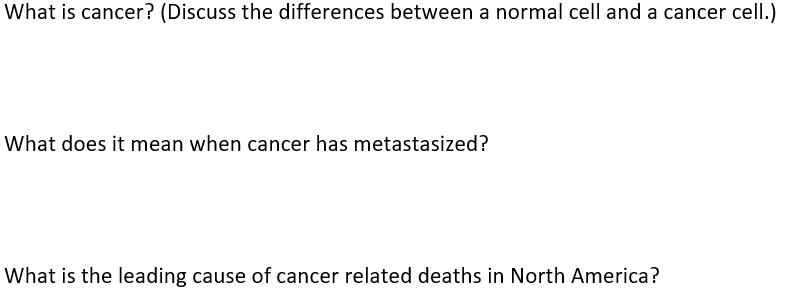
Normal cells:
Has a SMALL, UNIFORM-SHAPED NUCLEI
Cells are SIMILAR SHAPED/SIZES
Can DEVELOP DIFF FUNCTIONS to help with cell div
Distinguishable
Cancer Cell
DIFFERENT SHAPES, LARGE
Different sizes
Specific functions are more common compared to different
This can result in uncontrolled growth and survival because there isn't different types of functions that can help with a controlled growth
Question 2
When cancer has metastasized it means that the CANCER HAS SPREAD TO DIFFERENT AREAS OF THE BODY
Question 3
Lung cancer
Question 1
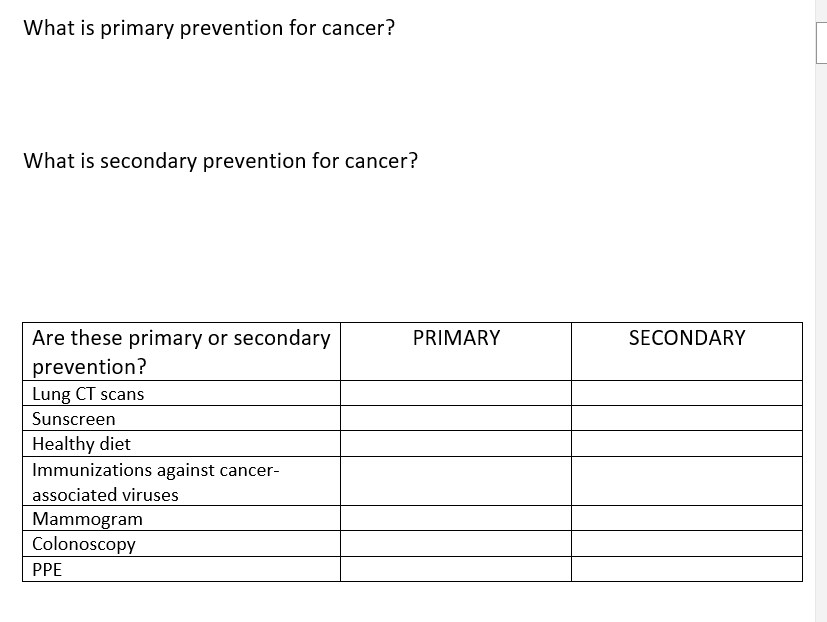
Primary preventative care: when you STOP DISEASES BEFORE IT STARTS (removing things that can cause the problem before you acquire the problem)
e.g, getting vaccines, eating healthier, reading articles about health, wearing PPE, etc
Question 2
Secondary preventative care: when DETECT/SCREEN before the disease escalates
By this time, there’s ALREADY AN OSET OF DISEASE, but you’re TRYING TO PREVENT DISEASE ESCALATION
e.g, screening for diseases,
ANYTHING DEALING WITH SCANS IS SECONDARY
Question 3
Secondary
Primary
Primary
Secondary
Secondary
Secondary
Primary
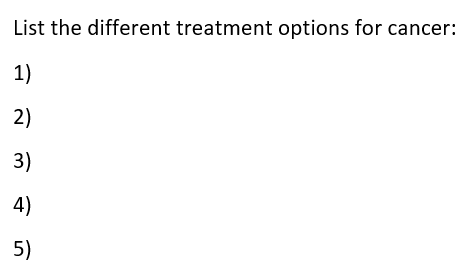
Surgery (Local)
Radiation (Local)
Radiation only AFFECTS CANCER CELLS, not all cells
Chemotherapy (Systemic)
AFFECTS ALL CELLS; it can’t differentiate what to not kill
Biotherapy
Uses BIO MOLECULES (e.g, antibodies) to STIMULATE IMMUNE SYSTEM AND DESTROY CANCER CELLS
Complementary therapies
Think: Sugar Rush Crush Bio . Com
Question 1
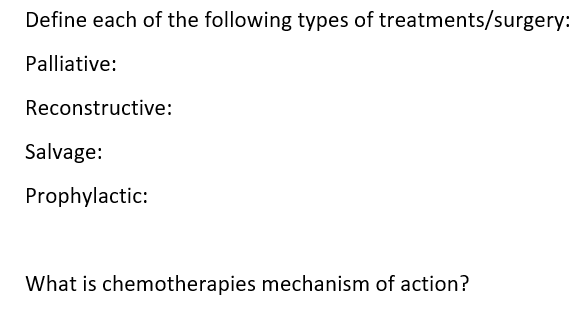
Palliative surgery: RELIEVING SYMPTOMS OF CANCER to improve quality of life WITHOUT HAVING TO CURE DISEASE
Reconstructive surgery: when you RESTORE FORM + FUNCTION OF BODY PART that’s been damaged because of the cancer
Usually remove cancer first, then do this
Kinda like plastic surgery
Salvage treatment/surgery: Treatment after chemo/radiation (that failed initially) to REMOVE LEFTOVER/RECURRENT TUMORS
Prophylactic surgery: REMOVES a healthy ORGAN/TISSUE that HASN’T DEVELOPED CANCER (but prone to) to PREVENT METASTASIZING (spreading)
Question 2

Does not
All
Myelosuppression
Context: the bone marrow PRODUCES ALL BLOOD CELLS. It FIRST CREATES HEMATOPOIETIC STEM CELLS, which MATURES INTO RBC, WBC, and PLATELETS
When a person goes through chemotherapy, it decreases bone marrow cell production, which can lead to myelosuppression
⭐⭐ Explain the following for Neutropenia:
What is it? What is the ABNORMAL pathophysiology for this?
What are the priority assessments?
What are the nursing interventions and types of precautions?
What are the NORMAL VALUES for this?
What medications should be given?
What are the nursing diagnoses?
What are some precautions/patient teachings for this?
⭐⭐ Explain the following for Thrombocytopenia:
What is it? What is the ABNORMAL pathophysiology for this?
What are the priority assessments?
What are the nursing interventions and types of precautions?
What are the NORMAL VALUES for this?
What medications should be given?
What are the nursing diagnoses?
What are some precautions/patient teachings for this?
⭐⭐ Explain the following for Anemia:
What is it? What is the ABNORMAL pathophysiology for this?
What are the priority assessments?
What are the nursing interventions and types of precautions?
What are the NORMAL VALUES for this?
What medications should be given?
What are the nursing diagnoses?
What are some precautions/patient teachings for this?
⭐⭐ Give me the priority assessment, nursing intervention, medications, and patient teaching for the following:
Nausea/Vomiting
Diarrhea
Anorexia
Mucositis/Stomatitis
⭐⭐ Give me the priority assessment, nursing intervention, medications, and patient teaching for the following:
Thrush
Alopecia
Fatigue
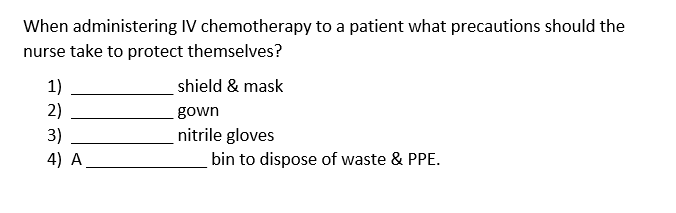
Face
Chemotherapy
Double
Yellow bin
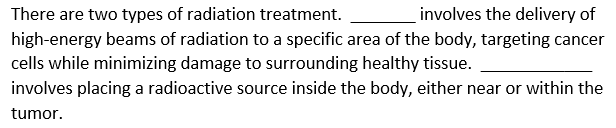
What is an external and internal (brachytherapy) radiation therapy?
External radiation therapy uses a MACHINE that DELIVERS HIGH-ENERGY BEAMS, TARGETING CANCER CELLS while DECREASING DAMAGE TO SURROUNDING HEALTHY TISSUE
Doesn’t do a lot of damage to healthy tissue
Internal radiation therapy uses HIGH DOSE OF RADIATION and PLACING IT NEAR/WITHIN TUMOR to DELIVER TO CANCEROUS AREA
Kills cancer cells with HIGH DOSE OF RADIATION ADDED INSIDE THE BODY through the usage of an implant that directs energy at the tumor
The radiation (either a small implant like seeds, capsules, etc) is delivered through a catheter or application
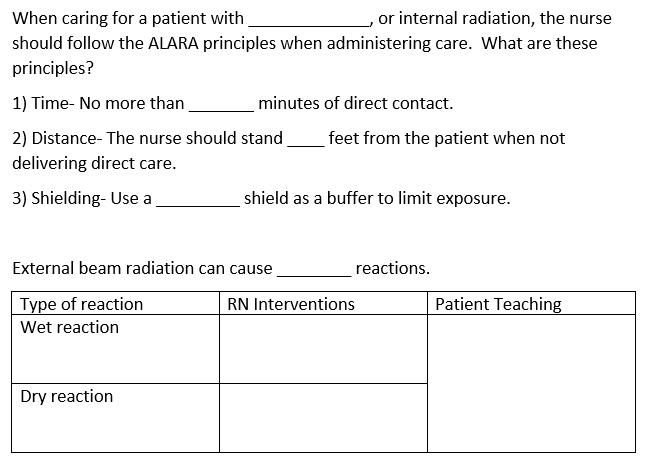
Brachytherapy
30 minutes
6 feet
Lead shield
cause SKIN (cutaneous) reactions
Wet reaction: peeling skin with blisters and exposed dermis
RN interventions
CLEANSE WITH NORMAL SALINE
APPLY HYDROCOLLOID (or non-adherent) DRESSINGS
MONITOR FOR SIGNS OF INFECTION
Patient teaching
WASH WITH WATER + SOAP
AVOID SCRATCHING/RUBBING
Pat skin dry; DON’T RUB
Dry reaction: peeling skin with FLAKINESS, REDNESS, or ITCHINESS
RN interventions
Manage itching
Avoid applying unapproved creams
Patient teaching
WASH WITH WATER + SOAP
AVOID SCRATCHING/RUBBING
Pat skin dry; DON’T RUB
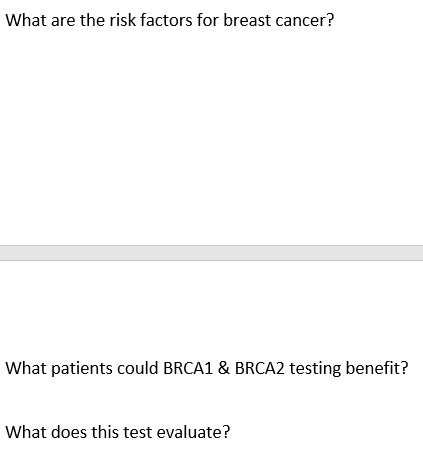

⭐⭐ Give me the description and post-op precautions/teachings for the following mastectomies:
Simple/total
Modified
Radical
Simple/total: type of MASTECTOMY (removal of 1 or both breasts) WITHOUT LYMPH NODE DISSECTION
for NONINVASIVE CANCER
ONLY BREAST TISSUE REMOVED
Precautions:
AVOID AFFECTED ARM (don’t put ivs, vaccines, or blood pressure readings in the specific arm)
APPLY COMPRESSION SLEEVE AND ELEVATE ARM to PREVENT SWELLING
NO STRENUOUS ACTIVITIES
Expected reactions
Numbness
Lymph node swelling
Modified: Mastectomy that REMOVES THE BREAST, SKIN, etc but KEEPS CHEST MUSCLES
Radical: Mastectomy that REMOVES EVERYTHING ABOUT THE BREAST (EVEN CHEST MUSCLES)
Give me the definition and description for the following reconstructive surgeries:
Tissue expansion with implant
Tissue Transfer
TRAM Flap
DIEP Flap
Gluteal Flap
Latissimus Dorsi Flap
Tissue expansion with implant: Use an expander under the skin/muscle after mastectomy and SLOWLY FILL IT WITH SALINE TO STRETCH THE TISSUE, which gets replaced with a breast implant
You want to stretch the muscle/skin to ALLOW SLOW EXPANSION OF THE SKIN FOR THE PLACEMENT OF THE PERMANENT BREAST IMPLANT
Tissue transfer: MOVE SKIN/FAT/MUSCLE from ANOTHER BODY PART TO RECONSTRUCT BREAST
TRAM flap: Using ABDOMINAL MUSCLES to reconstruct the breast (also includes the fat and skin)
DIEP flap: Using ONLY ABDOMINAL FAT AND SKIN (EXCLUDES MUSCLES)
Gluteal flap: Uses BUTT MUSCLES
Latissimus Dorsi flap: Uses BACK MUSCLES AND SKIN