BIO 201 Chapter 4: Epithelial Tissue
 Call Kai
 Learn
Learn Practice Test
 Spaced Repetition
 Match
Match Flashcards
 Knowt Play
1/51

There's no tags or description
Looks like no tags are added yet.
Name | Mastery | Learn | Test | Matching | Spaced | Call with Kai | Chat |
|---|
No analytics yet
Send a link to your students to track their progress
52 Terms

_ tissue
epithelial

_ tissue
connective
epithelial tissue
consists of cells arranged in continuous sheets, in either single or multiple layers (cell rich)
little intercellular space between cells (matrix)
avascular (lacks blood vessels)
surface epithelium
covers or lines a surface
forms outer covering of skin and some internal organs
inner lining of blood vessels, ducts, body cavities, and the respiratory, digestive, urinary and reproductive systems
glandular epithelium
makes up secreting portion of glands
thyroid, adrenal, sweat and digestive glands

apical surface
faces body surface, body cavity, lumen (interior) of internal organ, or tubular duct that receives cell secretions
may contain cilia or microvilli
most superficial layer of cells in multicellular epithelia
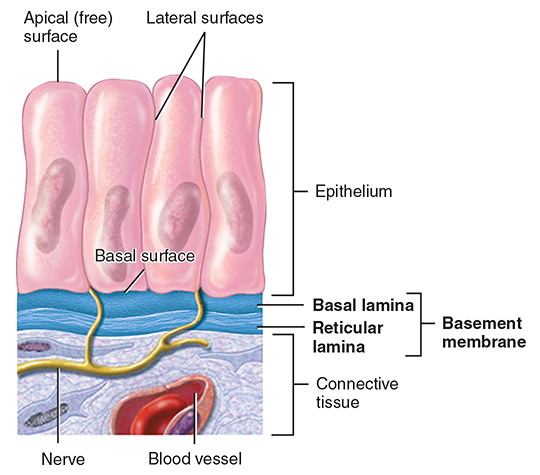
lateral surface
face adjacent cells on either side
contain tight junctions, adhering junctions, desmosomes and/or gap junctions

basal surface
opposite the apical surface
deepest layer of cells in multilayered epithelia
adhere to extracellular materials such as the basement membrane

basement membrane
composed of basal lamina and reticular lamina
forms a surface on which epithelial cells migrate during growth or wound healing
restrict passage of larger molecules between epithelium and connective tissue
participate in filtration of blood in the kidneys
basal lamina
thin layer
secreted by epithelial cells
contains laminin (adhere to integrins in hemidesmosomes, attaching epithelial cells to basement membrane) and collagen
reticular lamina
close to connective tissue
contains collagen produced by fibroblasts (connective tissue cells)

Simple epithelium
single layer of cells that functions in diffusion, osmosis, filtration, secretion, or absorption

Pseudostratified epithelium
appears to have multiple layers of cells because the cell nuclei lie at different levels and not all cells reach the apical surface
actually a simple epithelium because all its cells rest on the basement membrane
May contain cilia or secrete mucus
Stratified epithelium
two or more layers of cells that protect underlying tissues in locations where there is considerable wear and tear

Squamous
thin, which allows for the rapid passage of substances through them

Cuboidal
as tall as they are wide and are shaped like cubes or hexagons.
may have microvilli at their apical surface and function in either secretion or absorption

Columnar
much taller than they are wide, like columns, and protect underlying tissues.
Their apical surfaces may have cilia or microvilli, and they often are specialized for secretion and absorption
Transitional
change shape, from squamous to cuboidal and back, as organs of the urinary system such as the urinary bladder stretch (distend) to a larger size and then collapse to a smaller size

Simple squamous epithelium
a single layer of flat cells that resembles a tiled floor when viewed from apical surface; centrally located nucleus that is flattened and oval or spherical in shape
Location: lining of lungs (mesothelium), blood and lymphatic vessels (endothelium)
Function: filtration (such as blood filtration in kidneys) or diffusion (such as diffusion of oxygen into blood vessels of lungs)
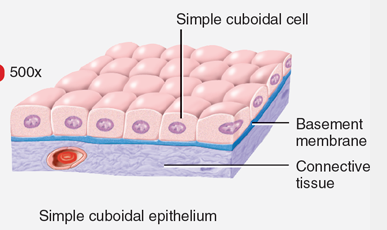
Simple cuboidal epithelium
single layer of cube-shaped cells; round, centrally located nucleus
Location: surface of ovary, lens and retina of eye, lines kidney tubules, secreting portion and smaller ducts of many glands
Function: Secretion and absorption
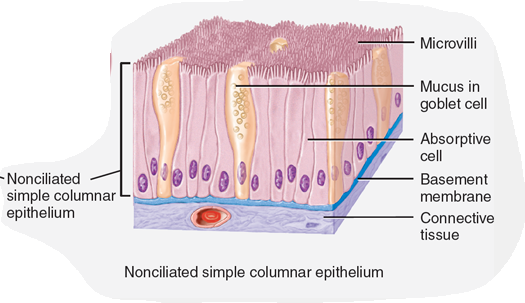
Nonciliated simple columnar epithelium
single layer of nonciliated columnlike cells with oval nuclei near base of cells
contains columnar epithelial cells with microvilli at apical surface and mucus-secreting goblet cells
Location: digestive canal, gallbladder, ducts of many glands
Function: Secretion and absorption; helps prevent destruction of stomach lining by acidic gastric juice secreted by stomach; lubricates linings of digestive, respiratory and reproductive tracts
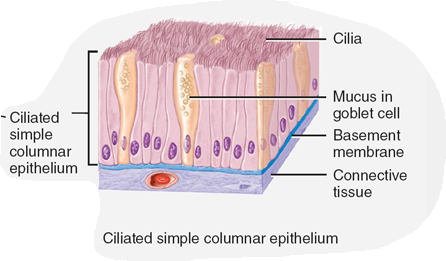
Ciliated simple columnar epithelium
single layer of ciliated columnlike cells with oval nuclei near base of cells and goblet cells interspersed
Location: bronchioles of respiratory tract, uterine tubes, uterus, sinuses, spinal cord, and ventricles of brain
Function: cilia move mucus and foreign molecules toward throat and move oocytes from ovaries into uterus in the Fallopian tubes

Nonciliated pseudostratified columnar epithelium
Appears layered because nuclei are at various levels, some cells do not extend to apical surface
Lacks cilia and goblet cells
Location: lines epidermis, larger ducts of many glands, parts of male urethra
Function: absorption and secretion

Ciliated pseudostratified columnar epithelium
Appears layered because nuclei are at various levels, some cells do not extend to apical surface
Some cells extend to apical surface and secrete mucus or have cilia
Location: Lining of airways
Function: secrete mucus to trap foreign particles, cilia sweep mucus away for elimination
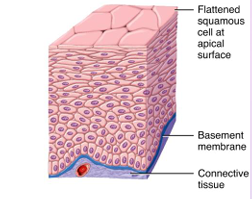
Stratified squamous epithelium
As basal cells move toward apical surface, they become dehydrated and though, eventually dying and sloughing off to be replaced by new cells
Can be keratinized or nonkeratinized

Nonkeratinized stratified squamous epithelium
Does not contain large amounts of keratin
Constantly moistened by mucus from salivary and mucous glands
Surface cells are shed before they die
Location: lines wet surfaces (ex. inside mouth)
Function: Protection against abrasion, water loss, ultraviolet radiation, and foreign invasion

Keratinized stratified squamous epithelium
Tough layer of keratin in apical layer and several layers deep
Relative amount of keratin increases in cells as they move away from nutritive blood supply and organelles die
Location: skin
Function: Protection against abrasion, water loss, ultraviolet radiation, and foreign invasion
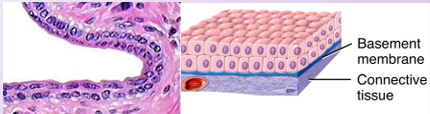
Stratified cuboidal epithelium
Two or more layers of cells, cubical apical cells
Location: ducts of sweat and esophageal glands, male urethra
Function: protection, secretion, absorption

Stratified columnar epithelium
Basal layers consist of shortened, irregular cells
Location: lines part of urethra; large excretory ducts of some glands, such as esophageal glands; small areas in anal mucous membrane; part of conjunctiva of eye
Function: protection and secretion
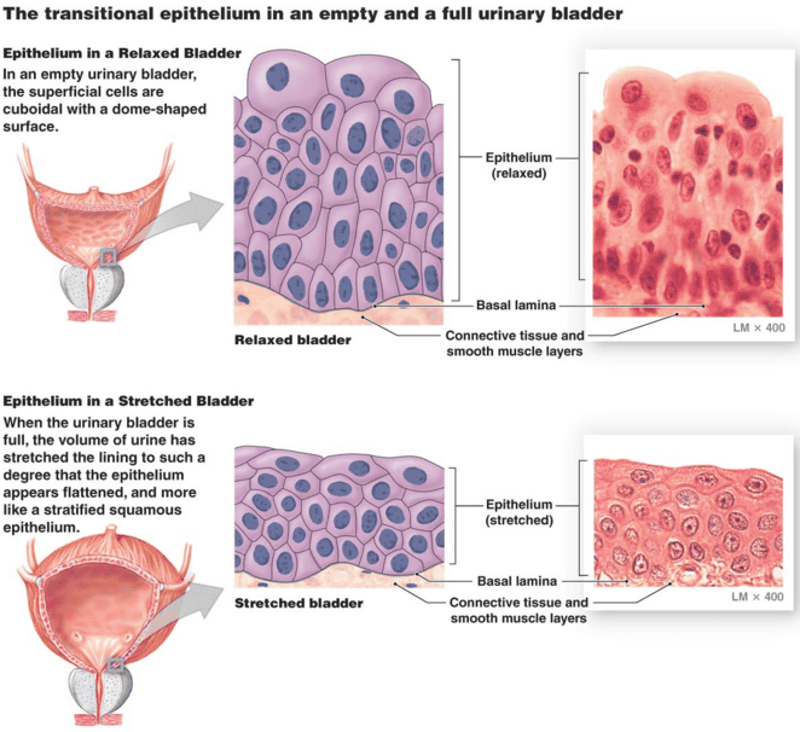
Transitional epithelium
AKA urothelium
Looks like stratified cuboidal epithelium in relaxed state and stratified squamous epithelium in filled state
Location: unique to bladder, ureters and urethra
Function: allows stretching of urinary organs while maintaining protective lining
Pap smear
involves collection and microscopic examination of epithelial cells that have been scraped off the apical layer of a tissue
commonly examines nonkeratinized stratified squamous epithelial cells
mainly performed to detect early signs of cancer
Gland
Specialized epithelial cell or cells that secrete substances; may be exocrine or endocrine
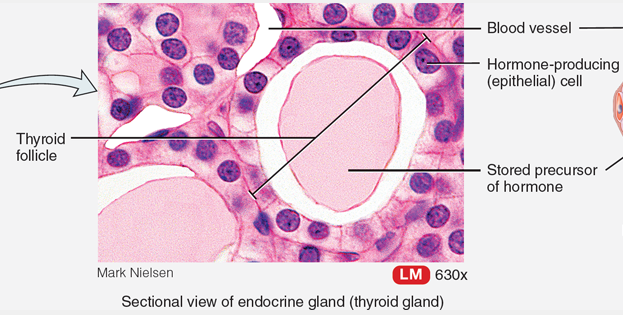
Endocrine gland
secretes hormones into bloodstream without flowing through duct
Location: pituitary gland, pineal gland, thyroid and parathyroid glands, adrenal glands, pancreas, ovaries, testes, thymus
Function: regulate metabolic and physiological activities to maintain homeostasis

Exocrine gland
secreted products are release into ducts that empty onto an epithelium that lines a surface (ex. skin, organ lumen)
Location: sweat, oil and earwax glands; salivary glands; pancreas
Function: produce substances such as sweat to help lower body temperature, oil, earwax, saliva, or digestive enzymes
Unicellular glands
single-celled glands (ex. goblet cells)
Multicellular glands
multi-celled glands; most exocrine glands
Simple gland
a gland with a duct that does not branch
Compound gland
a gland with a duct that branches
Acinar gland
a gland with rounded secretory portions
Tubular gland
a gland with tubular secretory parts
Tubuloacinar glands
glands with both tubular and round secretory parts
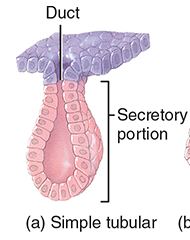
Simple tubular
Example: glands in the large intestine

Simple branched tubular
Example: gastric glands
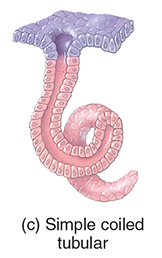
Simple coiled tubular
Example: sweat glands

Simple acinar
Example: glands of spongy urethra

Simple branched acinar
Example: glands of spongy urethra
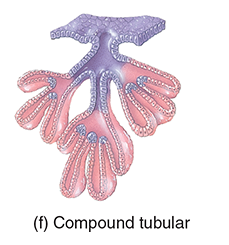
Compound tubular
Example: glands of spongy urethra

Compound acinar
Example: glands of spongy urethra

Compound tubuloacinar
Example: acinar glands of the pancreas

Merocrine glands
release substances via exocytosis using secretory vesicles generated at rough ER and then Golgi complex

Apocrine glands
Product builds up apical surface then releases
Portion of cell is pinched off via exocytosis
Cell repairs to repeat process

Holocrine glands
product builds up in cytosol
as cell matures, it ruptures and releases product
the cell is then replaced with a new cell