dat organic chemistry: 1H NMR, IR, mass spectroscopy Diagram | Quizlet
 Call Kai
 Learn
Learn Practice Test
 Spaced Repetition
 Match
Match Flashcards
 Knowt Play
1/47

There's no tags or description
Looks like no tags are added yet.
Name | Mastery | Learn | Test | Matching | Spaced | Call with Kai | Chat |
|---|
No analytics yet
Send a link to your students to track their progress
48 Terms
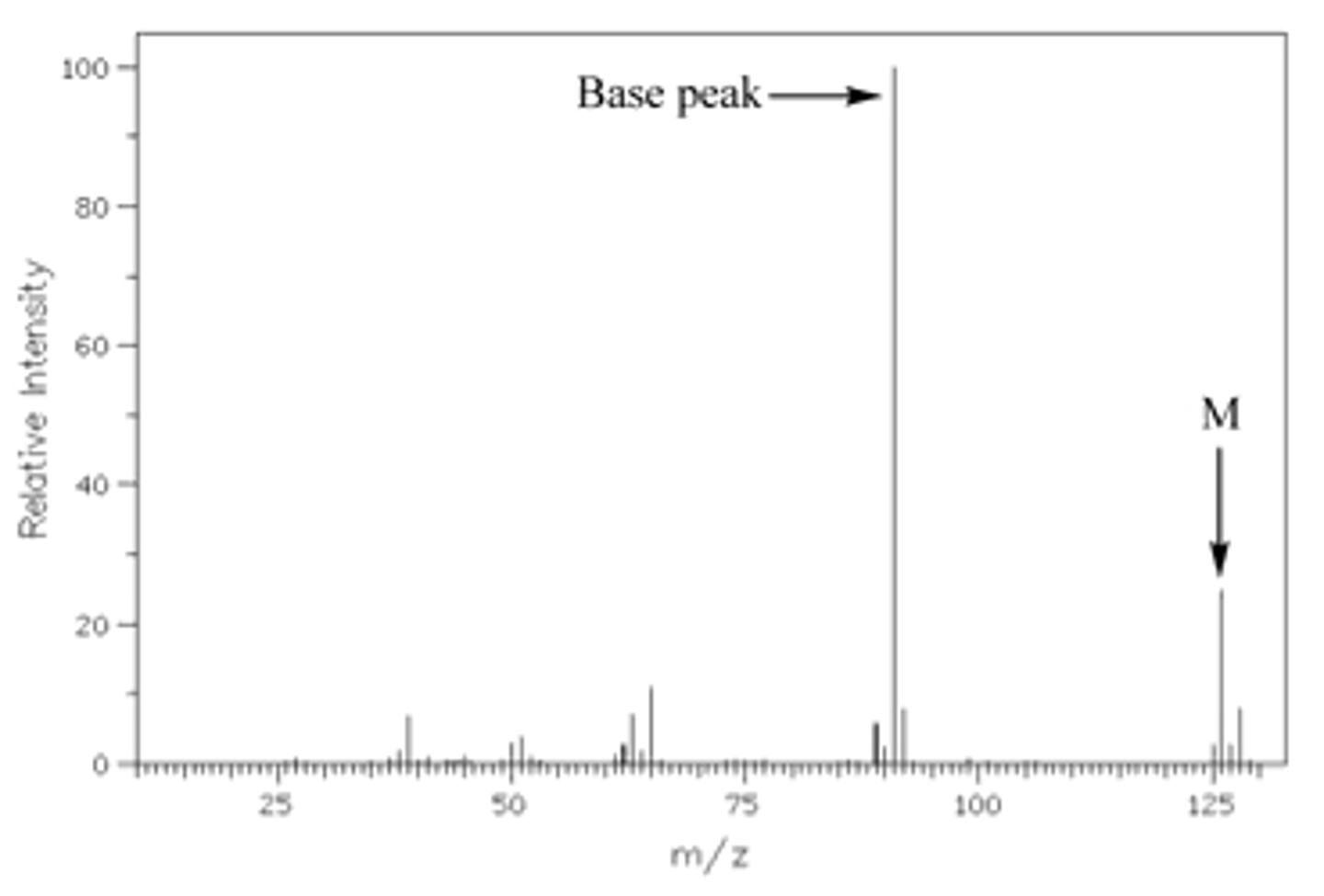
mass spectrometry is an analytical tool used to determine...
the MASS of a molecule lol
mass spec: we take a pure sample of the compound (random mass) and do what with it?
vaporize it and fragment it into a bunch of ions
what happens to the ions in the mass spectrometer?
(guided from where to where, and how?)
the charged molecules are guided by electromagnetic attraction or repulsion (depending on m/z) to a detector mechanism
what does a mass spectrum plot?
(what does the detector tell us?)
a mass spectrum plots the different mass-to-charge ratios (m/z) against their "relative abundances" within the sample (how many of that ion did the sample have?).
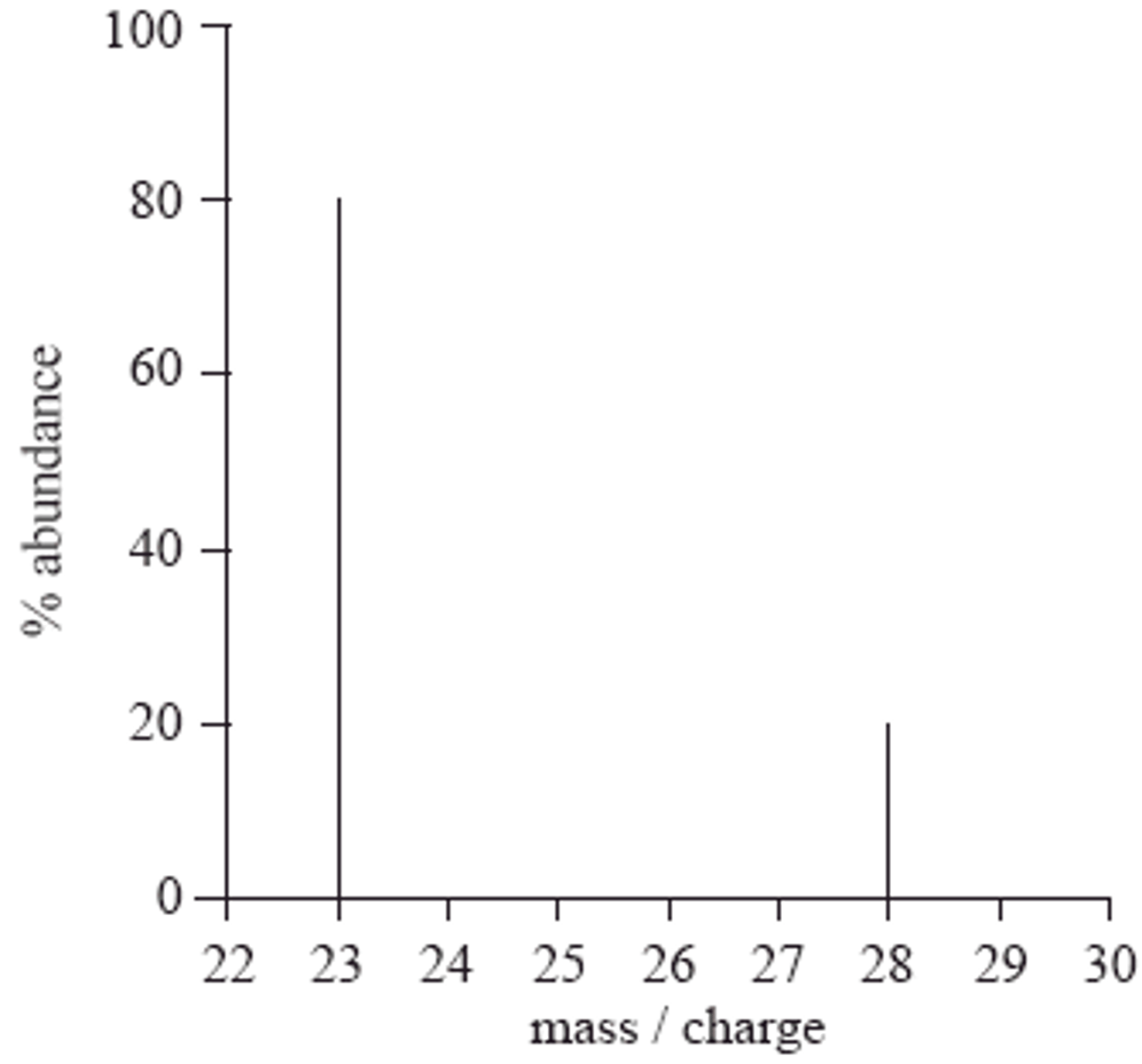
mass spec: the taller the peak....
the greater abundance of the corresponding fragment.
but on what scale are we quantifying the mass spec peaks? is it straight up # of occurrences?
not exactly. rather, the intensity of the peaks is set RELATIVE to the tallest peak (most abundant ion) in the entire spectrum: the base peak. this corresponds to the most stable molecular fragment.
abundance is a %
where can we find the molecular ion peak (mass spec)?
it is typically a high peak with the highest m/z ratio (rightmost on the X axis). note that the base peak and molecular ion peak are often NOT the same peak.
what type of spectroscopy is commonly used to identify the functional groups present in a molecule?
infrared (IR) spec
an IR spectrum is acquired when an organic molecule vibrates upon exposure to infrared radiation. for vibrations to occur for a given bond, it MUST....
have a NET DIPOLE MOMENT
IR: does C-OH have a net dipole moment? what about O=O? what about C2H4 (C=C)?
C-OH yes
O=O no
C=C no
fully symmetrical bonds don't have a net dipole moment and don't show up on the IR spec
IR spec:
x-axis
y-axis
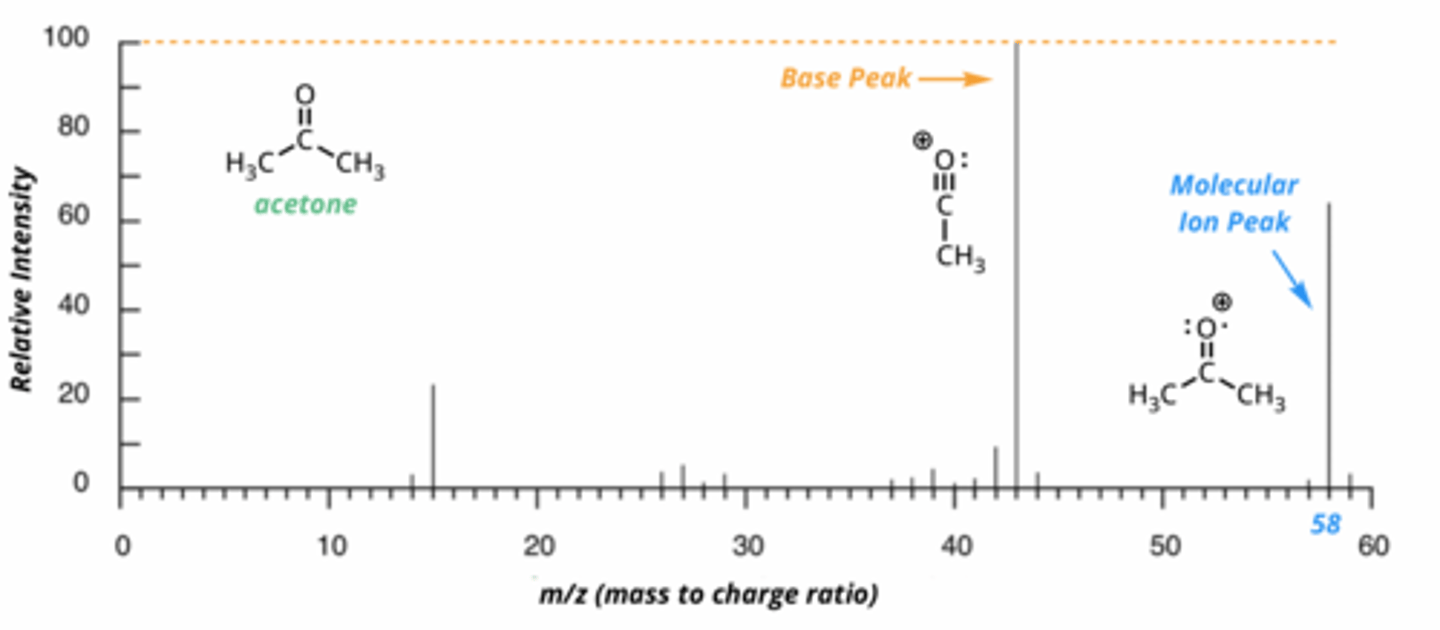
x-axis: wavenumber (cm^-1) (proportional to energy)
y-axis: % transmittance (how much light was absorbed by the detector)
IR spec: a low % transmittance implies what? wb high?
if the detector absorbed a lot of light (high %T), then the sample/expected functional group didn't (so it "doesn't exist" from the pov of the detector).
but if the detector didn't absorb a lot of light (low %T) at a given wavelength, this means the functional group did instead, meaning it definitely exists
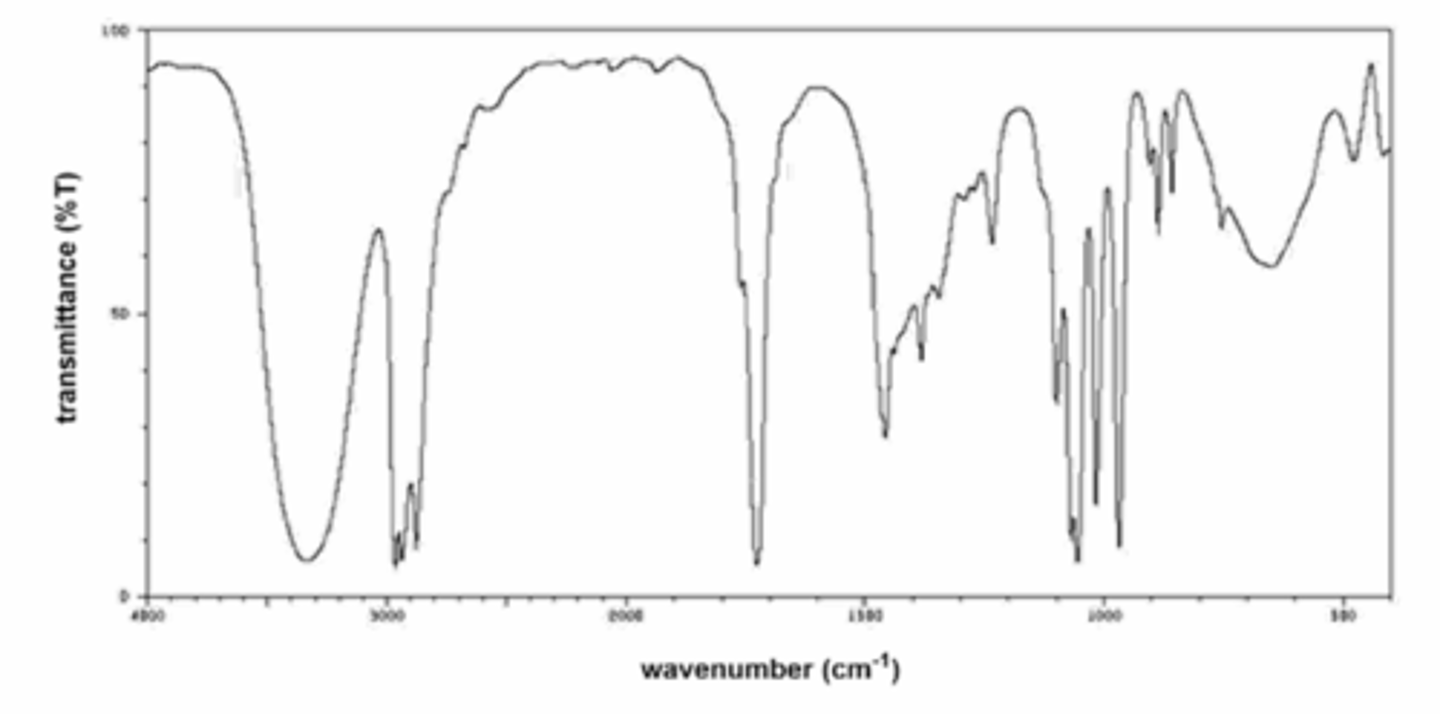
mass spec: but what actually tells us the mass of the original, unfragmented compound? do we combine the peaks or something?
NO: there is ONE peak we are looking for. it is called the molecular ion peak, and it represents the entire molecule in question, prior to any fragmentation. the M/Z ratio of this peak IS the mass of the original molecule.
overall range of IR spec
0-4000
TERM
single bond to H!!! region
DEFINITION
single bonds to H region (2500-4000)
TERM
triple bond region
DEFINITION
triple bond region (2000-2500)
TERM
double bond region
DEFINITION
double bond region (1500-2000)
TERM
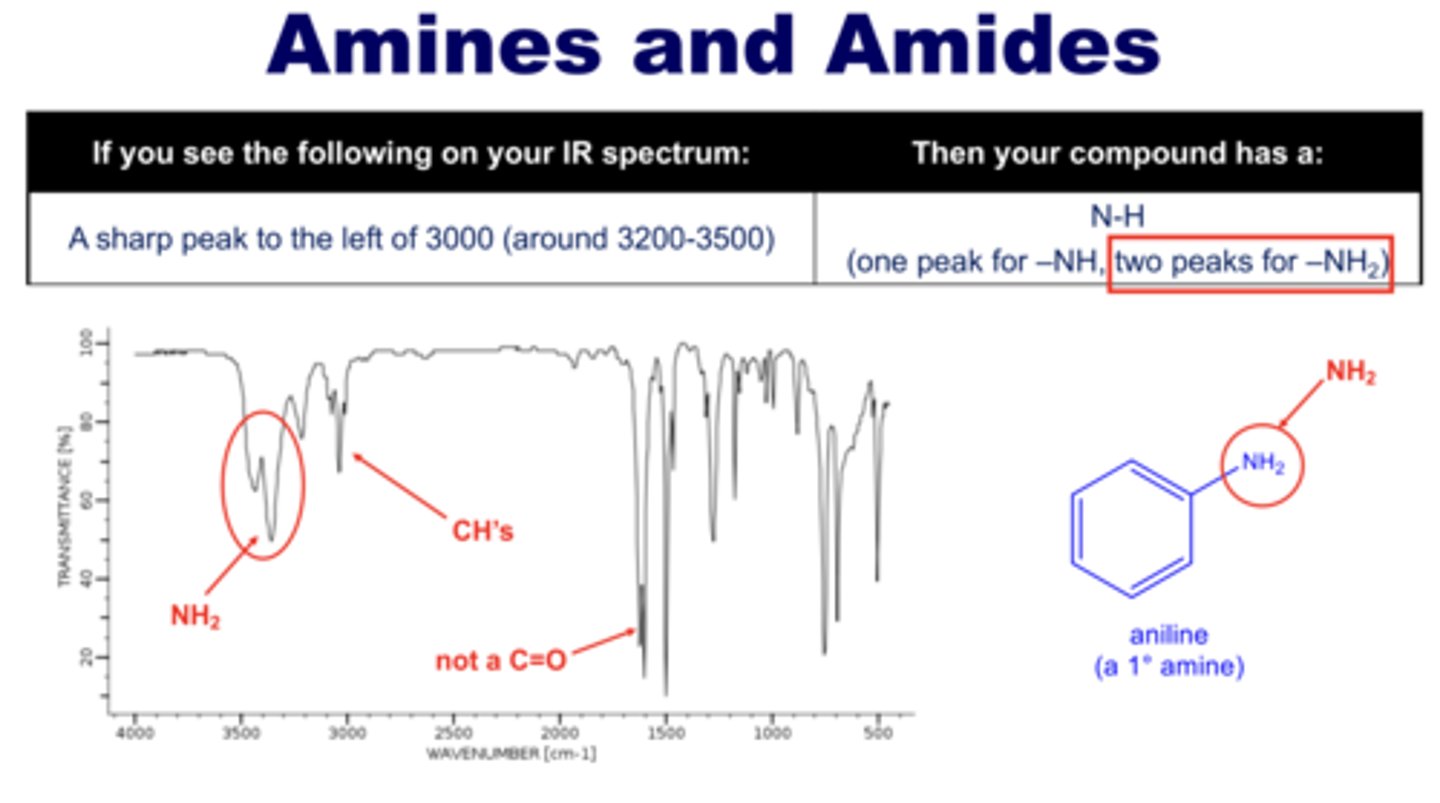
secondary amine
DEFINITION
3200-3500
secondary amine: ONE peak
R2-NH bc one N-H bond
TERM
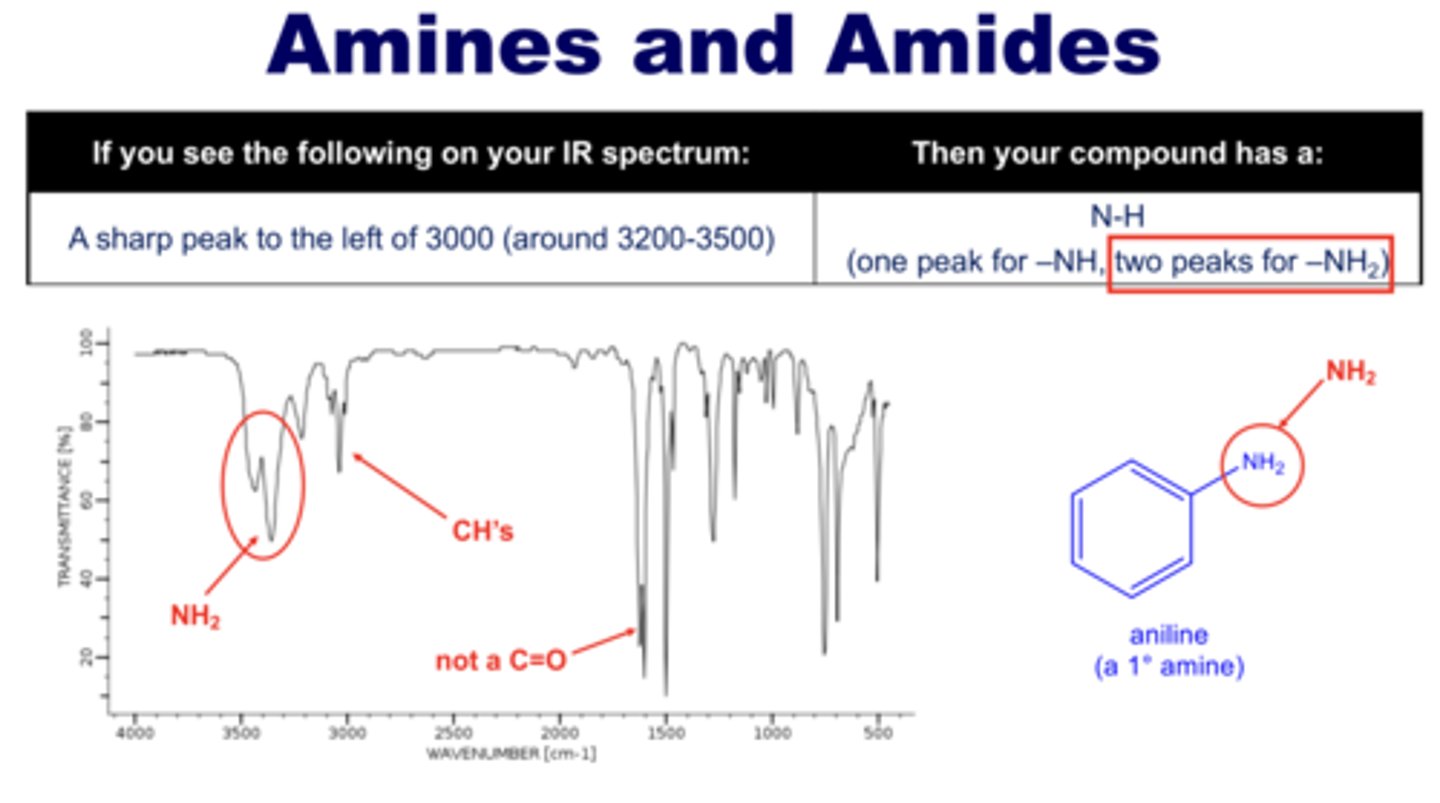
primary amine
DEFINITION
3200-3500
primary amine: TWO peaks
R-NH2 bc two N-H bonds
TERM
sp3 CH
DEFINITION
sp3 CH: just RIGHT of 3000
can pretty much ignore this peak since it shows up at every spectroscopy
TERM
sp2 CH
DEFINITION
sp2 CH: just LEFT of 3000
can pretty much ignore this peak since it shows up at every spectroscopy
TERM
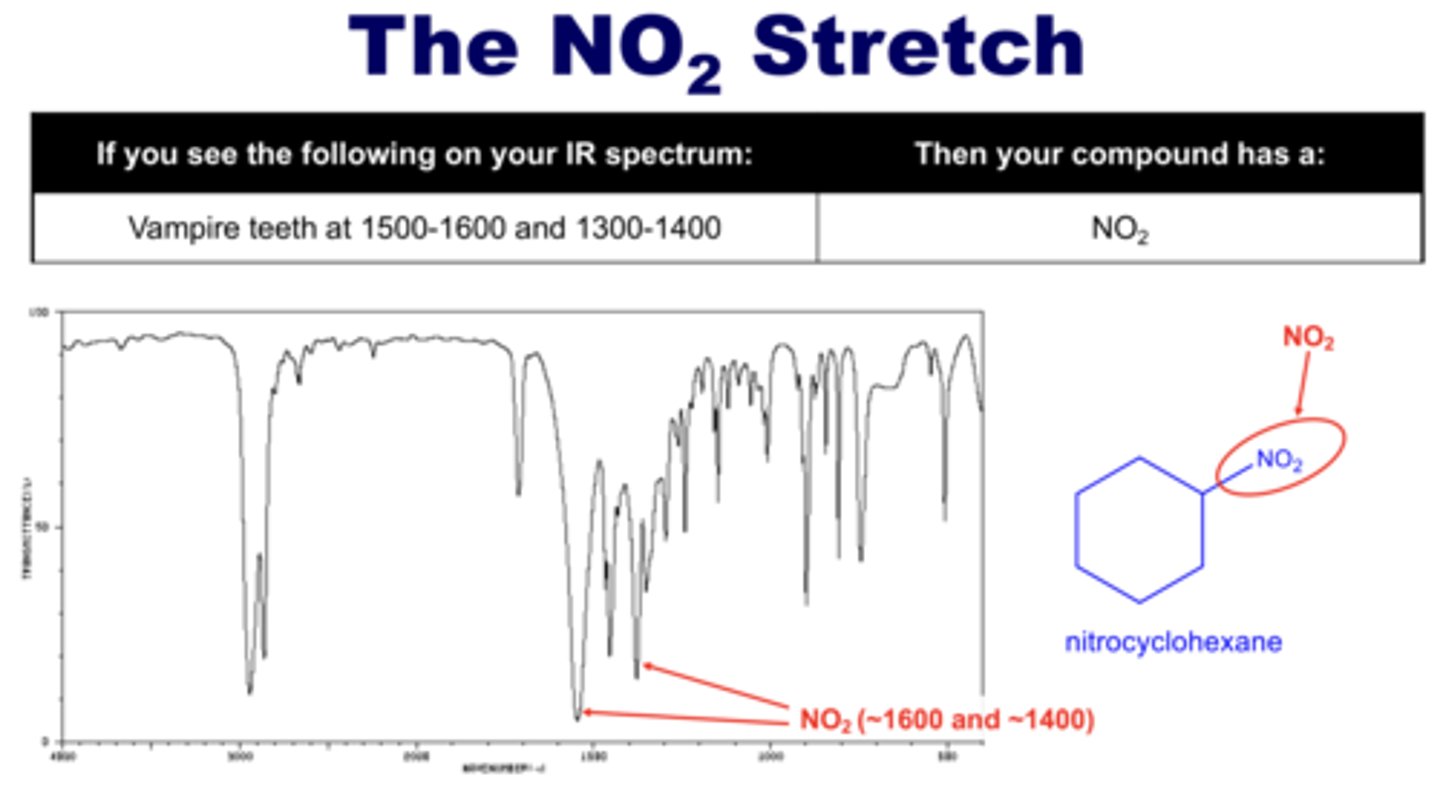
NO2 nitro
DEFINITION
NO2 nitro
vampire teeth 1500, 1400
TERM
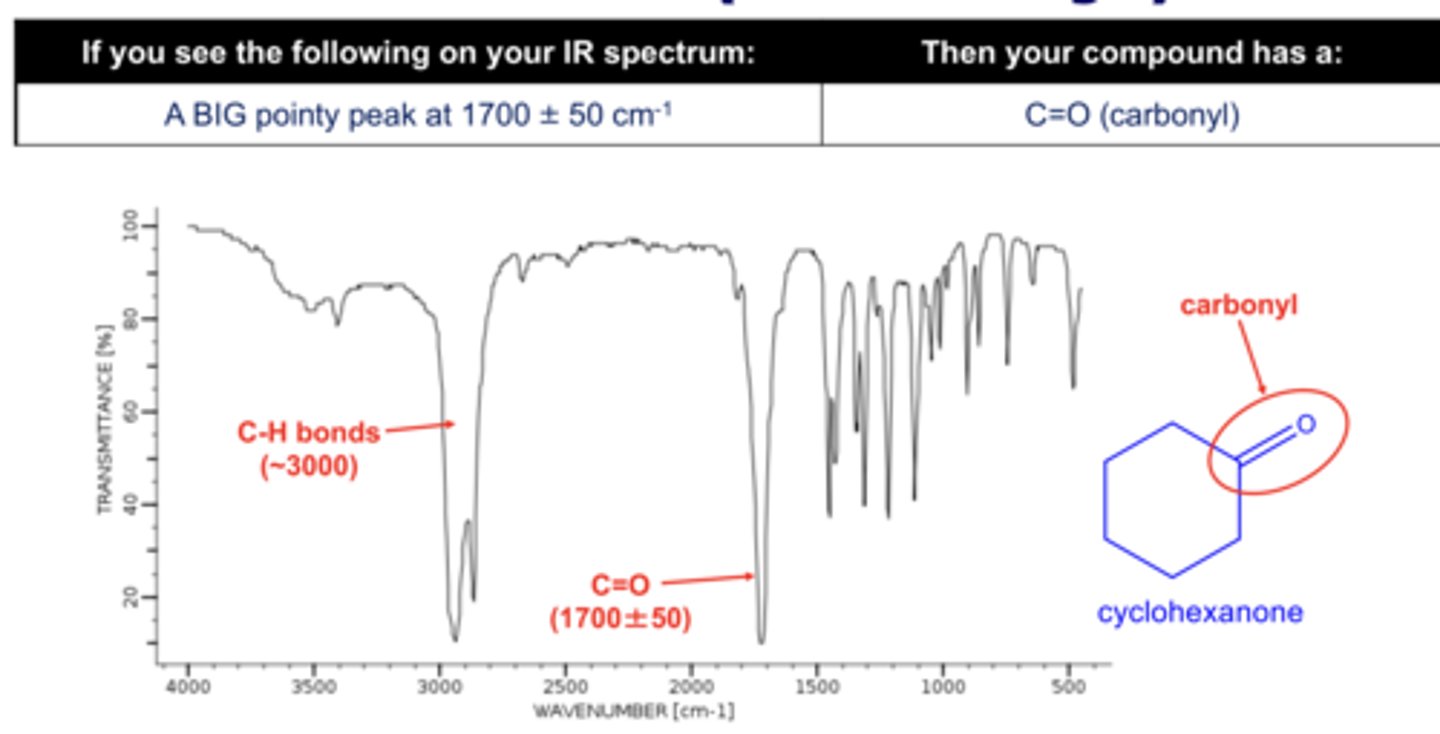
carbonyl
DEFINITION
carbonyl 1700 ish long peak
TERM
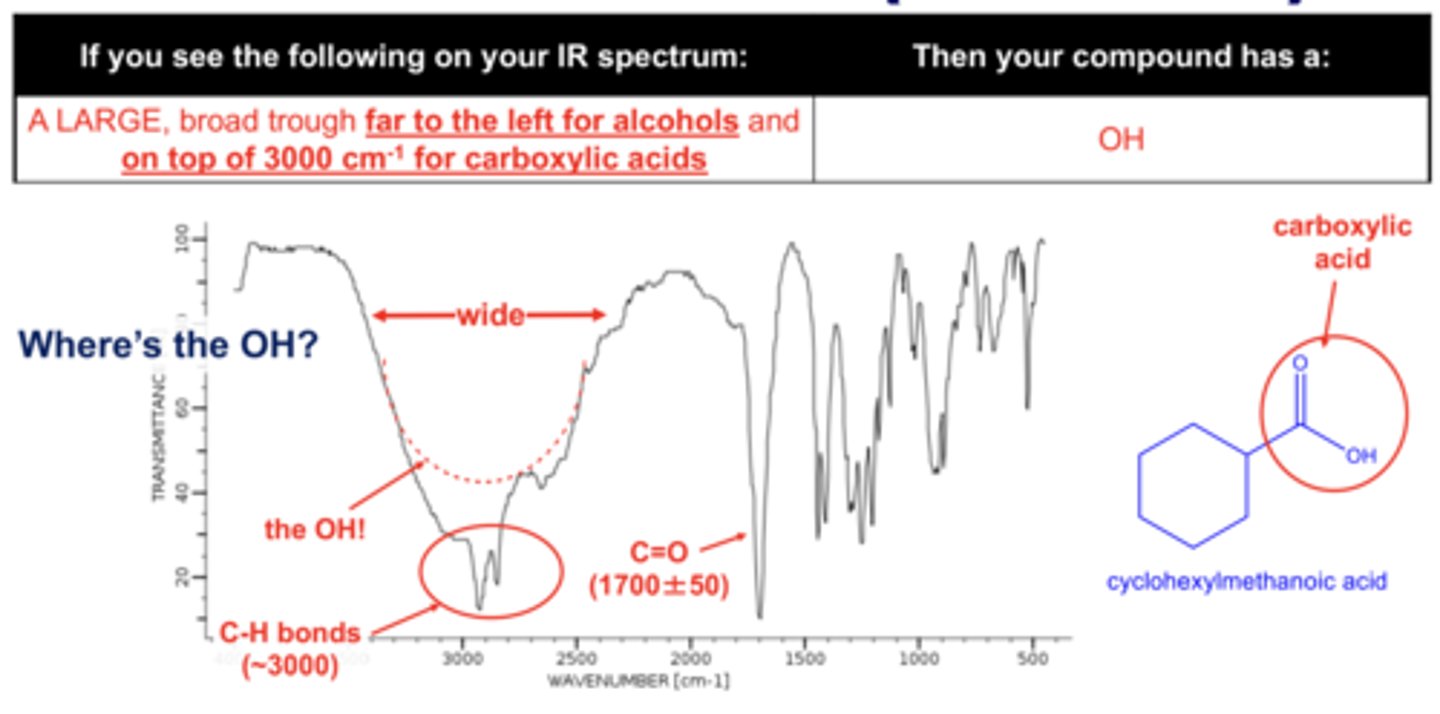
-OH thats a part of acid (COOH)
DEFINITION
-OH thats a part of acid (COOH)
2500-3500 BROAD JAGGED PEAK
TERM
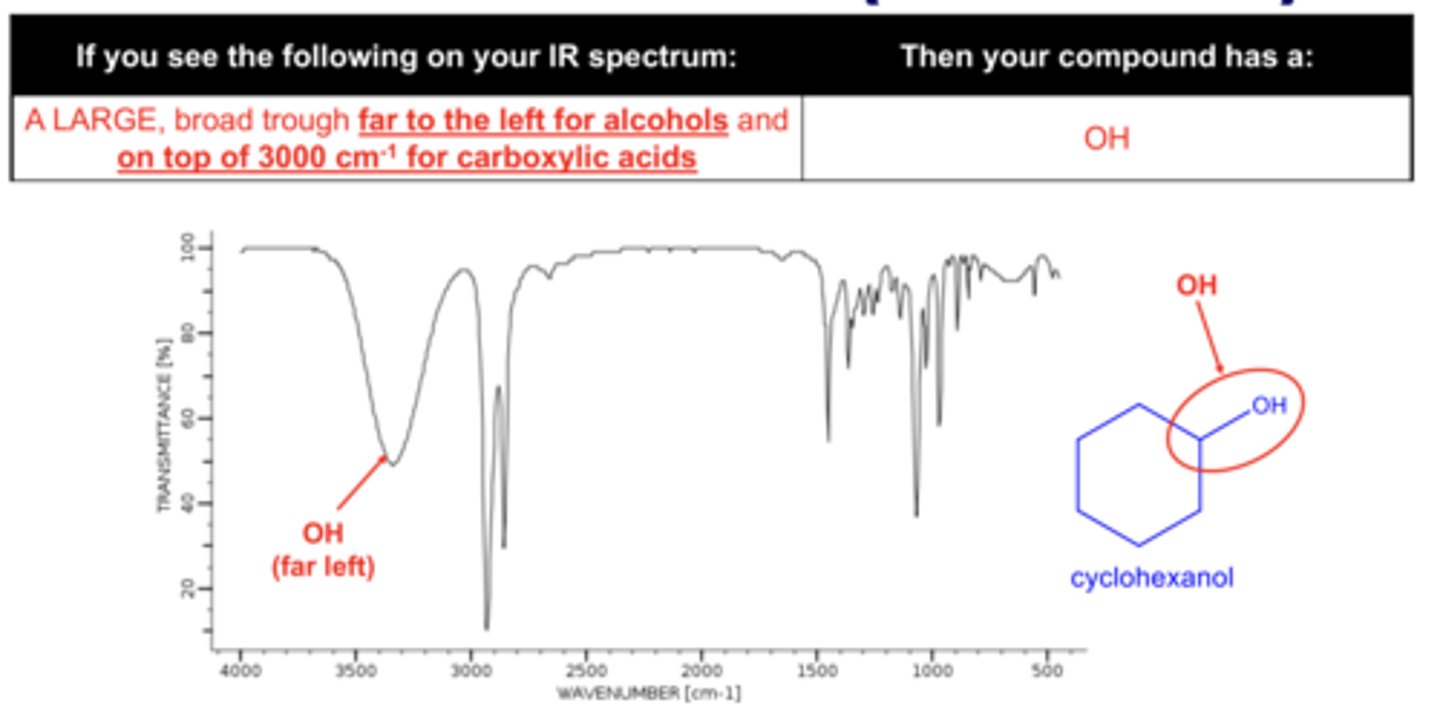
-OH (not part of acid)
DEFINITION
-OH (not part of acid)
3200-3500 large broad smooth peak
TERM
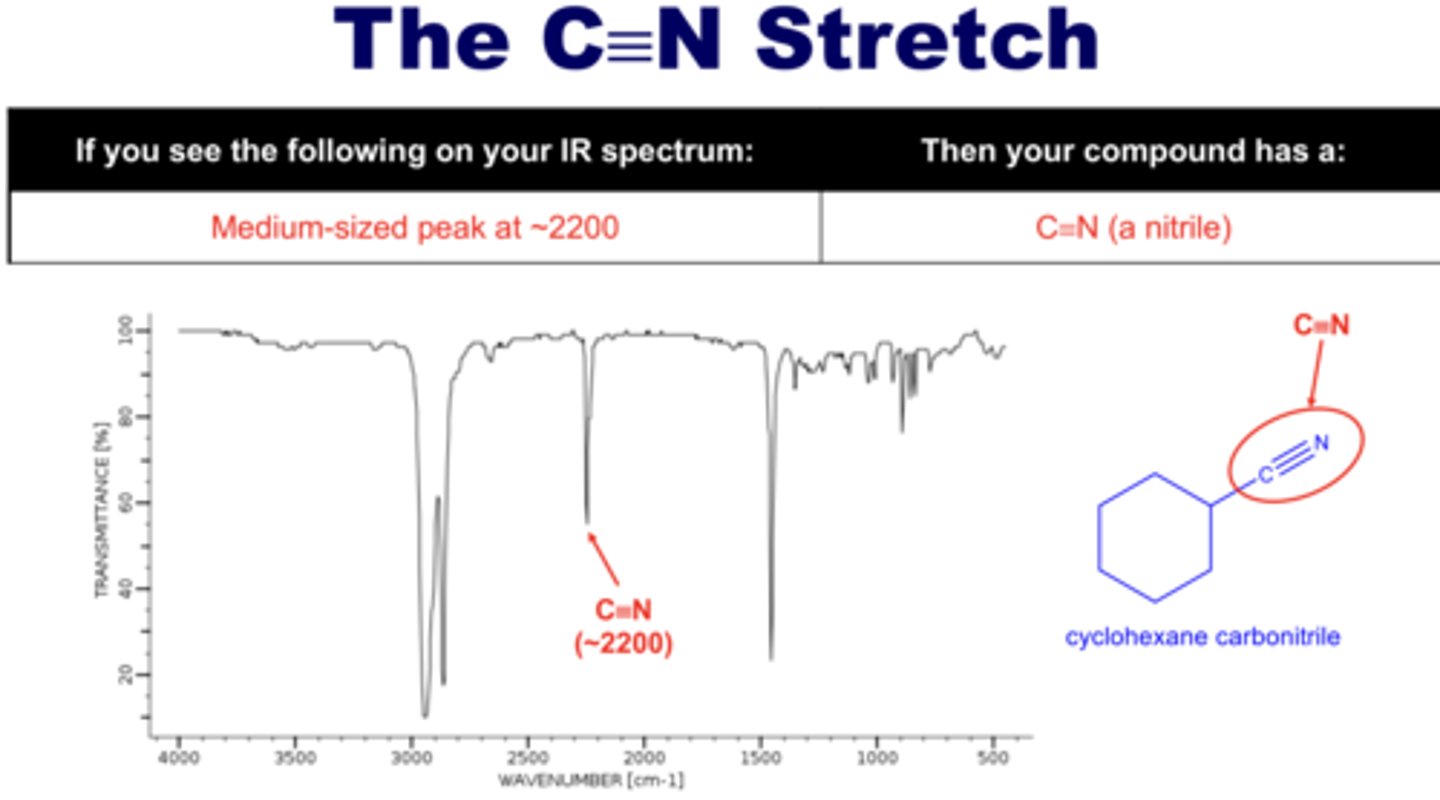
nitrile C≡N
DEFINITION
nitrile C≡N
2200-2250
medium peak
TERM
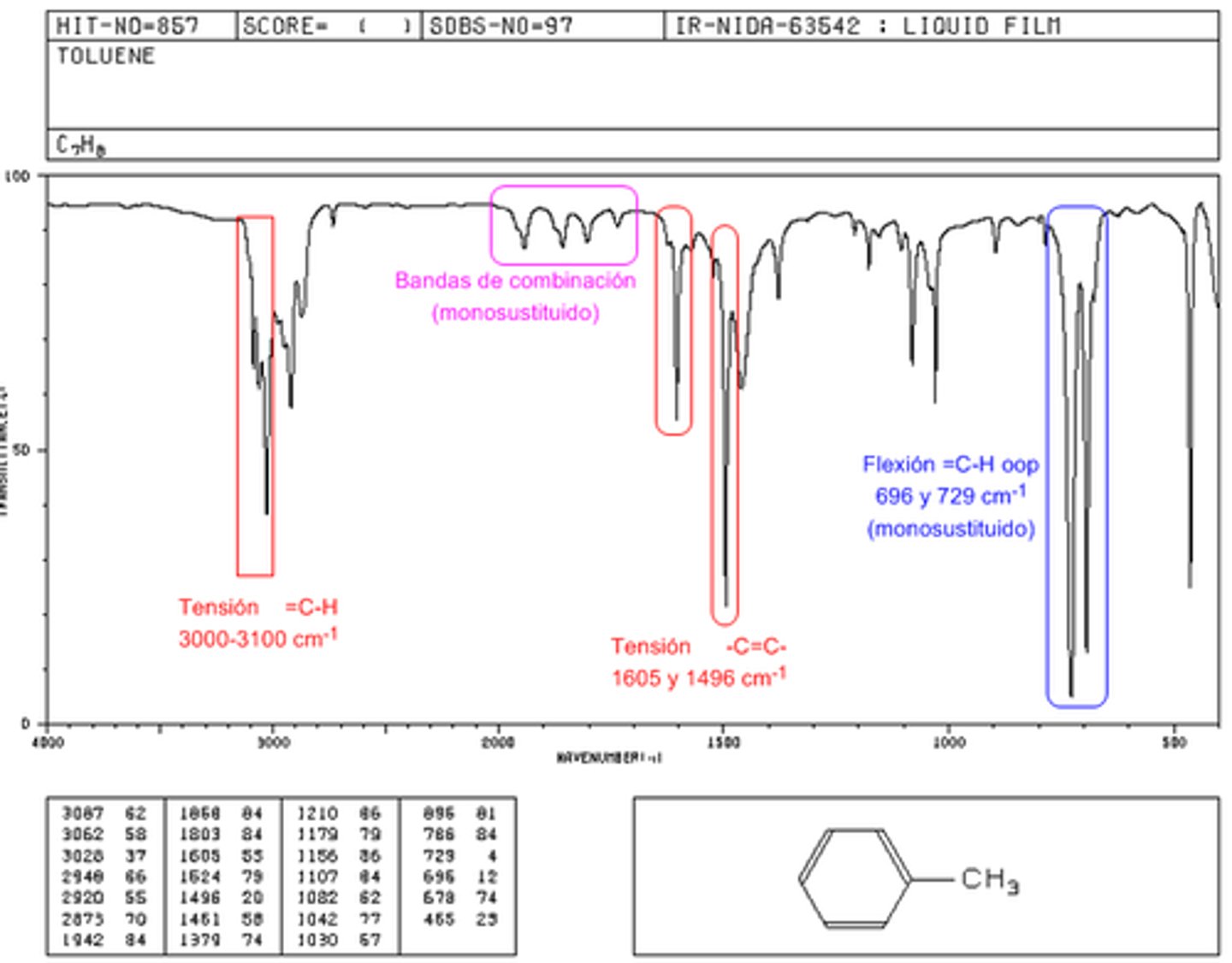
aromatic
DEFINITION
aromatic:
squiggly tiny peak in btwn double and triple bond region
medium peak btwn double and fingerprint region
long peak in fingerprint region ~1000
TERM
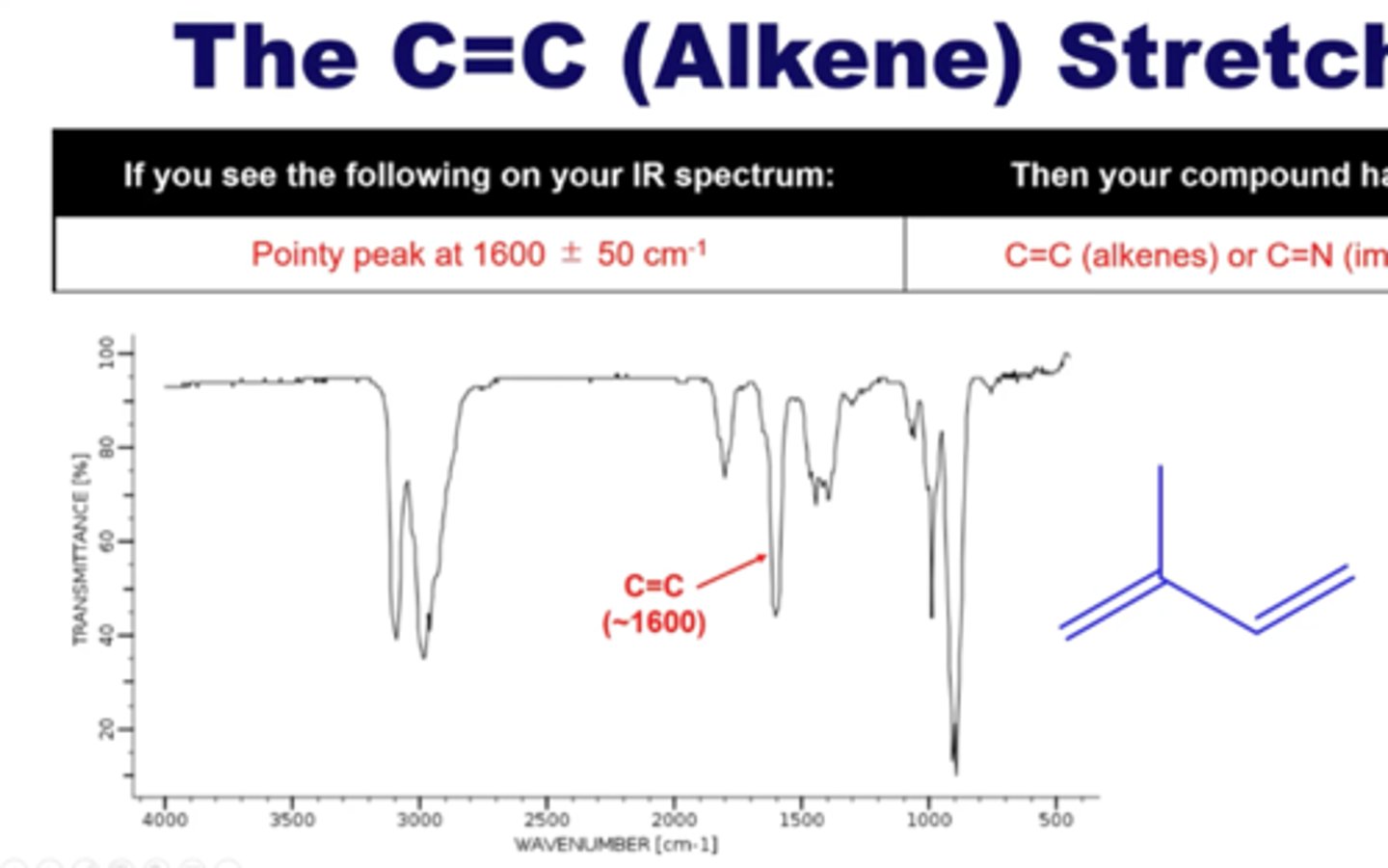
C=C alkenes or C=N imines
DEFINITION
C=C alkenes or C=N imines ~1600
TERM
fingerprint region
DEFINITION
fingerprint region
before 1500
what is 1H NMR spectroscopy?
(goal, measure what signals?)
- used to determine the molecular structure of a compound
- measures the signals produced by different protons (hydrogen atoms) in a molecule when exposed to a magnetic field
1H NMR: what does each signal represent?
(we already said proton.... think deeper)
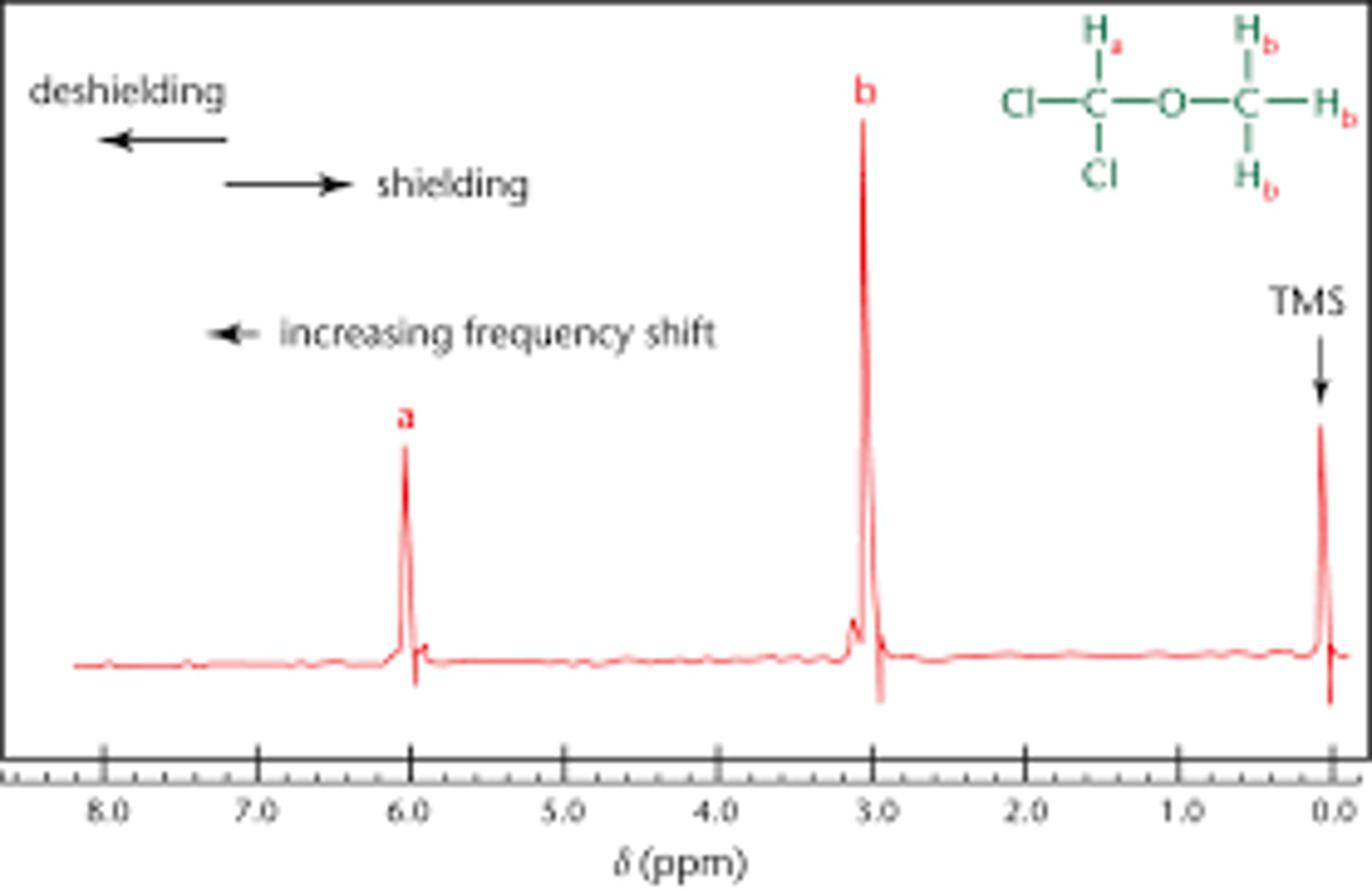
signals correspond to protons in "different chemical environments."
equivalent protons (in the same chemical environment) produce the same signal, so they contribute to the same peak!!
only non-equivalent protons (in different environments) produce distinct signals.
1H NMR: what does the number of signals tell us?
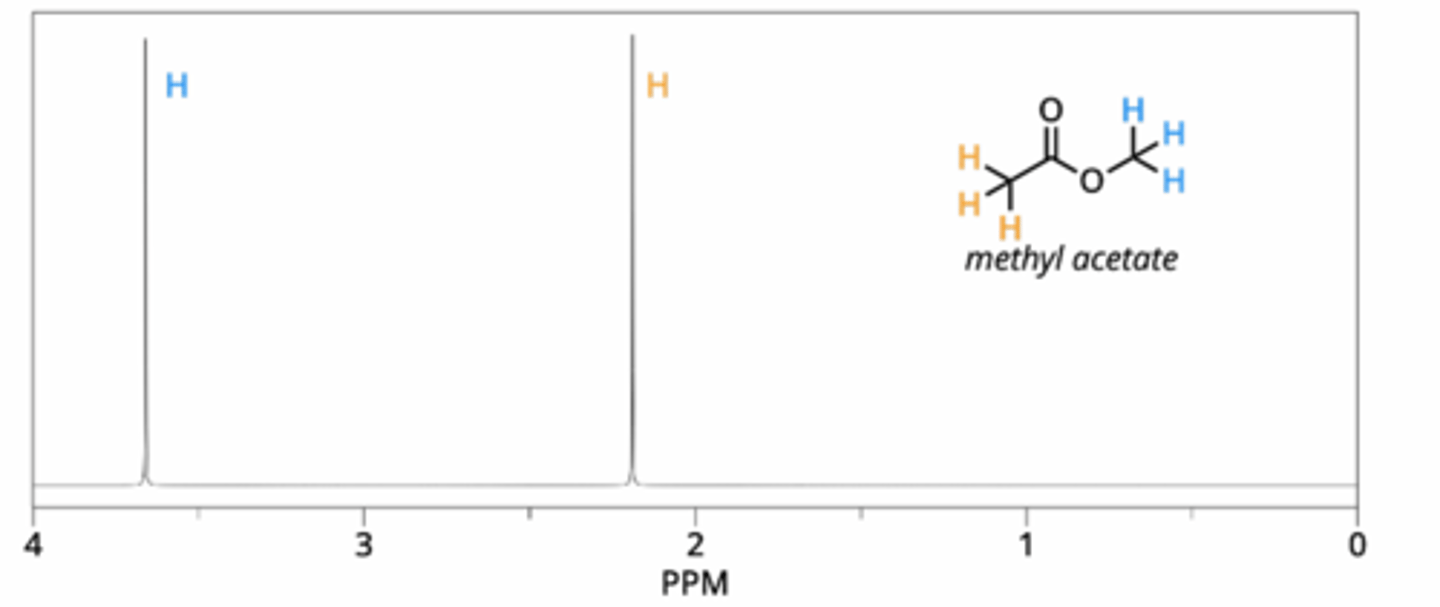
# of sets of non-equivalent protons in a molecule.
For example, methyl acetate has two signals because it has two sets of protons in different environments.
1H NMR: what does symmetry do?
Symmetry can make protons chemically equivalent, even if they are attached to different carbons.
Example: In bromobenzene, the molecule's symmetry results in only three signals despite having five protons.
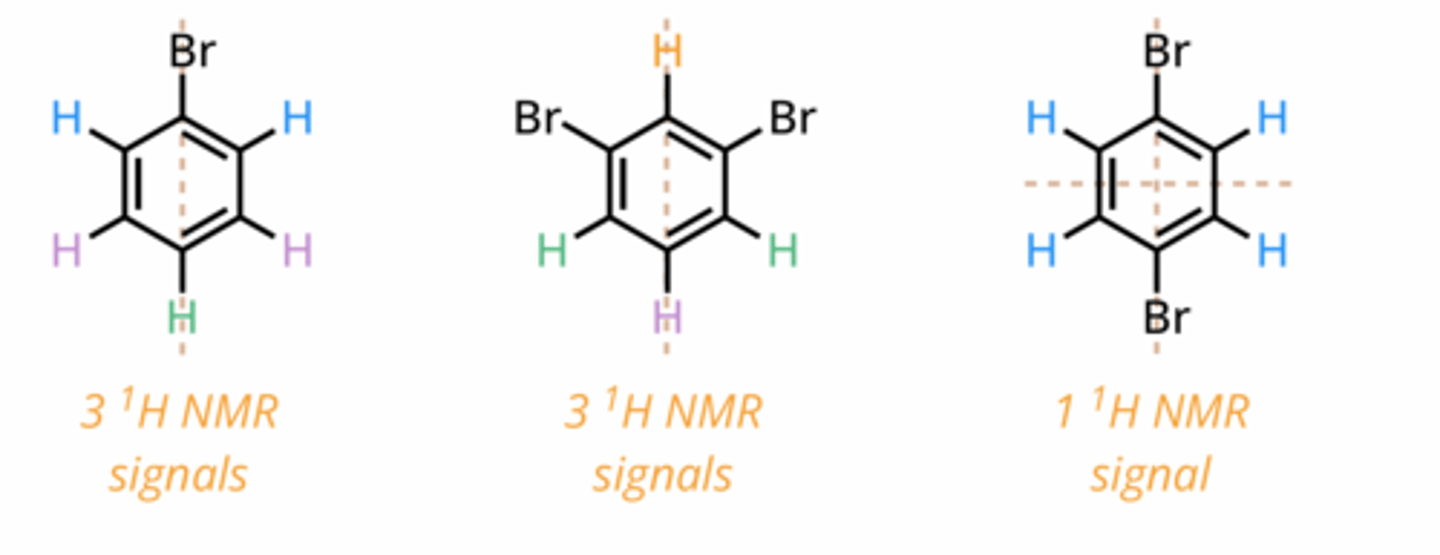
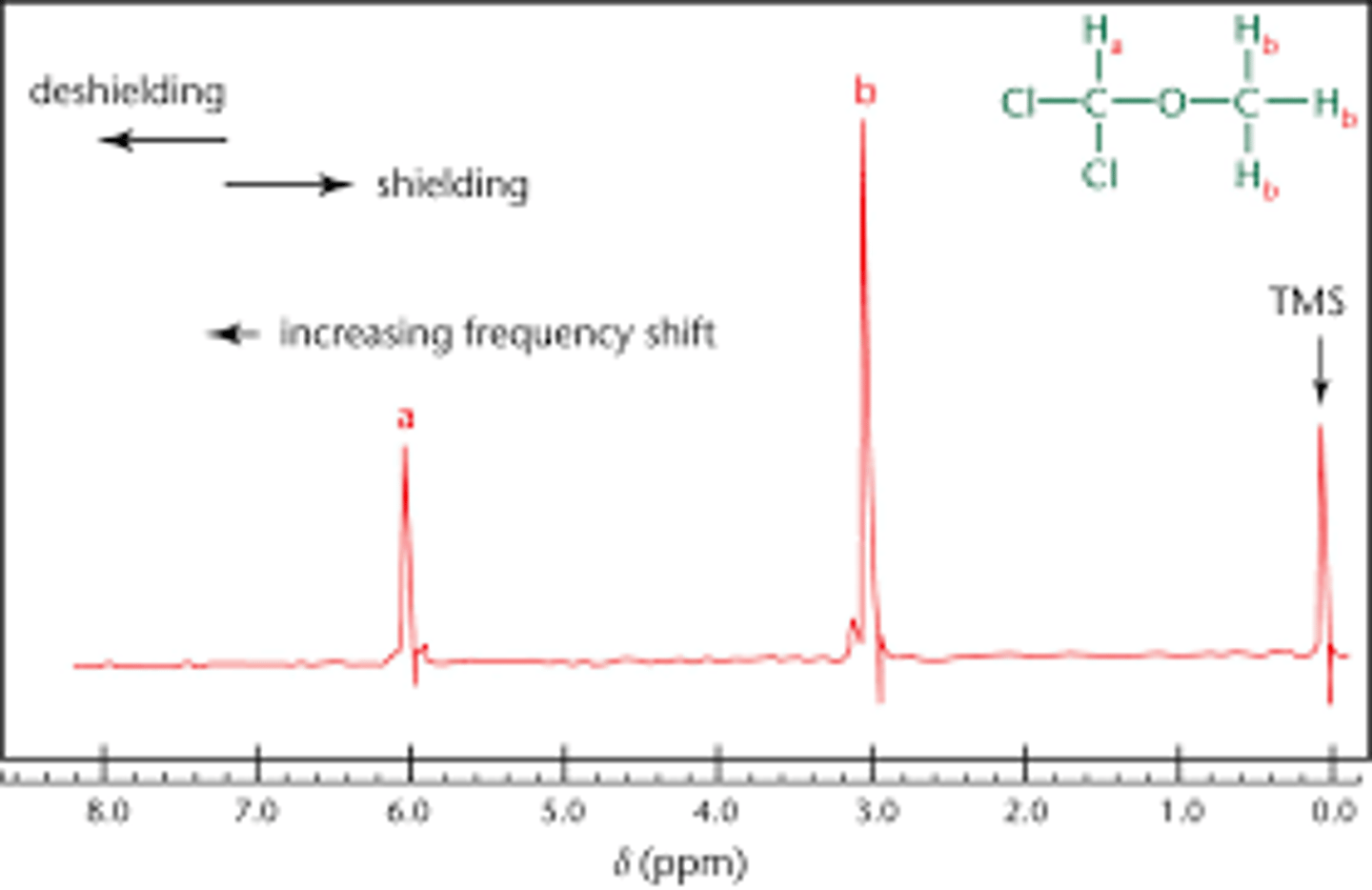
1H NMR: what is chemical shift?
when, due to electron shielding, the peak shifts from its expected place for a specific type of grp
1H NMR: chemical shift
deshielded protons (less electron density), ex near EWG/en groups, appear _____field (further __________).
shielded protons (more electron density) _____field (further __________).
1H NMR: chemical shift
deshielded protons (less electron density), ex near EWG/en groups, appear DOWNfield (further LEFT).
shielded protons (more electron density) UPfield (further RIGHT).
1H NMR: what is "signal multiplicity"?
refers to the number of peaks within a signal, caused by non-equivalent neighboring protons.
1H NMR: what is a "neighboring non-equivalent proton"?
on the atom directly adjacent!!!!!!!
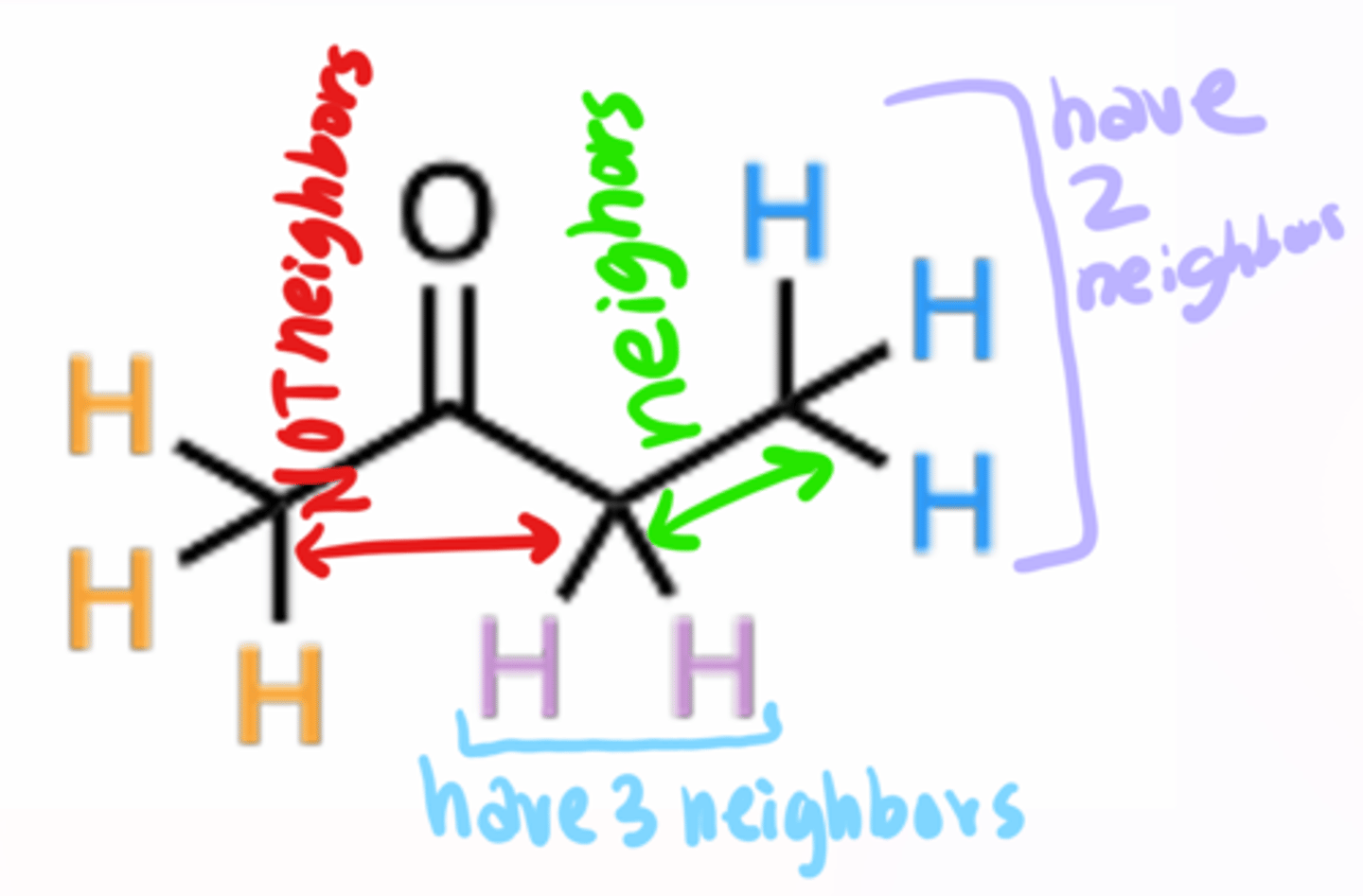
1H NMR: the number of peaks (multiplicity) with in a signal = ?????
(special rule!!!)
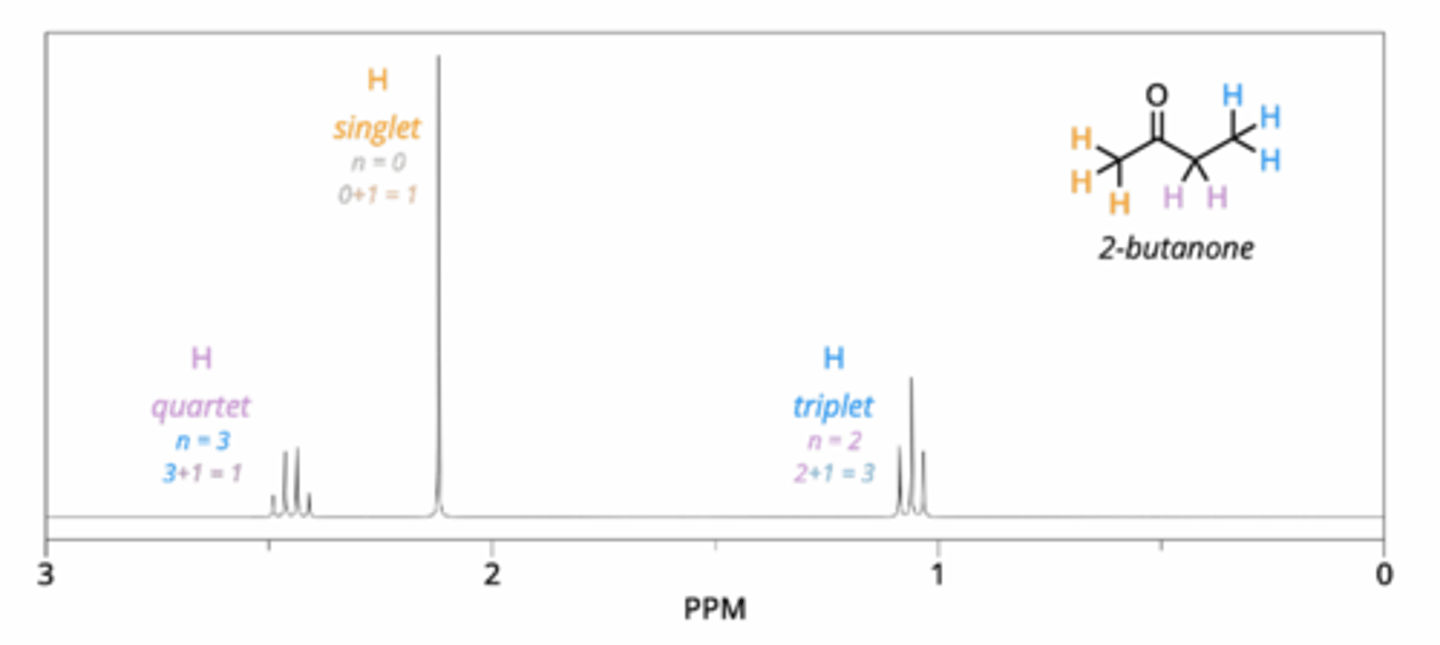
n+1 rule: # of peaks = number of neighboring non-equivalent protons (n) + 1
Example: In 2-butanone:
- Methyl group protons (–CH3) have no neighbors → singlet (1 peak).
- CH2 protons have 3 neighbors → quartet (4 peaks).
- CH3 protons have 2 neighbors → triplet (3 peaks).
1H NMR: what is signal integration?
relative # of protons giving rise to each signal
GIVEN TO US
Example: If signal A has twice the integration of signal B, there are twice as many protons contributing to signal A.
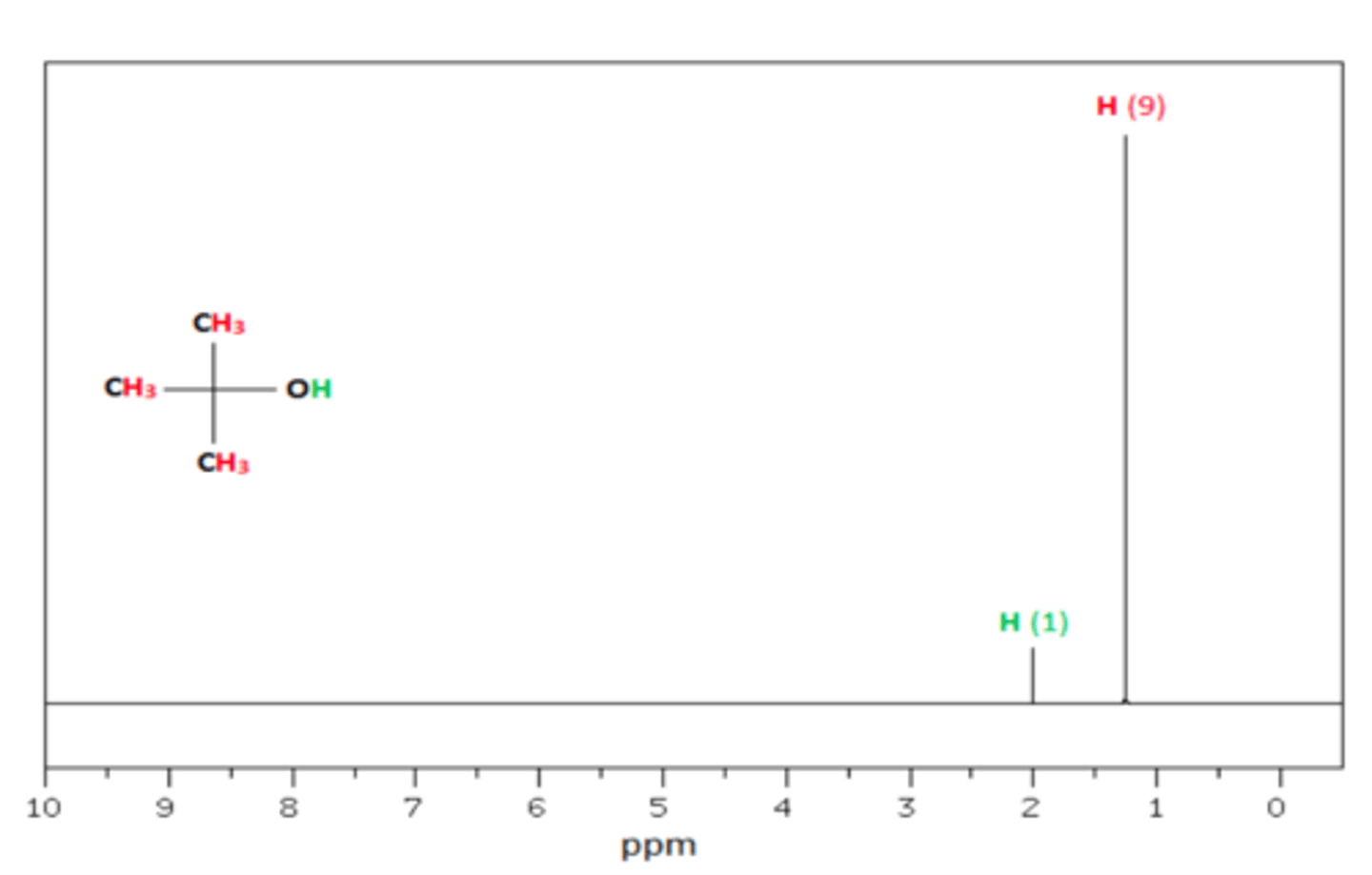
1H NMR: what does the height of the peak represent?
upfield (closer to 0, far right) means more electron density. downfield (further from 0, far left) means less electron density.
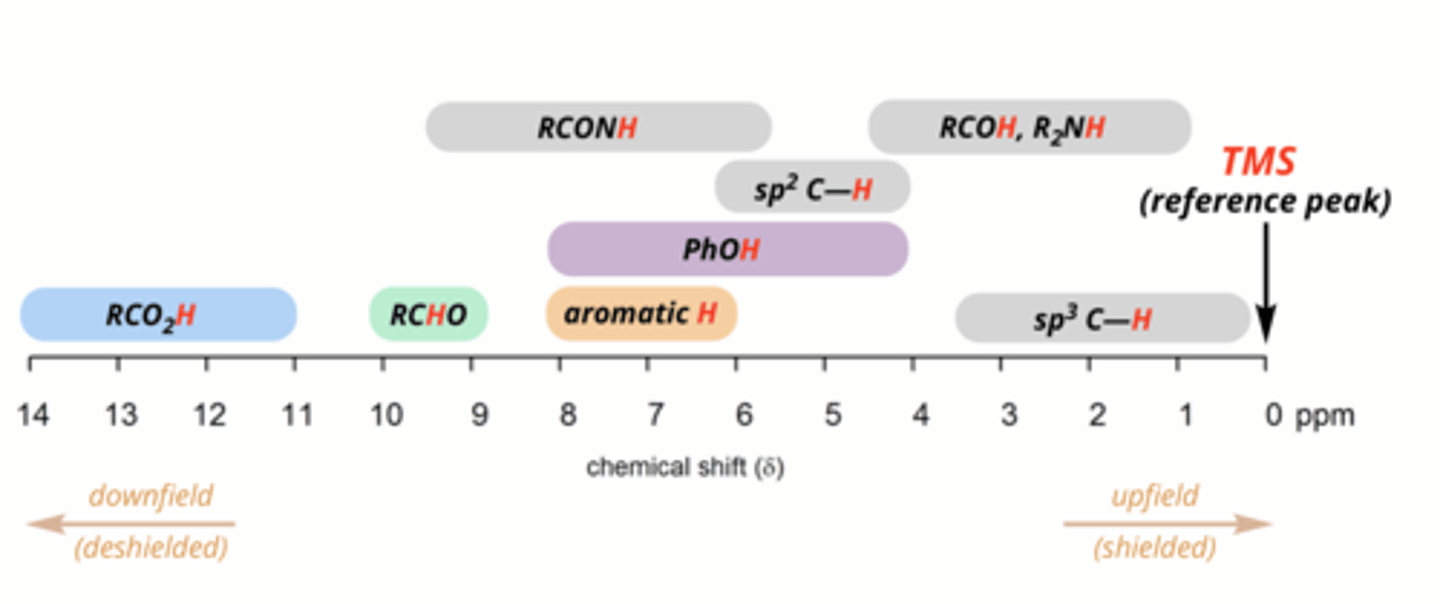
rank the following, guessing at 0-14 range
- sp3 C-C-H
- sp2 C=C-H
- R-(C=O)-OH
- aromatic-H
- Ph-OH
- R-(C=O)-NH
- R-C-OH, R2-NH
- R-(C=O)-H
(1) sp3 C-C-H (~0.5–2 ppm) - most shielded, high electron density.
(2) R-C-OH, R2-NH (~2–5 ppm) - moderately deshielded by electronegative O/N.
(3) sp2 C=C-H (~4–6.5 ppm) - slightly deshielded by double bonds.
(4) Ph-OH (~4–8 ppm) - Phenol group deshields.
(5) aromatic-H (~6–8 ppm) - Deshielded by ring current effect.
(6) R-(C=O)-NH (~6–9.5 ppm) - Amide, moderately deshielded by carbonyl (since it's separated by 1 atom) and N.
(7) R-(C=O)-H (~9–10 ppm) - Strong deshielding due to aldehyde H being directly on carbonyl C.
(8) R-(C=O)-OH (~11–14 ppm) - Highly deshielded due to carboxyl group.
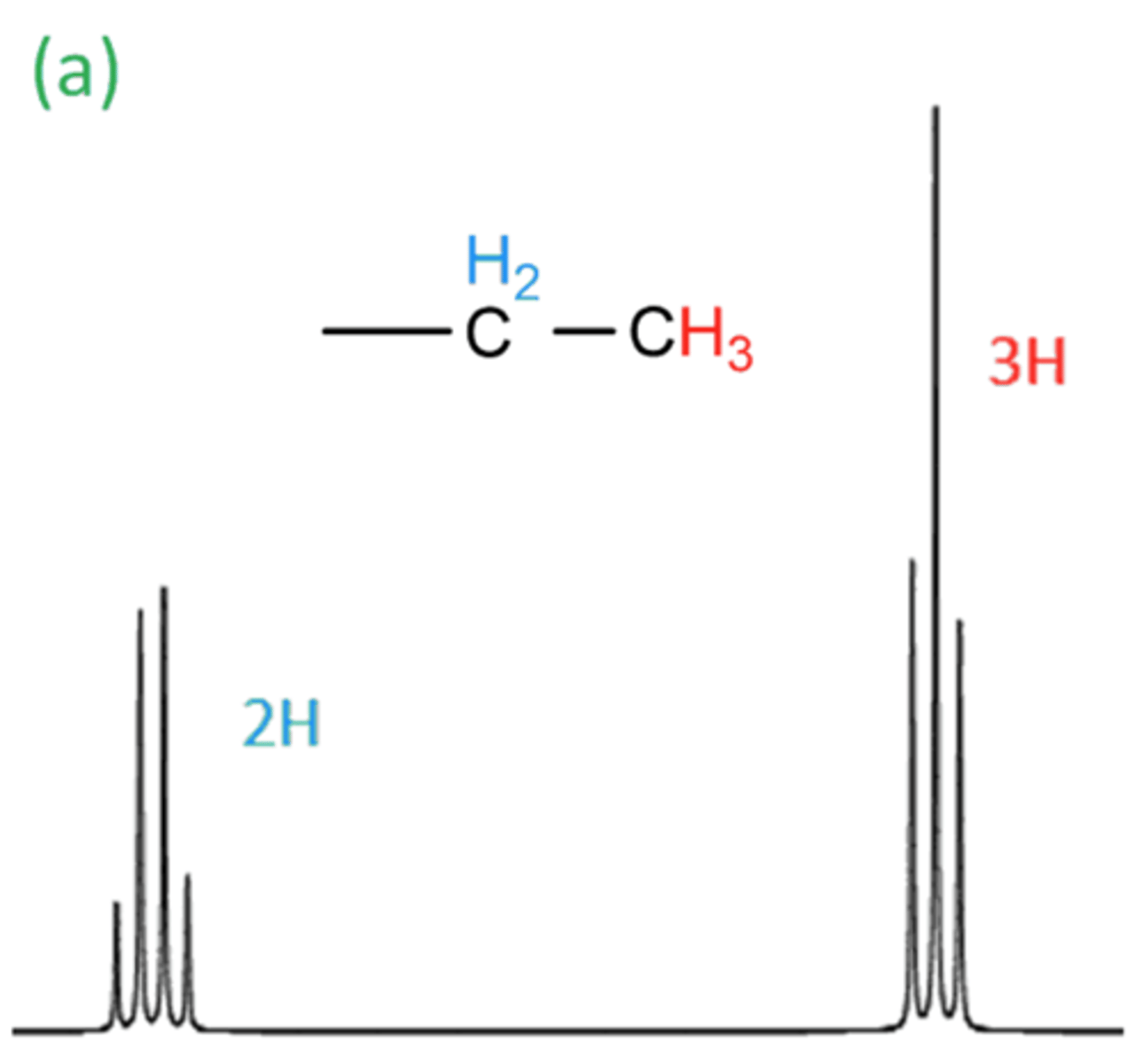
1H NMR: ethyl
quartet and triplet
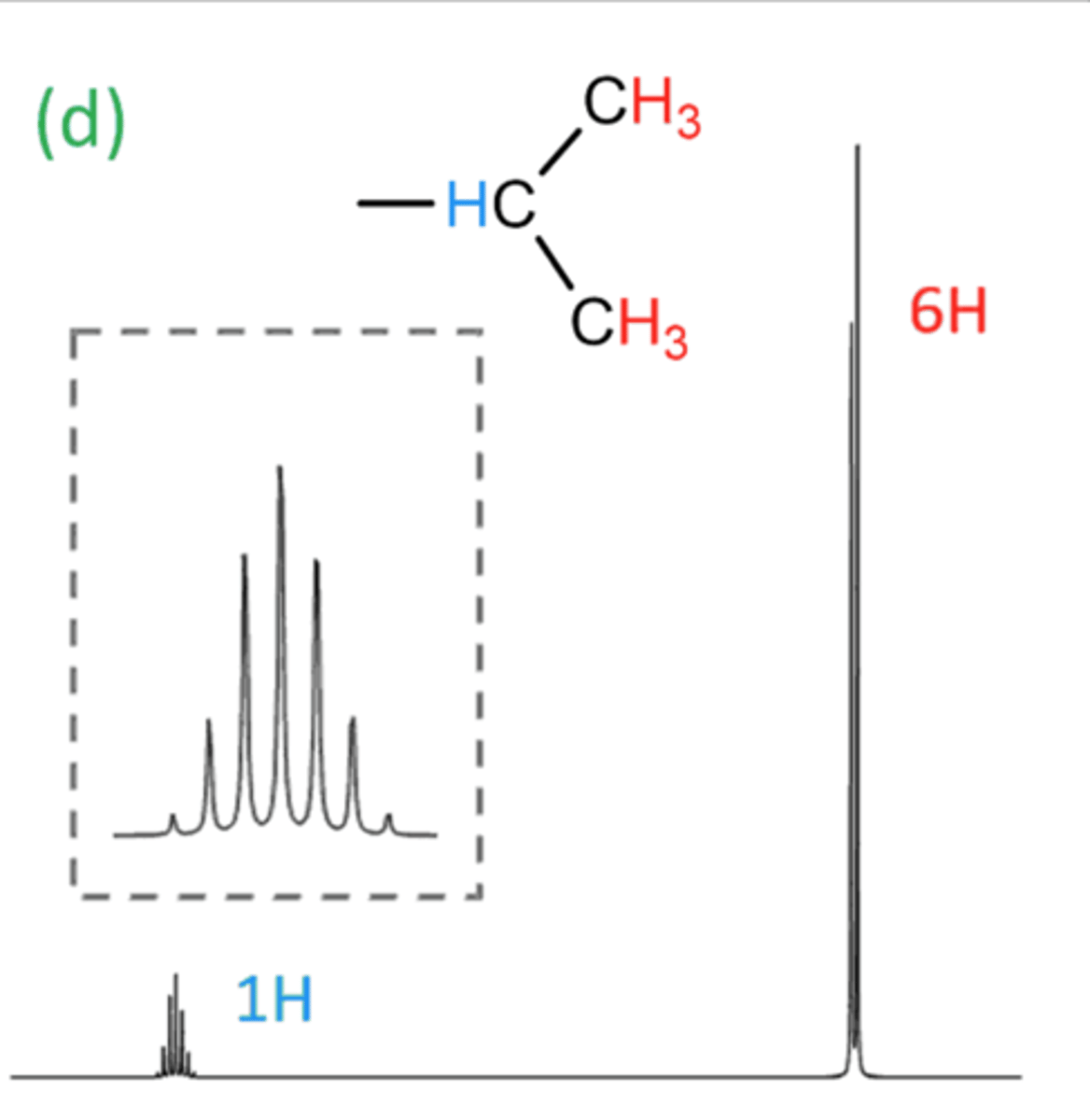
1H NMR: isopropyl
septet and doublet
1H NMR: tert-Butyl
singlet
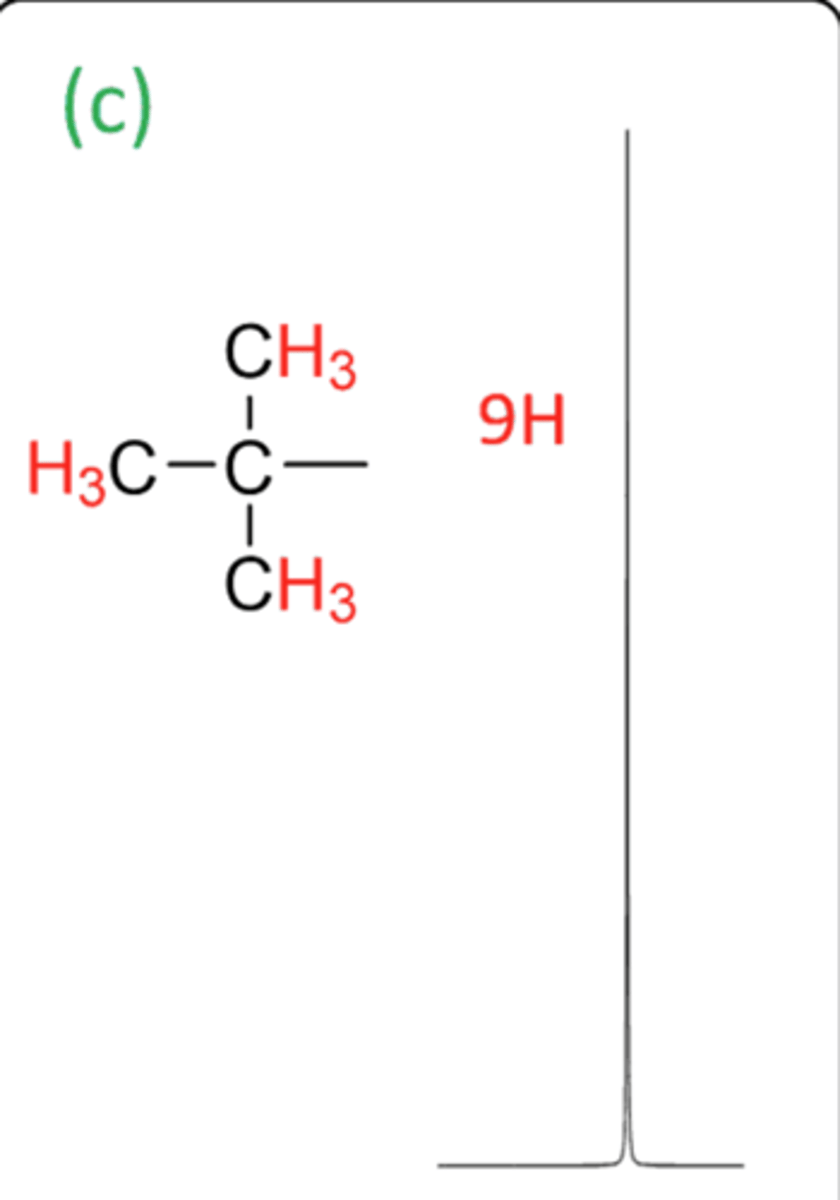
which protons count for 1H NMR?
any, whether they r connected to O, C, N, etc
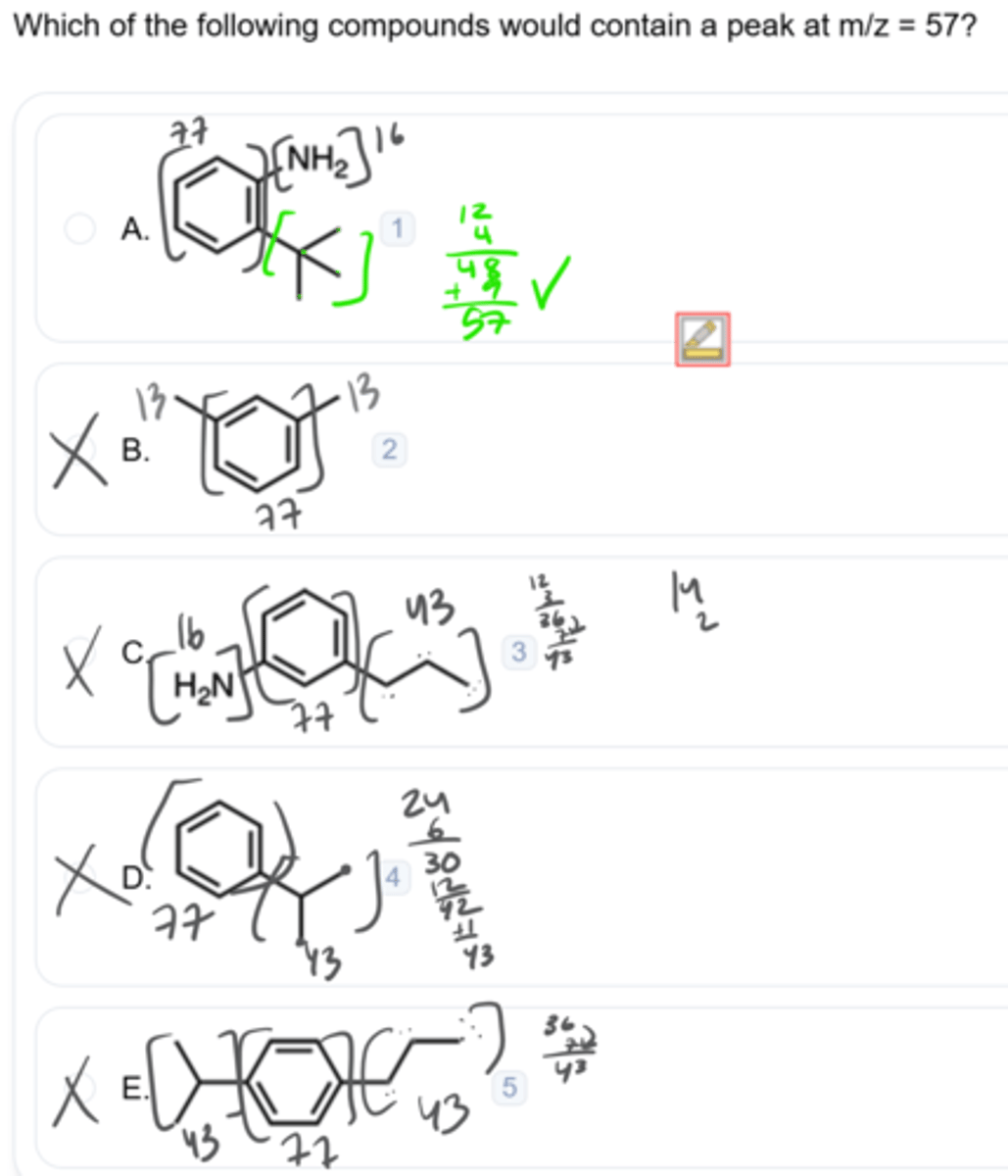
Which of the following compounds would contain a peak at m/z = ______?
notice if there is a weaker C-C bond that seems prone to breaking off - if heres basically a full functional grp of that particular m/z
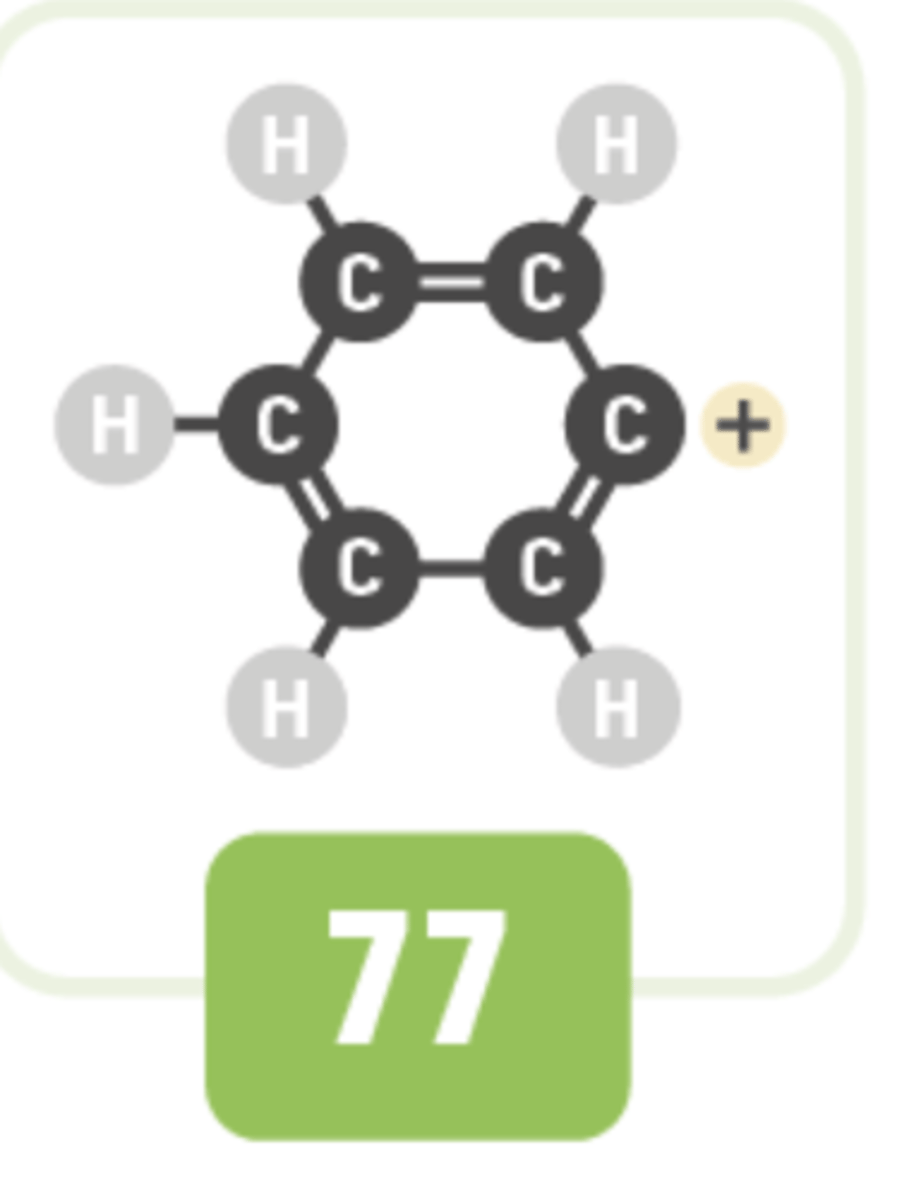
aromatic group mass
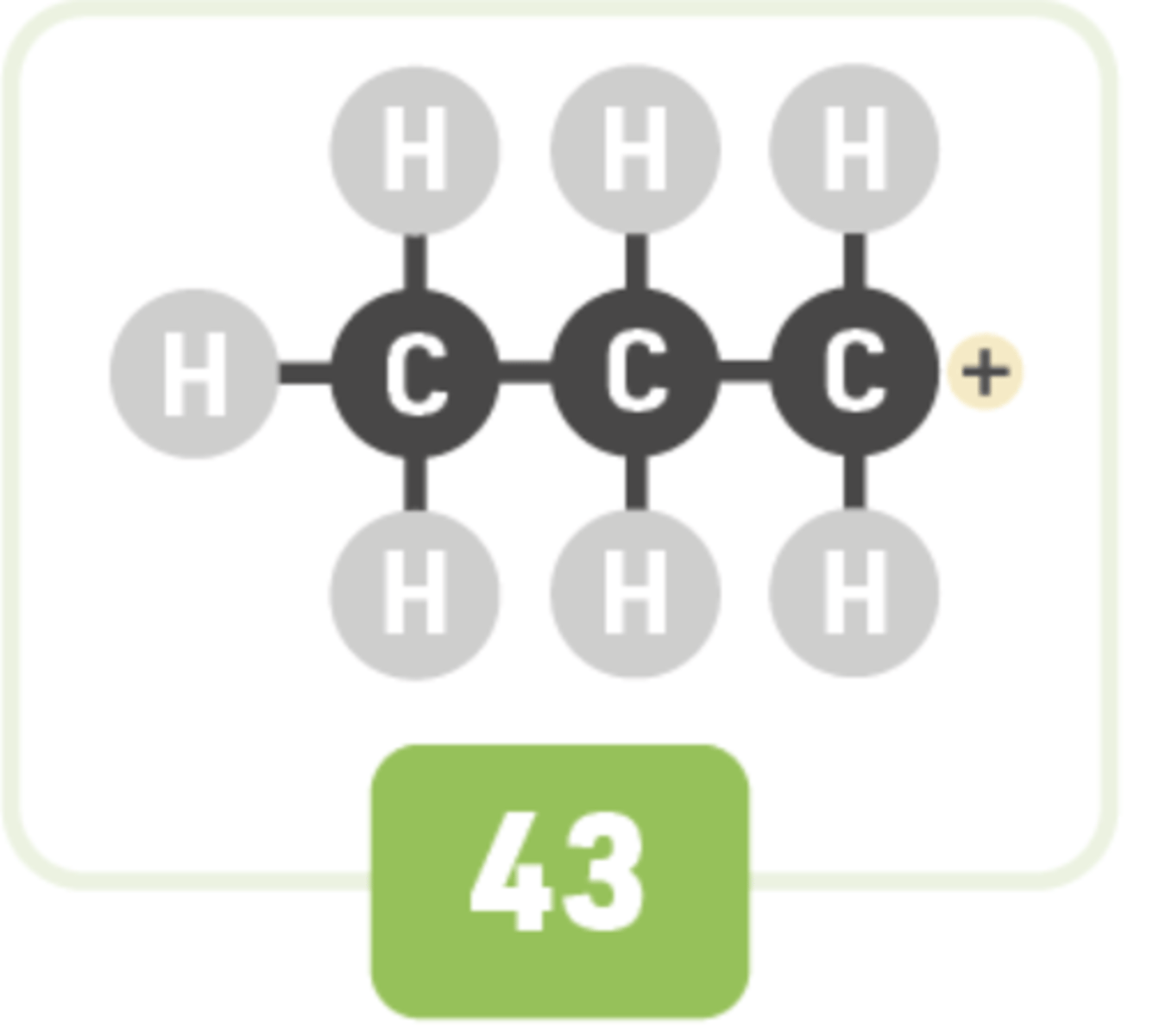
propane mass