HSF Exam #1 Lecture Materials
 Call Kai
 Learn
Learn Practice Test
 Spaced Repetition
 Match
Match Flashcards
 Knowt Play
1/293

There's no tags or description
Looks like no tags are added yet.
Name | Mastery | Learn | Test | Matching | Spaced | Call with Kai | Chat |
|---|
No analytics yet
Send a link to your students to track their progress
294 Terms
anatomy
Form, Structure, or morphology of the body
physiology
functions of anatomical structures (body parts)
function
structure and _______ are largely related
atomes, molecules, cells, tissues, organs, organ system, organism
What are the levels of structural organization?
maintaining boundaries, movement, responsiveness, digestion, metabolism, excretion, reproduction, growth
What are the necessary life functions?
interdependent
All cell/systems are interrelated/__________
Superior (cranial)

toward the head end or upper part of a structure or the body; above
inferior (caudal)
away from the head end or toward the lower part of a structure or the body; below

Ventral (anterior)

toward or at the front of the body; in front of
dorsal (posterior)
Toward or at the back of the body; behind

Dorsal (specifically)
Back
medial
Toward the midline of the body

lateral
away from the midline
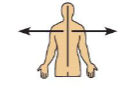
intermediate
between a more medial and a more lateral structure
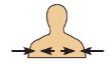
proximal
Closer to the torso or point of attachment
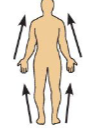
distal
Farther from the trunk of the body or point of attachment

superficial
Near or at the body surface

deep
Away from the body surface; more internal

Median (Midsagittal)
A plane that divides the body into right and left portions.
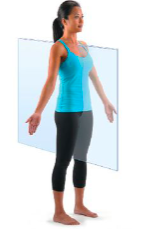
Frontal (coronal) plane
cuts body into front and back
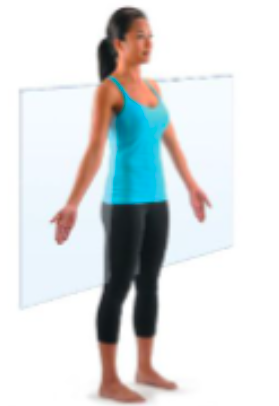
Transverse Plane
Cuts body horizontally (up/down)
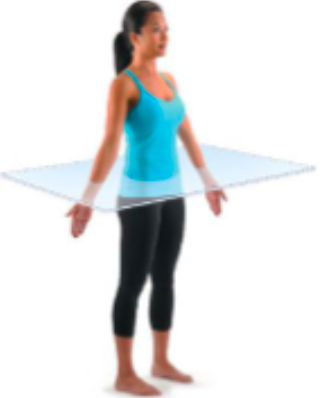
body cavities
spaces within the body that contain vital organs
Serous membranes
Cavities and Organs are lined with…
parietal and visceral
The serous membrane is made up of 2 layers, what are they?
parietal
lines the cavity wall
visceral
Lines the organ
Serous Fluid
Fills space b/w parietal and visceral embranes to prevent sticking and reduce friction
cranial cavity
houses the brain

vertebral cavity
encases spinal cord
thoracic cavity
contains heart and lungs

abdominal cavity
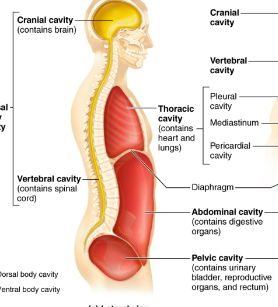
contains primarily the major organs of digestion
pelvic cavity
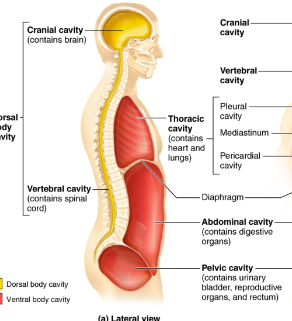
Contains urinary bladder, reproductive organs, and rectum
pleural cavity

the potential space between the two layers of the pleura (visceral and parietal) that surrounds each lung
pericardium
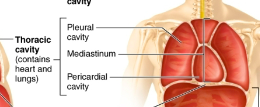
Double-layered membrane surrounding the heart.
abdominal Pelvic Cavity
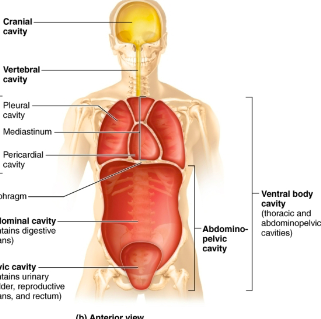
anterior body trunk inferior to ribs
Ventral Body Cavity

Thoracic + Abdominopelvic Cavities
Dorsal Body Cavity
Cranial Cavity + Vertebral Cavity
Grid system, 4 large quadrants, 9 smaller regions
What do we use to get an accurate approximation of where the organs should be in the body?
Right upper quadrant (RUQ)
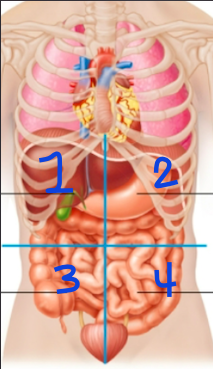
Name of area 1
Left upper quadrant (LUQ)
Name of Area 2

Right lower Quadrant (RLQ)
Name of Area 3?

Left Lower Quadrant (LLQ)
Name of Area 4?

Right Hypochondriac region
Region 1?
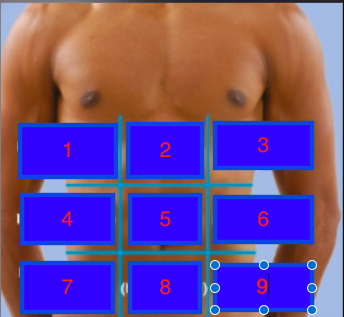
Epigastric region
Region 2?
Left Hypochondriac region
Region 3?
Right lumbar region
Region 4?
Umbilical region
Region 5?
Left Lumber region
Region 6?
Right Inguinal (iliac) region
Region 7?
Public (hypogastric) region
Region 8?
Left Inguinal (iliac) region
Region 9?
Frontal
Forehead
Orbital
Eyes
Nasal
Nose
Buccal
Cheek
Oral
Mouth
Mental
Chin
Cervical
Neck
Sternal, Axillary, Pectoral
Thoracic Includes (3)
Sternal
Sternum
Axillary
Armpit area
Mammary/Pectoral
Chest/breast area
Umbilical
Belly button
Pelvic

Area below umbilical
Inguinal

Crease b/w thigh
Pubic
Genital
Acromial

Top of shoulder (red)?
Deltoid
Below Acromial (orange)
Brachial
Arm (yellow)
Antecubital
Inner Elbow (green)
Antebrachial
Forearm (Blue)
Carpal
Wrist (Purple)
Digits
Fingers (pink)
Palmer
Palm
Pollex
Thumb
Coxal
Hip
Femoral
Thigh
Patellar
Knee
Crural
Leg (shin/front)
Fibular
Side of leg
Manus
Hand
Foot
Pedal
Tarsal
Ankle
Digits
toes
Cephalic
Head
Occipital
back of head
Scapular

Shoulder blades
Dorsal
Back
Vertebral
Spine
Lumbar
Lower back

Sacral

Between butt cheeks
Gluteal
Butt
Popliteal
Back of knee
Sural
Calf
Calcaneal
Heal
Plantar
Bottom of foot
Hallux
Big toe
Perineal
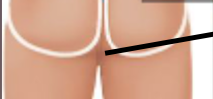
Between anus and external genitalia
Skin, hair, and nails; cutaneous sense organs and glands
Protects deeper organs, excretes salt & urea
Integumentary
Bones, cartilages, tendons,
ligaments, and joints
Body support and protection of internal organs
Skeletal